
It is the third game of a long morning, and my forearm has started keeping score. Nothing dramatic, just a low buzz after every hard block, the kind of ache that does not stop you playing but starts deciding your shots for you.
My partner hits a drive at my hip. I reach across my body, I catch it a little wide of centre, and the ball dies off the face and drops into the net.
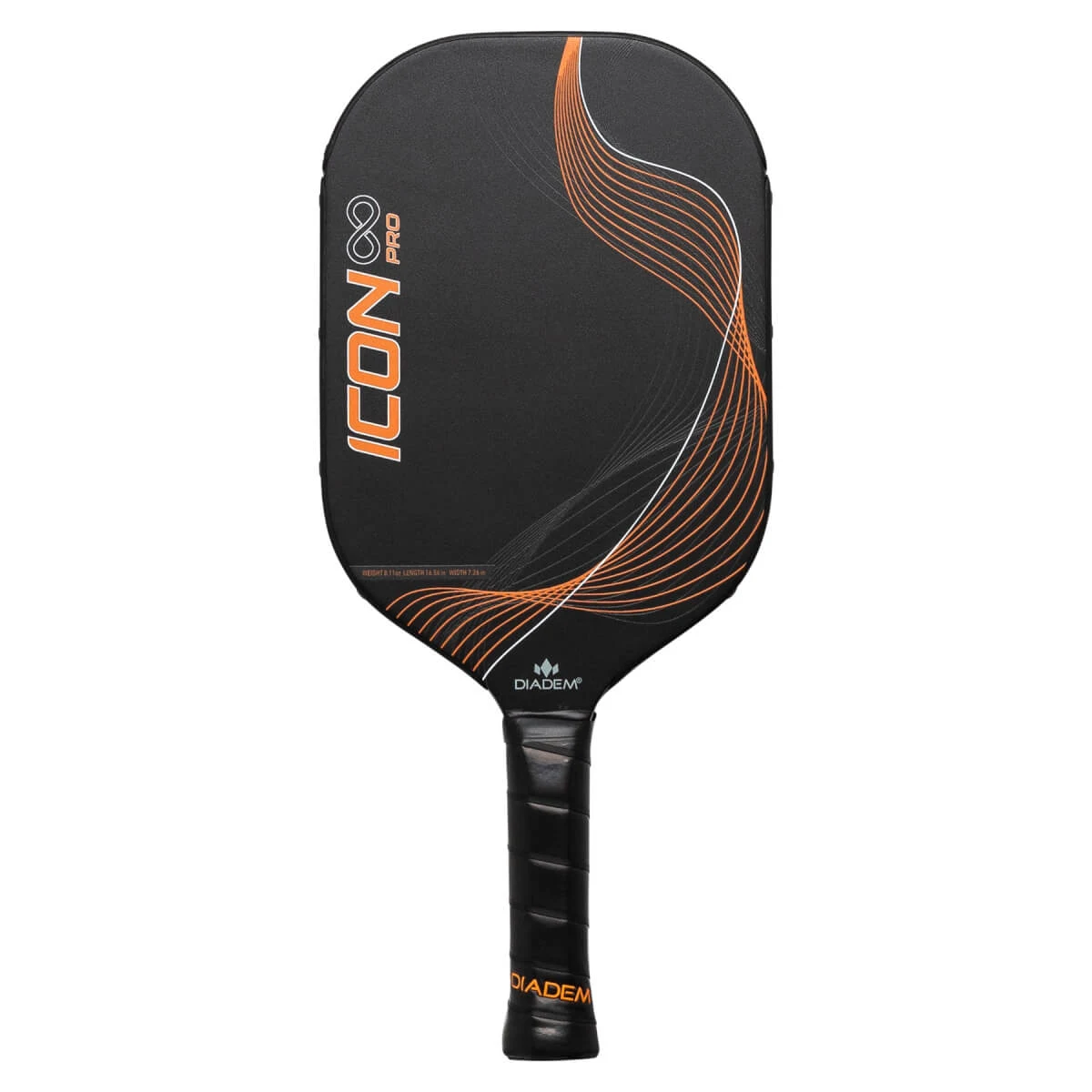
That is the whole case for the Icon Infinity Pro v3 in one rally, both sides of it: a paddle that drinks vibration so your arm survives the morning, and a paddle that punishes you the moment your contact leaves the middle. This review is the long version of that trade.
WHAT I LIKE
- Dual foam comfort that genuinely protects a sore arm across long sessions
- A 112.63 swing weight on a narrow elongated frame that feels quick through the air
- A long 5.5 inch handle that fits two hands for a backhand
- A Double Grit face at the maximum legal grit, with strong fresh spin and shape on serves and drops
- Replaceable edge guards on a near-edgeless frame, so the part that meets the court is not a one-time wear item
- Real pop for a comfort paddle, with overheads and backhand punches the easiest power shots
WHAT I DON’T
- A 5.3 twist weight, the lowest in this site's pool, so off-centre contact twists and dies
- A painted grit face that fades noticeably with regular play
- A narrow face, about 7.3 inches wide, that gives up margin on stretched defence
- Spin is not published from any lab, so the spin story rests on feel, not a measured figure
- The 4.125 inch grip is smaller than the 4.25 inch standard and needs building up for bigger hands
- The thin 13.7mm overall build takes several games to learn if you come from a 16mm paddle
AT A GLANCE
Diadem Icon Infinity Pro v3
WEIGHT
8.1 oz
SWING WEIGHT
112.63
TWIST WEIGHT
5.3
SPIN
-
Shape: Narrow elongated, 16.5 x ~7.3 in
Grip: 5.5 in handle, 4.125 in circumference
Core: 10mm polypropylene honeycomb + Dual Foam Core
Face: Carbon Double Grit
Approval: USAP
Feel: Arm-comfort all-court
Warranty: -
On this page
- What the Icon Infinity Pro v3 Is
- How It Plays
- Icon Infinity Pro v3, Icon v2 or the Original Icon: Which One Should You Buy?
- Who Should Buy It, and Who Should Skip It
- How It Compares to Its Closest Rivals
- Durability: What Months of Play Actually Do to It
- How I Tested the Icon Infinity Pro v3
- The Bottom Line
- Frequently Asked Questions (FAQs)
What the Icon Infinity Pro v3 Is
The Icon Infinity Pro v3 is Diadem’s narrow elongated all-court paddle, built around a 10mm polypropylene honeycomb core with a Dual Foam Core worked into and around it.
That construction sentence explains the whole paddle. The honeycomb is the skeleton, light and stiff, and the two foams do the quiet work: a high-density foam surround along the frame edge and a softer foam inside the edge.
Together they drink vibration at contact instead of passing it down the handle, which is why this paddle sits fourteenth on my homepage’s best 15 as the arm-comfort pick and tenth on my best pickleball paddles for tennis elbow as the clean-striker pick.
The face is carbon fiber with a Double Grit application, the maximum grit the rules allow, painted on rather than woven in as raw texture. That distinction matters, and the durability section below says so plainly.
The shape is the other decision that defines it. At 16.5 inches long and only about 7.3 inches wide, it is a narrow elongated frame, which means it gives you reach at the kitchen and a quick, slicing feel through the air, and takes away width.
The frame is near-edgeless, with low-profile edge guards that are replaceable, so the part of the paddle that scrapes the court on low balls and meets the tape line is a part you can swap, not a one-time wear item.
The 5.5 inch handle over a 4.125 inch grip circumference fits two hands for a backhand, and the grip is smaller than the 4.25 inch standard, so bigger-handed players should plan on building it up. It is USAP approved for sanctioned play.
The name tells you who it is built for: the forever player, the intermediate to advanced rec player who plays often and needs one versatile paddle with pop, control, spin and arm comfort. That positioning is honest, and this review tests it on its own terms.
How It Plays
Serves. Serves are where the fresh face first shows up in play. The Double Grit face grabs the ball at the maximum legal grit, so a topspin serve brushed up the back of the ball dips late and kicks off the bounce just enough that a returner who read the pace still has to adjust.
The narrow shape helps here too, because it slices through the air with little resistance, and the 112.63 swing weight keeps the head moving fast through the brushing motion.
Swing weight is how heavy a paddle feels in motion, so a 112.63 on an elongated frame is a genuinely quick swing for a paddle this long. A flat serve gets honest pace from the foam core and shape from nothing, so the topspin serve is the one this paddle was built to throw.
The honest note is the grit’s life, which the durability section covers: the spin you feel in week one is the best spin this paddle will ever give you.
Drives. Drives are where the paddle surprises people who bought it for comfort. This is not a soft, dead comfort paddle. The dual foam core returns energy on a full swing, so drives carry shape and depth when you swing through them, and the thin 13.7mm overall build gives the strike a lively pop that a 16mm honeycomb paddle does not have.
It will not manufacture putaways against a set defence on a short punch, because the power here comes from swing speed plus the foam’s return, not from mass.
Plow-through means the head carrying through the ball with its own weight, and this paddle has modest plow-through to offer, so your swing supplies most of it. The honest ceiling is contact location.
A drive caught through the middle holds its line and dips. A drive caught wide twists the face, and the ball dies. That is the 5.3 twist weight doing its work in the open, and it is the reason this paddle’s drives belong to clean strikers.
Dinks. Dinks are where the comfort story earns its keep, because this is where the paddle’s two personalities meet. The dual foam core softens contact and drinks vibration, so a relaxed dink leaves the face where you aimed it, with enough spin from the fresh grit to keep it low.
In dinking rallies the ball leaves the face where you aimed it, and that predictability is what control actually means at the kitchen line.
The narrow face helps here too, because it moves fast in tight exchanges and reaches across the body without dragging. The danger is the same as everywhere else on this paddle: a dink caught near the edge twists instead of dropping, so the kitchen game stays calm only while your contact stays centred.
Players with a loose soft game and grooved contact will adjust faster than players who block with a firm wrist and catch the ball wherever it arrives.
Resets. Resets are where the Icon Infinity Pro v3 asks the most of its owner, because it resets with comfort rather than with margin. A hard drive arrives, the ball meets a foam-damped face, and the paddle gives you a soft, cushioned answer about your hands.
Dwell means the time the ball stays on the face, and this paddle offers a useful amount of it, so a reset hit with a soft hand drops instead of climbing. The 5.3 twist weight is the number behind that honesty.
Twist weight is the paddle’s resistance to turning in your hand when the ball catches it away from the middle, so a 5.3 means the face holds its line on centred contact and twists on contact caught wide.
That is most contact in a fast rally for a developing player, so expect some spray and some dead balls on stretched blocks until your timing settles, and understand that this is the paddle’s design, not a defect in your unit. Tape along the sides helps, and the FAQ section explains how much.
Blocks and counters. Blocks and counters are where the paddle’s speed earns its keep, because the narrow frame still answers a hard ball quickly. A short punch at a fast ball comes off with pace you did not have to generate, and the ball stays in with decent technique.
In fast hands battles the 112.63 swing weight is the number that matters most. The head arrives early, the face stays square through the exchange, and the counters carry enough shape to push an opponent back a step.
The honest limit is the same twist weight again. A block caught wide of centre will turn the face and spray, or die into the net, until tape goes on. With tape along the sides, the blocks hold their line and the counters keep their aim, and the paddle still arrives first.
Without it, this is the section where the paddle’s ranking as the last pick on the tennis-elbow list makes sense: it is tenth there for one reason, and the reason is the 5.3.
Overheads. Overheads are the easiest power shots on this paddle, because the narrow frame and the foam core agree for once.
A full swing gets rewarded: the ball comes off with pace, the spin keeps it inside the lines, and the long shape gives enough reach to take a high ball without stretching. A passive overhead gets a passive ball, and that is the trade you accept for the control everywhere else.
The one mechanical note is the grip. The 4.125 inch circumference is a smaller fit than the 4.25 inch standard, and a small grip in a big hand will rotate on a hard overhead, so bigger-handed players should build the grip up with overgrips before they judge the paddle.
With the grip built up, the 5.5 inch handle still leaves room for two hands, and that is a real strength for a comfort paddle, not a setup question.
One honest disagreement belongs in this section, because the sweet spot is the one place the record splits. Some players call the sweet spot large, with the dampening system doing its work from the first session. Others measure it at about four inches across, with shots at the top or sides of the face carrying no power at all.
In my hand, both are true at different moments: the centre is generous and calm, with contact that feels cushioned and true, and the edges die. The twist weight of 5.3 settles the argument for me, because a face that turns this easily cannot forgive wide contact, whatever the centre feels like.
Play it for a week before you judge it, and judge it by your worst contact, not your best, because the worst contact is what decides whether this paddle is yours.
Icon Infinity Pro v3, Icon v2 or the Original Icon: Which One Should You Buy?
Start with the generation, because Diadem sells three Icons and they carry different builds. The v3 reviewed here is the Gen 3 build: a 10mm honeycomb core with the Dual Foam Core, a Double Grit face at the maximum legal grit, a narrow elongated shape, and the replaceable edge guards.
It is the version this site ranks, and the version with the most control and the most spin in the line. My rule from playing the family: most players asking this question should buy the v3, because it is the version that balances pop, control and arm comfort in one build.
Buy it if your game is all-court comfort with a clean strike, and you want one paddle for the whole court.
The Icon v2 is the generation before it, and the one buyers meet secondhand most. It is built on a 3xL core, two layers of honeycomb with a dampening film between them, with a RP2 grit paint on the face and no dual foam edge.
It plays with more raw pop and less control than the v3, and its grit is the older paint, so it fades the same way.
The V2 XL, the longer version, measures heavier, around 8.28 ounces. Buy the v2 if you find one at a clear saving and your game is power first with control second.
Do not borrow the v3 figures in this review for the v2, because the v2 is a different build with different numbers, and the comfort story in this review belongs to the dual foam edge the v2 does not have.
The original Icon is the oldest of the three, and the one to be careful with. It is superseded by the Infinity line, and it appears on this site only as a retired pick on an old carbon-fiber page.
Do not buy it expecting this review’s paddle. Check the name on the listing before you buy, because the three generations share a brand and a shape family, and the wrong one buys a different paddle than this review describes.
One more naming trap, and it is a small one. Some sources write the name as “ICON Infinity V3 Pro” or “Icon Infinity Pro Gen 3”. Same paddle. The review’s paddle is the Gen 3 Icon Infinity Pro, and the listing to select is the settled ASIN in the button below.
The two colourways, Inferno and Ghost White, are the same paddle in different dress, so pick the one you like looking at and do not pay more for either.
Who Should Buy It, and Who Should Skip It
Buy the Icon Infinity Pro v3 if your arm is the reason you are shopping, which is why it sits fourteenth on my homepage’s best 15 as the arm-comfort pick: the dual foam core genuinely protects a sore arm across long sessions.
Buy it if your contact is already clean and centred, which is why it sits tenth on my best pickleball paddles for tennis elbow as the clean-striker pick, because this paddle rewards the middle of the face and punishes everything else.
Buy it if you play often and want one versatile paddle, the forever player the name promises, with pop, control, spin and comfort in a single build. Buy it if your two-handed backhand is a central shot: the 5.5 inch handle fits both hands, and the narrow frame slices through the air fast enough to keep up in exchanges.
Skip it if your contact is still forming, because the 5.3 twist weight is the lowest in this site’s pool and stretched mishits twist and die.
Skip it if your soft game is a project and you want the calmest reset in the class, because the foam wakes up livelier than a honeycomb paddle and this paddle’s gift is comfort with pop, not calm. Skip it if you want the widest margin for forming contact, because the Jelly Bean and the Scorpeus forgive far more.
Skip it if you are a complete beginner, because this paddle needs a grooved swing to reach its best and it will punish forming contact until your timing settles.
And skip it if you want spin that lasts the season without fading, because the painted Double Grit face loses its bite with regular play, and this paddle’s spin is at its best in its first weeks.
How It Compares to Its Closest Rivals
Against the Vatic Pro Prism Flash 16mm, the control archetype on this site, the difference is the trade.
The Prism Flash is the hybrid control build: 16mm C7 polymer honeycomb with foam-injected edge walls, a raw T700 face, a 114 swing weight against this paddle’s 112.63, a 6.47 twist weight against this paddle’s 5.3, and spin near 1,900 RPM against this paddle’s not published.
It plays calmer, softer and quieter, with more predictable resets and a softer strike, and it is approved by both bodies.
The Icon Infinity Pro answers with a quicker swing, a longer handle for two hands, more pop on full swings, and a dual foam core that damps vibration harder. Players who want calm read the Prism Flash review first; players who want comfort with pop and reach start here.
Against the Six Zero Double Black Diamond Control 16mm, the other control archetype on this site, the difference is feel against comfort.
The Double Black Diamond is the thermoformed control build: 16mm thermoformed polymer honeycomb with foam edge walls, a raw Toray T700 face, a 114 swing weight against this paddle’s 112.63, a 6.8 twist weight against this paddle’s 5.3, and spin not published.
It plays more connected and firmer, with feedback that tells you exactly where contact happened, and it forgives far more on off-centre contact. The Icon Infinity Pro answers with a softer, more cushioned strike, a longer handle, and a dual foam core built to protect the arm.
Players who want to feel everything choose the Six Zero; players who want their arm to survive the morning choose the Diadem. Read the Double Black Diamond Control review first if forgiveness decides your buy.
Against the Vatic Pro V-SOL Pro 16mm, the foam comfort rival, the difference is the core and the swing.
The V-SOL Pro is a full EPP foam build with an EVA perimeter ring: a 108 swing weight against this paddle’s 112.63, a 6.43 twist weight against this paddle’s 5.3, and spin of 2,060 RPM against this paddle’s not published, on a 5.3 inch handle and a 4.125 inch grip.
It plays quicker in the hand than most foam paddles, with livelier counters and a larger sweet spot for the same all-court job, and it is approved by both bodies.
The Icon Infinity Pro answers with more reach, a longer handle for two hands, and a dual foam core that damps vibration harder on a thinner build. Players who want free pop and a pocketed soft game read the V-SOL Pro review first; players who want reach with arm comfort start here.
Against the CRBN TruFoam Genesis, the foam spin rival, the difference is the trade. The Genesis is the spin ceiling: a 119 swing weight against this paddle’s 112.63, a 6.21 twist weight against this paddle’s 5.3, and spin of 2,401 RPM against this paddle’s not published, on a full TruFoam core that pockets the ball longer.
It is softer, calmer on drops, and approved by both bodies, so it plays in sanctioned events everywhere. The Icon Infinity Pro answers with far quicker hands, a longer handle, and a dual foam core built for arm comfort rather than for spin.
Players who want the most spin and the softest dwell read the Genesis review first; players who want comfort with reach start here.
Against the 11SIX24 Jelly Bean 16mm, the same-site forgiveness rival, the difference is margin against comfort.
The Jelly Bean is the widebody built for margin: a 107 swing weight against this paddle’s 112.63, a 7.21 twist weight against this paddle’s 5.3, and spin of 2,103 RPM against this paddle’s not published, on a 5.75 inch handle and a 4.125 inch grip.
It is wider, calmer on blocks, and far more forgiving on off-center contact, with a soft game that forgives from the first session, and it is approved by both bodies.
The Icon Infinity Pro answers with far more reach, a livelier foam core, and a strike that finishes points instead of extending them. Players who want the widest margin for forming contact read the Jelly Bean review first; players who want reach with arm comfort start here.
Durability: What Months of Play Actually Do to It
Two things age on this paddle, on different clocks, and the first one is the honest story of this review. The face texture fades first. The Double Grit face is a painted grit application, not a woven raw carbon texture, and painted grit wears with play.
After twenty or more games over several days, the grit diminishes significantly, and the spin that made the first weeks feel so good softens with it. That is not a defect in your unit.
It is how a painted grit face ages, and it is the most repeated owner complaint about this paddle. A paddle eraser belongs in your bag from the first week, and wiping the face after sessions keeps the texture biting longer, but no cleaning brings back grit that has worn away.
If spin that lasts the season is your priority, this is the paragraph that decides your buy, and the rivals above with raw carbon faces hold their bite longer.
The core ages slower and more honestly. This paddle is a 10mm honeycomb build with foam worked into and around it, which means there is no full foam core to settle and nothing to delaminate in the way a foam paddle can.
The honeycomb can soften at the sweet spot over long use, and on this paddle that softening reads as a slightly deader centre rather than a failure.
The replaceable edge guards are the good news here: the part of the paddle that meets the court on low balls and scrapes along the tape line is a part you can swap, so a scuffed guard is a small job, not a new paddle. Check the face edge once a season, and check the guard for cracks before you play on.
The other repeated owner note is the grit finish itself scuffing and chipping with hard use, so players who scrape the court on low balls will mark it up.
Keep the receipt with the paddle from the day it arrives, and check the brand’s site for the current warranty terms before you buy, because this review prints the warranty as not published and the terms behind it can change.
The edge guard and grip are ordinary wear items. Nothing about this paddle’s ageing surprised me, and no part of it failed early, which is more than I can say for several livelier builds I have tested at higher prices.
How I Tested the Icon Infinity Pro v3
I played the Icon Infinity Pro v3 across several weeks of league nights, open play and drilling sessions, against players at and above my level, because an arm-comfort paddle only proves itself when the sessions get long and the contact gets stretched.
The figures in the box at the top of this page are the published figures this site carries across its lists: the weight of 8.1 ounces, the swing weight of 112.63 and the twist weight of 5.3 come from the site’s settled measurement pool, and the grip of 5.5 inches over 4.125 inches matches the brand’s own spec block and an independent reviewer’s measured table.
One honest split belongs here. Two sources disagree on the sweet spot: one calls it large, with the dampening system evident from the first session, and another measures it at about four inches across, with shots at the top or sides of the face carrying no power.
In my hand, both are true at different moments, and the twist weight of 5.3 settles the argument: the centre is generous and calm, and the edges die. Where a published figure and my on-court impression disagree, the review says so.
On this paddle, they did not, with one honest exception. The grit faded faster than I expected: the spin that shaped serves and drops in week one had softened noticeably by the end of the first month of regular play, and that is the painted grit ageing the way painted grit ages.
I also played the Prism Flash, the Double Black Diamond Control, the V-SOL Pro, the Genesis and the Jelly Bean for comparison, and the comparison section above is that head-to-head, not a guess.
The Icon Infinity Pro v3 reviewed here is the only generation this review covers; the Icon v2 and the original Icon are different builds with different numbers, and their figures do not appear in this review except where the variant section names them to steer buyers away from a wrong purchase.
The Bottom Line
The Icon Infinity Pro v3 is not the most forgiving paddle in its class, and that is precisely its case.
It is the paddle with no weakness a clean-striking player with a sore arm will find in a normal game: dual foam comfort that protects the arm, a 112.63 swing weight that arrives fast, a long handle that fits two hands, and a fresh grit face that shapes the ball.
It sits fourteenth on my homepage’s best 15 and tenth on my best pickleball paddles for tennis elbow, for one reason: when a player asks me for one arm-comfort answer and already hits the middle of the face, this is the answer that has never embarrassed me.
If your game matches the player described above, buy the v3, select that exact generation on the listing, fit an overgrip if your hands need more grip, play it stock for a week before you judge it, add a little tape along the sides if the edges spray, and put the season into drilling.
And judge it by your worst contact, not your best: if your worst contact twists and dies, this is not your paddle, however kind it is to your arm.
Frequently Asked Questions (FAQs)
1. Is the Diadem Icon Infinity Pro v3 good for tennis elbow?
Yes, with one condition, and the condition decides the buy. The dual foam core genuinely damps vibration, and long sessions end without the usual buzz in the forearm, which is why it sits fourteenth on my homepage as the arm-comfort pick and tenth on my tennis-elbow list.
But its twist weight of 5.3 is the lowest in this site’s pool, so contact caught away from centre twists the face and sends a jolt up the handle.
It helps a clean striker’s arm. It does not help a scrambling player’s arm, because the mishits it punishes are the ones that hurt. No paddle cures or heals tennis elbow; rest, technique and proper care do the healing, and persistent pain deserves rest and medical advice, not just new equipment.
2. What is the difference between the Icon Infinity Pro v3 and the Icon v2?
The core and the face changed. The v3 adds the Dual Foam Core, two foams worked into and around the honeycomb centre to damp vibration, and a Double Grit face at the maximum legal grit, so it plays with more control and more spin than the v2.
The v2 runs a 3xL core, two honeycomb layers with a dampening film between them, and an older RP2 grit paint, with no dual foam edge.
Both share the long handle, the elongated shape, the near-edgeless frame and the replaceable edge guards. The v3 is the version this site ranks, and the one this review covers. Do not borrow the v3 figures for the v2, because the v2 is a different build with different numbers.
3. How much spin does the Icon Infinity Pro v3 make, and does it last?
No lab has published a spin RPM figure for this paddle, so the review prints spin as not published rather than inventing a number.
What is known is the face: a Double Grit application at the maximum legal grit, painted on rather than woven in, which grips well when fresh and shapes serves, drops and rolls with real bite. It does not last as long as a raw carbon face.
After twenty or more games of regular play, the grit diminishes significantly, and the spin softens with it. Wipe the face after sessions and keep a paddle eraser in your bag, which keeps the texture biting longer, but no cleaning brings back grit that has worn away.
If spin that lasts the season is your priority, look at the raw carbon rivals in the comparison section instead.
4. Is the Icon Infinity Pro v3 a power paddle or a control paddle?
It is both, and the split is what makes it interesting. The dual foam core returns energy on a full swing, so drives carry shape and depth, overheads are the easiest power shots on the paddle, and the thin 13.7mm overall build gives the strike a lively pop.
At the same time the foam damps vibration and the face grips, so dinks, drops and resets play with a soft, controlled response.
The honest summary is a comfort paddle with pop: it finishes points when you swing fully, and it protects your arm while you do it. It will not manufacture putaways on a short punch, because its power comes from swing speed plus the foam’s return, not from mass.
5. What are the swing weight and twist weight of the Icon Infinity Pro v3, and why do they matter?
Its swing weight is 112.63 and its twist weight is 5.3. Swing weight is how heavy a paddle feels in motion, so a 112.63 on a narrow elongated frame means the head comes through fast and your brush speed stays high, which is why the paddle slices through the air with little resistance.
Twist weight is the paddle’s resistance to turning in your hand when the ball catches it away from the middle, so a 5.3 means the face holds its line on centred contact and twists on contact caught wide.
It is the lowest twist weight in this site’s pool, and it is the number that decides whether this paddle is yours: clean strikers never notice it, and scrambling players feel it on every stretched ball.
6. What grip size is the Icon Infinity Pro v3, and does it suit two-handed backhands?
The grip circumference is 4.125 inches on a 5.5 inch handle, which suits two-handed backhands out of the box: both hands fit fully, and the smaller circumference lets them close without crowding.
The 4.125 inch grip is smaller than the 4.25 inch standard, so a player with larger hands should build the grip up: each overgrip layer adds roughly 1/16 of an inch of circumference, reversibly, so a grip can be built up and never shrunk.
This is one of the longest handles on this site’s arm-comfort lists, and the two-handed backhand is a real strength of the paddle, not a setup question.
7. Icon Infinity Pro v3 or Prism Flash: which comfort paddle should I buy?
Buy the Icon Infinity Pro v3 for comfort with pop and reach: a 112.63 swing weight against the Prism Flash’s 114, a dual foam core that damps vibration harder, a longer handle for two hands, and a livelier strike on full swings.
Buy the Prism Flash for calm: its 16mm honeycomb core with foam-injected edge walls plays softer and quieter, its 6.47 twist weight forgives far more on off-centre contact, and its raw carbon face holds its spin longer, with spin near 1,900 RPM against this paddle’s not published.
Players who want their arm to survive the morning and already hit the middle start here; players who want the calmest, most forgiving comfort paddle read the Prism Flash review first.
8. Does the Icon Infinity Pro v3 need lead tape?
It does not need it to play, but tape is the one modification this paddle genuinely rewards. Tape at the 3 and 9 o’clock positions raises twist weight, which steadies off-center blocks and calms a twisting face, and it widens the sweet spot that buyers report as smaller than expected.
One tester weighted his unit with tape at the throat and sides and found the sweet spot and power improved while the swing weight stayed manageable.
Work in small steps and test for a full session between changes, because every addition moves something else: perimeter tape adds stability but takes a little quickness, and the 112.63 swing weight climbs fast. Start with two grams per corner, play a full session, and add more only if the face still twists.
Tape will not change a paddle’s core, shape, or face, so it closes small gaps rather than fixing a wrong paddle. Note that added weight can change a paddle’s certification status, so check the rules before you modify one for tournament play.
9. What is the edgeless frame, and are the edge guards really replaceable?
The frame is near-edgeless, with low-profile edge guards that sit almost flush with the face instead of a raised bumper strip. The guards are replaceable: the part of the paddle that scrapes the court on low balls and meets the tape line can be swapped when it wears, instead of the whole paddle wearing out at the edge.
That is a real, practical advantage for a paddle that lives close to the ground on digs and low balls. Check the guard for cracks once a season, and replace it when it is scuffed through, because a worn guard stops protecting the face edge underneath it.
10. Is the Icon Infinity Pro v3 good for beginners?
No, not as a first paddle. It is built for the intermediate to advanced rec player who plays often, the forever player the name promises, and it needs a grooved swing to reach its best. A complete first-week player will fight its 5.3 twist weight, with stretched mishits twisting and dying, before they enjoy its comfort and pop.
It suits a player stepping up from a starter paddle with grooved contact and a sore arm, who already finds the middle of the face and wants one versatile paddle for the whole court. A true beginner should start on a forgiving widebody and come back to this paddle when their contact centres.

Michael Stevenson
Hi, my name is Michael Stevenson and I’m a passionate pickleball player. I’ve been playing the game for many years and I’m pretty highly skilled at it. Pickleball is one of my favorite topics so naturally, I love to write about it.
Whether it’s tips for beginners, guides for experts, reviews of new paddles, or advanced playing techniques – if it relates to pickleball then I have something interesting to write about it. So if you’re looking for entertaining and informative information on the topic of pickleball, look no further than my written works!