
Third game, tied at nine, and the rally has gone the way long doubles rallies go: nobody missing, everybody waiting for the ball that forces a stretch. It comes at my backhand hip, hard, from a player who has decided the point ends on his terms.
I have half a step and no time to set my feet. I reach, I block, and the ball I send back is not a prayer. It drops low over the net and dies in the kitchen, and the point is ours. That block is the whole case for the widebody shape, and it is the shot this list is built around.
A widebody pickleball paddle is the short, wide, square-ish frame: roughly 15.5 to 16 inches long and 8 inches wide, with a shorter handle than an elongated paddle and the largest sweet spot of the three shape classes.
It trades reach and leverage for stability, forgiveness and hand speed, which is why doubles players live on it and why stretched blocks and late counters stay playable on it when longer frames twist open.
Search it as wide body pickleball paddles and you will find the same shape under a dozen names, Standard, Max, Epic, Pegasus, Scorpeus, Bloom, so this list judges every paddle on its dimensions, never on the name printed on the face.
I tested the ten below the way widebody buyers actually use them: kitchen exchanges, blocks against hard drives, resets under pressure, and the wide gets that decide doubles points. My homepage list of the 15 best paddles shows where these widebody picks sit against the rest of the sport.
The 10 Best Widebody Pickleball Paddles in 2027
1Engage X2 Widebody 16mm: Best Widebody Pickleball Paddles in 2027 for Foam Power
AT A GLANCE
Engage X2 Widebody 16mm
WEIGHT
8.2 oz
SWING WEIGHT
111
TWIST WEIGHT
7.1
SPIN
2,289 RPM
Shape: Widebody (dimensions -)
Grip: -
Core: Quad-density foam, 100% foam, 16mm
Face: Micro-weave carbon fiber
Approval: USAP and UPA-A
Feel: Dense, soft pocketing
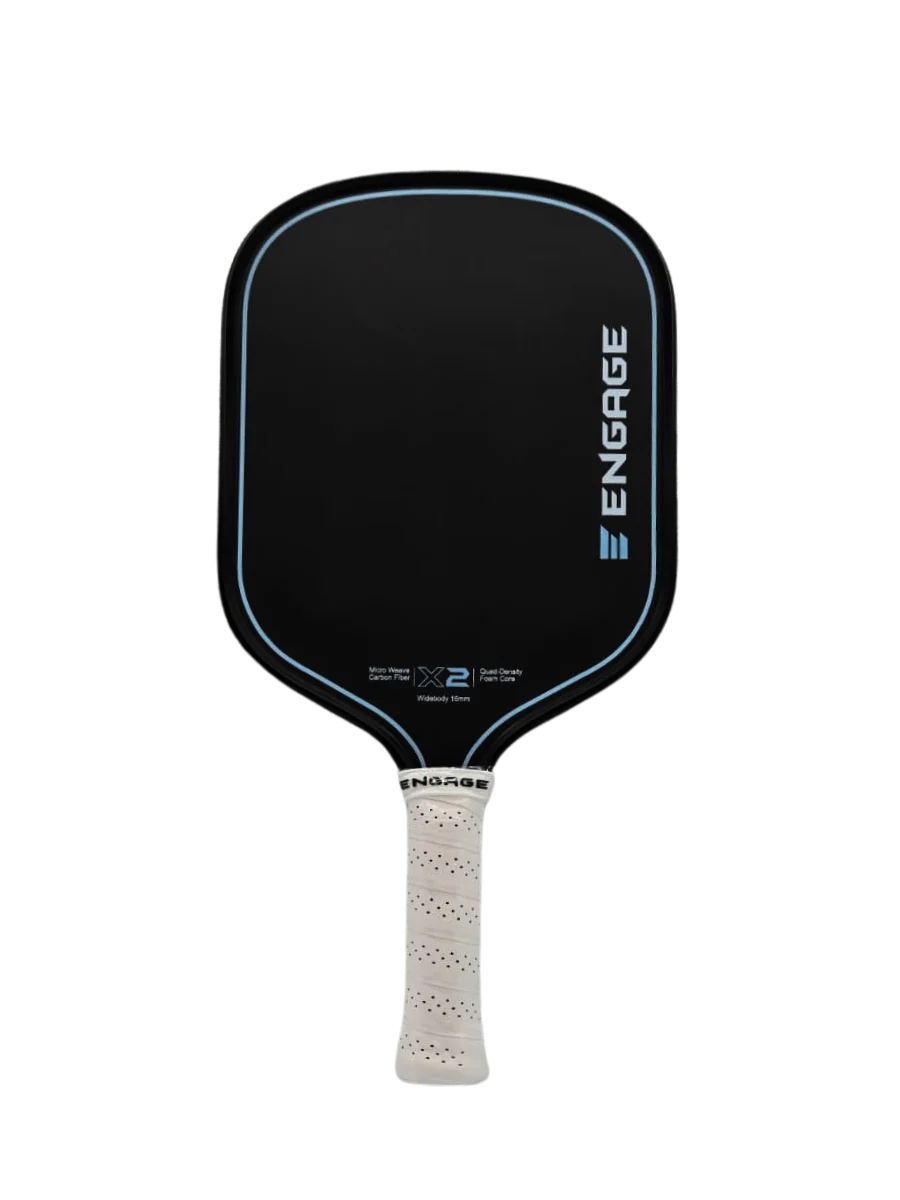
The Engage X2 Widebody is the foam flagship of this shape, and it plays like one. The core is quad-density foam, foam all the way through with no honeycomb anywhere in the build, and contact feels dense and soft at once: the ball pockets, holds for a fraction, and leaves with free pop on short swings. That pocketing is the whole appeal.
Drops sit down without a full swing behind them, blocks absorb pace instead of handing it back, and counters come off the face with weight I did not expect from a widebody.
The measured line backs up the feel. At 8.2 ounces with a swing weight of 111 it moves quickly in hands battles, and a twist weight of 7.1 keeps stretched blocks on line when contact drifts toward the edge.
Spin measures 2,289 RPM off the micro-weave carbon face, the highest figure on this page, and it shows on serves that dip late and drives that hold their line. The foam feel is a taste, and I will say so plainly.
Players raised on the sharp crack of honeycomb may never take to the muted, dense response, and the widebody gives back reach on overheads and wide gets, so singles players who live on leverage should look at the elongated picks instead.
Buy it if you want foam power and forgiveness in one frame and you play mostly doubles. Skip it if you need maximum reach or you love the crisp answer of a honeycomb core.
2JOOLA Scorpeus Pro IV 16mm: Best Widebody Pickleball Paddles in 2027 for Widebody Control
AT A GLANCE
JOOLA Scorpeus Pro IV 16mm
WEIGHT
8.24 oz
SWING WEIGHT
114.95
TWIST WEIGHT
7.4
SPIN
2,221 RPM
Shape: Widebody (dimensions -)
Grip: 5.25 in handle, 4.25 in circumference
Core: Gen 3 Propulsion Core, 16mm
Face: Peel-ply carbon fiber
Approval: USAP and UPA-A
Feel: Stable plush
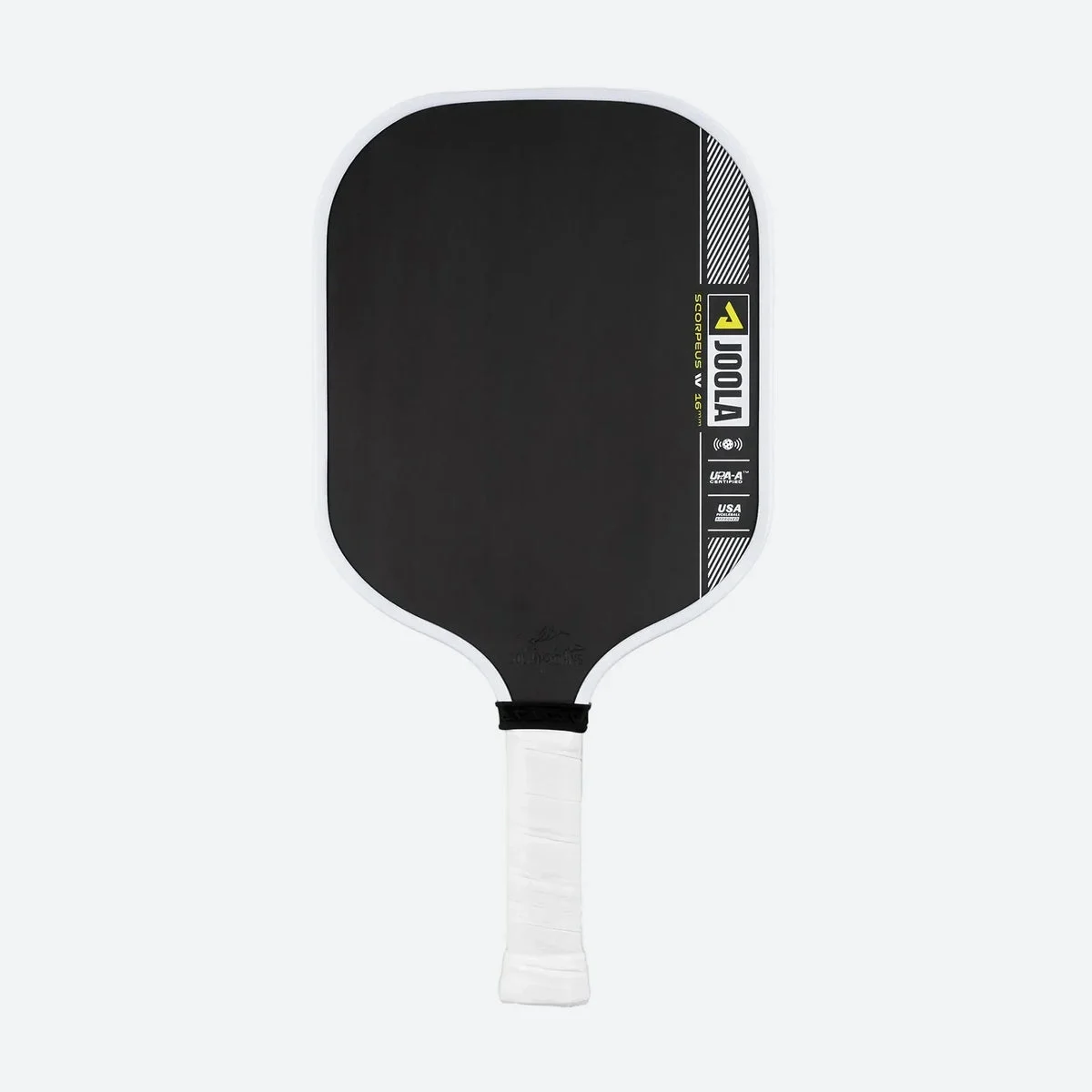
Take the Perseus power recipe and put it in a frame built for defense, and you get the Scorpeus Pro IV. The widebody shape spreads the hitting surface out instead of stretching it long, and the number that explains the whole paddle is the 7.4 twist weight, the highest on this page and the highest the site publishes for any paddle.
Hard drives caught off center simply do not turn the face over. Blocks stay square, resets land low, and the ball goes where it was aimed even when my feet were still moving.
That stability is the control story here: a face that refuses to twist is a face that keeps your defense honest. The surprise is how much of the JOOLA power survives the move.
The same Gen 3 Propulsion Core sits inside, so serves still jump and drives still carry, and the measured spin, 2,221 RPM, actually beats its elongated sibling, which is why it also leads my spin list for the widebody shape.
At a swing weight just under 115 it changes direction faster than the Perseus, so counters at the kitchen feel like choices rather than reactions. Power here is not about reach and leverage.
It is about a stable face that lets you swing with confidence from defensive positions. What you give up is length. The widebody gives back the extra reach on wide gets and overheads, and players who live on a two-handed drive will feel the shorter hitting zone.
The soft game is calm rather than buttery, closer to firm control than to a foam pocket. Buy it if your points start with defense and end with a counter. Skip it if reach and elongated leverage are how you create power.
311SIX24 Jelly Bean 16mm: Best Widebody Pickleball Paddles in 2027 for Forgiveness
AT A GLANCE
11SIX24 Jelly Bean 16mm
WEIGHT
8.0-8.3 oz
SWING WEIGHT
107
TWIST WEIGHT
7.21
SPIN
2,103 RPM
Shape: Widebody (Pegasus), 15.82 x 8.04 in
Grip: 5.75 in handle, 4.125 in circumference
Core: 16mm polypropylene honeycomb, Gen 1.5 unibody with foam-injected edge walls
Face: CFC: two layers of Toray T700 raw carbon fiber over one fiberglass layer
Approval: USAP
Feel: Soft, springy forgiveness
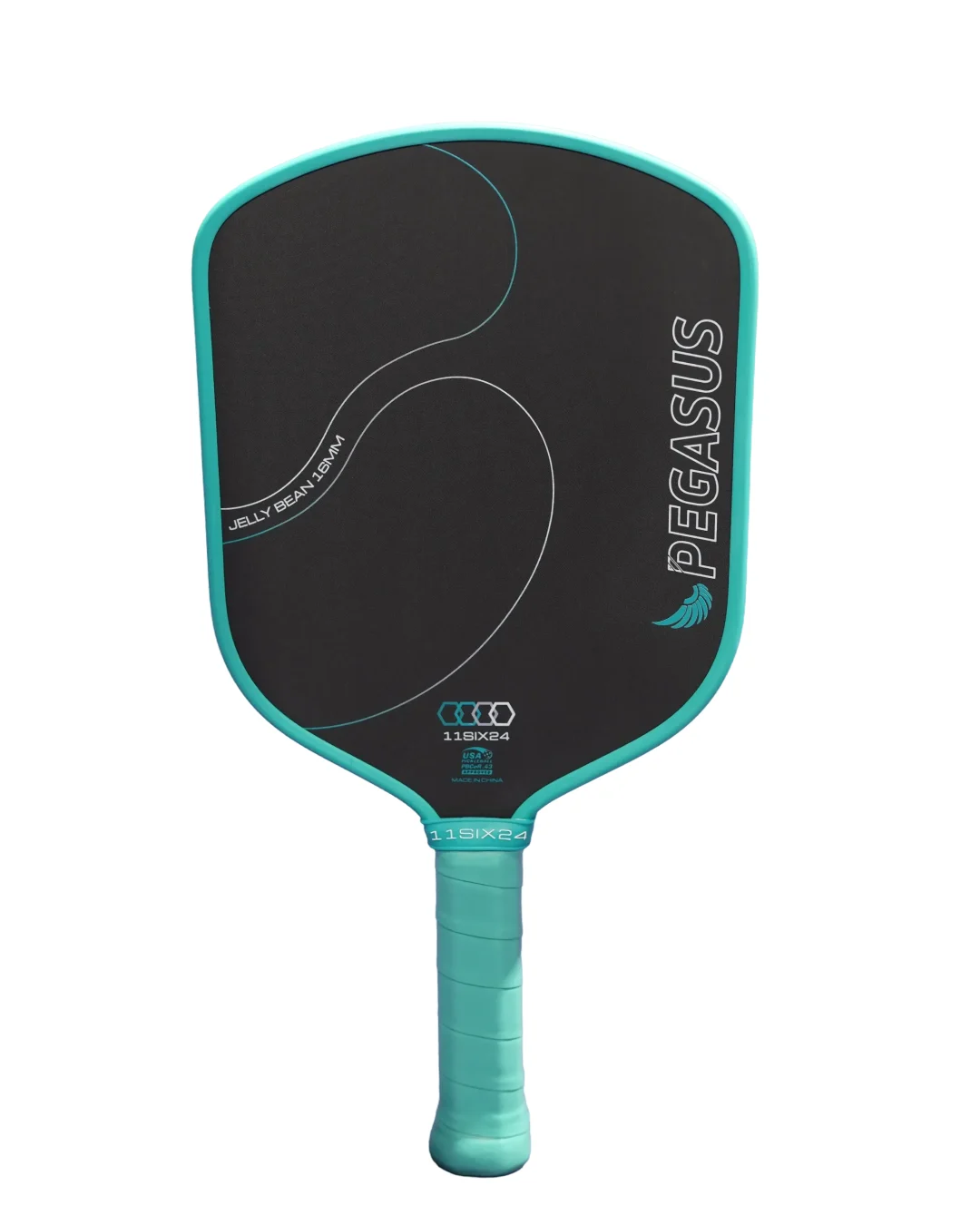
Forgiveness is a measurable thing, and for hands getting faster faster than they are getting cleaner, this is where it peaks.
The Jelly Bean’s Pegasus widebody is a full 8 inches across, the widest face on this page, and its measured twist weight of 7.21 means contact caught wide of center still leaves on your line, so stretched blocks and late defensive stabs stay playable instead of spraying toward the fence.
Those are the contacts that decide rallies, and this paddle wins more of them than any other here.
On the scale it is midweight, 8.0 to 8.3 ounces, and I will not pretend otherwise. But its measured swing weight of 107 is the lowest on this page, so in play it arrives at the kitchen quicker than paddles that weigh less in the hand.
The layered CFC face produces genuine spin at 2,103 RPM, and the 5.75 inch handle leaves real room for a two-handed backhand on a slim 4.125 inch grip that builds up with an overgrip. It also sits on my intermediate-players list for the same reason: it keeps a developing player in rallies long enough to learn.
What it will not do is finish points from the baseline: drives come off politely, and the softness that forgives so completely also caps putaway sting. The face collects dust, so keep a paddle eraser in your bag.
If your points are won by placement, hands and patience, you will never notice the ceiling. If they are won by pace, the elongated picks are your read. Buy it if mishits and stretched defense are where your points leak away. Skip it if baseline power is the hole in your game.
4Friday Aura Pro Widebody 16mm: Best Widebody Pickleball Paddles in 2027 for Fast-Hands Power
AT A GLANCE
Friday Aura Pro Widebody 16mm
WEIGHT
7.85 oz
SWING WEIGHT
108
TWIST WEIGHT
6.86
SPIN
2,097 RPM
Shape: Widebody, 16 x 8 in
Grip: 5.5 in handle, 4.25 in circumference
Core: Gen 4 dual-density EPP/EVA foam, 16mm
Face: Raw texture peel-ply carbon fiber
Approval: USAP
Feel: Lively power with a wide, stable face
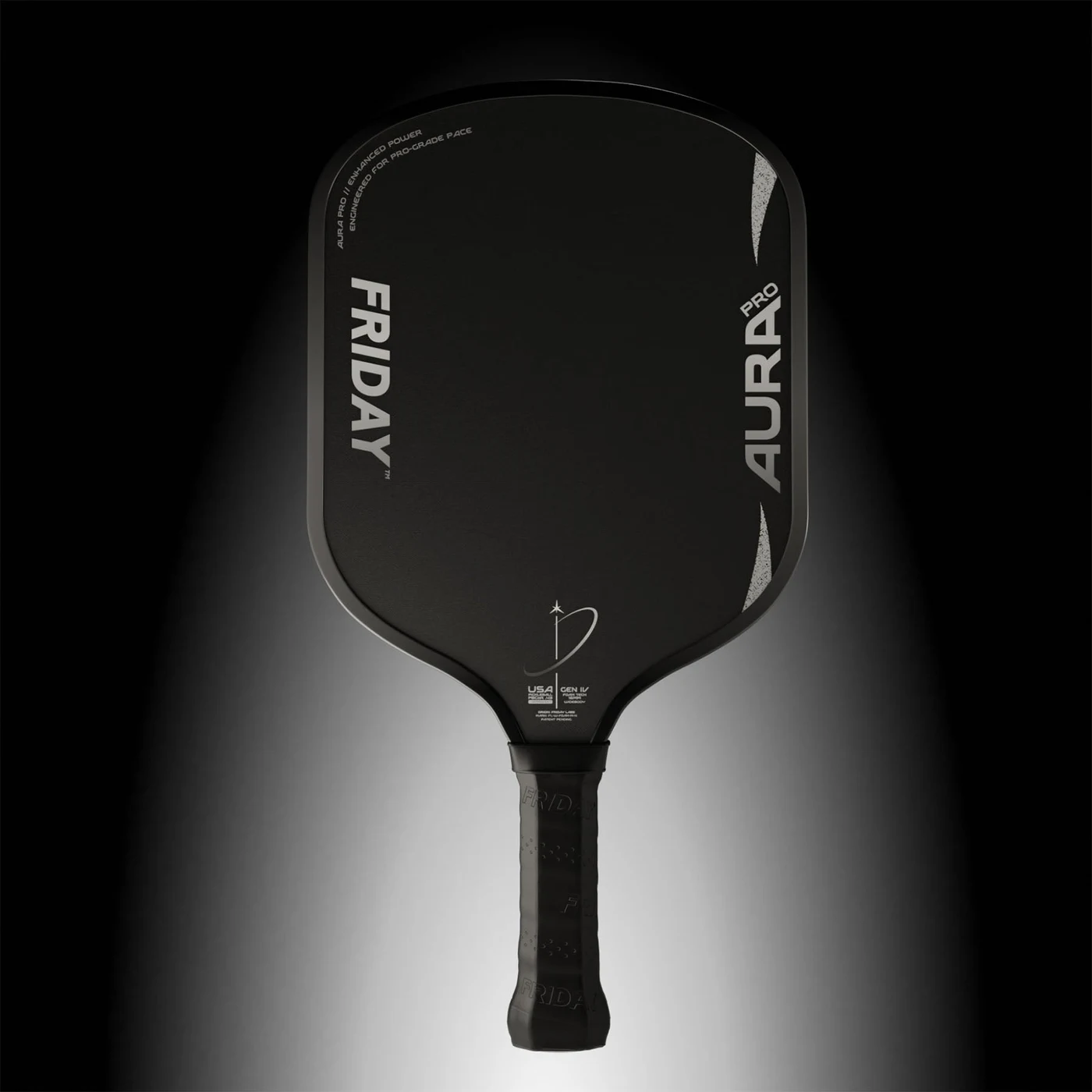
The Aura Pro Widebody is the lightest swinging paddle in its class, and you feel it from the first hands battle. At 7.85 ounces with a swing weight of 108, it arrives at the kitchen quicker than anything else here, and speed-ups that I usually block became speed-ups I could aim.
The Gen 4 core is dual-density foam, EPP layered with EVA, and contact plays lively rather than muted: the ball pockets briefly and leaves with a straight, honest line of power that builds with your swing instead of arriving all at once.
Spin measures 2,097 RPM off the raw peel-ply carbon face, enough bite for dipping drives and roll volleys that fall at the feet.
A twist weight of 6.86 keeps the wide face steady on stretched contact, though it will not rescue the wildest blocks the way the 7-plus paddles above do.
The 5.5 inch handle and standard 4.25 inch grip fit the widest range of hands, and the 16 by 8 inch frame is a genuine widebody, short and square with the biggest sweet spot of the Friday line. Two honest cautions.
Resets run firmer than on the standard Aura, so the soft game needs a session of calibration before it behaves. And the peel-ply grit fades across a few months of heavy play, so the spin you test in week one is not the spin you own in month six unless you protect the face.
Buy it if your game is quick hands and lively power in a forgiving shape. Skip it if you want the softest, calmest contact or maximum stability on defense.
5Selkirk SLK Dauntless Widebody 16mm: Best Widebody Pickleball Paddles in 2027 for Foam Stability
AT A GLANCE
Selkirk SLK Dauntless Widebody 16mm
WEIGHT
7.7-8.1 oz
SWING WEIGHT
110
TWIST WEIGHT
7.36
SPIN
~2,020 RPM
Shape: Widebody (dimensions -)
Grip: 5.6 in handle, 4.25 in circumference
Core: SoloCore PureFoam with IsoFlex, 16mm, one-piece foam
Face: T700 raw carbon fiber
Approval: USAP
Feel: Soft, dense, muted control
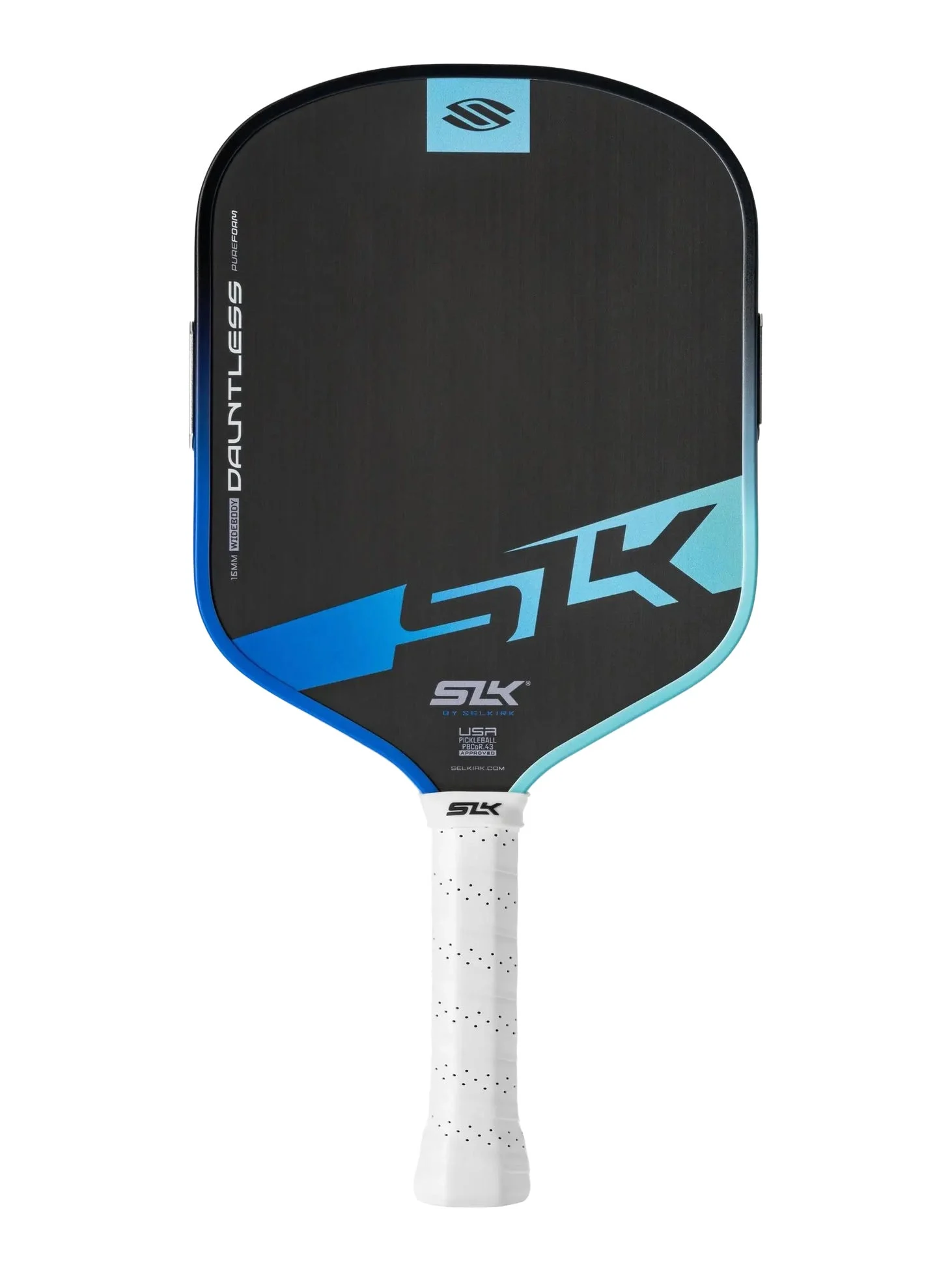
Stability is this paddle’s whole argument, and the numbers state it cleanly. A twist weight of 7.36 is the second-highest figure on this page: contact caught toward either edge still leaves on the line you chose, because the face barely rotates in your hand.
Blocks against hard drives hold their shape instead of wobbling, resets stay low and predictable, and the widebody face gives a developing player the largest margin for contact that is still forming.
If your rallies leak away on off-center balls at the net, this is the most direct fix on the list.
Under the face sits Selkirk’s SoloCore PureFoam, a one-piece 16mm foam core with factory pre-tuned perimeter weighting, and the strike reads planted and secure rather than crisp: the ball pockets, holds, and leaves with a heavy, settled shape.
Spin around 2,020 RPM is real working spin for shaped drives and dipping rolls.
The 5.6 inch handle is the longest among the widebodies here and serves a two-handed backhand properly, and a swing weight of 110 is the session-friendly middle of this page’s window, quick enough for hands battles without asking for finished technique. The trades are the widebody’s usual ones.
Reach gives back a step to the elongated picks, and the foam dwell that steadies contact also softens the sharpest putaway pop; you finish points with placement and pressure rather than one swing.
Buy it if off-center contact and twisting blocks are where your rallies leak away. Skip it if reach is your priority or you need the paddle to supply your pace.
6JOOLA Scorpeus Pro V 16mm: Best Widebody Pickleball Paddles in 2027 for All-Court Play
AT A GLANCE
JOOLA Scorpeus Pro V 16mm
WEIGHT
8.2 oz
SWING WEIGHT
113
TWIST WEIGHT
7.21
SPIN
-
Shape: Widebody, 16 x 8 in
Grip: 5.25 in handle, 4.125 in circumference (Anna Bright edition)
Core: Propulsion Core with KineticFrame, 16mm
Face: Textured carbon fiber
Approval: USAP and UPA-A
Feel: Stable and quick
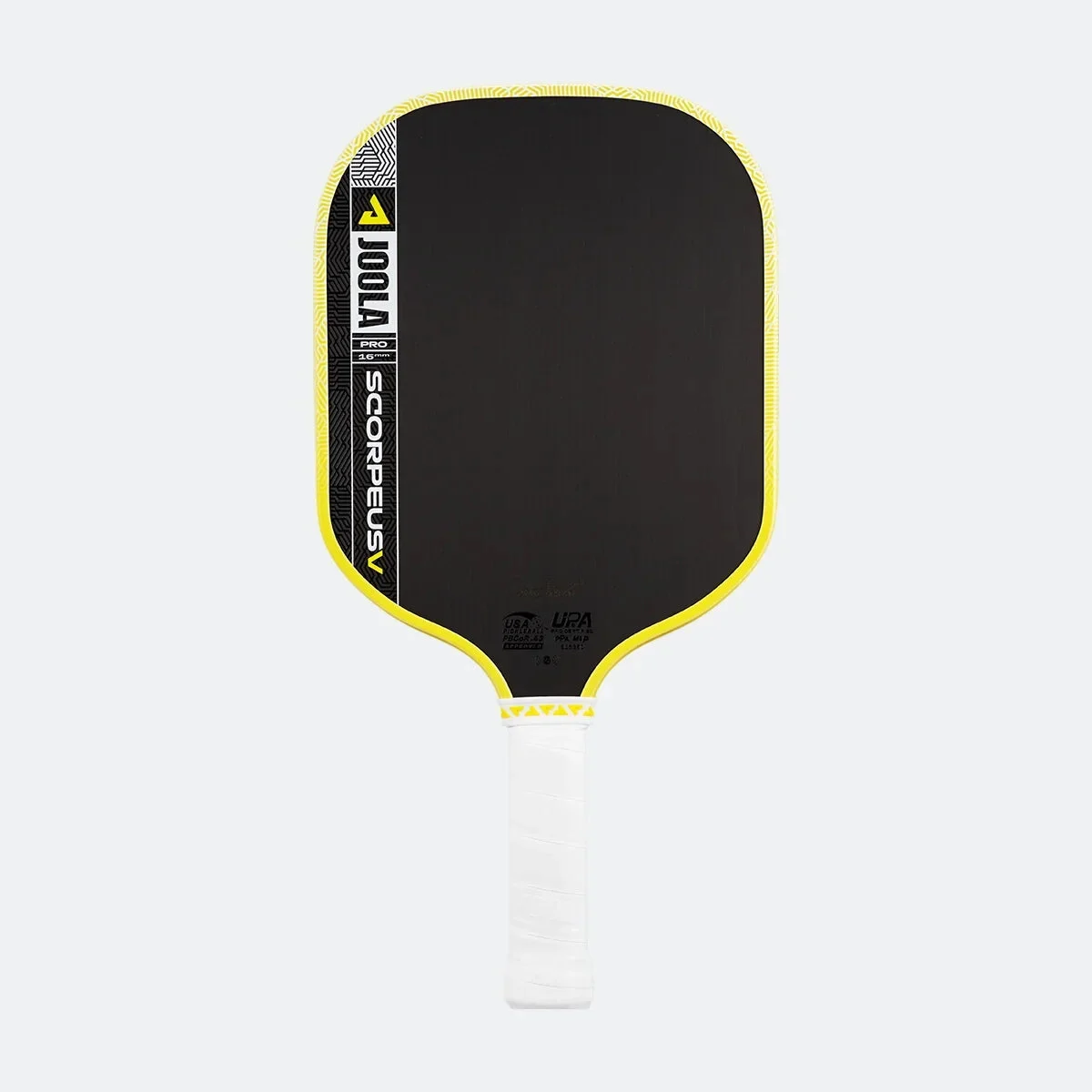
The Scorpeus Pro V is the current generation of JOOLA’s widebody, and it is the most forgiving shape the brand makes.
At 16 by 8 inches with the KineticFrame throat, it is the widest, shortest frame in the flagship line, built for the defensive doubles brief: blocks, resets and counters from positions where your feet have not caught up yet.
A twist weight of 7.21 keeps the face square on stretched contact, and a swing weight of 113 moves quicker through the kitchen than its elongated sibling, which is the kitchen-hands argument for this shape in one number.
The Propulsion Core with KineticFrame gives counters a firm push without turning resets into a lottery, and the textured carbon face grips the ball well on rolls and dips, though no lab spin figure has been published for this shape and the box says so honestly rather than borrowing its predecessor’s number.
At 8.2 ounces it is a substantial paddle to whip, and the 5.25 inch handle is short enough that two-handed backhand players should test the fit before committing. The grip circumference of 4.125 inches is the Anna Bright edition figure, so check your listing’s edition when it arrives.
What you give up is the same as every widebody here: reach on wide gets and overheads, and the leverage that makes elongated serves jump.
Buy it if you play doubles, defend first, and want the current generation’s most forgiving frame. Skip it if reach and serve leverage lead your game, or if a published spin figure is a condition of your buy.
7Vatic Pro V-SOL Pro Bloom 16mm: Best Widebody Pickleball Paddles in 2027 for Control-First Foam
AT A GLANCE
Vatic Pro V-SOL Pro Bloom 16mm
WEIGHT
7.9 oz avg
SWING WEIGHT
107
TWIST WEIGHT
6.87
SPIN
2,111 RPM
Shape: Widebody (Bloom), 16.0 x 8.0 in
Grip: 4.125 in circumference, handle -
Core: Full EPP foam with EVA perimeter ring (floating foam), 16mm Gen 4
Face: Raw Toray T700 carbon fiber
Approval: USAP
Feel: Control-first foam
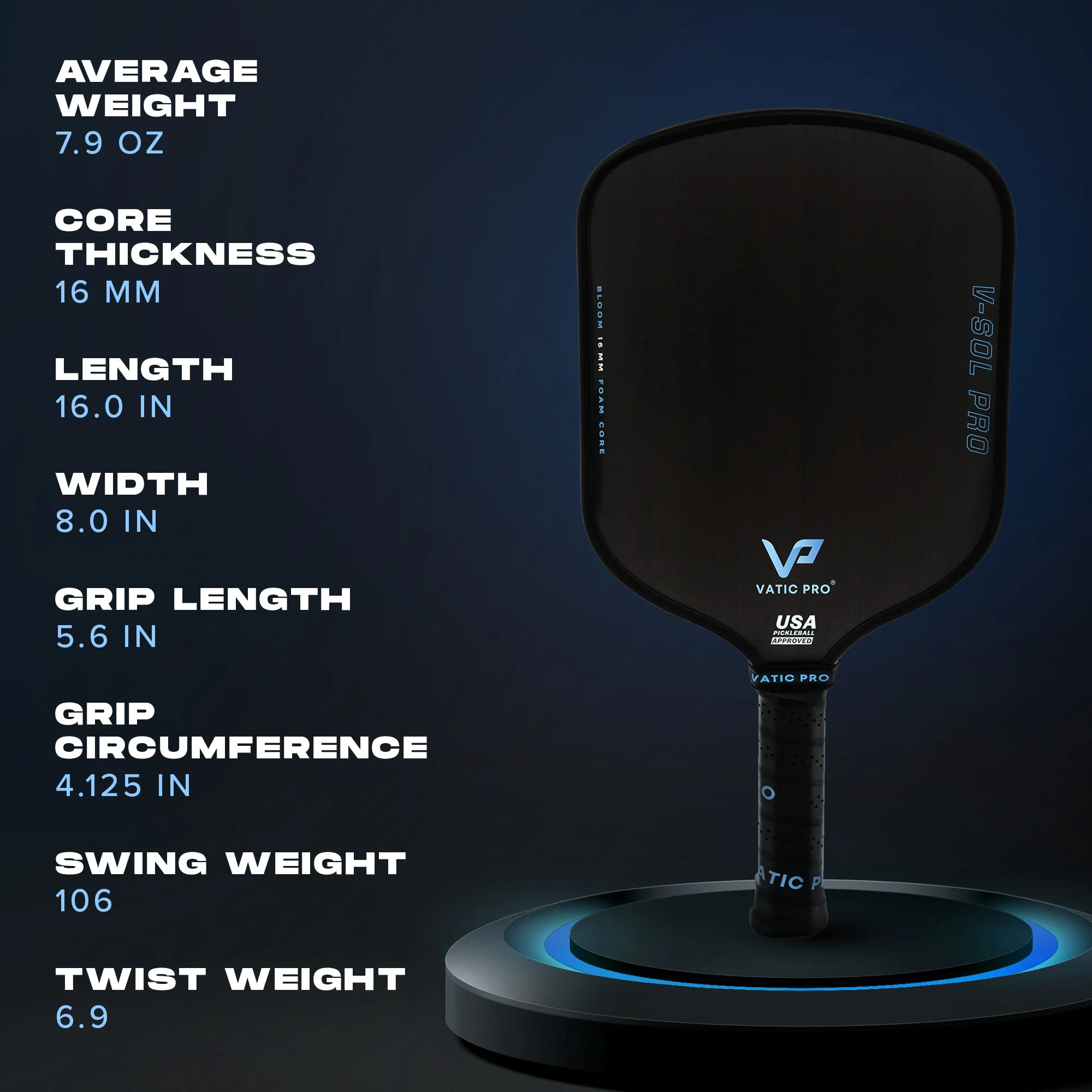
The V-SOL Pro Bloom is the control-first member of the V-SOL Pro line, and the shape is the whole decision. At 16.0 by 8.0 inches it is the widebody of the family: the same full EPP foam core with its EVA perimeter ring, the same raw Toray T700 carbon face, but spread wide instead of stretched long.
The result is the most forgiving V-SOL Pro and the calmest. A swing weight of 107 keeps it quick in hands battles, a twist weight of 6.87 keeps stretched blocks honest, and spin measures 2,111 RPM, genuine working spin for drives that dip and rolls that bite. What it trades away is output.
Power and spin sit below the line’s average, because this shape spends its foam on control and forgiveness instead: drops land soft, dinks stay low, and contact toward the edges comes back playable instead of twisting away.
Every Vatic Pro grip carries two shock-absorbing inserts, and the 4.125 inch circumference is the slim, comfortable hold the line is known for. One distinction matters, so I will state it plainly.
The Bloom is the widebody shape. The Flash is the hybrid, and my standalone review covers the Flash only, so nothing on this page claims that review tested this shape.
The raw peel-ply grit is also a wear surface, so expect its bite to fade with heavy use. Buy it if control and forgiveness are your whole brief and you want foam to do the work. Skip it if power or spin leads your game.
8Vatic Pro V-SOL Power Bloom 16mm: Best Widebody Pickleball Paddles in 2027 for Budget Power
AT A GLANCE
Vatic Pro V-SOL Power Bloom 16mm
WEIGHT
7.95 oz
SWING WEIGHT
109
TWIST WEIGHT
7.02
SPIN
2,069 RPM
Shape: Widebody (Bloom), 16.0 x 8.0 in
Grip: 5.6 in handle, 4.125 in circumference
Core: Full solid indented EPP foam slab, 16mm
Face: Raw Toray T700 carbon fiber
Approval: USAP
Feel: Muted all-court power
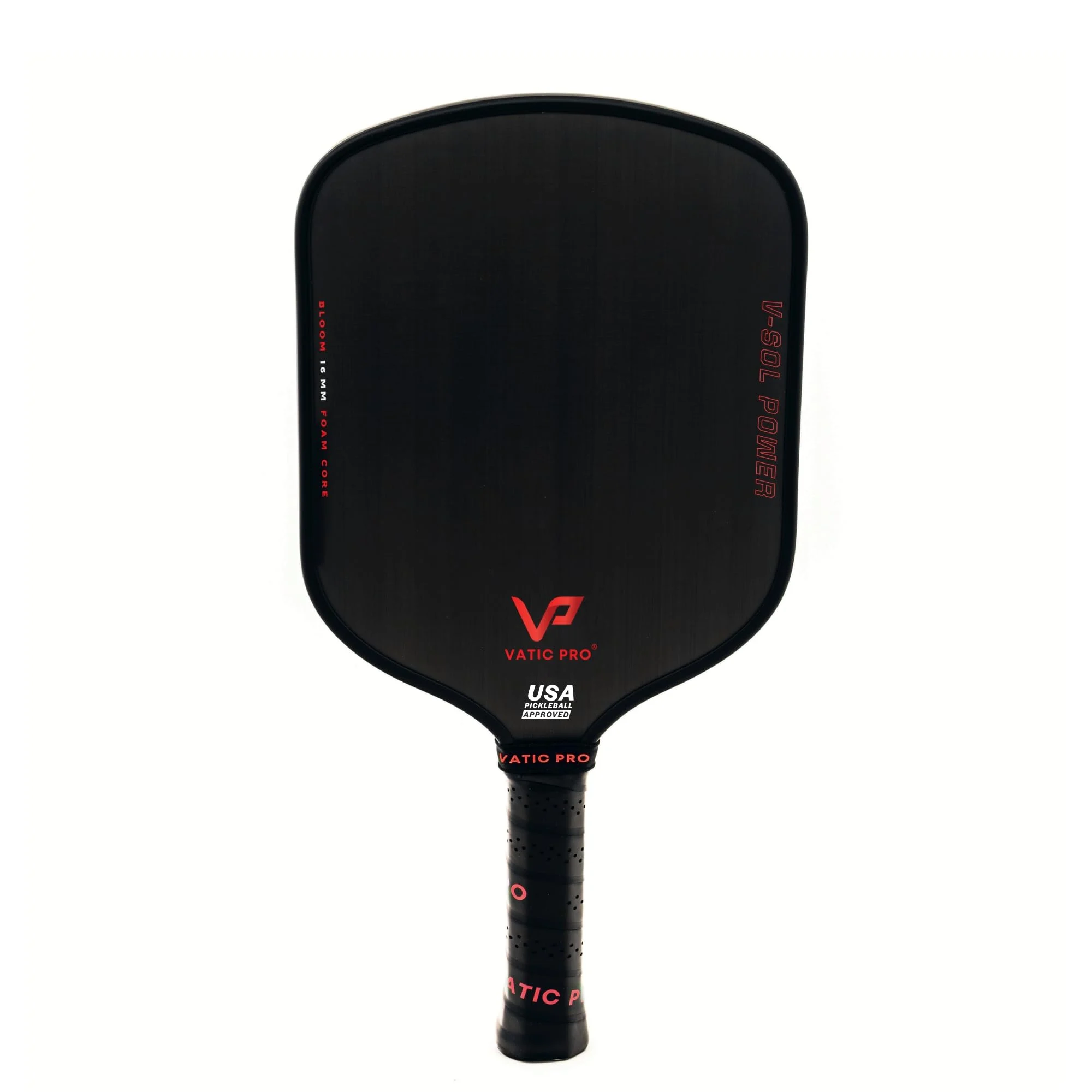
The V-SOL Power Bloom is the offensive member of the V-SOL Power line in its widebody shape, and it answers the question the Pro Bloom leaves open: what if the same forgiving frame could also finish points. At 16.0 by 8.0 inches on a full 16mm foam slab, it carries genuine offensive capability into a shape built for forgiveness.
A swing weight of 109 and a twist weight of 7.02 keep it quick and steady, and spin measures 2,069 RPM off the raw Toray T700 face, enough shape on drives and serves to keep opponents honest.
The core is a solid indented EPP foam slab with no EVA ring, which makes the response muted rather than lively: the ball sinks in, the feel runs deep and soft, and the power arrives on a full swing rather than a short one.
That is the honest trade. A short, punchy swing gets a polite ball back, and players who arm their shots will call it quiet until they commit their shoulders. The sweet spot is also smaller than the Pro Bloom’s, so centered contact matters more here, and the raw carbon grit fades with heavy use like every peel-ply face in this class.
The 5.6 inch handle and 4.125 inch grip leave room for two hands and fit most players as they come. Buy it if you want a widebody that forgives and still finishes, and you swing fully. Skip it if you want free power on short swings or the largest sweet spot on this page.
9Franklin C45 Aurelius 12.7mm: Best Widebody Pickleball Paddles in 2027 for Fast-Hands Control
AT A GLANCE
Franklin C45 Aurelius 12.7mm
WEIGHT
-
SWING WEIGHT
-
TWIST WEIGHT
-
SPIN
-
Shape: Widebody, 15.7 x 7.9 in
Grip: 5.1 in handle, circumference -
Core: PowerFlex polymer, 12.7mm, double thermoformed
Face: T700 carbon fiber, 45-degree peel-ply
Approval: USAP and UPA-A
Feel: Feather fast
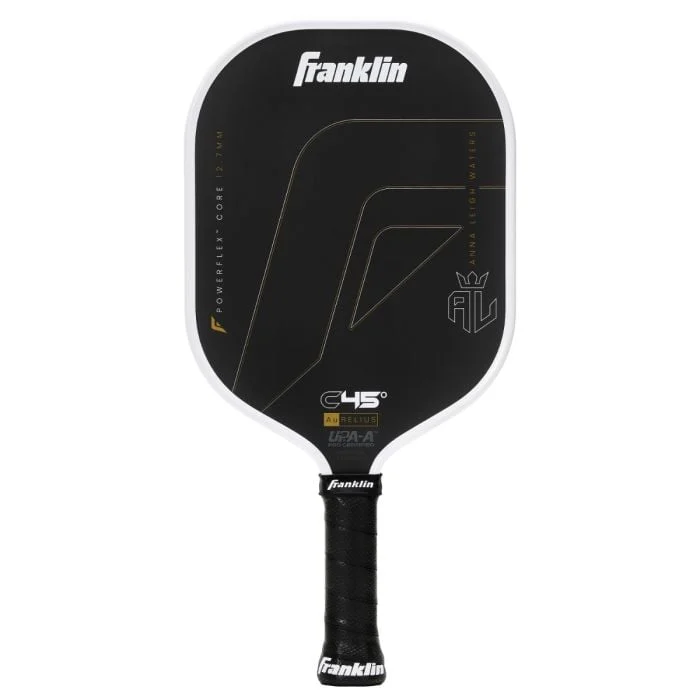
Nothing on this list moves like the Aurelius. It is the signature widebody, short and wide at 15.7 by 7.9 inches, light in the hand, and so quick that hand battles at the kitchen stop feeling like reactions and start feeling like choices.
Counters I normally block became counters I could aim. That speed is control: the paddle arrives on time, so the reset I meant to hit is the reset I actually hit, and the dink I shaped with my wrist lands shaped instead of late.
The carbon face is laid at a 45 degree angle, and you feel that design in the spin. Topspin drives dip hard, rolls shape easily, and serves come off with a bite that heavier paddles need twice the effort to produce.
The 12.7mm PowerFlex core is the thinnest on this page and answers immediately: drops and dinks sit down instead of floating, and the whole paddle feels calm even when the rally is not.
Choose the 12.7mm ALW variant: the thicker versions are different paddles, heavier swinging and slower to redirect. Stock, it has a weakness you feel immediately.
Hit off-center and the face twists, because there is so little mass to hold it steady, and no lab has published swing or twist figures for this thickness. This paddle is famous among players for one reason: a little added weight transforms it.
Tape along the sides settles the twisting, widens the sweet spot, and turns good drives into heavy ones while keeping the hand speed. The 5.1 inch handle crowds two-handed backhand players, so they should look elsewhere.
Buy it if your game is speed, spin and quick hands, and you enjoy tuning a paddle. Skip it if you want power and forgiveness straight out of the wrapper.
10Selkirk Vanguard Power Air Epic 16mm: Best Widebody Pickleball Paddles in 2027 for Edgeless Play
AT A GLANCE
Selkirk Vanguard Power Air Epic 16mm
WEIGHT
7.7-8.1 oz
SWING WEIGHT
-
TWIST WEIGHT
-
SPIN
-
Shape: Widebody (Epic), 15.75 x 8 in
Grip: 5.25 in handle, 4.25 in circumference
Core: SuperCore polymer honeycomb, 13mm
Face: QuadFlex fiberglass and carbon fiber
Approval: USAP
Feel: -
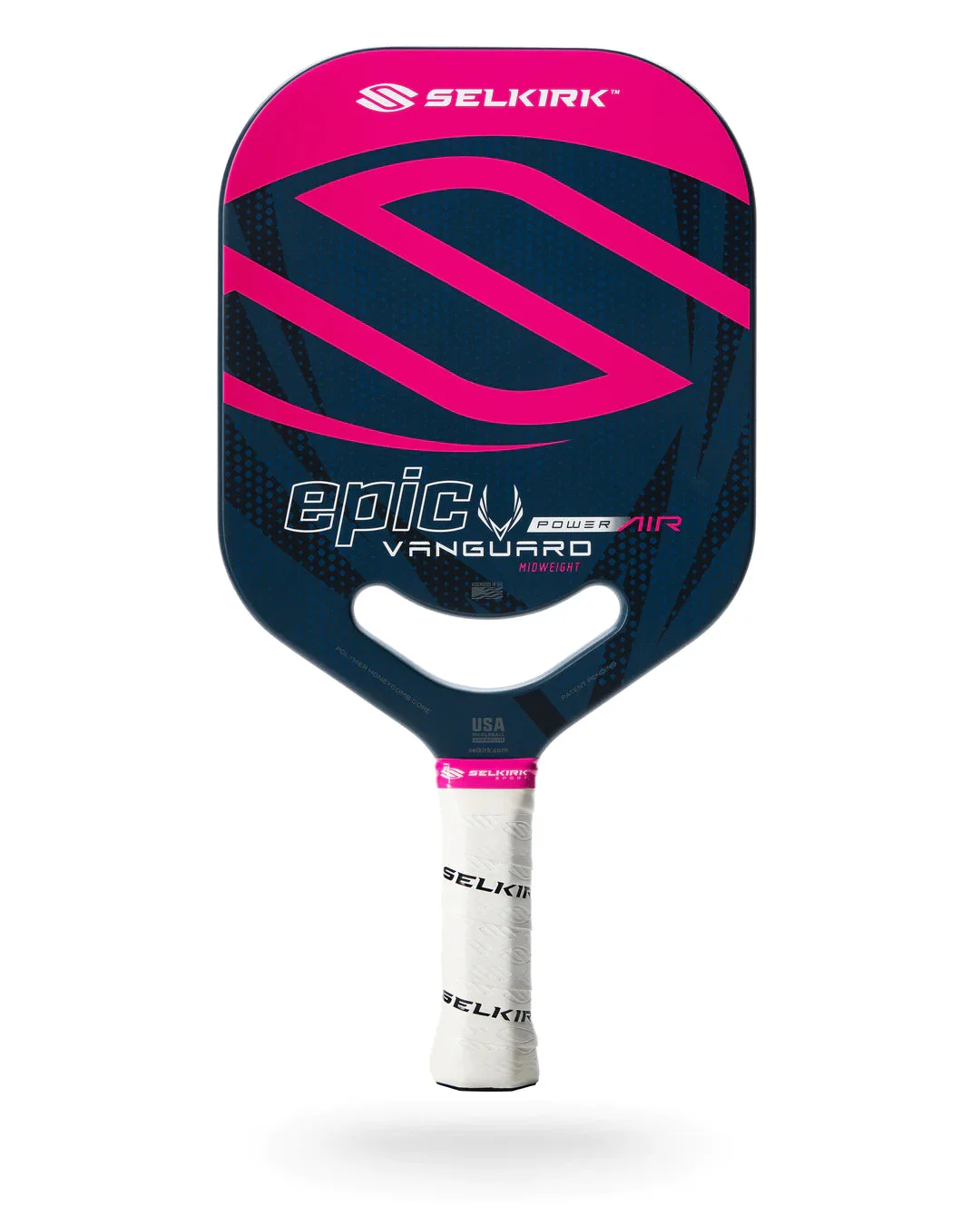
The Vanguard Power Air Epic is the only edgeless widebody on this page, and the missing edge guard is the whole story. Without a guard wrapping the frame, the full 15.75 by 8 inch Epic face plays: contact near the perimeter stays live instead of dying on plastic, and the sweet spot stretches to the very edge of the paddle.
That is the edgeless promise, and in hands battles it shows up as blocks that hold their line when the ball catches the outer third of the face.
Inside, the SuperCore polymer honeycomb runs 13mm, thinner than the foam cores above, so the answer comes quicker and firmer: the ball leaves the QuadFlex fiberglass and carbon face with a crisp, direct strike rather than a deep pocket.
Drops need a softer hand than the foam picks demand, and resets reward a relaxed grip, because this core gives back what you put in rather than absorbing it for you. The 5.25 inch handle and standard 4.25 inch grip are the familiar Selkirk fit, and at 7.7 to 8.1 ounces it sits in the middle of this page’s weight window.
No lab has published swing weight, twist weight or spin for this shape, so the box prints those cells honestly as unpublished instead of borrowing figures from the elongated Epic’s cousins.
Buy it if you want the widest usable face on this page and you like a crisp, direct answer. Skip it if you want foam dwell and a soft, pocketed strike, because this one plays the other way.
How to Choose the Best Widebody Pickleball Paddles in 2027
Forgiveness is the promise every widebody makes, and the shape keeps it, but only if you buy the shape and not the name.
Work through the sections below in order: what a widebody is, the two weight numbers that decide most of it, how foam changed the power story, the reach trade, handles, face and spin, and the approval check before you buy.
If you want the control half of the argument, my control list ranks the paddles that put the ball where you aimed it, and my spin list shows where the widebody spin figures on this page sit against the rest of the sport.
What a Widebody Is, and What It Is Not
A widebody is the short, wide, square-ish shape: roughly 15.5 to 16 inches long and 8 inches wide, with a shorter handle than an elongated paddle and the largest sweet spot of the three shape classes.
An elongated paddle stretches to about 16.5 inches long and 7.5 wide, which adds reach and leverage and shrinks the sweet spot. A hybrid sits between the two.
Brands rarely print the word widebody on the face. The same shape is sold as Standard, Max, Epic, Pegasus, Scorpeus, Bloom and EX, so learn the names and then ignore them: the shape is decided by the dimensions, never by the marketing name.
Conversely, a paddle called wide that measures 16.5 by 7.5 inches is elongated, not widebody, whatever the listing calls it. Measure first, buy second.
Sweet Spot and Twist Weight: The Widebody Numbers
Twist weight is the control number on this shape. It measures how hard the face resists rotating on off-center contact, and on a widebody it is usually the highest figure the paddle posts.
Six of the ten picks here clear 7.0: the Scorpeus Pro IV at 7.4, the Dauntless at 7.36, the Jelly Bean and the Scorpeus Pro V at 7.21, the X2 at 7.1, and the Power Bloom at 7.02.
What a 7-plus twist weight feels like is simple: a stretched block stays square, a late counter keeps its line, and the ball goes where your hands sent it even when your feet had not caught up.
Swing weight is the hand-speed number. The 107 to 108 quick hands of the Jelly Bean, the Aura Pro and the Pro Bloom suit kitchen exchanges and long sessions, while the 113 to 115 of the Scorpeus pair adds stability and plow-through.
Across the class on the same test rig, widebodies average a far larger sweet spot and more control than elongated paddles, and a lower average swing weight, which is the whole shape argument in numbers.
Foam Changed the Shape’s Power Story
The old knock on the shape was power: widebodies hit soft, because a short frame gives the swing less leverage. Full foam closed the gap.
On the same test rig, the full-foam widebodies average far more power than the rest of the class, which is why five of the ten picks here are foam cored and why the X2 and the two Vatic Blooms finish points the old honeycomb widebodies could not.
Honeycomb still has its place: it answers crisper, gives a more connected strike, and suits players who like feedback at contact. Foam dwells longer, pockets the ball, and forgives more, at the cost of a muted feel some players never warm to.
Carbon rib cores are the third way, a lattice instead of cells or foam, built for a dwell time that does not fade with age. Pick the core by the feel you want to live with for a season, not by the power number on the box.
Reach: The Trade You Actually Pay
Every widebody gives something back, and it is reach. Lobs over your head, overheads on a high ball, stretched dinks wide of your body, and the extra step a singles player covers: all of them get harder when the frame is an inch shorter.
In doubles, where the court is shared and the kitchen decides points, that trade is cheap, which is why this shape dominates doubles bags. In singles, where one player covers the whole court, it is expensive.
Widebody vs elongated is the comparison buyers actually search for, and the honest answer is that neither shape is better in general. Choose the widebody if your points leak on contact, mishits, stretched blocks, late counters.
Choose the elongated if they leak on coverage, wide gets, overheads, serves that need leverage. If you play both formats, own the shape your weaker game needs, because the shape covers the weakness and your technique covers the rest.
Handles and Two-Handed Backhands
Widebody handles run short, because the face takes the length the handle gives up, and that is the real fit question on this page. The rule is 5.5 inches: handles at 5.5 inches and beyond leave genuine room for a two-handed backhand, while shorter handles keep a one-handed game quick.
Three picks clear the bar: the Jelly Bean at 5.75 inches, the Dauntless and the Power Bloom at 5.6.
The rest do not: the Aurelius at 5.1 inches is the shortest handle here and crowds two hands badly, the Scorpeus pair and the Vanguard at 5.25 inches are tight but workable with a compact second hand, and the X2’s handle length is not published.
Grip circumference runs from the slim 4.125 inches of the Jelly Bean, the Scorpeus Pro V and both Vatic Blooms to the standard 4.25 inches of the rest. A slim grip suits smaller hands and two-handed play and builds up easily with an overgrip, layer by layer, until it fits.
A grip can never be shrunk below the handle underneath the wrap, which is why the slimmer factory grips on this page are chosen with building up in mind.
Face, Grit and Spin: Why Widebody Spin Survives Contact
The spin figures on this page run from 2,069 RPM on the Power Bloom to 2,289 RPM on the X2, and the interesting thing is not the top of the range. It is that the spin survives contact. On a narrow frame, an off-center brush twists the face open and the ball floats.
On a widebody, the same contact stays square, the brush still happens, and the roll volley still dips, which is why the Scorpeus Pro IV’s 2,221 RPM beats its elongated sibling’s figure in real rallies even though the numbers look close on paper.
Face layups tune the spin further. Fiberglass layers, used in the Jelly Bean and the Vanguard, add liveliness and pop on counters, with a launch you have to learn as the trade.
Pure carbon faces answer calmer and hold the ball longer. The last variable is survival: plain raw carbon slowly goes smooth with play, so its spin, and the control that spin provides, fades.
Durable grit surfaces like embedded-particle textures and coated grit systems are built to hold their bite, which means the spin you tested in week one is still the spin you own in month four.
Two simple checks tell you where your face stands: drag a fingernail across it and feel for bite, and see whether a ball still grabs when you roll it over the surface.
Approvals, Authenticity, and the Warranty
Every pick on this page is approved by USA Pickleball for the exact variant listed, and four add UPA-A approval on top, so all ten play in sanctioned events.
The distinction matters because the two approvals are not interchangeable: UPA-A is the pro tour’s approval, and a UPA-A-only paddle is not legal for USAP-sanctioned events however well it plays, so check your exact model on the current approved list before entering a sanctioned event rather than trusting the badge printed on a listing.
And authenticity matters: buy from the brand’s own Amazon store or from Amazon itself, never from an unfamiliar third-party listing, and register the paddle when it arrives.
Warranty terms vary by brand and no warranty figure was verified for these exact variants, so no warranty is printed on this page’s boxes; check the brand’s warranty page before you buy, keep the receipt, and registration starts the record.
Frequently Asked Questions (FAQs)
1. What is a widebody pickleball paddle?
A widebody pickleball paddle is the short, wide, square-ish shape: roughly 15.5 to 16 inches long and 8 inches wide, with a shorter handle than an elongated paddle and the largest sweet spot of the three shape classes.
It trades reach and leverage for stability, forgiveness and hand speed. Brands sell the same shape under many names, Standard, Max, Epic, Pegasus, Scorpeus, Bloom, so judge it on its dimensions, never on the name printed on the face.
2. Widebody, hybrid, or elongated: which shape should I choose?
Choose by where your points leak, because the elongated vs widebody question has no general answer. Choose a widebody if they leak on contact: the Scorpeus Pro IV, the Dauntless and the Jelly Bean post this page’s stability figures, so mishits stay on line and blocks hold against pace.
Choose elongated if they leak on coverage: the longer frame takes balls a step earlier and adds serve leverage, accepting the swing weight that comes with length. Choose a hybrid if your game is still deciding what it is; the hybrids split the difference and are the safest default for most players.
3. Do widebody paddles have less power than elongated paddles?
They used to, and the gap has mostly closed. The old knock was real: a short frame gives the swing less leverage, so honeycomb widebodies hit soft. Full-foam widebodies changed that, and the foam picks on this page, the X2, the Aura Pro and both Vatic Blooms, finish points the old widebodies could not.
What remains is a leverage gap, not a power gap: an elongated paddle still adds more to serves and overheads from the same swing, while a widebody adds more forgiveness to the shots you actually mishit.
4. What swing weight and twist weight should I look for in a widebody paddle?
For most players, a swing weight between 107 and 115 and a twist weight at or above 7.0. Toward 107, the Jelly Bean, the Aura Pro and the Pro Bloom, hand speed and long-session freshness come first, which suits kitchen players and hands battles.
From 111 upward, the X2, the Scorpeus pair and the Dauntless add stability and plow-through. Twist weight is the widebody number: above roughly 7.0, mishits stop turning the paddle in your hand, and six of the ten picks here clear it.
5. Are widebody paddles good for beginners?
Yes, they are the most beginner-friendly shape. The wide face and high twist weight give a new player’s contact point margin while their strokes form, so mishits stay in play instead of spraying, and the quick swing weight keeps hands battles manageable.
The 11SIX24 Jelly Bean 16mm is the best first widebody on this list for that reason, with the lowest swing weight here and the widest face, and the Selkirk SLK Dauntless Widebody is the calmest teacher for a player who wants foam forgiveness from day one.
6. Can I hit a two-handed backhand with a widebody paddle?
Yes, if the handle is long enough. Handles at 5.5 inches and beyond leave genuine room for a two-handed backhand, and three picks here clear that bar: the Jelly Bean at 5.75 inches, the Dauntless and the Power Bloom at 5.6.
The Aurelius at 5.1 inches crowds two hands badly and suits a one-handed game, while the Scorpeus pair and the Vanguard at 5.25 inches are tight but workable with a compact second hand. Test the fit before you commit if two hands are part of your game.
7. Which widebody paddle has the biggest sweet spot?
The JOOLA Scorpeus Pro IV, on the number that matters most: its 7.4 twist weight is the highest on this page, so contact caught toward the edges still leaves on your line. On face width alone the Jelly Bean wins, at 15.82 by 8.04 inches, the widest face here.
And the Vanguard Power Air Epic deserves a mention for a different reason: with no edge guard, its whole face plays, so its usable sweet spot stretches to the very edge of the paddle. All three forgive; they forgive in different ways.
8. Is the Vatic Pro V-SOL Pro a widebody paddle?
No, not as a line. The V-SOL Pro comes in three shapes, and only one of them is a widebody. The Bloom is the widebody shape, at 16.0 by 8.0 inches, and it is pick 7 on this list. The Flash is the hybrid, at 16.2 by 7.7 inches, and the V7 is the elongated shape, at 16.5 by 7.5 inches.
My standalone review covers the Flash hybrid only, so it does not test the Bloom, and this list never claims otherwise. If you want the widebody, buy the Bloom by name and check the dimensions on the listing before you order.
9. Do widebody paddles help with tennis elbow or arm pain?
They can help, but they are not a treatment. A widebody helps in two ways: the high twist weight means off-center contact twists the paddle less, so less shock reaches your arm, and foam cores absorb vibration better than stiff honeycomb.
The Dauntless and the Pro Bloom are the gentlest picks on this page for that reason. But no paddle fixes an overuse injury, and if pain persists, see a clinician and look at your technique, grip size and playing load alongside the paddle.
10. Which widebody paddle is best for doubles?
The best widebody pickleball paddle for doubles is the JOOLA Scorpeus Pro IV, for the defensive game doubles actually rewards: the highest twist weight on this page keeps blocks and resets square, the spin beats its elongated sibling, and the wide face is a bigger target in hands battles.
If your doubles points leak on forgiveness rather than defense, the Jelly Bean is the pick, with the widest face and the quickest swing here. If they leak on putaway power, the Engage X2 Widebody finishes points the other two set up.
11. Can I add weight tape to a widebody paddle, and where?
Yes, and you should try it before buying. Tape at the 3 and 9 o’clock positions raises twist weight, which steadies off-center blocks and calms a twisting face. Tape at the throat or under the grip shifts the feel toward hand speed.
Work in small steps and test for a full session between changes, because every addition moves something else: perimeter tape adds stability but takes a little quickness.
The C45 Aurelius on this list is transformed by exactly this adjustment. Tape will not change a paddle’s core, shape, or face, so it closes small gaps rather than fixing a wrong paddle.
12. Are all of these paddles legal for league and tournament play?
Yes, under the approval that sanctioned play runs on. All ten are approved by USA Pickleball for the exact variant listed, and the X2 Widebody, the Scorpeus Pro IV, the Scorpeus Pro V and the C45 Aurelius carry UPA-A approval as well.
The distinction matters because the two approvals are not interchangeable: UPA-A is the pro tour’s approval, and a UPA-A-only paddle is not legal for USAP-sanctioned events however well it plays. Before you travel to an event, confirm your exact model name on the approved list.

Michael Stevenson
Hi, my name is Michael Stevenson and I’m a passionate pickleball player. I’ve been playing the game for many years and I’m pretty highly skilled at it. Pickleball is one of my favorite topics so naturally, I love to write about it.
Whether it’s tips for beginners, guides for experts, reviews of new paddles, or advanced playing techniques – if it relates to pickleball then I have something interesting to write about it. So if you’re looking for entertaining and informative information on the topic of pickleball, look no further than my written works!