
A regular at my morning open play bought herself a paddle last season because it was the prettiest one on the wall.
It was also built on a standard grip she could not close her fingers around, and I watched the same scene repeat for a month: every block against a hard drive twisted in her hand, every third shot sailed, and she blamed her technique for what was really a fitting problem.
When she finally tried a lighter paddle with a smaller grip, nothing about her swing changed, and half her errors simply stopped happening.
That fitting problem is what this page is actually about, so let me be plain about the framing before the list starts. No performance brand builds a women’s paddle with different construction. The paddles marketed hardest at women change the colour and the graphics, not the core or the face.
What genuinely differs on average is fit: smaller hands that need a grip they can wrap, arms that swing a lighter swing weight for longer sessions, and a lot of players who are newer to the sport and need forgiveness while technique develops.
Every pick below is a unisex performance model that earns its place on measured weight, swing weight, grip size, and stability data, never on a colourway.
I tested these the way this reader plays: open play against mixed levels, drilling sessions on drops and resets, and long weekend sessions where a heavy swing stops being a theory and starts being tired arms. Where independent labs publish swing weight, twist weight, and spin, those figures are in the boxes.
Where no lab has measured a paddle, the box shows a dash rather than borrowing a number from a sibling model. Every pick is USA Pickleball approved, so nothing here ever has to be replaced for eligibility reasons.
The 10 Best Pickleball Paddles for Women in 2027
1Vatic Pro Prism Flash 16mm: Best Overall Pickleball Paddle in 2027
AT A GLANCE
Vatic Pro Prism Flash 16mm
WEIGHT
7.9-8.2 oz
SWING WEIGHT
114
TWIST WEIGHT
6.47
SPIN
~1,900 RPM
Shape: Hybrid, 16.25 x 7.7 in
Grip: 5.3 in handle, 4.25 in circumference
Core: 16mm C7 polymer honeycomb with foam-injected edge walls
Face: Raw carbon fiber, T700 class
Approval: USAP
Feel: Plush control

The Prism Flash leads this list for the same reason it leads several others on this site: it is the balanced middle of everything a paddle needs to do. Its 16mm polymer honeycomb core has foam-injected edge walls, and the contact it produces is calm and pocketed.
Drops leave the face without drama, resets sit down instead of climbing, and when a harder drive arrives at your chest, the block stays low instead of jumping off the face.
The measured figures explain the steadiness. Twist weight tells you how much a paddle twists in your hand on off-center contact, and at 6.47 this one keeps mishits pointing at the court.
The 114 swing weight sits at the top of the comfortable window rather than beyond it, so it feels substantial without dragging, and the raw carbon face produces around 1,900 RPM of measured spin for dipping drives and roll volleys.
Nothing about this paddle is women-specific, and I will not pretend otherwise. It is here on balance, not branding.
The honest limits are power and that swing weight ceiling. It will not manufacture putaways for a short swing, and if a 114 swing weight still feels like work by the third game, the TS-5 at pick 4 and the Aurelius at pick 5 swing far lighter. It is a family listing, so select the Flash 16mm.
Buy it if you want the most complete paddle on this page. Skip it if you already know you want the lightest possible swing.
2Selkirk SLK Halo Control Max 16mm: Best Control Pickleball Paddle in 2027
AT A GLANCE
Selkirk SLK Halo Control Max 16mm
WEIGHT
7.7-8.0 oz
SWING WEIGHT
-
TWIST WEIGHT
-
SPIN
-
Shape: Max, 16 x 7.85 in
Grip: 4.85 in handle, 4.25 in circumference
Core: 16mm Rev-Control polymer honeycomb
Face: 18K UltraWeave carbon fiber
Approval: USAP
Feel: Soft, muted control
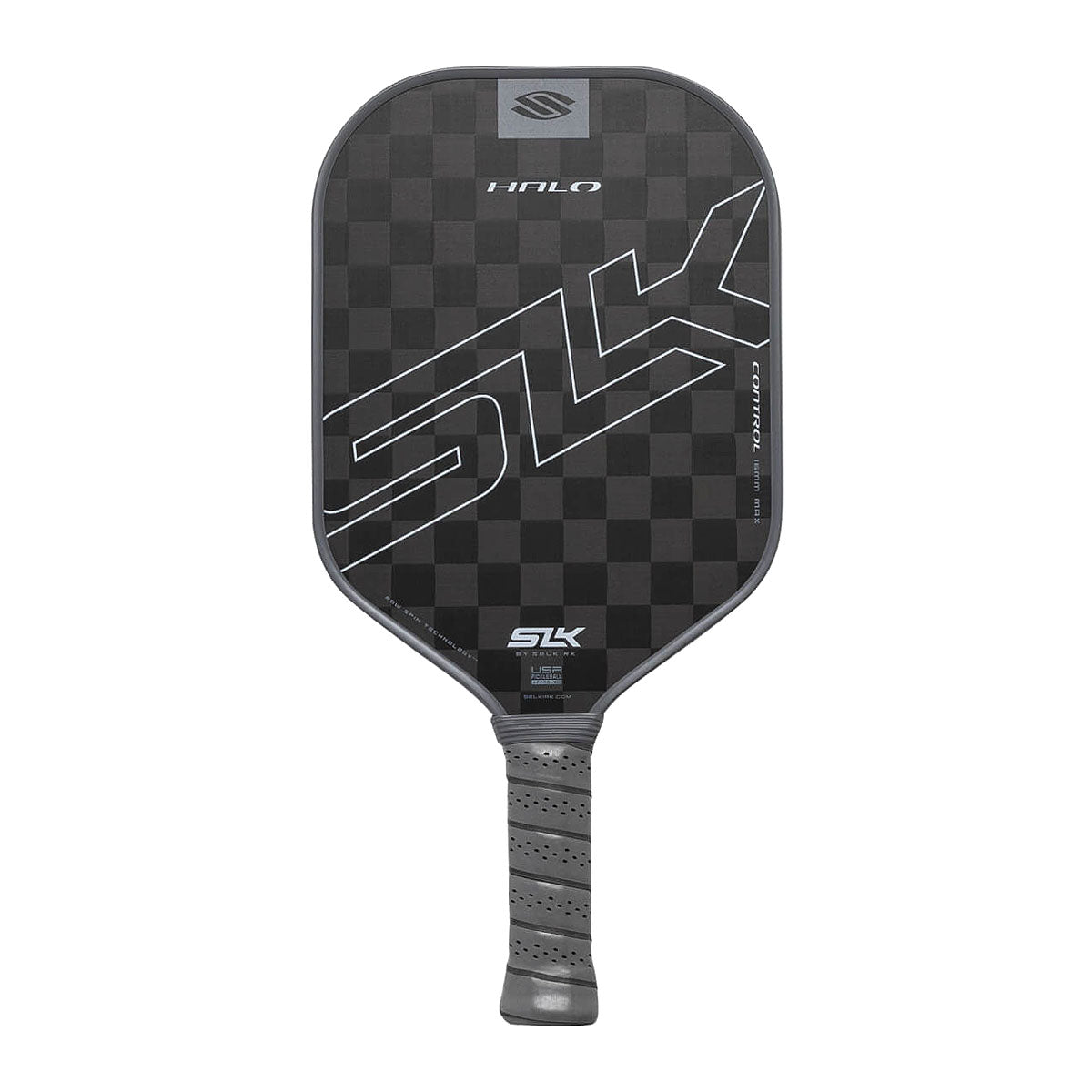
The Halo Control Max is the quietest paddle on this page, and for a player whose game is built at the kitchen line, quiet is the whole point.
Its 16mm Rev-Control polymer core and 18K UltraWeave carbon face produce a soft, muted contact that takes pace off the ball instead of returning it. Dinks land where you aim them, drops settle instead of floating long, and resets against a hard drive stay down where they belong.
The Max is Selkirk’s largest-surface shape, 16 by 7.85 inches, which gives developing contact patterns more face to find, and the brand weight of 7.7 to 8.0 ounces is genuinely light. Its 4.85 inch handle is shorter than the elongated Halo at pick 7, and that shorter handle suits smaller hands better.
Do not confuse the two picks: this Max is the wide one, the XL further down is the long one, and they are different paddles on different listings.
I should also be plain about the data: no independent lab has published swing weight, twist weight, or spin for the Max shape, so the box leaves those fields unpublished rather than borrowing numbers from other Halo variants.
Choose the current 18K UltraWeave Control version in the 16mm Max shape, because older Halo Control listings with a different face material still circulate.
Selkirk lists the line as USA Pickleball approved; check the exact Max variant against the approved list before a sanctioned event. Free power is the tradeoff: pace has to come from your swing.
Buy it if your game is dinks, drops, and resets. Skip it if you want measured lab figures or a livelier response.
3Friday Aura Pro Widebody: Best Power That Stays Manageable Pickleball Paddle in 2027
AT A GLANCE
Friday Aura Pro Widebody
WEIGHT
7.85 oz
SWING WEIGHT
108
TWIST WEIGHT
6.86
SPIN
2,097 RPM
Shape: Widebody, 16 x 8 in class
Grip: 5.5 in handle, 4.25 in circumference
Core: Gen 4 full-foam, 16mm
Face: Raw texture peel-ply carbon fiber
Approval: USAP
Feel: Lively power with a wide, stable face

Every list like this one needs a power pick, and the discipline is in which power pick. The flagship power paddles swing at 116 and beyond, and that is exactly the weight class that punishes smaller wrists in a fast hands battle.
The Aura Pro Widebody makes its pace at a 108 swing weight instead. Its Gen 4 full-foam core gives drives and counters a lively launch, and the widebody face stays stable while it does it, with a measured twist weight of 6.86 keeping off-center counters on line.
Be clear about how it qualifies, because the scale number alone would mislead you. At 7.85 ounces measured, this is not a featherweight on the scale; it earns this slot on swing weight, which is the number your arm actually feels.
The 5.5 inch handle leaves room for a two-handed backhand, and the measured spin of 2,097 RPM is the strongest early figure on this page.
Now the caution, and it is a real one. That spin figure is an early-life figure. The peel-ply texture that produces it wears smooth with play, and the bite fades over the months even though the paddle itself keeps playing.
The lively foam response also asks for soft hands on resets, because the same launch that powers a counter will float a careless block. Neither point removes it from the power slot. They just belong in the open.
Buy it if you want real pace that your arm can still swing in the third game. Skip it if holding spin for years matters more than power now.
4Paddletek Bantam TS-5: Best Lightweight Pickleball Paddle in 2027
AT A GLANCE
Paddletek Bantam TS-5
WEIGHT
7.0-7.5 oz
SWING WEIGHT
-
TWIST WEIGHT
-
SPIN
-
Shape: Standard, 15 5/8 x 7 7/8 in
Grip: 5 in handle, 4.25 in circumference
Core: Bantam PolyCore, 12.7mm
Face: Textured fiberglass epoxy hybrid
Approval: USAP
Feel: Light, simple, and fast in the hand

The TS-5 is the lightest mainstream paddle on this page, full stop.
Its brand weight range of 7.0 to 7.5 ounces sits below everything else here, and what that buys you at the kitchen line is hand speed: counters snap around faster, blocks get in front of balls that would beat a heavier swing, and a long session stops feeling like arm work somewhere around game two.
It also carries the best documented answer to the idea that women need heavy paddles to hit hard. The TS-5 was Anna Leigh Waters’ signature Paddletek for years, which means the most dominant woman in the sport’s history built her early reign on a paddle in this exact weight class.
She has since moved on to newer Bantam models, so that is a historical fact, not a current equipment claim, but the lesson stands: her power came from technique and timing, not from swinging extra grams.
The honest side of the ledger is age. This is an older, simpler build: a textured fiberglass face and a 12.7mm core from before the raw carbon era, with no lab-measured swing weight, twist weight, or spin to publish.
Its bite on the ball is a step behind the carbon faces here, and the standard model is the pick, not the Pro or any signature edition. What it wins on is grams and hand speed, and for the player who tires quickly, that trade is the right one.
Buy it if your arm gives out before your legs do. Skip it if maximum spin and modern face texture lead your list.
5Franklin C45 Aurelius 12.7mm: Best for Small Hands Pickleball Paddle in 2027
AT A GLANCE
Franklin C45 Aurelius 12.7mm
WEIGHT
7.2-7.7 oz
SWING WEIGHT
92.3
TWIST WEIGHT
-
SPIN
-
Shape: Standard/hybrid, 15.7 x 7.9 in
Grip: 5.1 in handle, 3.9 in circumference
Core: PowerFlex polymer, 12.7mm
Face: T700 raw carbon fiber at a 45-degree layup
Approval: USAP + UPA-A
Feel: Feather-light swing, firm and quick

Start with the grip, because on this pick the grip is the story. At 3.9 inches in circumference, it is a full size under the 4.25 inch standard and the smallest handle on this page.
If your fingers cannot close around a standard grip without the paddle twisting on contact, this is the one that fits out of the box instead of after an overgrip workaround. Your fingers wrap fully, your hand relaxes, and the paddle stops rotating on the mishits that used to sail.
The swing matches the fit. A 92.3 swing weight is the lowest figure on this list by a wide margin, so the paddle feels feather-light through counters and quick exchanges, and the 45-degree T700 raw carbon layup gives contact a firm, crisp answer.
One piece of variant discipline matters here: this is the 12.7mm ALW build only. The 16mm Aurelius that appears elsewhere on this site, including the homepage, is a different paddle with different figures, and nothing crosses between the two. On the listing, select the 12.7mm ALW variant.
The tradeoff for all that speed is firmness. A 12.7mm core plays firmer than every 16mm pick here, blocks need cleaner hands, and the dwell you get from the plush control paddles is not on offer. If your hands are a standard size, the grip advantage disappears and the thicker control builds will serve you better.
Buy it if small hands have been fighting standard grips. Skip it if you want plush, pocketed contact.
611SIX24 Jelly Bean 16mm: Best for Beginners Pickleball Paddle in 2027
AT A GLANCE
11SIX24 Jelly Bean 16mm
WEIGHT
8.0-8.3 oz
SWING WEIGHT
107
TWIST WEIGHT
7.21
SPIN
2,103 RPM
Shape: Widebody (Pegasus), 16 x 8 in
Grip: 5.75 in handle, 4.125 in circumference
Core: 16mm polymer honeycomb, thermoformed
Face: CFC: two layers of Toray T700 raw carbon fiber over one fiberglass layer
Approval: USAP
Feel: Soft forgiveness

Beginners do not miss in the middle of the paddle. They miss high, low, and toward the edges, which is exactly the contact this widebody was built to absorb.
The Pegasus shape stretches the face to a full 8 inches wide, and its measured twist weight of 7.21 is the highest forgiveness figure among the proven starter paddles I have tested. When you catch the ball near the frame, the paddle barely twists, and a shot that felt like a mistake still lands in play.
That forgiveness comes with a face that teaches spin early. The layered surface, two sheets of raw carbon laid over a fiberglass layer, produces a measured 2,103 RPM, so a new player feels a topspin drive dip and a roll volley bite while her mechanics are still forming.
The thermoformed 16mm core keeps the response soft and settled, blocks stay under control, and the 107 swing weight keeps the paddle moving well in exchanges even though the scale weight is not low.
Here is the honest counterweight. At 8.0 to 8.3 ounces, this is the heaviest static pick on the page.
It qualifies on swing weight and forgiveness, not on grams, and a player who tires quickly should look at the TS-5 at pick 4 or the Pro Flight at pick 9 in the same breath. It is a family listing, so select the Jelly Bean 16mm in the Pegasus widebody shape.
Buy it if your contact still wanders and you want the widest margin for error. Skip it if you strike the center reliably and want elongated reach instead.
7Selkirk SLK Halo Control XL: Best Elongated Pickleball Paddle in 2027
AT A GLANCE
Selkirk SLK Halo Control XL
WEIGHT
7.7-8.0 oz
SWING WEIGHT
-
TWIST WEIGHT
-
SPIN
-
Shape: Elongated (XL), 16.4 x 7.4 in
Grip: 5.75 in handle, 4.25 in circumference
Core: Rev-Core polymer, 16mm
Face: T700 raw carbon fiber
Approval: USAP
Feel: Calm control with reach

The elongated slot on a fit-first page has to be chosen carefully, because most elongated paddles are leverage-power builds with head-heavy swings. The Halo Control XL is the exception: an elongated shape with a control character.
Its 16mm Rev-Core polymer core answers contact with the same muted calm as the Max at pick 2, and the extra length buys reach at the kitchen and on stretched counters without turning the swing into a hammer.
The 5.75 inch handle is the longest on this page, which makes this the two-handed backhand option here; there is genuine room for a second hand on the grip. Now the grip honesty, because it matters.
Selkirk publishes the circumference as 4.25 inches, and that brand figure is what the box prints, but a careful hands-on measurement of this handle came out at 4.35 inches and it feels fuller than the printed number suggests.
Do not buy this paddle as a small-grip solution. Players between sizes should know what their hand will actually meet, and genuinely small hands belong at picks 5, 8, and 9.
The limits are the shape’s own. An elongated face concentrates the sweet spot higher and punishes late contact more than the widebodies here, and no lab has published swing weight, twist weight, or spin for the XL, so those fields stay unpublished.
This is the pick for a player whose strokes are already formed and who wants reach with control. It is not a first paddle.
Buy it if you want elongated reach without a power paddle’s swing. Skip it if your contact is still developing.
8Six Zero Coral Light Weight 16mm Widebody: Best Premium Pickleball Paddle in 2027
AT A GLANCE
Six Zero Coral Light Weight 16mm Widebody
WEIGHT
7.6-7.9 oz
SWING WEIGHT
106
TWIST WEIGHT
~7.0
SPIN
-
Shape: Widebody, 16 x 7.8-8 in
Grip: 5.5 in handle, 4.0 in circumference
Core: Tectonic Core Suspension foam core, 16mm
Face: Diamond Tough raw carbon fiber
Approval: USAP + UPA-A
Feel: Plush, stable, and fast in the hand

The premium slot on this page had to be a genuine build difference, not a paint job, and this is one. The standard Coral is Six Zero’s full foam-core flagship platform.
The Light Weight version keeps that Tectonic Core Suspension construction and re-engineers it lighter, at 7.6 to 7.9 ounces, with a thinner handle profile. What you get is flagship foam-core feel, plush and stable, in a build that lands exactly on this page’s fit criteria instead of fighting them.
The widebody figures tell the story: a 106 swing weight, a twist weight around 7.0, and a 4.0 inch grip circumference that smaller hands wrap without a stretch. Those numbers are for this widebody shape; the Hybrid and Elongated Light Weight variants carry different figures, and nothing should be borrowed across shapes.
Spin is not published for this paddle, so judge it on contact quality rather than a spin headline. Contact is where it shines anyway: counters feel cushioned and directed, and the face stays composed when a drive arrives with pace.
One honesty note, because this page exists to make it. Six Zero sells this paddle in a Misty Blue colourway marketed with women in view. The colourway is fine.
It is also irrelevant to why the paddle is here: the construction underneath is the same for everyone, and it is the construction, the lighter build and the smaller grip, that earned the slot.
Buy it if you want flagship foam-core construction fitted to a smaller hand. Skip it if published spin figures matter to you.
9ProKennex Pro Flight: Best for Arm Comfort Pickleball Paddle in 2027
AT A GLANCE
ProKennex Pro Flight
WEIGHT
7.3-7.6 oz
SWING WEIGHT
-
TWIST WEIGHT
-
SPIN
-
Shape: Standard, 15.43 x 7.6 in
Grip: 4 7/8 in handle, 4.0 in tapered circumference
Core: Cloud Cell polymer honeycomb (core thickness -)
Face: Toray T700 carbon fiber with Diamond Frost texture
Approval: USAP
Feel: Light and quiet, with the Kinetic handle system

The arm-comfort pick earns its place on mechanics, not promises, so let me describe exactly what is mechanical about it. Start with the load: at 7.3 to 7.6 ounces on brand figures, this is the second-lightest paddle on the page, and less mass per swing means less work per rally.
Add the grip: a 4.0 inch tapered circumference that a smaller hand closes around fully, without the constant squeezing a too-big handle forces on every shot.
Then there is the handle itself. ProKennex builds kinetic material into it, a system the brand documents as absorbing vibration at impact. In play, that shows up as feel: mishits sound and feel quieter, and less buzz travels up through the grip on off-center contact.
It is a comfort mechanism you can feel in the hand, and that is the honest extent of the claim. If your arm troubles you beyond ordinary end-of-session tiredness, that is a conversation for a professional who can look at your arm, not something a paddle purchase settles.
The limits are plain. This is an older platform with no lab-published swing weight, twist weight, or spin, and its core thickness is not published either, so the box says so. Power is modest and comes from your swing. What it offers is a light load, a grip that fits, and the quietest mishits on this page.
Buy it if long sessions leave your arm feeling every mishit. Skip it if you shop by published lab figures.
10Six Zero Quartz: Best for Fast Hands Pickleball Paddle in 2027
AT A GLANCE
Six Zero Quartz
WEIGHT
7.6-8.2 oz
SWING WEIGHT
108
TWIST WEIGHT
6.4
SPIN
1,950 RPM
Shape: Standard, 16 x 7.9 in
Grip: 5 in handle, 4.25 in circumference
Core: 15mm polypropylene honeycomb
Face: Raw carbon fiber (T300)
Approval: USAP
Feel: Light control

The closer on this list is a kitchen paddle. A 108 swing weight and a 6.4 twist weight in a true standard shape is the combination that wins counters and resets: quick enough to get the face in front of a speed-up, stable enough that the face is still pointing the right way when the ball arrives.
In my testing this is the paddle that makes hands battles feel a half-step slower, in your favour.
The figures deserve their provenance stated. The swing weight, twist weight, and 1,950 RPM spin number on this paddle are retailer-published rather than measured by one of the big independent labs, and I am not going to upgrade them in the telling.
They match what the paddle feels like on court, which is why they stand, but they carry a different weight of evidence than the lab figures elsewhere on this page. The T300 raw carbon face is also a step below the T700 class in bite, honest and adequate rather than exceptional.
Two clarifications before the button. The static weight range tops out at 8.2 ounces, so this pick qualifies on swing weight; nobody should call it a lightweight paddle.
And yes, it is the list’s second Six Zero. It shares nothing with the Coral Light Weight at pick 8 but the brand: a honeycomb core instead of foam, a different face, a different job.
Buy it if your game is won on counters and resets at the kitchen. Skip it if you want a foam-core response or a smaller grip.
How to Choose the Best Pickleball Paddle for Women in 2027
The six sections below are the whole method behind the list above, in the order I would work through them: what a women’s paddle actually is, grip size first, then the two different weight numbers, shape and forgiveness, power without punishment, and finally approval plus what the professional women really play.
Read these and you can judge any paddle marketed at you, including the ones that did not make this page.
A Women’s Paddle Is a Fit Question, Not a Product Line
Here is the honest opening: no performance brand builds a different paddle for women. There is no women’s core, no women’s face material, no separate construction line. What differs is the marketing.
The paddles pushed hardest at women change the colourway and the graphics and keep everything underneath identical, and some go further than that: design-led fashion paddles are sold on looks with no published performance data at all.
The Recess Vista, a paddle built entirely around appearance, is the clearest example of the trap, and it is named here so you can spot the pattern elsewhere.
What genuinely differs on average is fit. Hand size, upper-body strength, and experience level are the real variables, and every one of them is measurable.
Weight, swing weight, grip circumference, and twist weight are printed or measured on every serious paddle. Colourways are not a spec. Shop the numbers and the marketing loses its power over the decision.
Grip Size First
Grip size is the decision your hand makes on every single shot, so make it first.
Two ways to measure: wrap your playing hand around a grip and check that the index finger of your other hand fits snugly in the gap between your fingertips and your palm, or use a ruler and measure from the tip of your ring finger to the middle crease of your palm.
For most women, the working window lands between 4.0 and 4.25 inches of circumference.
Get it wrong in either direction and the paddle misbehaves. A grip that is too big lets the paddle twist on off-center contact and makes your forearm work overtime holding on. A grip that is too small makes you squeeze, which builds wrist tension into every swing.
Small corrections are easy: one overgrip adds roughly a sixteenth of an inch, and a thinner replacement grip can slim a handle slightly. Start from the right size where you can. On this page, pick 5 measures 3.9 inches, and picks 8 and 9 measure 4.0 inches.
Weight and Swing Weight, in Plain Terms
Two different numbers describe how heavy a paddle feels, and confusing them is the most common buying mistake in this sport. Static weight is what the scale says.
Swing weight is how heavy the paddle feels while you swing it, and it is the number your arm actually notices. Two paddles at the same scale weight can feel completely different if one carries its mass toward the head.
For this reader, the working windows are a static weight under about 8.0 ounces and a swing weight roughly between 92 and 114. Inside that window, a paddle stays quick at the kitchen and kind over a long session.
A slightly heavier paddle is sometimes the right call anyway: tennis converts with grooved swings, players who hit a two-handed backhand and want the stability, and anyone playing outdoors in wind, where a fluttering face is its own problem. The list above says, for every pick, which of the two numbers it qualified on.
Shape and Forgiveness
Shape decides where your margin for error lives. Widebody paddles spread the face to a full 8 inches wide and protect contact toward the edges. Hybrid shapes trade a little width for a little reach. Elongated shapes trade the most forgiveness for the most leverage, concentrating the sweet spot higher up the face.
Twist weight is the lab figure behind forgiveness: it measures how much a paddle resists twisting in your hand when contact is off center, and higher is steadier. When a box on this page publishes a twist weight, that is the mishit number to compare.
This is also why the elongated slot on this page went to a control build, the Halo Control XL at pick 7, instead of a leverage-power elongated.
Reach justifies its smaller sweet spot once your strokes are consistent. While they are still developing, width and twist weight keep more of your shots in play, and staying in rallies is how strokes develop.
Power Without Punishment
Power in pickleball comes from technique first: leg drive, timing, and a full swing path. The paddle is the last contributor, not the first. That ordering is good news, because it means nobody needs to swing a heavy paddle to hit hard, and the proof is sitting at pick 4 on this page.
Foam-core paddles are the lively ones, and liveliness cuts both ways: the launch that powers a drive will float a careless reset. That is why this page caps its power pick at a 108 swing weight, enough pace to finish points while the face still answers soft hands.
One more piece of honesty belongs here: textured faces wear. The grit that produces a big spin figure on a new paddle smooths with play, and spin figures are early-life figures on every paddle that has them, including pick 3. Judge a paddle on the contact you will still have in month six, not only the bite of week one.
Approval, and What the Pros Actually Play
Two approval bodies matter. USAP, short for USA Pickleball, approves paddles for sanctioned play, and UPA-A covers events on the United Pickleball Association pathway. Open play, park games, and most local leagues never check your paddle at all.
Sanctioned tournaments do, and they check the exact model and variant, not the brand name. Every pick on this page is USA Pickleball approved, so nothing here has to be replaced for eligibility reasons when you enter your first event.
As for the professionals, they close the argument this guide opened with. Pro women play the same flagship lines as pro men. There is no separate women’s tour equipment, because there is no separate women’s paddle.
The documented detail that matters most here is about fitting: the women’s world number one played a signature paddle weighing 7.0 to 7.5 ounces for years, the TS-5 at pick 4, before moving to newer models in the same brand’s line.
The best player in the women’s game was fitted by grip and weight, exactly like everyone else. The fitting is the whole story.
Frequently Asked Questions (FAQs)
1. Is there really such a thing as a women’s pickleball paddle?
Not as a separate construction. No performance brand builds a paddle with a different core or face for women; the models marketed at women are unisex paddles wearing different colourways.
What is real is fit. Grip circumference, static weight, and swing weight decide how a paddle suits a particular player, and those are the numbers this page ranks on.
2. What grip size should a woman choose, and how do I measure my hand?
Most women land between 4.0 and 4.25 inches of grip circumference. Measure two ways: hold the paddle and check that the index finger of your free hand fits snugly in the gap between your fingertips and your palm, or run a ruler from the tip of your ring finger to the middle crease of your palm.
A grip that is too big lets the paddle twist and works your forearm; a grip that is too small makes you squeeze. An overgrip fine-tunes the fit by about a sixteenth of an inch. On this page, pick 5 measures 3.9 inches and picks 8 and 9 measure 4.0 inches.
3. What weight paddle is best for a woman?
For most women, a paddle under about 8.0 ounces on the scale, with a swing weight roughly between 92 and 114. That window keeps the face quick at the kitchen and the arm fresh over a long session. Players who tire quickly should look at the light end, like the TS-5 at pick 4 at 7.0 to 7.5 ounces.
Stronger players and tennis converts can play a little heavier without trouble, and one pick here, the Jelly Bean, qualifies at 8.0 to 8.3 ounces on its swing weight and forgiveness rather than its grams.
4. What is swing weight, and why does it matter more than the number on the scale?
Swing weight is how heavy a paddle feels while you swing it; the scale number, static weight, is only what it weighs sitting still. Two paddles at the same static weight can feel completely different depending on where the mass sits along the frame.
Your arm notices swing weight on every counter, every block, and every shot in the third game, which is why this page qualifies several picks on their swing weight even when their scale weight is unremarkable. The Aura Pro at pick 3 is the clean example: midweight on the scale, but a 108 swing weight that keeps it fast in the hand.
5. I have small hands. Which paddle fits me best?
The Franklin C45 Aurelius 12.7mm at pick 5. Its 3.9 inch grip circumference is the smallest on this page, a full size under the standard, and its 92.3 swing weight is the lowest here, so the fit and the swing suit smaller hands together.
The next options are the 4.0 inch grips on the Coral Light Weight at pick 8 and the Pro Flight at pick 9. One caution: judge a handle by more than its printed figure where you can, because at least one paddle on this page, the Halo Control XL at pick 7, measures fuller in the hand than its brand spec suggests.
6. Are lighter paddles always better for women?
No. Lighter is better for hand speed and for lasting a long session, but a paddle can be too light: it flutters when a hard-hit ball arrives, and blocks lose their steadiness because there is little mass holding the face on line. Twist weight and balance matter as much as grams.
The right weight is the one that keeps your face steady and your arm fresh at the same time, and for some players that is a midweight paddle with a high twist weight, like the Jelly Bean at pick 6, rather than the lightest option on the shelf.
7. Can a woman use a power paddle, or should I stick to control?
A woman can use any power paddle she likes; no category is closed to anyone. The practical question is what the paddle asks of your arm. The flagship power builds swing at 116 and beyond, and that weight class costs hand speed in fast kitchen exchanges and tires smaller wrists over a session.
This page’s power pick, the Aura Pro at pick 3, makes its pace at a 108 swing weight for exactly that reason. If your technique already produces pace, a power paddle adds to it. If your technique is still forming, control teaches faster and the power arrives with your swing.
8. Widebody or elongated: which shape suits a developing player?
A widebody, for most developing players. Its broader face and higher twist weight forgive the off-center contact that defines the learning months, so more shots stay in play while timing develops.
An elongated paddle adds reach and leverage, but it concentrates the sweet spot higher on the face and punishes late contact. The one elongated pick on this page, the Halo Control XL at pick 7, is a control build chosen for players whose strokes are already formed, not a first paddle.
9. What paddle do professional women players use?
The same flagship lines the professional men use, fitted by grip and weight. There is no separate women’s equipment at the top of the sport, because there is no separate women’s paddle.
The best documented fitting story is about weight: the women’s world number one played a signature paddle weighing 7.0 to 7.5 ounces, the Paddletek Bantam TS-5 at pick 4, for years before moving on to newer models in the same brand’s line.
Professionals choose by fit and feel. That is the same method this page uses, and it is available to every player.
10. My arm gets tired or sore during long sessions. What should I change first?
Change the load first. Swing weight is the biggest lever, so move toward the lighter-swinging picks on this page before changing anything else.
Second, check your grip fit with the finger test, because a handle that is too big or too small makes your forearm work on every shot. Third, look at habits: a relaxed grip between shots and shorter sessions while you build up both help.
The Pro Flight at pick 9 holds the arm-comfort slot because it combines a light build, a 4.0 inch grip, and a handle the brand documents as absorbing vibration at impact. If soreness keeps coming back away from the court, get it looked at by a professional. That is beyond what equipment can answer.
11. Do I need a USA Pickleball approved paddle for league and tournament play?
For sanctioned tournaments, yes: the exact model and variant must appear on the USA Pickleball approved list, and officials check the paddle itself, not the brand name. Most local leagues and open play never check at all.
A second body, UPA-A, covers a separate event pathway. Every pick on this page is USA Pickleball approved, and picks 5 and 8 carry UPA-A approval as well, so nothing here needs to be replaced for eligibility reasons when you start competing.
12. How long will my paddle last, and when should I replace it?
The face wears out before the paddle breaks. The grit on a textured face smooths with play and spin fades first, sometimes well within a first season of regular play, while the core underneath keeps playing for longer. Pick 3’s wear caution is the honest example on this page.
Replace a paddle when the face has gone smooth and lost its bite, when dead or inconsistent spots appear on contact, or when the edge guard starts working loose. A regularly played paddle commonly gives a season or two before one of those signs shows up.

Michael Stevenson
Hi, my name is Michael Stevenson and I’m a passionate pickleball player. I’ve been playing the game for many years and I’m pretty highly skilled at it. Pickleball is one of my favorite topics so naturally, I love to write about it.
Whether it’s tips for beginners, guides for experts, reviews of new paddles, or advanced playing techniques – if it relates to pickleball then I have something interesting to write about it. So if you’re looking for entertaining and informative information on the topic of pickleball, look no further than my written works!