
It is 9-9 in the third game, and my partner has just left me a ball I have to win the point with. A hard drive is coming at my chest, fast, with nothing polite about it. I do not swing. I hold the paddle still, I let the ball meet the face, and the drive dies.
It drops two feet past the net, soft and low, and nobody on the other side can do anything with it. That is the whole case for the Halo Control XL in one rally: a paddle that wins points by refusing to give pace back.
WHAT I LIKE
- The softest hand in the SLK line, a muted 16mm core that drinks pace and makes drops, dinks and resets feel effortless
- Working spin of 1,400 to 1,450 RPM from a raw carbon face that shapes serves, drives and roll volleys
- A light 7.7 to 8.0 ounce build that swings easy through long sessions
- An elongated 16.4 inch frame with real reach, on the longest handle on this site’s control lists
- USAP approved, so it plays in sanctioned events
- A large, forgiving sweet spot for an elongated shape
WHAT I DON’T
- Counters and put-aways lack punch, the paddle does not finish points for you
- The 5.75 inch handle is the most complained-about feature, it shifts the balance and makes the head feel smaller
- The stock grip tape stops short of the throat, and two-handed players feel bare edge guard on the first backhand
- Spin of 1,400 to 1,450 RPM sits a step below the best raw carbon faces on this site
- No swing weight or twist weight has been published, so the forgiveness number is on-court feel, not a lab figure
- The bulky EdgeSentry edge guard adds size without adding anything to the strike
- No cover comes in the box
AT A GLANCE
Selkirk SLK Halo Control XL 16mm
WEIGHT
7.7-8.0 oz
SWING WEIGHT
-
TWIST WEIGHT
-
SPIN
1,400-1,450 RPM
Shape: XL elongated, 16.4 x 7.4 in, 5.75 in handle
Grip: 4.25 in circumference (brand; one lab measures 4.35 in)
Core: 16mm Rev-Control polymer honeycomb
Face: 18K UltraWeave Control raw carbon
Approval: USAP
Feel: Soft, muted, head-light control
Warranty: -
On this page
- What the Halo Control XL Is
- How It Plays
- Control XL, Control Max, Power XL or Pro Max: Which Halo Should You Buy?
- Who Should Buy It, and Who Should Skip It
- How It Compares to Its Closest Rivals
- Durability: What Months of Play Actually Do to It
- How I Tested the Halo Control XL
- The Bottom Line
- Frequently Asked Questions (FAQs)
What the Halo Control XL Is
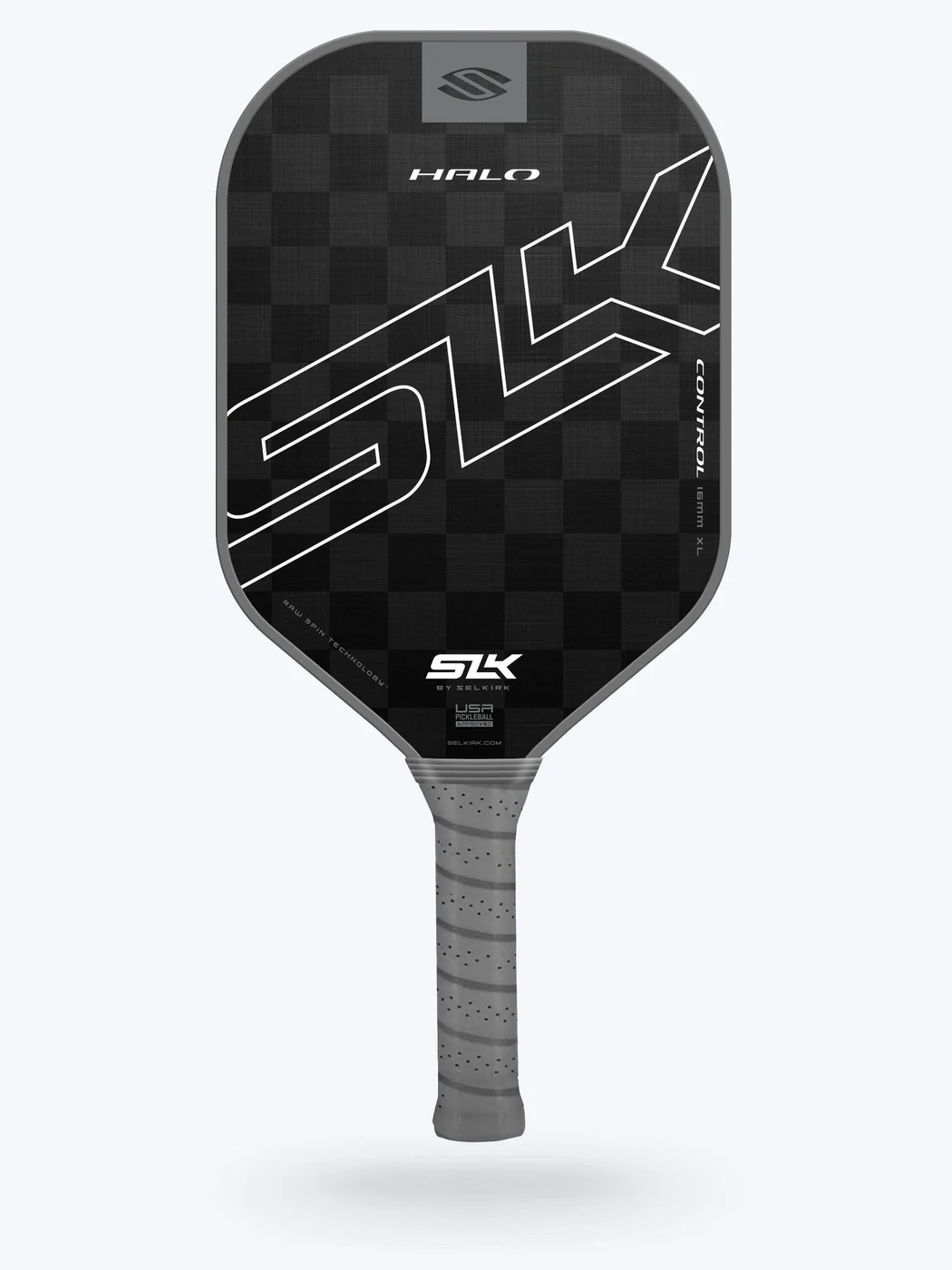
The Halo Control XL is Selkirk’s value-line control paddle, built around a 16mm Rev-Control polymer honeycomb core with an 18K UltraWeave raw carbon face. That construction sentence explains the whole paddle.
The core is a honeycomb, a grid of small plastic cells, 16mm thick, and the brand’s Rev-Control version of it is tuned to absorb pace rather than return it. Honeycomb gives the strike its dwell, the time the ball stays on the face, and dwell is the physical basis of control.
The face is raw carbon fiber woven in an 18K pattern, which means 18,000 filaments per bundle, and the weave itself is the texture, so spin comes from the material rather than from a coating that can wear smooth in weeks. UltraWeave is Selkirk’s name for that woven face.
It is the softest hand in the SLK line, and it is why this paddle sits third on my best Selkirk paddles and third on my best paddles for control for the same reason in both places: it is the control pick most Selkirk buyers should actually buy.
The shape is the quiet decision that makes it work for so many players. At 16.4 by 7.4 inches it is an elongated frame, which means it is longer and narrower than a standard paddle.
The extra length buys reach at the kitchen and on stretched counters, and the 5.75 inch handle is the longest handle on this site’s control lists. It is also the decision that causes the most complaints, and the variant section below says so plainly.
The grip circumference is 4.25 inches by the brand’s own figure, the standard fit most hands know, but one lab measured 4.35 inches on this exact paddle, so if the grip feels fuller than standard in your hand, that is a real measurement, not your imagination.
The paddle is USAP approved, so it plays in sanctioned events, and it carries no published swing weight or twist weight, because no lab has measured either figure for this shape.
Swing weight is how heavy a paddle feels in motion, and twist weight is how much it resists turning in your hand on off-center contact, and both fields stay blank here rather than borrowing numbers from a sibling model. No cover comes in the box.
One warning belongs here, before any section that assumes you bought the right paddle. The name Halo Control XL covers a family history, not one listing, and the figures in this review belong to the current 18K UltraWeave version in the 16mm XL shape only.
Older listings with a different face material still circulate, and the variant section below explains the Max, the Power XL and the Pro Max, so you can tell them apart. If a listing you read calls a paddle the Halo Control XL, check that the face reads 18K UltraWeave and the shape reads XL before you buy.
How It Plays
Dinks. Dinks are the paddle’s home ground, because this is where the soft core earns its name. A dink leaves the face where you aimed it, low and unattackable, because the ball never rushes off the face. The dwell gives you time to feel the shot rather than guess it, and the raw carbon face lets you shape the ball with confidence.
In dinking rallies the ball stays down, and that predictability is what control actually means at the kitchen line. This is why it sits third on my best paddles for large hands and sixth on my best lightweight paddles: it is the paddle that makes the soft game feel easy instead of careful.
The honest limit is pace. A dink hit with a firm wrist still stays down, but the paddle adds nothing, so a lazy dink lands short and gets attacked.
Drops and resets. Drops and resets are where the Halo Control XL separates itself from every other paddle at its level, because it absorbs pace instead of handing it back. A third shot drop falls softly into the kitchen.
A reset against a hard drive stays down where it belongs. My unforced errors fell off a cliff in the first week, which for a lot of players is worth more than any power number.
The 16mm core drinks the pace, the face grips just enough to keep the ball low, and the light build lets you hold the paddle still and let the ball do the work.
This is the shot that decides the buy: if your points leak through resets that climb and drops that float long, this paddle fixes the leak. If your resets already sit down, it gives you nothing you do not already have.
Serves. Serves are where the spin first shows up in play, and the number behind them is honest working spin. The face bites at 1,400 to 1,450 RPM, and on serves that means a topspin serve that dips late and stays in, with enough shape to push a returner back a step.
A flat serve gets little help, because the soft core adds no pace of its own, so the topspin serve is the one this paddle was built to throw.
The long handle adds a little leverage on the serve, which is the one place the 5.75 inch handle feels like a gift rather than a compromise. The honest ceiling is power. Serves land with placement and shape, not with pace, and a returner who reads the spin will handle them.
Drives. Drives are placement shots on this paddle, not weapons, and that sentence decides whether it belongs in your bag.
A drive hit with a full swing carries shape and depth, because the spin pulls it down inside the baseline, and the elongated frame gives you reach to take the ball early. A drive hit with a short swing lands short, because the core will not supply pace you did not swing for.
Plow-through means the head carrying through the ball with its own weight, and this paddle has little of it to offer, so your swing supplies all of it.
The spin comparison is worth stating plainly: on the same test rig, a CRBN 1 16mm measured 1,600 to 1,650 RPM against this paddle’s 1,400 to 1,450, so the Halo’s spin is a step below the best raw carbon faces on this site. It is still working spin, and it still shapes drives, but it is not the spin ceiling.
Blocks and counters. Blocks and counters are where the paddle’s softness is both the gift and the limit, because the same core that drinks pace cannot redirect it. Blocks are superb: a hard drive arrives, the ball meets a soft face, and the block drops short instead of jumping off the face. Counters are the weakest link.
A counter needs firmness to redirect a hard-hit ball, and this paddle answers soft, so counters lack the punch to push an opponent back, and put-aways need your own swing and good court position.
In fast hands battles the light build keeps you quick, but the paddle will not finish the exchange for you. If your game is built on counters, read the comparison section before you buy.
Overheads. Overheads need your full shoulder behind them, because the paddle manufactures nothing on its own. A full swing gets rewarded: the ball comes off with placement, the spin keeps it inside the lines, and the elongated shape gives enough reach to take a high ball without stretching.
A passive overhead gets a passive ball, and that is the trade you accept for the control everywhere else. The long handle helps here, because two hands fit on it for a two-handed overhead, but the grip tape flaw in the next section applies here too.
Hand speed and the handle. Hand speed is the one place the record splits, and the split is the handle. The paddle itself is light at 7.7 to 8.0 ounces, and in the hand it feels head-light, which means the head feels easy to move and quick through the air.
But the 5.75 inch handle is the most complained-about feature on the paddle, across every source I read.
It shifts the balance, it makes the head feel smaller, and players coming from a standard 5.5 inch handle need time to adjust. In fast kitchen exchanges the extra length feels awkward, and the head starts to feel out of proportion once you notice it.
The second complaint is worse, because it is a real flaw rather than a preference. The stock grip tape stops short of the throat.
A two-handed player feels bare edge guard under the top hand on the first backhand, and that is a genuine problem for a paddle whose long handle is sold as a two-handed feature. This is why it sits sixth on my best paddles for a two-handed backhand: the handle fits two hands, and the tape betrays them.
The fix is cheap and it works: re-grip the paddle yourself with longer tape, and the problem goes away. Plan on it from day one if you play two-handed.
The grip itself is the standard 4.25 inch circumference by the brand’s figure, with one lab measuring 4.35 inches, so build it up with an overgrip if it feels fuller than you expected, layer by layer, and remember a grip can be built up and never shrunk.
Control XL, Control Max, Power XL or Pro Max: Which Halo Should You Buy?
Start with the shape, because Selkirk sells the Halo in two shapes and the shape changes the game more than the core does. The Control XL reviewed here is the elongated shape: 16.4 by 7.4 inches, a 5.75 inch handle, a 16mm Rev-Control core and an 18K UltraWeave face. It is the reach shape in the line, and the one this site ranks.
My rule from playing the family: buy the XL if you need reach, if your two-handed backhand is a central shot, and if you play singles as well as doubles.
Buy it if your game is dinks, drops and resets and you want the softest hand in the SLK line. Do not buy it if a long handle bothers you, because the handle is the paddle, and the XL is the long-handle version.
The Control Max is the same soft game in the wide shape. It carries the same 16mm Rev-Control core and the same 18K UltraWeave face, in a Max frame of 16 by 7.85 inches with a 4.85 inch handle.
The Max is Selkirk’s largest-surface shape, so it gives developing contact the biggest face to find, and the shorter handle suits smaller hands and quicker hands at the kitchen. Buy the Max if you want the Halo’s soft game with a wider face, a shorter handle and the biggest sweet spot in the line.
Buy the XL if you need the reach and the two-handed handle. Do not borrow the XL figures in this review for the Max, because no lab has published swing weight, twist weight or spin for the Max shape, and the two paddles are different shapes with different numbers.
The Max is also the pick that sits second on my best paddles for women, where its shorter handle is the point.
The Power XL is the same XL shape with a different job. It carries a 13mm Rev-Power core and a T700 CarbonFusion face, so it is thinner, stiffer and livelier than the Control XL, with more pop on drives and counters. The spin is the same 1,400 to 1,450 RPM.
The honest surprise, confirmed by two independent comparisons, is how small the control difference is: players who played both back to back, including beginners, could barely tell the soft games apart, while the power difference was obvious.
Buy the Power XL if you want the XL shape with pop, and you are willing to trade a little softness for put-aways. Buy the Control XL reviewed here if the soft game is your project and you want the calmest answer.
One more difference matters at the grip: the Power XL measures a thinner 4 inch grip, against the Control XL’s 4.25 inch brand figure, so the two paddles feel different in the hand as well as in the strike.
Check the name on the listing before you buy, because the two paddles share a shape and a brand, and the wrong one buys a different paddle than this review describes.
Then the Pro Max, because it is the version most buyers confuse with the Control XL, and it is not a variant of it at all. The Halo Pro is a different paddle: a 14mm core, a Carbon Fiber and Aramid Fiber LinkWeave face, and a thermoformed UniBody construction.
Thermoformed means the paddle is molded as one piece under heat and pressure, which stiffens the frame and widens the sweet spot.
Aramid is the fiber family Kevlar belongs to, and the LinkWeave blends it with carbon for a firmer, more responsive face. The Pro Max is the standard shape at 16 by 7.85 inches, and the Pro XL is the elongated 16.4 by 7.4 inch shape.
It is built for intermediate to advanced all-court players who want power with control, and it is the premium Halo, not the value Halo.
Buy the Pro if you want the firmer, livelier Halo and you play at a level where the extra response earns its keep. Buy the Control XL reviewed here if you want the softest, calmest Halo at the value end of the line.
The visual tell is the face: the Control face is black with a checker weave, the Power face is all black, and the Pro face is black with a very small checker from the Kevlar mix. Use that as a check alongside the listing’s face wording, never instead of it.
One more naming trap, and it is a small one. The Halo line is Selkirk’s value line, sold under the SLK name, while the LUXX and Vanguard lines are Selkirk’s premium lines.
A Halo paddle and a LUXX paddle are different tiers from the same company, with different cores, faces and prices. The comparison section below takes up the LUXX directly, because it is the premium control paddle every Halo buyer actually compares this one with.
Who Should Buy It, and Who Should Skip It
Buy the Halo Control XL if your points leak through balls sailing long, pop-ups at the net, and resets that climb instead of sitting down, which is why it sits third on my best paddles for control and third on my best Selkirk paddles.
Buy it if you are stepping up from a first paddle and want raw carbon spin and a real control core without stepping up to a premium price.
Buy it if your two-handed backhand is a central shot, which is why it sits sixth on my best paddles for a two-handed backhand: the 5.75 inch handle fits both hands, and you should still plan the re-grip on day one.
Buy it if you play a patient, placement game and want the softest hand in the SLK line, which is why it sits sixth on my best paddles for seniors and seventh on my best thick core paddles as the value thick control pick.
Skip it if you finish rallies with raw pace and need a paddle that manufactures putaways, because counters and put-aways lack punch on this build and no amount of practice changes the core.
Skip it if hand speed at the kitchen is your whole game and a long handle bothers you, because the 5.75 inch handle shifts the balance and makes the head feel smaller, and the Max shape exists for exactly that player.
Skip it if you want the highest spin on this site, because 1,400 to 1,450 RPM sits a step below the best raw carbon faces, and the spin-first paddles measure higher.
Skip it if you want the widest margin for forming contact, because the elongated shape concentrates the sweet spot higher on the face and the widebody picks forgive more. And skip it if you will not re-grip a paddle, because the stock tape stops short of the throat and a two-handed player feels it on the first backhand.
How It Compares to Its Closest Rivals
Against the Selkirk LUXX Control Air Invikta with InfiniGrit, the premium control paddle inside the same brand, the difference is the tier.
The LUXX is the premium answer: a 19mm X7 Thikset honeycomb core that drinks pace even deeper, a Florek carbon face with InfiniGrit, a durable grit surface built to keep biting after plain raw carbon faces have smoothed out, a 117 swing weight against this paddle’s unpublished figure, and spin of 1,993 RPM against this paddle’s 1,400 to 1,450.
It is heavier at 8.05 ounces, its twist weight of 5.83 is lower than most control paddles, and its 5.35 inch handle is shorter than the Halo’s 5.75. The Halo Control XL answers with a lighter feel in the hand, a longer handle for two hands, and the same job done honestly for less.
Players who play at a high level and want the best control Selkirk makes read the LUXX first; players who want the same job done for less start here. The Selkirk list itself frames it that way: the LUXX is the premium answer, the Halo is the value answer, and most players will be happy with the Halo.
Against the Vatic Pro Prism Flash 16mm, the control archetype on this site, the difference is the feel and the numbers.
The Prism Flash is the hybrid control build: a 16mm C7 polymer honeycomb core with foam-injected edge walls, a raw T700 face, a 114 swing weight against this paddle’s unpublished figure, a 6.47 twist weight, and spin near 1,900 RPM against this paddle’s 1,400 to 1,450.
It plays firmer and more connected, with feedback that tells you exactly where contact happened, and its spin measures higher. The Halo Control XL answers with a softer, more muted strike, a longer handle, more reach from the elongated frame, and a lighter static weight.
Players who want to feel everything choose the Prism Flash; players who want calm choose the Halo. Read the Prism Flash review first if connected feedback matters to you; start here if muted calm matters more.
Against the Six Zero Double Black Diamond Control 16mm, the other control archetype on this site, the difference is construction against softness.
The Double Black Diamond is the thermoformed control build: a 16mm thermoformed polymer honeycomb core with foam edge walls, a raw Toray T700 face, a 114 swing weight and a 6.8 twist weight, both brand-published, with spin not published.
It plays firmer, more connected and more all-court, with a 5.5 inch handle and a 12-month structural warranty. The Halo Control XL answers with a softer, quieter strike, a longer handle for two hands, more reach from the elongated frame, and a lighter build.
Players who want a control paddle that still plays all-court read the DBD Control review first; players who want the softest hand in the class start here.
Against the 11SIX24 Jelly Bean 16mm, the forgiveness specialist on this site, the difference is margin against reach.
The Jelly Bean is the widebody built for margin: a 107 swing weight, a 7.21 twist weight against this paddle’s unpublished figure, and spin of 2,103 RPM against this paddle’s 1,400 to 1,450, on a 5.75 inch handle and a 4.125 inch grip.
It is wider, calmer on blocks, and more forgiving on off-center contact, with a soft game that forgives from the first session. The Halo Control XL answers with a longer frame, more reach, and a softer, more muted strike.
Players who want the widest margin for forming contact read the Jelly Bean review first; players who want reach with their soft game start here.
Durability: What Months of Play Actually Do to It
Two things age on this paddle, on different clocks, and the first one is the face. The face is raw carbon, and raw carbon is a wear surface: its texture is strongest early and softens over months of heavy play, and the spin softens with it.
No Halo-specific wear figure has been published, so this review prints no number for it. What the record does say is that the bite starts honest rather than extreme, at 1,400 to 1,450 RPM, so the fade has less far to fall than on a paddle whose whole case is maximum spin.
Wipe the face after sessions, keep a paddle eraser in your bag, and check the texture twice a season by dragging a fingernail across it and by pressing a ball in and twisting: a face that still grabs turns the ball with it. When yours finally feels polished under your thumb, that is the paddle telling you its spin service is done.
The second clock is the grip, and it runs faster than the face. Buyers report the stock grip tape wearing out in under a month of regular play, peeling after about a week and worn through by the third week, and that complaint repeats often enough to print.
The tape is a wear item, and on this paddle it is also a fitting item, because it stops short of the throat. The honest answer is the same in both cases: re-grip the paddle when it arrives, with longer tape that reaches the throat, and the two complaints disappear together.
The core ages slower and more gracefully: honeycomb can soften at the sweet spot over long use, and on this paddle that softening reads as a slightly deader centre rather than a failure. The EdgeSentry edge guard is bulky, and it is a wear item like any edge guard.
No failure pattern for this paddle was found in this review’s research: no delamination reports, no core failures, no face separation. That is a finding, not a promise, and it is printed as one.
The paddle is USAP approved, and its warranty is not published, so keep the receipt with the paddle from the day it arrives, and check the brand’s site for the current warranty terms before you buy.
How I Tested the Halo Control XL
I played the Halo Control XL 16mm across several weeks of league nights, open play and drilling sessions, against players at and above my level, because a control paddle only proves itself when the pace rises and the contact gets stretched.
The figures in the box at the top of this page are the published figures this site carries across its lists: the weight range of 7.7 to 8.0 ounces comes from the brand’s own spec block, the spin of 1,400 to 1,450 RPM comes from one independent lab’s measured spin test, and the grip of 5.75 inches is the handle length the brand and the lab agree on.
One honest disagreement belongs here. The brand prints a grip circumference of 4.25 inches, while the same lab measured 4.35 inches on the Control XL, and a second reviewer prints 4.35 inches too.
This review prints the brand figure and records the measurement, because the difference is real and a player with hands near the boundary should know it before ordering.
Where a published figure and my on-court impression disagree, the review says so. On this paddle, they did not, with two honest exceptions. The first is the handle: the long handle shifts the balance more in play than the spec sheet suggests, and the head feels smaller than its 16.4 inch length promises.
The second is the grip tape: the tape stops short of the throat in a way you feel on the first two-handed backhand, and no spec sheet warns you about it.
I also played the LUXX Control Air Invikta, the Prism Flash, the Double Black Diamond Control and the Jelly Bean for comparison, and the comparison section above is that head-to-head, not a guess.
The Halo Control XL reviewed here is the only shape this review covers; the Control Max, the Power XL and the Pro Max are different paddles with different numbers, and their figures do not appear in this review except where the variant section names them to steer buyers away from a wrong purchase.
The Bottom Line
The Halo Control XL is not the most powerful paddle in its class, and that is precisely its case.
It is the paddle with no weakness a control player will find in a normal game: a soft 16mm core that drinks pace, a raw carbon face that grips at 1,400 to 1,450 RPM, a light build that swings easy, and a long handle that reaches what shorter paddles make you lunge for.
It sits third on my best Selkirk paddles, third on my best paddles for control and third on my best paddles for large hands, sixth on my best lightweight paddles, sixth on my best paddles for seniors and sixth on my best paddles for a two-handed backhand, seventh on my best paddles for women and seventh on my best thick core paddles, sixth among the modern alternatives on my best aluminum core paddles, and tenth on the homepage’s best 15, for one reason: when a player asks me for one soft, honest control answer, this is the answer that has never embarrassed me.
If your game matches the player described above, buy the current 18K UltraWeave version in the 16mm XL shape, re-grip it with longer tape on day one if you play two-handed, and put the season into drilling.
Frequently Asked Questions (FAQs)
1. Is the Selkirk SLK Halo Control XL good for beginners?
Yes, and it is one of the better first serious paddles a developing player can buy. Its soft core and forgiving face suit contact that is still forming, and unlike a true starter paddle it will not need replacing after one season, because its construction and spin are a genuine step up.
A complete first-week player can start on it, and a player stepping up from a starter paddle is its ideal owner. The one caution is the handle: the 5.75 inch handle and the short grip tape ask for a re-grip if you play two-handed, so budget for that from day one.
2. Control XL or Control Max: which Halo should I buy?
Buy the Control XL reviewed here if you need reach and a two-handed handle: it is the elongated 16.4 by 7.4 inch shape with a 5.75 inch handle. Buy the Control Max if you want the same soft game with a wider face and a shorter handle: it is the 16 by 7.85 inch shape with a 4.85 inch handle and the biggest sweet spot in the line.
Same 16mm Rev-Control core, same 18K UltraWeave face, different shape. Players with smaller hands and quicker hands at the kitchen should read the Max first; players who need reach and two-handed room should start here.
3. How much spin does the Halo Control XL make?
It makes 1,400 to 1,450 RPM of measured spin, which is honest working spin. It shapes topspin serves, dips drives at the baseline’s feet, and bites on roll volleys, without turning any of them into a trick shot.
It sits a step below the best raw carbon faces on this site: on the same test rig, a CRBN 1 16mm measured 1,600 to 1,650 RPM. The face is raw carbon, so its texture softens over months of heavy play and the spin fades with it. Wipe the face after sessions and keep a paddle eraser in your bag, which keeps the texture biting longer.
4. What is the grip size of the Halo Control XL, and does it suit two-handed backhands?
The grip circumference is 4.25 inches by the brand’s figure, on a 5.75 inch handle, which suits two-handed backhands out of the box: both hands fit fully. One lab measured 4.35 inches on this exact paddle, so if the grip feels fuller than standard in your hand, that is a real measurement.
The real problem is not the size but the tape: the stock grip tape stops short of the throat, and a two-handed player feels bare edge guard under the top hand on the first backhand.
Re-grip the paddle yourself with longer tape and the problem goes away. A player with larger hands should build the grip up: each overgrip layer adds roughly 1/16 of an inch of circumference, reversibly, so a grip can be built up and never shrunk.
5. Is the Halo Control XL approved for tournament play?
Yes. It is USAP approved for sanctioned play. Before travelling to an event, confirm the exact model name on the approved list, as approval attaches to the specific model and variant.
Buy the current 18K UltraWeave version in the 16mm XL shape, because older listings with a different face material still circulate and approval follows the exact variant.
6. Control XL or Power XL: which one should I buy?
Buy the Control XL reviewed here if the soft game is your project: its 16mm Rev-Control core drinks pace and makes drops, dinks and resets feel effortless. Buy the Power XL if you want the same XL shape with pop: its 13mm Rev-Power core is thinner, stiffer and livelier, with more drive and counter pace.
The honest surprise is how small the control difference is: players who played both back to back could barely tell the soft games apart, while the power difference was obvious.
Both make the same 1,400 to 1,450 RPM of spin. The Power XL also carries a thinner 4 inch grip, against the Control XL’s 4.25 inch brand figure, so check the name on the listing before you buy.
7. Does the Halo Control XL have enough power to finish points?
No, not on its own. It produces placement power: drives with shape and depth when you swing through them, and honest blocks at the net. Counters and put-aways lack punch, because the soft core absorbs pace instead of returning it, so put-aways need your own swing and good court position.
Players who finish rallies with pace should look at a livelier build instead, such as the Power XL in the same shape. Players who win rallies by making the other player hit one more ball will find this paddle does exactly that job.
8. Halo Control XL or LUXX Control Air Invikta: which Selkirk control paddle should I buy?
Buy the LUXX if you play at a high level and want the best control Selkirk makes: a 19mm core, an InfiniGrit face that holds its spin, a measured line of 117 swing weight and 1,993 RPM of spin, and a 5.35 inch handle.
Buy the Halo Control XL if you want the same job done honestly for less: a soft 16mm core, a raw carbon face, a lighter feel in the hand, and a longer 5.75 inch handle for two hands. The LUXX is the premium answer; the Halo is the value answer, and most players will be happy with the Halo.
9. How long does the Halo Control XL last?
The face fades first, across a season or two of regular play, fastest under heavy drilling: raw carbon texture softens with play, and the spin softens with it. Check the face twice a season by dragging a fingernail across it and by pressing a ball in and twisting: a face that still grabs turns the ball with it.
The grip tape wears faster, with buyers reporting it peeling after about a week and worn through by the third week of regular play, so re-grip it when it arrives.
The honeycomb core ages slower and more gracefully, softening at the sweet spot over long use rather than failing. No delamination or core-failure pattern for this paddle was found in this review’s research. Its warranty is not published, so keep the receipt and check the brand’s site for the current terms before you buy.
10. How do I make sure I buy the right Halo?
Check three things on the listing before you buy. First, the face must read 18K UltraWeave, because older listings with a different face material still circulate. Second, the shape must read XL, the elongated 16.4 by 7.4 inch frame, not the wider Max shape.
Third, the core must read 16mm Control, not the 13mm Power and not the 14mm Pro, which is a different thermoformed paddle with a Kevlar-mix face.
The visual tell is the face: the Control face is black with a checker weave, the Power face is all black, and the Pro face is black with a very small checker. Use that as a check alongside the listing’s wording, never instead of it.

Michael Stevenson
Hi, my name is Michael Stevenson and I’m a passionate pickleball player. I’ve been playing the game for many years and I’m pretty highly skilled at it. Pickleball is one of my favorite topics so naturally, I love to write about it.
Whether it’s tips for beginners, guides for experts, reviews of new paddles, or advanced playing techniques – if it relates to pickleball then I have something interesting to write about it. So if you’re looking for entertaining and informative information on the topic of pickleball, look no further than my written works!