
There is a question I get from other players more than any other: if you could only keep one paddle for the next year, which one? For two seasons my answer has been the Prism Flash, and this review is the long version of why. It is not the most powerful paddle I own, not the fastest, and not the one I reach for when I want to show off. It is the one that has never once been the reason I lost a rally I should have won.
My verdict: The Prism Flash is the control paddle I recommend first because it does the three things a developing game needs at the same time: it holds the ball long enough to place it, it forgives the contact you actually make rather than the contact you meant to make, and its face still grips after months of play. Its limits are just as clear. Baseline power is placement power, and a swing weight of 114 asks your hands to be on time. Everything below is those two paragraphs earned in detail.
What I Like
- Plush, predictable control: drops, resets and blocks land where they are aimed
- Forgives off-centre contact quietly, with a foam-stiffened perimeter
- Raw carbon spin around 1,900 RPM that keeps its bite across a season
- A balanced hybrid shape that suits a game still deciding what it is
What I Don’t
- Swing weight of 114 taxes players who win on pure hand speed
- Baseline power is placement only; it manufactures no putaways
- The 5.3 inch handle is tight for a committed two-handed backhand
AT A GLANCE
Vatic Pro Prism Flash 16mm
WEIGHT
7.9-8.2 oz
SWING WEIGHT
114
TWIST WEIGHT
6.47
SPIN
~1,900 RPM
Shape: Hybrid, 16.25 x 7.7 in
Grip: 5.3 in handle, 4.25 in circumference
Core: 16mm C7 polymer honeycomb with foam-injected edge walls
Face: Raw carbon fiber, T700 class
Approval: USAP
Feel: Plush control
On this page
- What the Prism Flash Is
- How It Plays
- 14mm or 16mm: Which Prism Flash Should You Buy?
- Who Should Buy It, and Who Should Skip It
- How It Compares to Its Closest Rivals
- Durability: What Months of Play Actually Do to It
- How I Tested the Prism Flash
- The Bottom Line
- Frequently Asked Questions (FAQs)
What the Prism Flash Is
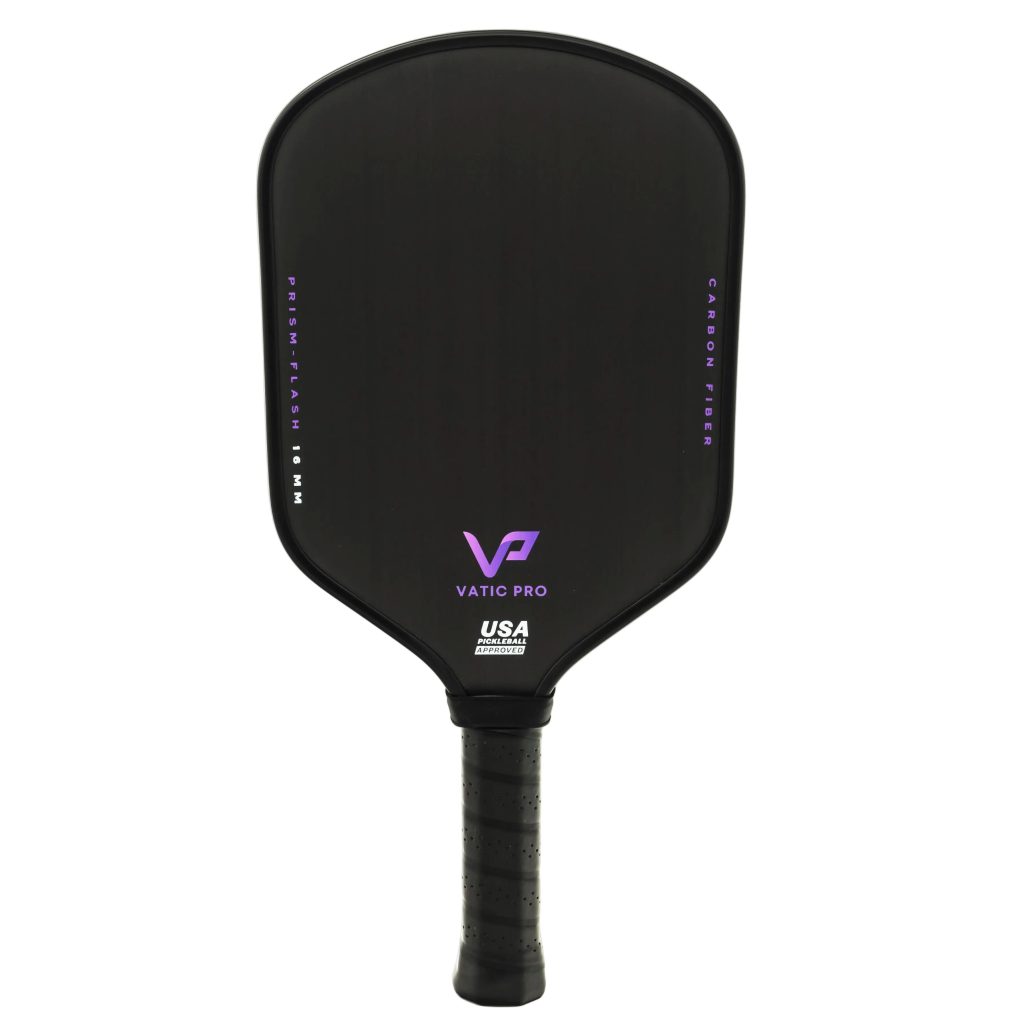
The Prism Flash is Vatic Pro’s hybrid-shape control paddle, built around a 16mm C7 polymer honeycomb core with foam injected into the edge walls and a raw carbon fiber face in the T700 class. That construction sentence explains the whole paddle. The thick honeycomb gives the strike its dwell, the ball stays on the face a fraction longer, which is the physical basis of control. The foam in the walls stiffens the perimeter, so contact near the edges behaves more like contact in the middle. And the raw carbon face is textured by the weave itself, so spin comes from the material rather than from a coating that can wear smooth in weeks.
The shape is the quiet decision that makes it work for so many players. At 16.25 by 7.7 inches it is neither a widebody nor an elongated frame; it splits reach and width down the middle, which is why it suits a game that is still deciding what it is. The 5.3 inch handle over a standard 4.25 inch grip circumference is a fit most hands already know.
How It Plays
Control and the soft game. This is the paddle’s home ground. Third shot drops land with shape instead of hope, because the dwell gives you time to feel the shot rather than guess it. Resets sit down low. Blocks absorb pace instead of handing it back to the other side of the net. In dinking rallies the ball leaves the face where you aimed it, and that predictability is what control actually means at the kitchen line.
Forgiveness. A twist weight of 6.47 will not lead any stat category, and I am not going to dress it up as one. What it does in play is keep the face square when a faster rally pushes your contact toward the edges, which for a developing player is most contacts in a hard game. Stretched defensive stabs stay playable. Off-centre blocks hold their line instead of spraying. It forgives like a control paddle should: quietly, on the balls you did not hit cleanly.
Spin. Measured spin around 1,900 RPM is honest working spin. It dips drives at the baseline’s feet, shapes roll volleys, and bites on serves without turning any of them into a trick shot. The raw carbon texture is the reason it lasts: peel-ply grit fades across months of regular play, faster under heavy drilling, and I check mine with a fingernail drag and a ball-grab twist twice a season. The Prism Flash’s face has kept its bite longer than most peel-ply faces I have played, and when yours finally feels polished under your thumb, that is the paddle telling you its spin service is done.
Power. Placement power, stated plainly. Drives carry shape and depth when you swing through them, and the paddle will not manufacture putaways against a set defence. Counters at the net are honest rather than explosive. If your points are won by pace, this is the wrong review to be reading; if they are won by making the other player hit one more ball, it is exactly the right one.
Hand speed. A swing weight of 114 sits toward the heavier end of the control class. In fast hands battles it asks you to be on time, and players who win purely on reaction speed will feel it by the third game. It is the one number on this paddle I would change if I could, and it is the reason the faster, lighter picks exist on the lists where this paddle also appears.
14mm or 16mm: Which Prism Flash Should You Buy?
The Prism Flash comes in two core thicknesses, and they are not the same paddle with a different number. The 16mm reviewed here is the control build: more dwell, a calmer strike, more margin on contact away from centre. The 14mm answers quicker, with more pop and a firmer strike, and less forgiveness while your contact is forming. My rule from playing both: if your soft game is your project, buy the 16mm. If your contact is already centred and grooved and you want the faster answer at the net, the 14mm is your version. Most players asking this question should buy the 16mm, and it is the version ranked across this site.
Who Should Buy It, and Who Should Skip It
Buy the Prism Flash if your points leak through balls sailing long, pop-ups at the net, and a sweet spot that feels smaller than it should. Buy it if you are stepping up from a first paddle and want the balanced default that defends, drives and forgives in one build. Buy it if you play a patient, placement game and want a face that still grips in month six. It is also the paddle this site ranks first for seniors and first on the tennis elbow list, for the same reasons: dwell, forgiveness and a calm strike.
Skip it if hand speed is your whole game; lighter, quicker paddles exist and this one’s 114 swing weight will tax you. Skip it if you finish rallies with raw pace and need a paddle that manufactures putaways. And skip it if you want the liveliest, most energetic strike on the market; foam-core builds return more energy, and this paddle’s calm will feel muted by comparison.
How It Compares to Its Closest Rivals
Against the Six Zero Double Black Diamond Control, the other control archetype on this site, the Prism Flash plays softer and quieter while the Double Black Diamond plays more connected and firmer, with feedback that tells you exactly where contact happened. Players who want to feel everything choose the Six Zero; players who want calm choose the Vatic.
Against its own sibling, the Vatic Pro V-SOL Pro, the difference is the core. The V-SOL Pro’s full foam build pockets the ball longer and returns it livelier, with more headroom for a fast-improving technique. The Prism Flash is the calmer teacher of the two, and the one I hand to a player whose touch is still new.
Against the 11SIX24 Jelly Bean, the widebody forgiveness specialist, the Jelly Bean’s measured twist weight is higher and its swing weight lower, so it forgives more and arrives quicker. The Prism Flash answers with a longer shape, more reach, and a more traditional control feel. Mishit-driven players read the Jelly Bean first; all-court players start here.
Durability: What Months of Play Actually Do to It
Two things age on this paddle, on different clocks. The face texture fades first, across a season or two of regular play, fastest if you drill daily; the fingernail and ball-grab checks in the spin section above will tell you where yours stands. The core ages slower and more gracefully: honeycomb can soften at the sweet spot over long use, and on the Prism Flash that softening reads as a slightly deader centre rather than a failure. The edge guard and grip are ordinary wear items. Nothing about its ageing surprised me, and no part of it failed early, which is more than I can say for several livelier builds I have tested at higher prices.
How I Tested the Prism Flash
I played the Prism Flash across several weeks of league nights, open play and drilling sessions, against players at and above my level, because a control paddle only proves itself under pace. The figures in the box at the top of this page are the published lab measurements for this paddle, from the same measurement sources used across this site; where a number comes from a lab rather than from my hand, the review presents it as measured, not felt. When a published figure and my on-court impression disagree, the review says so. On this paddle, they did not.
The Bottom Line
The Prism Flash is not the best paddle at any single thing, and that is precisely its case. It is the paddle with no weakness a developing player will find in a normal game: dwell for the soft game, forgiveness for forming contact, spin that survives the season, and manners in defence and attack alike. It has led this site’s beginners list, its intermediate list and its under-100 list for one reason: when a player asks me for one answer, this is the answer that has never embarrassed me. If your game matches the player described above, buy the 16mm, and put the season into drilling.
Frequently Asked Questions (FAQs)
1. Is the Vatic Pro Prism Flash good for beginners?
Yes, and it is the paddle this site ranks first for beginners who plan to keep playing. Its dwell and forgiveness suit contact that is still forming, and unlike a true starter paddle it will not need replacing after one season, because its construction and spin are a genuine step up. A complete first-week player can start on it; a player stepping up from a starter paddle is its ideal owner.
2. What is the difference between the Prism Flash 14mm and 16mm?
The core thickness changes the personality. The 16mm holds the ball longer, plays calmer and forgives more on off-centre contact. The 14mm answers quicker with more pop and a firmer strike, and less margin. Same shape, same face, same grip; the 16mm is the control version and the one reviewed here.
3. How long does the Prism Flash’s spin last?
The raw carbon face grips because the woven fiber itself is rough, and that texture fades across months of regular play, faster under heavy drilling. Expect strong working spin through a season or two, and check the face twice a season by dragging a fingernail across it and by pressing a ball in and twisting: a face that still grabs turns the ball with it.
4. Is the Prism Flash approved for tournament play?
Yes. It is USAP approved for sanctioned play. Before travelling to an event, confirm the exact model name on the approved list, as approval attaches to the specific model and variant.
5. Is the Prism Flash a power paddle?
No. It produces placement power: drives with shape and depth when you swing through them, and honest counters at the net. It will not manufacture putaways against a set defence, and players who finish rallies with pace should look at a power build instead.
6. What grip size is the Prism Flash, and can I make it bigger?
The grip circumference is 4.25 inches on a 5.3 inch handle, the standard fit most hands know. You cannot make a grip smaller, but you can build one up: each overgrip layer adds roughly 1/16 of an inch of circumference, reversibly, so a player who wants a fuller grip can dial it in.
7. Prism Flash or V-SOL Pro: which Vatic should I buy?
Buy the Prism Flash for calm: a plush, predictable strike that teaches touch. Buy the V-SOL Pro for headroom: its full foam core pockets the ball longer and returns it livelier, rewarding technique as it develops. New touch belongs on the Prism Flash; fast-improving players who already groove their contact get more life from the V-SOL Pro.
8. How does the Prism Flash handle a two-handed backhand?
Its 5.3 inch handle is workable but not generous for two hands. A player whose two-handed backhand is a central shot should look at handles of 5.5 inches and beyond; a player who uses the second hand occasionally will manage fine, and the standard grip circumference suits the shot’s mechanics.
9. Is the Prism Flash thermoformed?
Not in the full unibody sense. Its perimeter is stiffened by foam injected into the edge walls around a polymer honeycomb core, which gives much of the uniformity players associate with thermoforming, but the frame is not moulded as one sealed piece around the core the way a true thermoformed build is. In play the difference is small: edge contact behaves well, and the strike stays calmer and less energetic than the liveliest thermoformed builds.
10. Prism Flash or Saga Flash: what is the difference?
They are different lines built for different games. The Prism Flash is the control build: a hybrid shape, a honeycomb core with foam-injected walls, and a calm, dwell-first strike. The Saga Flash is Vatic’s livelier all-court build, with a more energetic response and a stronger power lean. Players building a soft game start with the Prism Flash; players who already control their contact and want more pace from the same brand read the Saga line.

Michael Stevenson
Hi, my name is Michael Stevenson and I’m a passionate pickleball player. I’ve been playing the game for many years and I’m pretty highly skilled at it. Pickleball is one of my favorite topics so naturally, I love to write about it.
Whether it’s tips for beginners, guides for experts, reviews of new paddles, or advanced playing techniques – if it relates to pickleball then I have something interesting to write about it. So if you’re looking for entertaining and informative information on the topic of pickleball, look no further than my written works!