
It is 8-7 in the third game, and the rally has gone the way long rallies go at this level: nobody missing, everybody waiting for the ball that forces a stretch. It comes at me, a hard drive at my backhand hip, and I have half a step and no time to set my feet. I reach, I block, and the ball I send back is not a prayer. It drops low over the net and dies in the kitchen, and the point is ours. That block is the whole case for the Jelly Bean, a paddle built for the contact you do not plan.
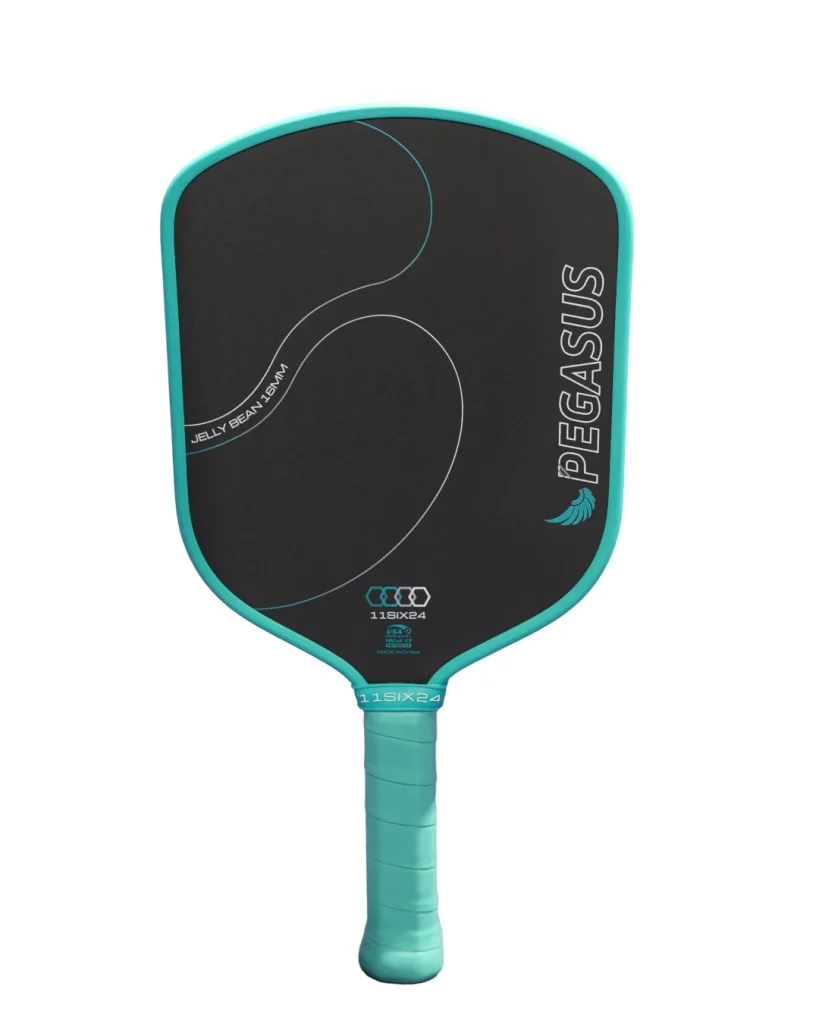
My verdict: The Jelly Bean is the most forgiving paddle I have played in this class, and the first paddle I hand to a new player without a second thought. Its wide Pegasus face, its 7.21 twist weight and its foam-injected edge walls add up to one thing: contact near the edges stays in play instead of spraying, which is the difference between a rally you survive and a rally you win. Its limits are just as clear. It will not supply putaway power you do not bring, its short face gives up reach to longer shapes, and its balance reads differently from hand to hand. Everything below is those two paragraphs earned in detail.
WHAT I LIKE
- The widest, calmest sweet spot I have played in this class
- A 7.21 twist weight that keeps stretched blocks on line
- Real spin from the textured CFC face, higher than its class suggests
- A 5.75 inch handle with honest room for two hands
- Fiberglass pop that makes counters and speed-ups live
- USAP approval for sanctioned play
WHAT I DON’T
- Supplies no putaway power, so overheads and drives need your full swing
- The short 15.82 inch face gives up reach to hybrid and elongated shapes
- Balance reads differently from hand to hand, and some players will want tape at 3 and 9
- The face collects dust and needs regular wiping
- The 14mm sibling is the weaker version, and the family listing makes it easy to pick the wrong one
AT A GLANCE
11SIX24 Jelly Bean 16mm
WEIGHT
8.0-8.3 oz
SWING WEIGHT
107
TWIST WEIGHT
7.21
SPIN
2,103 RPM
Shape: Widebody (Pegasus), 15.82 x 8.04 in
Grip: 5.75 in handle, 4.125 in circumference
Core: 16mm polypropylene honeycomb, Gen 1.5 unibody with foam-injected edge walls
Face: CFC: two layers of Toray T700 raw carbon fiber over one fiberglass layer
Approval: USAP
Feel: Soft, springy forgiveness
On this page
- What the Jelly Bean Is
- How It Plays
- Which Jelly Bean Should You Buy?
- Who Should Buy It, and Who Should Skip It
- How It Compares to Its Closest Rivals
- Durability: What Months of Play Actually Do to It
- How I Tested the Jelly Bean
- The Bottom Line
- Frequently Asked Questions (FAQs)
What the Jelly Bean Is
The Jelly Bean is 11SIX24’s widebody control paddle, and the name is literal: the face is wider at the shoulders and tapered toward the handle, shaped like a jelly bean, which pushes the sweet spot outward to where off-centre contact actually happens. At 15.82 by 8.04 inches it is the widest face in its class on this site, and that width is the whole design brief. This is a paddle for the player whose contact point still wanders, and for the doubles player who lives on blocks, resets and counters rather than on putaway pace.
The construction sentence explains the rest of the paddle. The face is CFC, a three-layer sandwich: two layers of Toray T700 raw carbon fiber with a single fiberglass layer between them. The carbon supplies grip and structure, the fiberglass middle supplies flex, and the result is a face that plays softer and calmer than a pure carbon face while keeping real bite on the ball. Under it sits a 16mm polypropylene honeycomb core in a Gen 1.5 unibody build, with foam injected into the edge walls to push stability outward toward the frame. That foam is the reason the sweet spot feels larger than the face looks, and it is the reason this paddle forgives contact that would twist a stiffer frame open.
The handle is the quiet surprise. At 5.75 inches on a widebody frame, it is longer than the shape usually allows, almost elongated territory, and it gives a two-handed backhand honest room without crowding the first hand. The grip circumference is 4.125 inches, on the smaller side, which suits smaller hands and two-handed play and builds up easily with an overgrip for larger ones. It is approved by USA Pickleball for sanctioned play, and it sits eighth on the homepage’s best 15, second on the beginners list and third on the under-100 list for the same reason in all three places: it is the paddle that keeps a developing player in rallies long enough to learn.
How It Plays
Control and the soft game. This is where the Jelly Bean earns its keep, and it is the strongest area of the paddle. Third shot drops land with shape instead of hope, because the 16mm core holds the ball long enough to feel the shot rather than guess it. Resets sit down low. Dinks leave the face where you aimed them, and the dwell on the ball lets you push a dink to a different spot to put pressure on the other side. In dinking rallies the paddle behaves like a control paddle should: predictable, calm, and unbothered by pace coming back at it. The fiberglass layer adds one thing a pure carbon control face does not: when a ball sits up and you decide to speed it up, the face answers instead of absorbing the decision.
Forgiveness. A twist weight of 7.21 is the number that matters most on this paddle, and I am going to say plainly what it buys. Contact caught wide of centre still leaves on your line, because the face refuses to rotate in your hand. Stretched blocks and late defensive stabs, the contacts that decide long rallies, stay playable instead of spraying toward the fence. The foam-injected edge walls do the same job from the other direction, stiffening the perimeter so the frame holds its shape when the ball arrives off-centre. It is the same forgiveness that puts this paddle third on the seniors list and seventh on the tennis elbow list, because both of those lists rank the same thing: a paddle that stays square when your arm cannot rescue the shot.
Spin. The measured spin of 2,103 RPM is the figure that surprises people, because it is higher than a beginner paddle has any right to post, and it plays exactly like the number promises. Topspin drives dip at the baseline’s feet. Roll volleys bite. Serves shape instead of floating. The textured CFC face is the reason it lasts as long as it does: the grip comes from the layered face itself rather than from a coating that can wear smooth in weeks, so the spin you buy is the spin you keep through a season. That is why it sits eighth on the spin list among paddles built for far more advanced hands. Technique still creates most of your spin, and a forgiving paddle that keeps you in rallies teaches that technique faster than a spin-first paddle with a small sweet spot.
Power. Power with an honest ceiling, stated plainly. This is not a power paddle, and no honest review should pretend otherwise. A full swing gets rewarded here: serves come off with weight, drives hold their line, and the fiberglass layer gives counters and speed-ups genuine pop. A passive swing gets a passive ball, and overheads and smashes need your full shoulder behind them, because the paddle manufactures nothing on its own. Measured firepower sits near the bottom of its class, and that is the trade you accept for the forgiveness. If your points are won by pace the paddle supplies, this is the wrong review to be reading. If they are won by placement, spin and staying in the rally until the other side misses, it is exactly the right one.
Hand speed. A swing weight of 107 is the number that resolves the apparent contradiction of this paddle: on the scale it is a midweight at 8.0 to 8.3 ounces, yet in the hand it swings light, because its mass sits low and the balance point keeps the head from dragging. In fast hands battles it arrives on time, quicker than the widebody outline suggests, and the long handle gives you leverage to whip it through the kitchen exchange. That is why it sits ninth on the lightweight list, not on its scale weight but on how it moves. One honest disagreement belongs here. Testers disagree on the balance: one calls it head-heavy and a touch slow at the kitchen, another found it head-light enough to add tape at 3 and 9 o’clock to settle it. In my hand it reads as balanced a touch toward the head, which is why counters carry extra weight, and the long handle keeps it quick anyway. Play it stock first, then decide whether tape belongs on yours.
Which Jelly Bean Should You Buy?
Start with the thickness, because it is the simplest choice on the page. The 16mm reviewed here is the control build: more dwell, a calmer strike, more margin on contact away from centre. The 14mm answers quicker, with more pop and a firmer strike, and less forgiveness while your contact is forming. In testing the thinner version also gets pushed around more by hard-hit balls, and it benefits from added weight in a way the 16mm does not need. My rule from playing both: if your soft game is your project, buy the 16mm. If your contact is already centred and grooved and you want the faster answer at the net, the 14mm is your version. Most players asking this question should buy the 16mm, and it is the version ranked across this site.
Then the shape, because the family listing hides three paddles under similar names. The Pegasus reviewed here is the widebody: the widest face, the highest twist weight, the most forgiveness. The Vapor is the hybrid: narrower, a little longer, a touch more reach, a little less width to hide behind. The Hurache-X is the elongated shape: the longest frame, the most coverage, the least forgiveness of the three. All three are the original Jelly Bean build with the same CFC face and the same honeycomb core, so the choice is the shape, not the technology. Doubles players who defend and block start with the Pegasus. Players who want reach without giving up all the forgiveness start with the Vapor. Singles players who need coverage start with the Hurache-X.
Then the generation, because this is where buyers actually get hurt. A newer Jelly Bean 2 exists, in the same four shapes, with a softer foam core and a new grit surface. It is a different paddle, and it carries a different approval: the Jelly Bean 2 is certified for pro tour events only and is not on the USA Pickleball approved list, while the original reviewed here is approved for sanctioned play. If you play sanctioned events, buy the original. If you play pro tour events and want the softest foam build in the line, the 2 is the one. One more naming trap: older listings call this paddle the Monarch Jelly Bean, after an earlier name the brand used. Same paddle, old name. If a listing says Monarch, check that it is the 16mm Pegasus widebody before you buy, and select that exact variant on the family listing, because the same listing also carries the hybrid and elongated shapes and the thinner core.
Who Should Buy It, and Who Should Skip It
Buy the Jelly Bean if you are learning and want the widest margin a first serious paddle offers, which is why it sits second on the beginners list and third on the intermediate list at the same time: it teaches the game instead of punishing the learning. Buy it if your contact still wanders and your points leak away on stretched blocks and late counters. Buy it if you play doubles and live at the kitchen, where the wide face and the quick swing win more points than reach does. Buy it if you want real spin and real forgiveness in one frame, and sixth on the paddles for women list is the same recommendation written for a different reader.
Skip it if you need the paddle to supply your pace; the power-first picks on the lists where this paddle also appears do that job better. Skip it if you play singles and reach decides your points, because the short face gives up coverage to every hybrid and elongated shape on this site. Skip it if your contact is already grooved and you want a livelier frame, because the Jelly Bean’s calm is a feature for a learner and a ceiling for a formed player. And skip the Jelly Bean 2 if you play sanctioned events, because that generation is not on the approved list, whatever the listing calls it.
How It Compares to Its Closest Rivals
Against the Vatic Pro Prism Flash, the rival every buyer in this class actually compares it with, the difference is the shape and the feel. The Prism Flash is the hybrid: longer at 16.25 inches, narrower at 7.7, a 114 swing weight against this paddle’s 107, and a 6.47 twist weight against this paddle’s 7.21. It reaches further, plays calmer and more cushioned, and its spin measures near 1,900 RPM against this paddle’s 2,103. The Jelly Bean answers with the wider face, the higher twist weight, and the fiberglass pop that makes counters and speed-ups live at the net. Players who want reach and the calmest contact read the Prism Flash review first; players who want the widest margin for forming contact start here. The composite list ranks the Jelly Bean second for its hybrid face, and the composite list is where the two faces are compared properly.
Against the Friday Aura Pro Widebody, the foam widebody rival, the difference is the core. The Aura Pro is full foam: it pockets the ball longer, plays plusher, and measures nearly identical spin at 2,097 RPM with a 108 swing weight and a 6.86 twist weight. The Jelly Bean answers with a firmer, more connected strike and a spin surface that leans less on grit, where the Aura Pro’s peel-ply texture is known to fade over months of play. Spin-first players who love a plush foam feel read the Aura Pro first; players who want the same spin with a face that holds its bite longer start here.
Against the Franklin Signature Pro, the elongated fiberglass rival, the difference is the shape and the swing. The Signature Pro is longer at 16.5 inches, heavier in the swing at 116, and built around a fiberglass face that drives harder from the baseline. It gives up forgiveness to do it, with a 6.95 twist weight against this paddle’s 7.21, and its spin figure is not published. Players who drive from the baseline and want reach read the Signature Pro first; players who defend, block and reset from the kitchen start here.
Against the Selkirk SLK Halo Control Max, the control-first rival, the difference is the feel and the evidence. The Halo Control Max is softer and more muted, with a larger Max face and no published lab figures for swing weight, twist weight or spin. The Jelly Bean answers with a livelier, springier response, a measured spin figure, and the highest twist weight of the four. Players who want the softest, quietest control frame read the Halo Control Max first; players who want control with spin and pop start here. The aluminum core page lists the Jelly Bean as its forgiveness alternative, and the aluminum core list shows where it sits against the old materials.
Durability: What Months of Play Actually Do to It
Three things age on this paddle, on different clocks. The face texture ages first, and it ages in a specific way: the face collects dust, which is why a paddle eraser belongs in your bag from the first week. Wipe it after sessions, use the eraser when it looks dusty, and the spin holds well, because the grip comes from the layered CFC face rather than from a coating alone. Expect strong working spin through a season, then a slow slide toward a smoother face if you drill daily. That is the honest trade of a textured surface, and this paddle gives up less of its spin to it than most, because its spin does not rely on texture the way a pure grit face does.
The core ages slower. The Gen 1.5 build with its foam-injected edge walls was designed to widen the sweet spot, not to chase stiffness, and in my time with it the response stayed consistent rather than softening at the sweet spot. No pattern of core trouble attaches to this paddle in the reports I have read, and no part of it failed early in my hands. What owners should watch is the edge guard, which is slim by design: inspect it when the paddle arrives and after any hard court contact, because a slim guard shows wear sooner than a thick one, and the frame underneath is what the guard is there to protect.
The grip and the fiberglass layer are the quiet durability story. The fiberglass middle layer shields the carbon from the kind of breakdown that ends a pure carbon face early, which is the structural reason this paddle lasts. The stock padded grip is comfortable and holds up to sweat, and it builds up easily with an overgrip for larger hands. The warranty runs 180 days, so keep the receipt with the paddle from the day it arrives. Nothing about this paddle’s ageing surprised me, and no part of it failed early in my hands.
How I Tested the Jelly Bean
I played the Jelly Bean across several weeks of league nights, open play and drilling sessions, against players at and above my level, because a beginner paddle only proves itself when the pace rises and the contact gets stretched. The figures in the box at the top of this page are the published lab measurements this site carries across its lists; where a number comes from a lab rather than from my hand, the review presents it as measured, not felt. The one place this review departs from the single-number habit is the record behind it: measured figures for this paddle vary a little by rig, and this site’s own pages carry more than one set. The review prints the set the site carries across most of its lists, and the full record of the other sets lives in the research file, because a photo finish between rigs is not a fact about the paddle. When a published figure and my on-court impression disagree, the review says so. On this paddle, they did not, with one honest exception: testers disagree on the balance, one calling it head-heavy and another finding it head-light enough to add tape, while in my hand it reads as balanced a touch toward the head. I have kept the measured line and reported the disagreement rather than picking a side. I also played the 14mm version for comparison, and the variant section above is that head-to-head, not a guess.
The Bottom Line
The Jelly Bean is not the most powerful paddle in its class, and that is precisely its case. It is the paddle with no weakness a developing player will find in a normal game: the widest sweet spot in its class, forgiveness that keeps stretched contact on line, spin at the top of what its class has produced, a handle with room for two hands, and a response that stays identical in game three to the one you warmed up with. It sits second on the beginners list, third on the under-100, seniors and intermediate lists, fourth on the under-150 list, eighth on the spin list and eighth on the homepage’s best 15 for one reason: when a player asks me for one answer at the start of the game, this is the answer that has never embarrassed me. If your game matches the player described above, buy the 16mm Pegasus widebody, select that exact variant on the family listing, and put the season into drilling.
Frequently Asked Questions (FAQs)
1. Is the 11SIX24 Jelly Bean good for beginners?
Yes, it is the first paddle I hand to a new player. The wide Pegasus face, the 7.21 twist weight and the foam-injected edge walls forgive the off-centre contact every beginner produces, while the textured CFC face teaches modern spin shapes early. The one honest counterweight is the scale weight: at 8.0 to 8.3 ounces it is a midweight on the scale, not a featherweight. It qualifies on swing weight and forgiveness instead, because a 107 swing weight keeps it quick in the hand, and that is the weight a beginner actually feels.
2. Should I buy the Jelly Bean 16mm or the 14mm?
Buy the 16mm, which is the version reviewed here and the version ranked across this site. The 16mm holds the ball longer, plays calmer and forgives more on off-centre contact. The 14mm answers quicker with more pop and a firmer strike, and less margin, and in testing it gets pushed around more by hard-hit balls. Same shape, same face, same long handle; the 16mm is the control version. Most players asking this question should buy the 16mm.
3. Is the Jelly Bean approved for tournament play?
Yes, the original Jelly Bean 16mm reviewed here is approved by USA Pickleball, confirmed on the official approved equipment list, so it is legal for sanctioned play. Before travelling to an event, confirm the exact model name on the approved list, as approval attaches to the specific model and variant. Do not assume the newer Jelly Bean 2 carries the same approval: the 2 is certified for pro tour events only and is not on the USA Pickleball list, so a sanctioned-event player must buy the original.
4. What is the difference between the Jelly Bean and the Vatic Pro Prism Flash?
The shape and the feel. The Prism Flash is a hybrid: longer and narrower, with more reach, a calmer and more cushioned contact, a 114 swing weight and a 6.47 twist weight. The Jelly Bean is a widebody: wider, with a higher twist weight of 7.21, more forgiveness on off-centre contact, and fiberglass pop that makes counters and speed-ups live. The Jelly Bean also measures higher on spin. Players who want reach and the calmest contact read the Prism Flash first; players who want the widest margin for forming contact start with the Jelly Bean.
5. Is the Jelly Bean thermoformed?
No. It is a Gen 1.5 build: a polypropylene honeycomb core in a unibody frame with foam injected into the edge walls, not a fully thermoformed frame. In play that means a softer, more forgiving response with more dwell on the ball, rather than the stiffer, livelier strike a fully thermoformed core produces. The foam edge walls are what widen the sweet spot, and they are the reason off-centre contact stays playable.
6. What grip size is the Jelly Bean, and does the long handle suit a two-handed backhand?
The grip circumference is 4.125 inches on a 5.75 inch handle, a smaller grip with an unusually long handle for a widebody. The length gives a two-handed backhand honest room, with space for the second hand to sit without crowding the first, and the widebody shape puts the sweet spot low and wide, where a two-handed stroke already meets the ball. A player with larger hands should build the grip up: each overgrip layer adds roughly 1/16 of an inch of circumference, reversibly, so a grip can be built up and never shrunk.
7. Why do some listings call it the Monarch Jelly Bean?
Monarch was the paddle’s earlier name, used before a trademark dispute led the brand to rename it the Pegasus Jelly Bean. It is the same paddle under the old name, and early units still carry Monarch branding on the face. If a listing says Monarch Jelly Bean, check that it is the 16mm Pegasus widebody before you buy, and select that exact variant on the family listing.
8. How long does the Jelly Bean’s spin last, and how do I care for the face?
The spin holds well through a season, because the grip comes from the layered CFC face rather than from a coating alone. The face does collect dust, so wipe it after sessions and use a paddle eraser when it looks dusty, which keeps the texture biting. Expect strong working spin through a season of regular play, then a slow slide toward a smoother face if you drill daily. The fiberglass middle layer also shields the carbon face, which is the structural reason this paddle lasts.
9. Jelly Bean or Jelly Bean 2: which one should I buy?
Buy the original Jelly Bean reviewed here if you play sanctioned events, because it is approved by USA Pickleball and the 2 is not. Buy the Jelly Bean 2 if you play pro tour events and want the softest foam build in the line, with its denser foam core and its new grit surface, in the same four shapes. The two generations are different paddles with different cores, different surfaces and different approvals, so check the generation on the listing before you buy, not just the name.
10. Jelly Bean or Friday Aura Pro: which widebody should I buy?
Buy the Jelly Bean for forgiveness and lasting spin: its 7.21 twist weight beats the Aura Pro’s 6.86, and its spin leans less on surface texture, so the bite holds longer. Buy the Aura Pro for the plushest feel: its full foam core pockets the ball longer and plays softer, with nearly identical spin at 2,097 RPM and a 108 swing weight. Both are widebodies with the same quick swing. Players who defend and block start with the Jelly Bean; players who want the softest touch in the class start with the Aura Pro.

Michael Stevenson
Hi, my name is Michael Stevenson and I’m a passionate pickleball player. I’ve been playing the game for many years and I’m pretty highly skilled at it. Pickleball is one of my favorite topics so naturally, I love to write about it.
Whether it’s tips for beginners, guides for experts, reviews of new paddles, or advanced playing techniques – if it relates to pickleball then I have something interesting to write about it. So if you’re looking for entertaining and informative information on the topic of pickleball, look no further than my written works!