
Third game, and the rally has settled into the pattern I know too well: my partner pins the middle, I cover the line, and the ball keeps coming back at my backhand shoulder. I switch paddles between games, not because I am indecisive but because I want to feel the difference, and the difference is real.
One paddle answers fast and crisp and finishes the point on a counter. The next one pockets the ball a fraction longer and drops it soft at the kitchen line. Both say Paddletek on the face, and they play like different tools. That is the whole case for a brand list, and it is why this page exists.
Paddletek paddles are the paddles of one American brand, and the range splits into three clear lines. Paddletek Bantam paddles are the power line, built around a polymer honeycomb core and a raw carbon face. Paddletek Tempest Wave Pro paddles are the all-around and control line, built around a widebody shape and a forgiving core.
Paddletek Phoenix paddles are the budget line, built for comfort and easy control. The best Paddletek pickleball paddles for you depend on which line matches your game, and the ten below cover all three: the quickest power, the most forgiving control, the best two-hander shapes, and the two genuine beginner values.
You may also see the name spelled paddletech or paddleteck in searches. The brand spells it Paddletek, and every paddle below is a Paddletek.
I tested each one the way brand buyers actually use them, and the guide after the list explains the lines in plain words, including how to choose between power and control, and which core thickness fits your game.
My homepage list of the 15 best paddles shows where these Paddletek picks sit against the rest of the sport, and no third-party best Paddletek listicle ranks in the top results, so this page fills an open lane: one brand, tested properly, with the trade-offs stated plainly.
The 10 Best Paddletek Pickleball Paddles in 2027
1Paddletek Bantam TKO-C 14.3mm: Best Paddletek Pickleball Paddles in 2027 for Power
AT A GLANCE
Paddletek Bantam TKO-C 14.3mm
WEIGHT
7.9 oz (measured) / 7.8-8.2 oz (brand range)
SWING WEIGHT
115-117
TWIST WEIGHT
6.4-6.5
SPIN
1,910 RPM
Shape: Elongated, 16.5 x 7.5 in, 5.25 in handle
Grip: 4.25 in circumference (Amazon listing copy; Paddletek does not publish it)
Core: Bantam polymer honeycomb, 14.3mm
Face: PT-700 raw carbon with glass epoxy
Approval: USAP and UPA-A
Warranty: Limited lifetime performance guarantee, register within 14 days
Feel: Crisp and quick
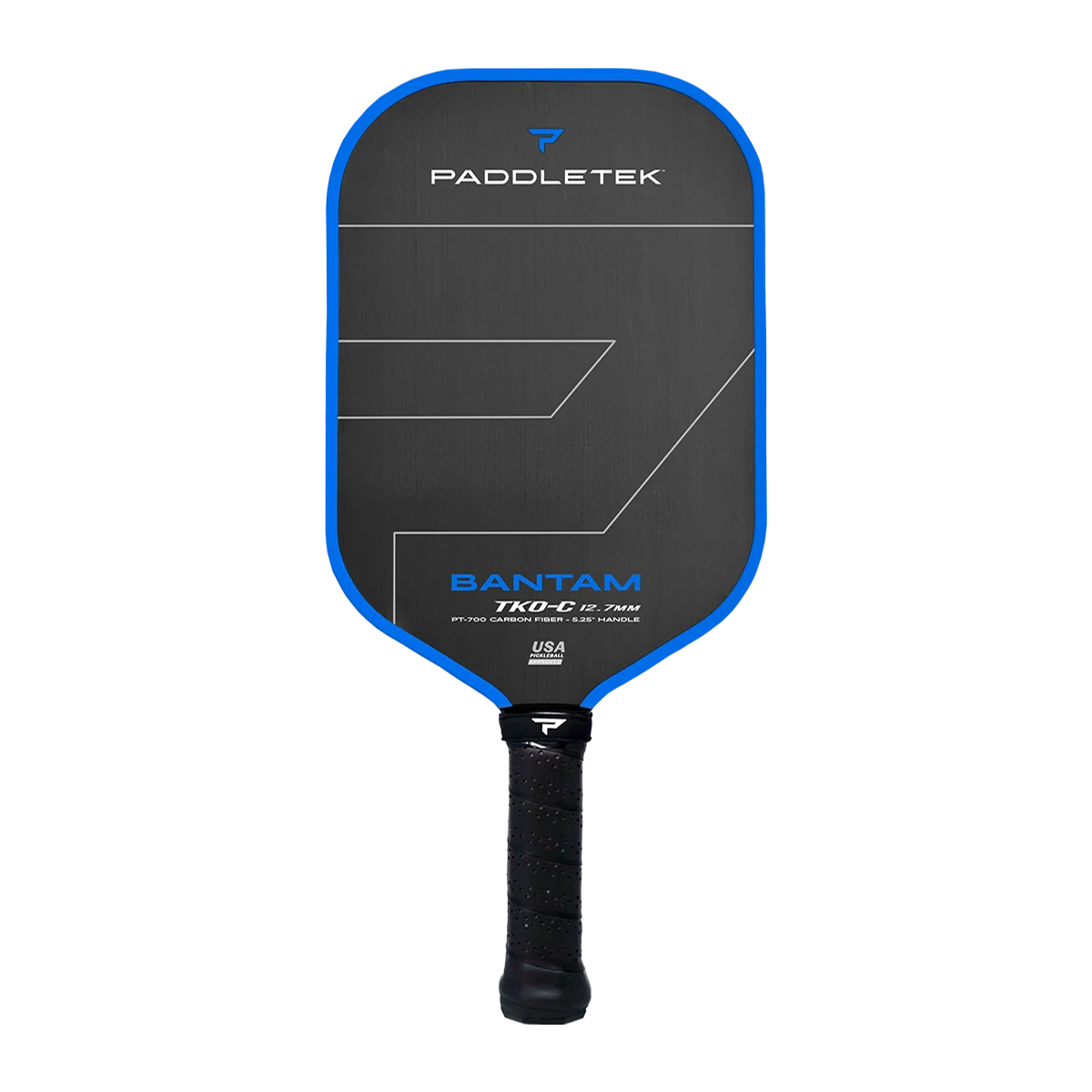
The Bantam TKO-C 14.3mm is the quickest power paddle Paddletek makes, and it earns the top slot on hand speed rather than on raw weight. Swing weight is the number that says how heavy a paddle feels when you swing it, and this one measures 115 to 117, which is the fast end of the elongated shape.
The face is PT-700 raw carbon, which is a grade of carbon fiber known for grip and spin, and the spin figure is 1,910 RPM, enough to keep drives dipping late and serves biting.
The core is a Bantam polymer honeycomb, which is a plastic honeycomb inside the paddle, and it answers crisp and quick, with a connected crack on contact rather than a soft pocket.
Twist weight is the number that says how much the face resists turning when you hit off center, and at 6.4 to 6.5 it keeps stretched blocks square on a narrow 7.5 inch face.
This is the pick for players who finish points with counters and placement rather than with plow-through, which is the way a heavier swinging paddle keeps moving through the ball. Buyers praise it again and again for fast hands and counters, for its crisp feel, for reliable spin, and for stability on a narrow frame. Two honest cautions.
The 5.25 inch handle is a one-handed paddle in practice, and two-handers run out of room. And the buyer-complaint record is thin in the sources I could check, so I do not invent a complaint pattern here; the lab evidence says the narrow face asks for clean contact.
Buy it if you want the fastest power hands in the brand and you trust your swing to find the middle. Skip it if a two-handed backhand leads your game.
2Paddletek Bantam ALW-C 14.3mm: Best Paddletek Pickleball Paddles in 2027 for Pro Signature Power
AT A GLANCE
Paddletek Bantam ALW-C 14.3mm
WEIGHT
7.5-7.8 oz
SWING WEIGHT
102-103 (updated version) / 105
TWIST WEIGHT
6.5
SPIN
2,020-2,098 RPM
Shape: Standard, 15.9 x 7.9 in (retailers list width 7.75-7.87 in), 5.25 in handle
Grip: 4.125 or 4.375 in circumference, 5.25 in handle
Core: Bantam QRT PolyCore, 14.3mm
Face: PT-700 raw carbon
Approval: USAP and UPA-A (14.3mm)
Warranty: Limited lifetime performance guarantee, register within 14 days
Feel: Super-light, very fast hands
The Bantam ALW-C 14.3mm is Anna Leigh Waters’ signature model, and it is the lightest, fastest serious power paddle Paddletek makes.
At 7.5 to 7.8 ounces it barely registers in the hand, and the swing weight of 102 to 103 is the lowest of any Bantam power paddle on this page, which is why hand battles at the kitchen stop feeling like reactions and start feeling like choices.
The face is PT-700 raw carbon, which is a grade of carbon fiber known for grip and spin, and the spin measures 2,020 to 2,098 RPM, the biggest measured spin in the Bantam line. The core is a Bantam QRT PolyCore, which is the brand’s polymer honeycomb core built for a quick, lively answer.
The twist weight of 6.5 keeps the face steady on off-center contact, and the standard shape gives a large sweet spot, which is the area of the face that returns the ball cleanly.
Buyers praise it again and again for super-light hands, for huge spin, for a large sweet spot, and for a clear power jump over the original ALW model.
It ranks behind the TKO-C only because its soft game is harder to control: the lively core makes dinks and resets fly long until the swing shortens. Two honest cautions. The soft game is the drawback, and buyers say so plainly.
And the small sweet spot complaint belongs to the first generation version, not this one, so do not carry it across. Buy it if you want the lightest power paddle in the brand and your hands are faster than your soft game. Skip it if touch and resets lead your brief, because the Wave Pro-C below controls those shots better.
3Paddletek Bantam TKO-CX 14.3mm: Best Paddletek Pickleball Paddles in 2027 for Heavy Stable Power
AT A GLANCE
Paddletek Bantam TKO-CX 14.3mm
WEIGHT
7.8-8.2 oz
SWING WEIGHT
123
TWIST WEIGHT
7.35
SPIN
1,910 RPM
Shape: Elongated, 16.5 x 7.5 in
Grip: 5.75 in handle, 4.25 in circumference
Core: Bantam PolyCore honeycomb, 14.3mm, steel perimeter weighting
Face: PT-700 raw carbon fiber with glass epoxy
Approval: USAP and UPA-A
Warranty: Limited lifetime performance guarantee, register within 14 days
Feel: Heavy stability
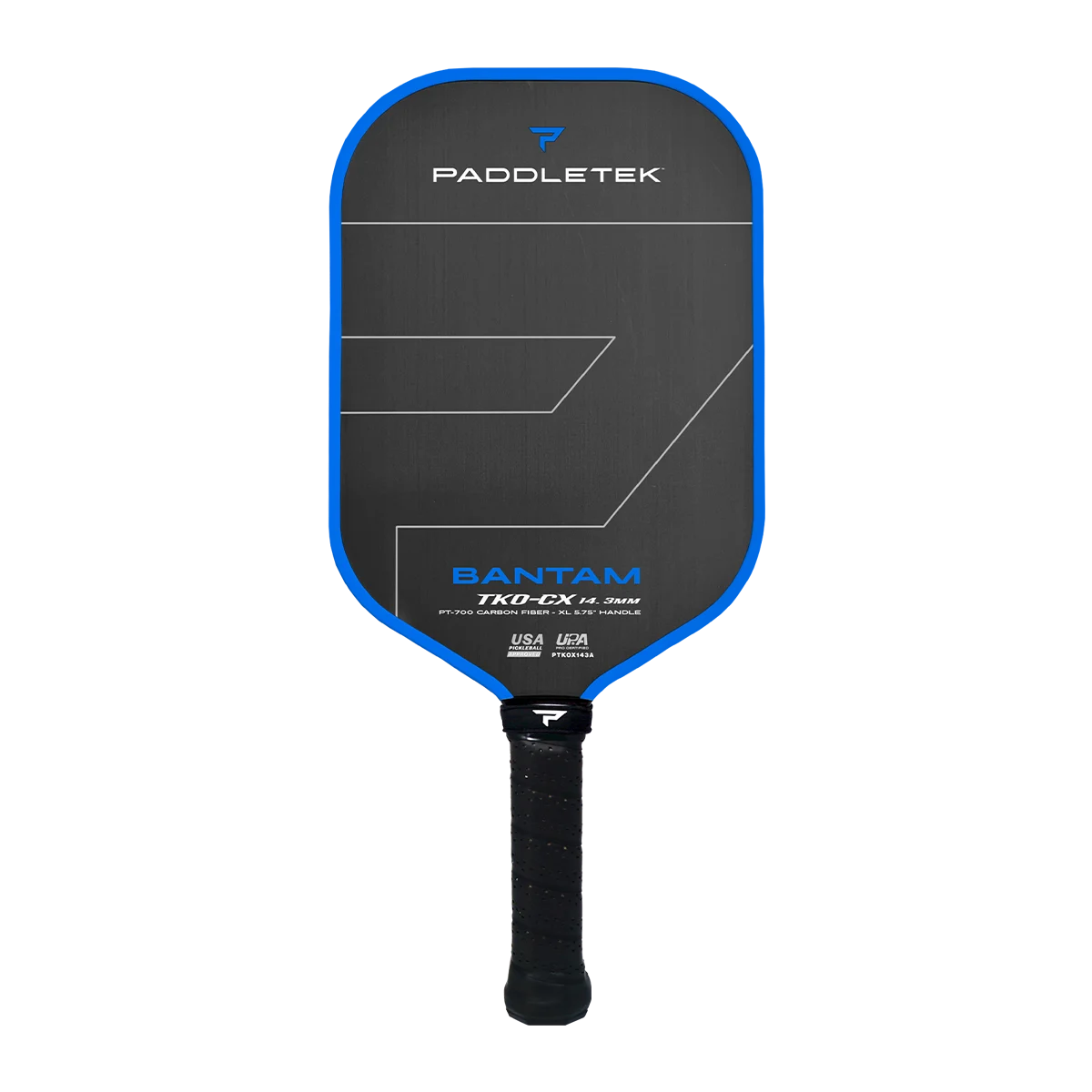
The Bantam TKO-CX 14.3mm is the hardest-hitting paddle on this page, and it earns that title on weight and stability rather than on hand speed. The CX adds steel perimeter weighting to the TKO-C platform, which is extra weight set around the edge of the paddle, and it adds a longer 5.75 inch handle.
The swing weight is 123, which is the heaviest swing on this page, and the twist weight is 7.35, which is the most stable face on this page.
Swing weight is the number that says how heavy a paddle feels when you swing it, and twist weight is the number that says how much the face resists turning when you hit off center. Together they mean plow-through and a big sweet spot that forgives stretched contact.
The face is PT-700 raw carbon, which is a grade of carbon fiber known for grip and spin, and the spin figure is 1,910 RPM, the settled figure this site prints for the 14.3 Bantams.
The long handle makes it the two-hander power pick, and my power list ranks it against the other power paddles on this site. Buyers praise it again and again for heavy stable power, for a big sweet spot, for plow-through on drives, and for a long handle that suits two-handers.
Two honest cautions. The heavy swing loads the arm over a long session, so it taxes hands that are still learning. And beginners should not start here: the weight asks for a full, committed swing, and a short swing gets punished.
Buy it if you swing fully, hit with two hands, and want the most stable power in the brand. Skip it if quick hands at the kitchen matter more than power, because the TKO-C above is quicker.
4Paddletek Bantam GTO-C 14.3mm: Best Paddletek Pickleball Paddles in 2027 for Hybrid Power
AT A GLANCE
Paddletek Bantam GTO-C 14.3mm
WEIGHT
7.7-8.1 oz
SWING WEIGHT
113-122
TWIST WEIGHT
6.7-7.5
SPIN
-
Shape: Hybrid, 16.25 x 7.75 in, 5.5 in handle
Grip: 4.25 in circumference (Amazon listing copy; Paddletek does not publish it), 5.5 in handle
Core: Bantam QRT polymer core, 14.3mm
Face: PT-700 raw carbon
Approval: USAP and UPA-A
Warranty: Limited lifetime performance guarantee, register within 14 days
Feel: Stable power with control
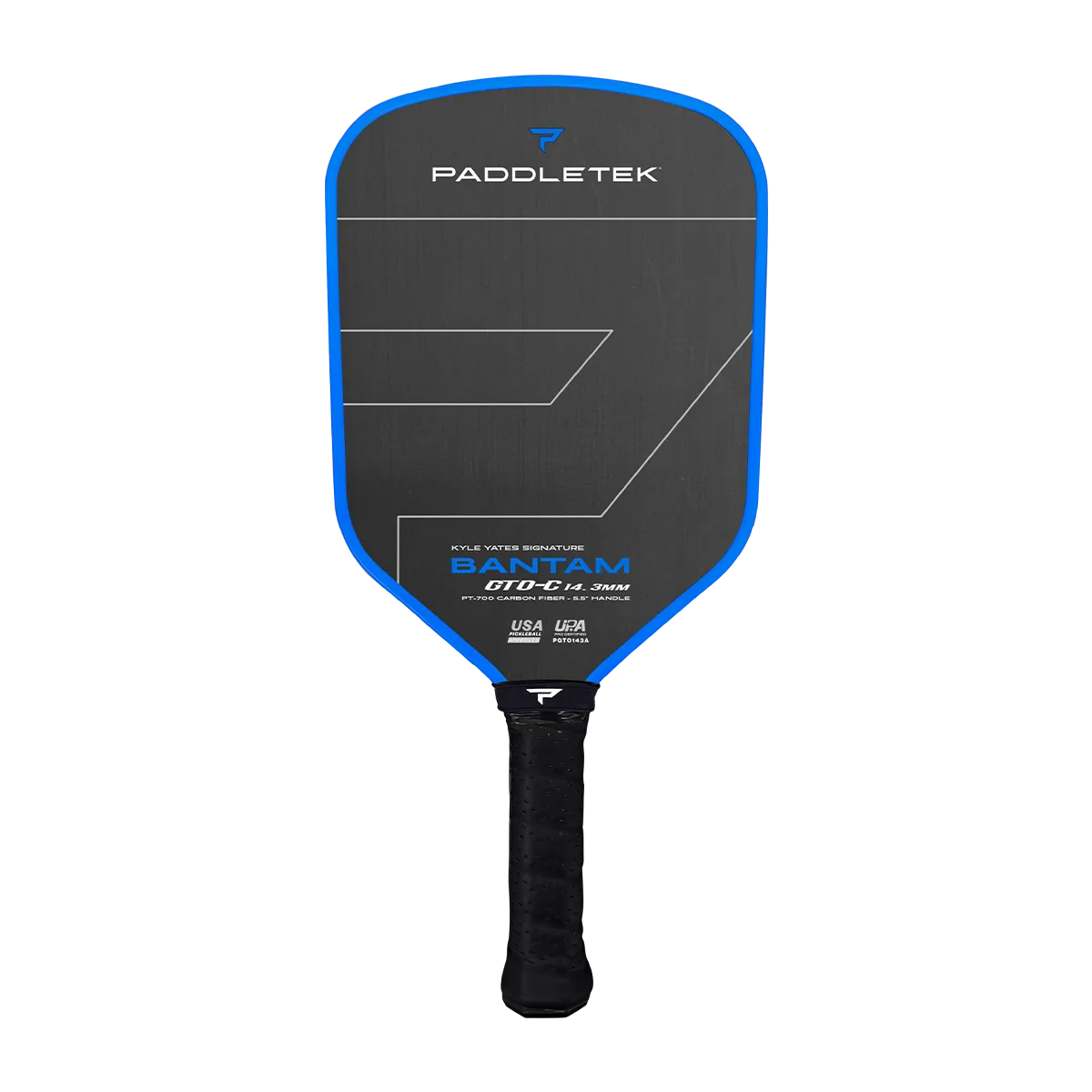
The Bantam GTO-C 14.3mm is the most versatile power paddle Paddletek makes, and it earns that title on shape rather than on any single number. A hybrid shape sits between the elongated shape and the widebody shape, and this one measures 16.25 by 7.75 inches, right in the middle of that band.
The face is PT-700 raw carbon, which is a grade of carbon fiber known for grip and spin, and the core is a Bantam QRT polymer core, which is the brand’s polymer core built for a quick, lively answer.
Steel twist weights steady the face on off-center contact. Twist weight is the number that says how much the face resists turning when you hit off center, and this one measures 6.7 to 7.5. Swing weight is the number that says how heavy a paddle feels when you swing it, and this one measures 113 to 122.
It is cold-pressed in the USA, and my hybrid list ranks it against the other hybrid paddles on this site. Buyers praise it again and again for a stable and versatile hybrid shape, for good power with control, and for balance in the hand.
It ranks behind the TKO-CX because it has less published lab data and less raw plow-through. Two honest cautions.
The spin figure is not published, so the box says so rather than borrowing a number from another Bantam. And the buyer-complaint record is thin in the sources I could check, so I do not invent a complaint pattern here.
Buy it if you want one power paddle for every shot and you do not want to give up reach or forgiveness completely. Skip it if maximum plow-through is your whole brief, because the TKO-CX above hits harder.
5Paddletek Tempest Wave Pro-C 14.3mm: Best Paddletek Pickleball Paddles in 2027 for Control
AT A GLANCE
Paddletek Tempest Wave Pro-C 14.3mm
WEIGHT
7.8-8.2 oz
SWING WEIGHT
108
TWIST WEIGHT
6.98
SPIN
1,835 RPM
Shape: Widebody, 15 7/8 x 8 in, 5.25 in handle
Grip: 5.25 in handle, 4.25 in circumference
Core: Tempest PolyCore with Smart Response Technology, 14.3mm
Face: PT-700 unidirectional raw carbon
Approval: USAP
Warranty: Limited lifetime performance guarantee, register within 14 days
Feel: Forgiving touch and control. Brand ratings: Power 8, Control 9, Forgiveness 9.5.
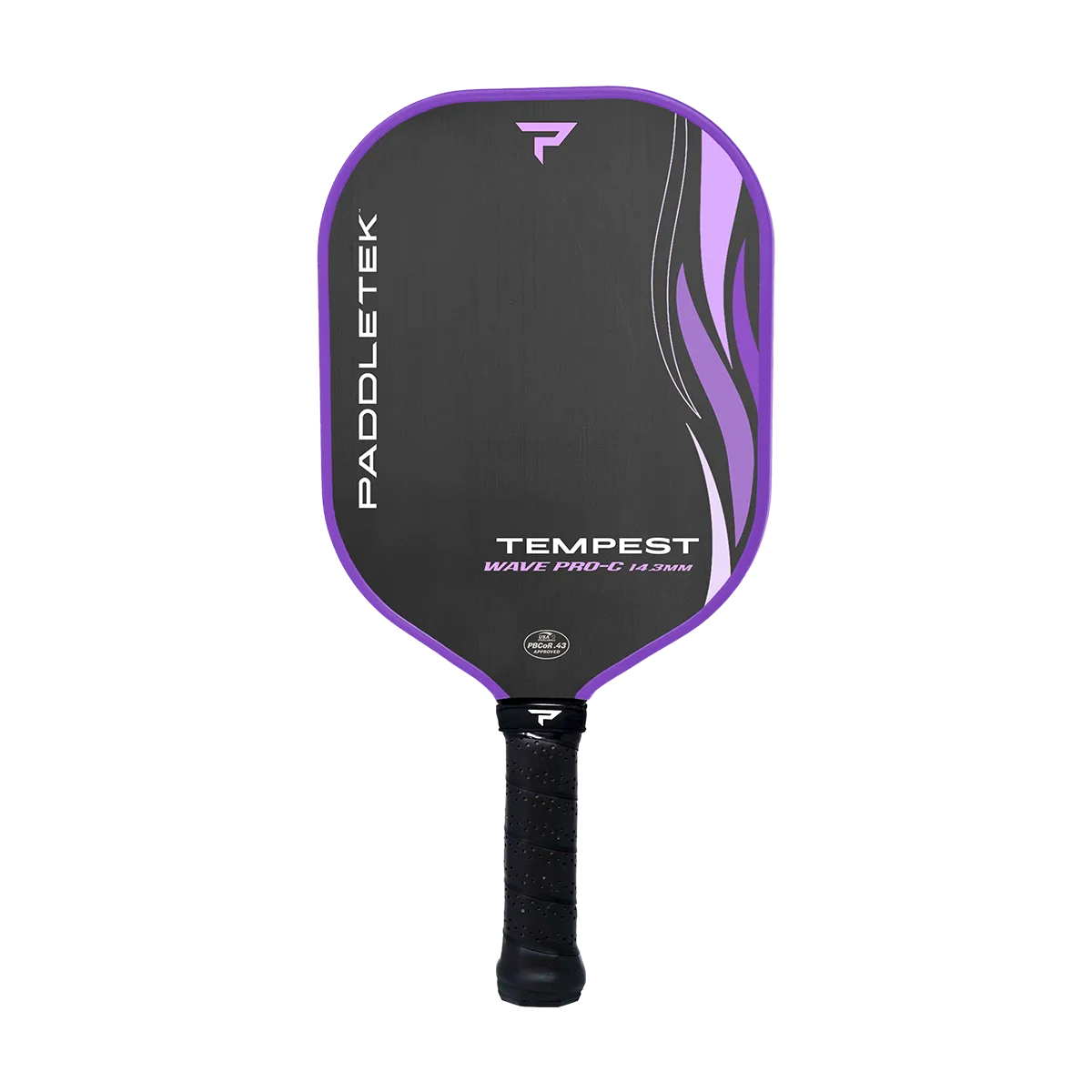
The Tempest Wave Pro-C 14.3mm is the control flagship of the Paddletek range, and it earns that title on forgiveness rather than on power. A widebody shape is short and wide, and this one measures 15 7/8 by 8 inches, which gives the biggest sweet spot among the serious paddles on this page.
The face is PT-700 unidirectional raw carbon, which is a grade of carbon fiber laid in one direction and known for grip and spin, and the spin measures 1,835 RPM.
The core is a Tempest PolyCore with Smart Response Technology, which is a core design that firms up on hard hits and softens on soft shots, so the same paddle answers drives with weight and drops with touch.
Swing weight is the number that says how heavy a paddle feels when you swing it, and this one measures 108, quick enough for hand battles.
Twist weight is the number that says how much the face resists turning when you hit off center, and at 6.98 it keeps stretched blocks honest. The brand rates it 8 for power, 9 for control and 9.5 for forgiveness.
My control list ranks it against the other control paddles on this site. Buyers praise it again and again for forgiving touch, a big sweet spot, strong spin and control, and comfort on soft shots.
Two honest cautions. Some buyers wanted a smaller grip, and a few found dead spots compared with earlier Wave Pros, which are patches of the face that answer flat.
A small number of low ratings mention cosmetic or wrong-color issues rather than play. Buy it if control and the soft game lead your brief. Skip it if putaway power is your whole brief, because the Bantam line above hits harder.
6Paddletek Bantam ESQ-C 14.3mm: Best Paddletek Pickleball Paddles in 2027 for All-Court Two-Handers
AT A GLANCE
Paddletek Bantam ESQ-C 14.3mm
WEIGHT
7.5-7.8 oz (some sources 7.6-7.9 oz)
SWING WEIGHT
102-107
TWIST WEIGHT
6.8-7.2
SPIN
- for the 14.3mm specifically
Shape: Standard/widebody, 15.9-16 x 8 in, 5.5 in handle
Grip: 4.25 in circumference, 5.5 in handle
Core: Bantam QRT polymer core, 14.3mm
Face: PT-700 raw carbon
Approval: USAP and UPA-A
Warranty: Limited lifetime performance guarantee, register within 14 days
Feel: Fast, light, big sweet spot
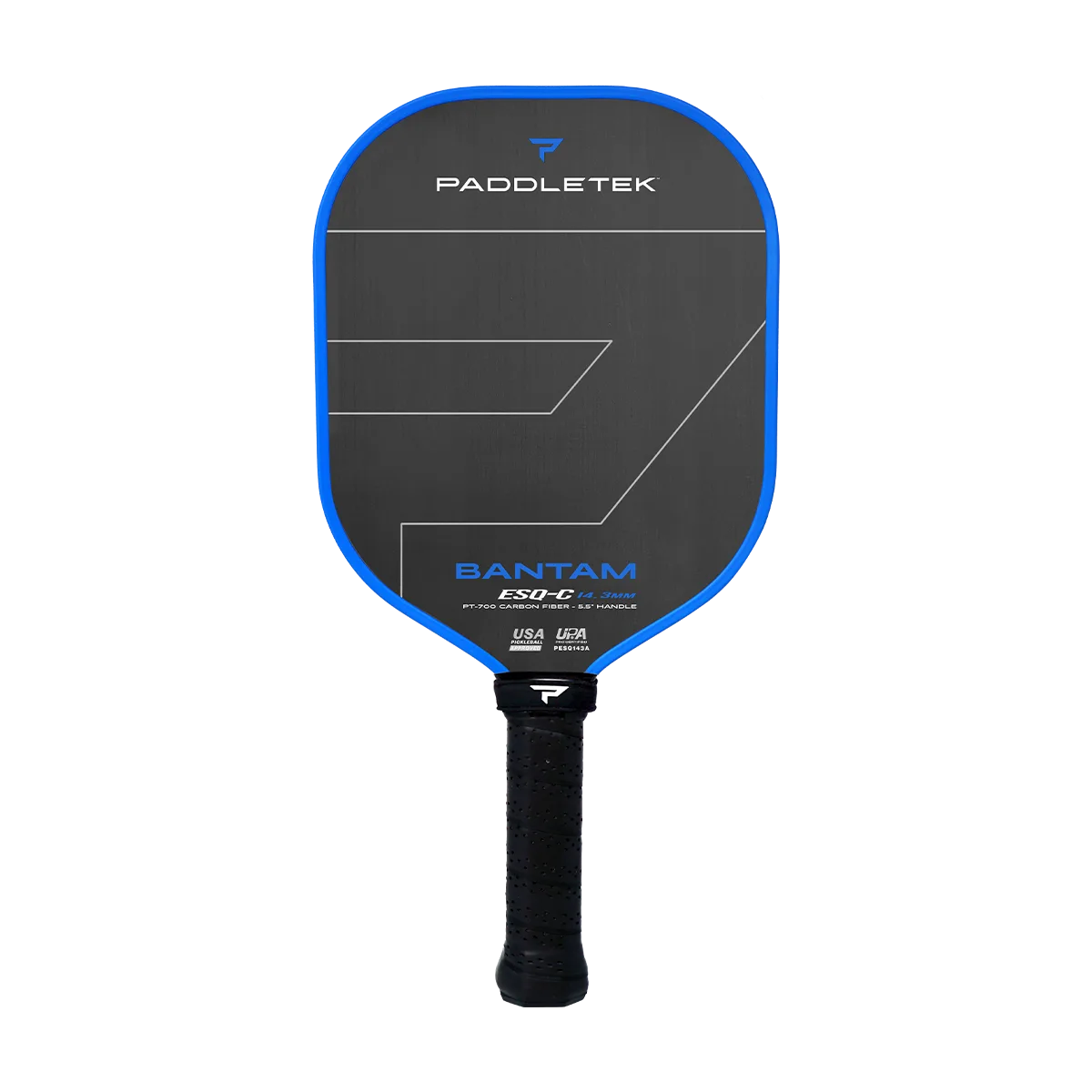
The Bantam ESQ-C 14.3mm is the all-court pick for two-handed players, and it earns that title on its handle. The handle measures 5.5 inches, which is the longest among the standard-shape Bantams, so both hands fit with room to spare.
At 7.5 to 7.8 ounces it is light, and the swing weight of 102 to 107 is the quick end of this page, so hand battles at the kitchen feel fast and free.
The face is PT-700 raw carbon, a grade of carbon fiber known for grip and spin, and the core is a Bantam QRT polymer core, the brand’s polymer core built for a quick, lively answer.
At 6.8 to 7.2 twist weight it keeps the face steady on stretched contact. The shape is a standard to widebody frame at about 16 by 8 inches, so the sweet spot, the area of the face that returns the ball cleanly, is big and forgiving.
One expert tester named it a personal favorite of the whole Bantam line, and buyers praise it again and again for fast, light hands, huge spin, a big sweet spot, and a long handle that suits two-handers.
My all-court list ranks it against the other all-court paddles on this site. The spin figure for the 14.3mm is not published, so the box says so honestly: a figure of 2,325 RPM was measured on the thinner 12.7mm version, and that number is never carried across to this one.
Two honest cautions. The lively core makes dinks and resets fly long, so touch is the drawback. And one user found the sweet spot smaller than expected. Buy it if you hit with two hands and you want a fast, light all-court paddle. Skip it if soft shots lead your game, because the Wave Pro-C above controls them better.
7Paddletek Bantam TKO-C 12.7mm: Best Paddletek Pickleball Paddles in 2027 for Thin-Core Power
AT A GLANCE
Paddletek Bantam TKO-C 12.7mm
WEIGHT
- for the 12.7mm specifically (TKO-C line brand range 7.8-8.2 oz)
SWING WEIGHT
114.7
TWIST WEIGHT
6.44
SPIN
2,315 RPM
Shape: Elongated, 16.5 x 7.5 in, 5.25 in handle
Grip: -
Core: Bantam polymer honeycomb, 12.7mm
Face: PT-700 raw carbon with glass epoxy
Approval: USAP and UPA-A
Warranty: Limited lifetime performance guarantee, register within 14 days
Feel: Poppy and fast, highest measured spin in the line
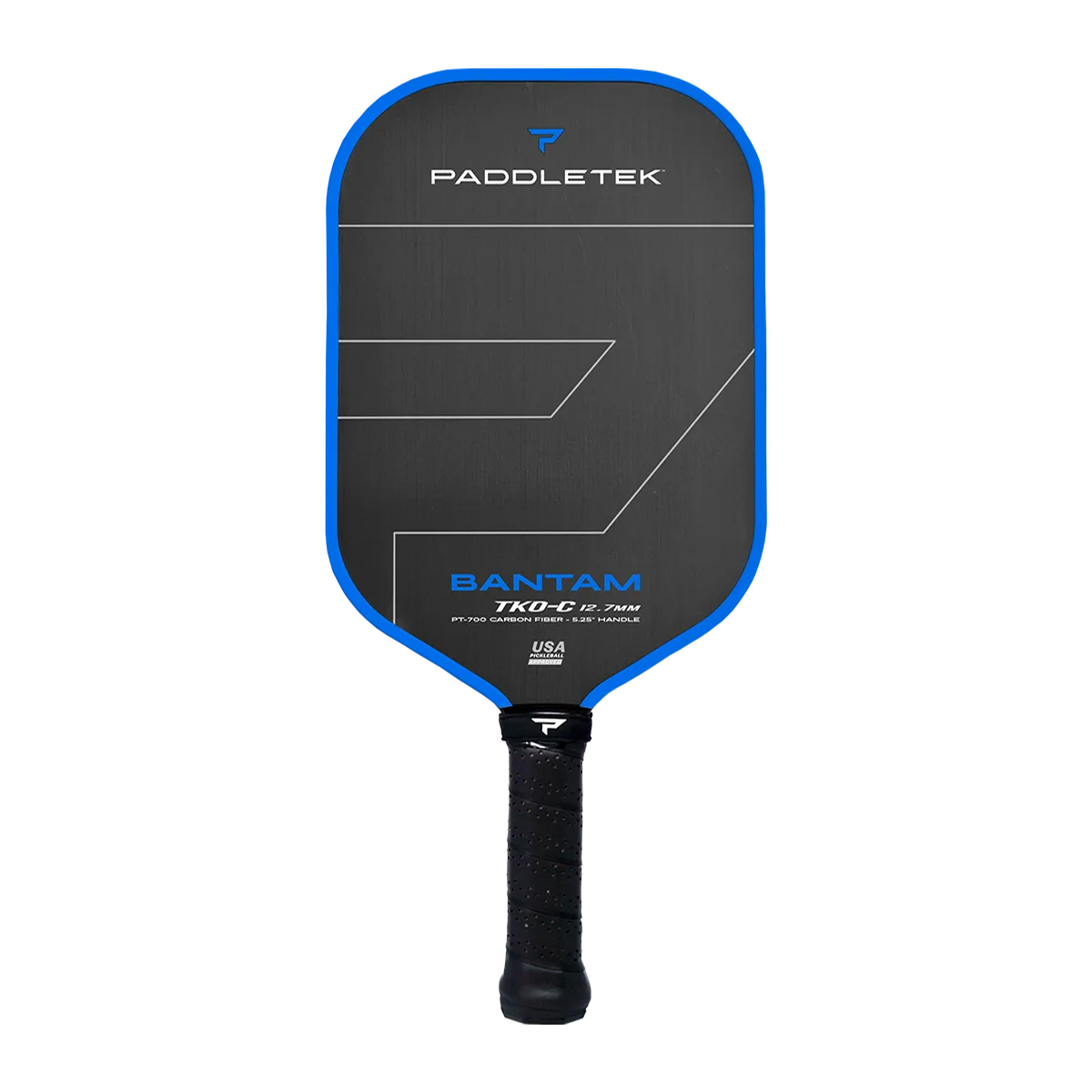
The Bantam TKO-C 12.7mm is the spinniest paddle on this page, and it earns its own slot because the numbers are distinct, not a variant note.
The core is 12.7mm thick, which is thinner than the 14.3mm flagship above, and a thinner core answers quicker and firmer, with more pop on short swings and less margin on mishits. Pop is the lively jump the ball gets off the face on a short swing.
The spin measures 2,315 RPM, the highest measured spin in the whole Bantam line, and the face is PT-700 raw carbon, a grade of carbon fiber known for grip and spin.
Swing weight is the number that says how heavy a paddle feels when you swing it, and this one measures 114.7, quick enough for hand battles. At 6.44 twist weight it keeps stretched blocks playable on a narrow 7.5 inch face.
The shape is elongated at 16.5 by 7.5 inches, with a 5.25 inch handle, and the core is a Bantam polymer honeycomb, a plastic honeycomb inside the paddle.
Buyers praise it again and again for huge spin, for poppy power, and for fast hands. It trades some of the 14.3mm version’s stability for extra pop and hand speed, and that trade is the whole point of the pick. Two honest cautions.
The buyer-complaint record is thin in the sources I could check, so I do not invent a complaint pattern here. And the lab evidence says the thinner core is less forgiving off center than the 14.3mm, so treat that as a lab finding, not a buyer pattern.
Buy it if spin leads your brief and you want the poppiest TKO-C in the brand. Skip it if forgiveness leads your brief, because the 14.3mm flagship above forgives more.
8Paddletek Phoenix Genesis Pro: Best Paddletek Pickleball Paddles in 2027 for All-Around Value
AT A GLANCE
Paddletek Phoenix Genesis Pro
WEIGHT
7.8-8.2 oz
SWING WEIGHT
-
TWIST WEIGHT
-
SPIN
-
Shape: Standard, 15 5/8 x 7 3/4 in
Grip: 5 in handle, 4 1/4 in circumference (standard 4 3/8 in / thin 4 1/8 in options per Amazon listing copy)
Core: SRT ProPolyCore, 14.3mm
Face: Textured fiberglass epoxy hybrid
Approval: USAPA approved
Warranty: Limited lifetime performance guarantee, register within 14 days
Feel: Balanced all-around, forgiving. Brand ratings: 8/10 power, control, forgiveness.
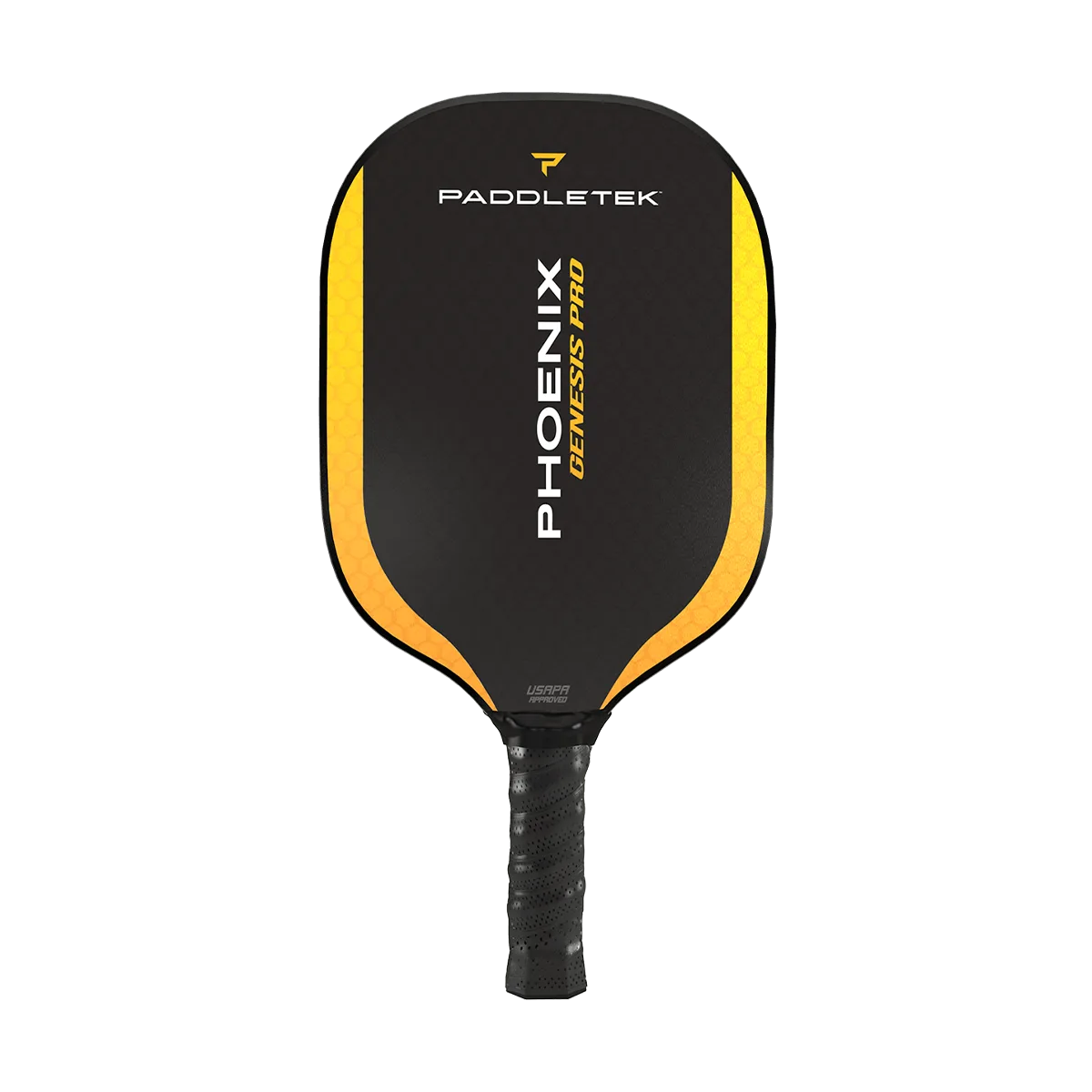
The Phoenix Genesis Pro is the forgiving all-rounder for players who are still defining their style, and it earns that title on balance rather than on any single shot.
The core is an SRT ProPolyCore, the brand’s polymer core with Smart Response Technology, a core design that firms up on hard hits and softens on soft shots. The face is a textured fiberglass epoxy hybrid, a fiberglass face with a rough texture that grips the ball, and it gives a broad, friendly sweet spot.
The brand rates it 8 out of 10 for power, control and forgiveness alike: no single strength, no single weakness.
Smart Response Technology, torsion vibration control, grip vibration dampening and perimeter weighting all work together to keep the hitting surface large and consistent: torsion control steadies the face, grip dampening takes the sting out of hard contact, and perimeter weighting widens the sweet spot.
The shape is a standard frame at 15 5/8 by 7 3/4 inches, with a 5 inch handle, and it sits in a friendlier tier than the carbon Bantams above. Buyers praise it again and again for balanced all-around play, forgiveness, and suiting players who are still defining their style.
It ranks below the carbon models on spin and power, which is the honest trade: fiberglass grips the ball less than raw carbon, so serves dip less and drives shape less.
Two honest cautions. Some buyers call it a bit light and short on extra power, and a few find the sweet spot finicky. Buy it if you want one forgiving paddle for every shot and you are still learning what your game needs. Skip it if spin or putaway power leads your brief, because the Bantam line above gives you both.
9Paddletek Bantam TS-5: Best Paddletek Pickleball Paddles in 2027 for Beginner Value
AT A GLANCE
Paddletek Bantam TS-5
WEIGHT
7.0-7.5 oz
SWING WEIGHT
-
TWIST WEIGHT
-
SPIN
-
Shape: Standard, 15 5/8 x 7 7/8 in
Grip: 5 in handle, 4.25 in circumference
Core: Bantam PolyCore polymer honeycomb, 12.7mm
Face: Textured fiberglass epoxy hybrid
Approval: USAP
Warranty: Limited lifetime performance guarantee, register within 14 days
Feel: Light and simple, featherweight and forgiving
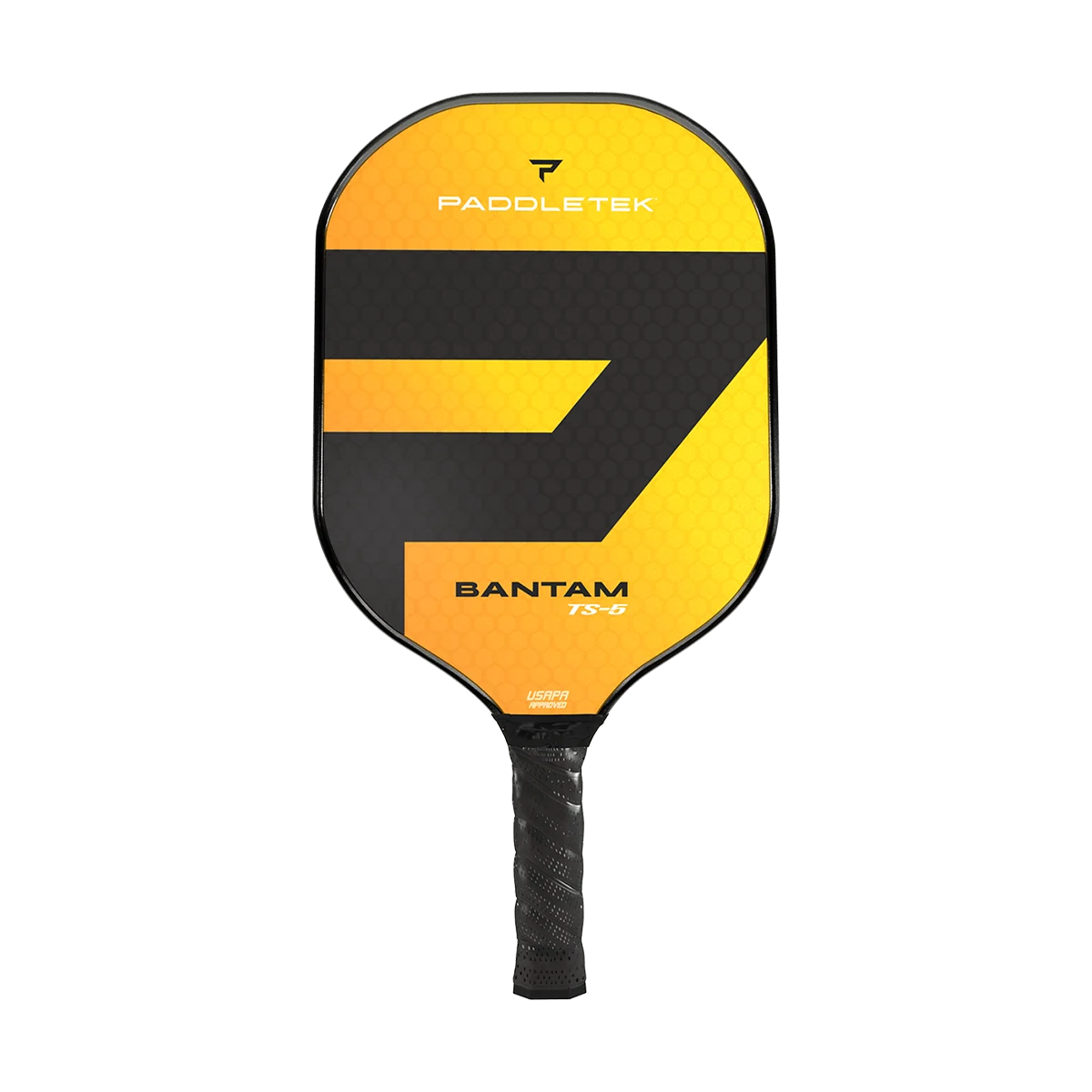
The Bantam TS-5 is the lightest paddle on this page and the genuine beginner value pick, and it earns that title on weight alone. At 7.0 to 7.5 ounces it swings all session without tiring the arm.
The shape is a standard frame at 15 5/8 by 7 7/8 inches, with a 5 inch handle, and the core is a Bantam PolyCore polymer honeycomb at 12.7mm, a plastic honeycomb inside the paddle that answers quick and forgiving.
The face is a textured fiberglass epoxy hybrid, a fiberglass face with a rough texture that grips the ball, and it gives a broad, friendly sweet spot.
This paddle was Anna Leigh Waters’ signature paddle for years, which gives it real buyer traction and a long review history. Buyers praise it again and again for featherweight feel, easy swinging, forgiveness, and being a simple and reliable first serious paddle.
It ranks below the Genesis Pro only because the fiberglass face gives less spin than the carbon models above it, so serves dip less and drives shape less. Two honest cautions.
The buyer-complaint record is thin in the sources I could check, so I state that plainly here. And the fiberglass face gives less spin than raw carbon models, so treat that as a lab finding, not a buyer pattern.
One warning: make sure the listing lands on the standard TS-5, never the TS-5 Pro and never the Anna Leigh Waters signature edition, because those are different paddles at different weights.
Buy it if you are new to the sport and you want the lightest serious paddle in the brand. Skip it if spin leads your brief, because the carbon Bantams above give you far more of it.
10Paddletek Phoenix G6: Best Paddletek Pickleball Paddles in 2027 for Beginner Comfort
AT A GLANCE
Paddletek Phoenix G6
WEIGHT
7.8-8.1 oz (brand figures)
SWING WEIGHT
- (no lab has measured it)
TWIST WEIGHT
- (no lab has measured it)
SPIN
- (no lab has measured it)
Shape: Standard, 15 5/8 x 7 3/4 in
Grip: 5 in handle, 4.25 in circumference, ultra-cushion high-tack wrap
Core: Polymer honeycomb (brand Graphite PolyCore)
Face: Composite (polycarbonate/graphite composite surface; also described as velvet textured polycarbonate)
Approval: USAPA approved
Warranty: Limited lifetime performance guarantee, register within 14 days
Feel: Comfort-first control
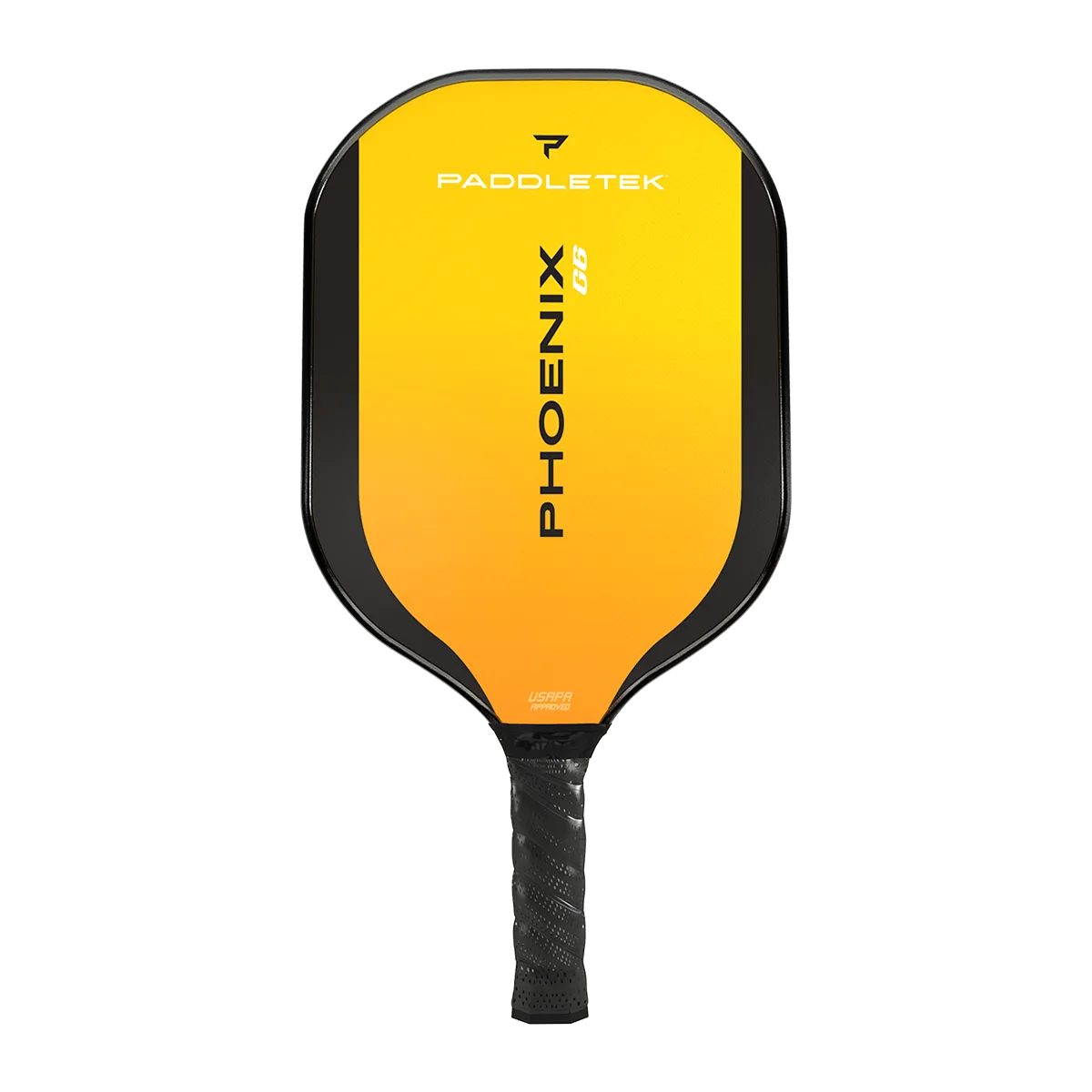
The Phoenix G6 is the comfort pick for bigger hands and newer players, and it earns that title on its grip rather than on any single shot. The handle wears the thickest cushioned wrap on this page, an ultra-cushion high-tack wrap that fills a larger palm.
High-tack means the grip surface holds the hand firmly without slipping. The shape is a standard frame at 15 5/8 by 7 3/4 inches, with a 5 inch handle, and the core is a polymer honeycomb, a plastic honeycomb inside the paddle that gives a broad, friendly sweet spot.
The face is a composite surface, described by brand and retailer sources as a polycarbonate and graphite composite and also as a velvet textured polycarbonate, and both wordings are printed in the box because the sources disagree.
The weight is 7.8 to 8.1 ounces, which is a comfortable middle weight that swings all session without tiring the arm.
Buyers praise it again and again for a comfortable cushioned grip, a large sweet spot, easy control, and suiting beginner to intermediate players. Two honest cautions, and they matter.
The review history includes complaints about handles breaking, and the brand warranty covers manufacturing defects, but the toughness record is not spotless, so check the warranty terms before you buy.
One roundup notes the tier may feel high for some beginners. One more warning: link the single paddle only, because the same model is also sold as a 2-paddle set, and the set is never the pick.
Buy it if comfort leads your brief and you want the easiest paddle in the brand to hold for a full session. Skip it if spin or power leads your brief, because the carbon Bantams above give you far more of both.
How to Choose the Best Paddletek Pickleball Paddle in 2027
A Paddletek paddle is one brand’s answer to the same question every player asks: power or control, quick hands or forgiveness, and how much paddle do I need for the game I actually play. The ten picks above split into three lines, and the wrong pick inside the same brand can still be the wrong paddle.
Work through the sections below in order: the three lines, the shapes, power against control, core thickness, the three weight numbers and the sweet spot, beginners, power, budget and value, and the approval check before you buy.
No third-party best Paddletek listicle ranks in the top results, so this page fills an open lane, and the brand’s own guide is the top content competitor, which is why the sections below answer the same questions it answers, with tested picks attached.
Paddletek Bantam: the Power Line
Paddletek Bantam paddles are the power line of the brand, and they are built for players who finish points. The line runs on a Bantam polymer honeycomb core, which is a plastic honeycomb inside the paddle, and a PT-700 raw carbon face, which is a grade of carbon fiber known for grip and spin.
That pairing gives a crisp, quick answer with real spin: the TKO-C 14.3mm at 1,910 RPM, the ALW-C at 2,020 to 2,098 RPM, and the thin-core TKO-C 12.7mm at 2,315 RPM. The Bantam line splits by shape.
The elongated TKO-C and TKO-CX give reach and leverage. The standard ALW-C and ESQ-C give a bigger sweet spot and quicker hands. The hybrid GTO-C splits the difference.
The sweet spot is the area of the face that returns the ball cleanly. Choose Bantam if power leads your brief and you can control a lively face. Choose the TKO-C if you want the quickest power hands. Choose the TKO-CX if you swing fully and want the most stable power. Choose the ALW-C if you want the lightest power paddle.
Choose the ESQ-C if you hit with two hands. Choose the GTO-C if you want power in a hybrid shape. Choose the TS-5 if you are new and you want the lightest paddle in the brand. The Bantam line is not the beginner line, apart from the TS-5, and the TKO-CX is the clearest example: beginners should not start there.
Paddletek Tempest Wave Pro: the All-Around and Control Line
Paddletek Tempest Wave Pro paddles are the all-around and control line of the brand, and they are built for players who win points with placement. The line runs on a widebody shape, which is short and wide, and that shape gives the biggest sweet spot in the brand.
The current model is the Tempest Wave Pro-C, with a PT-700 unidirectional raw carbon face, which is a grade of carbon fiber laid in one direction and known for grip and spin, and a Tempest PolyCore with Smart Response Technology, which is a core design that firms up on hard hits and softens on soft shots.
The spin measures 1,835 RPM, which is a big jump from the old graphite Tempest line, where spin sat near the 1,000 RPM range.
The older graphite Tempest Wave Pro is superseded by the Pro-C and is not a pick on this page. The widebody shape also gives the quickest hands in the brand for defense: blocks, resets and counters at the kitchen. The brand rates the Wave Pro-C 8 for power, 9 for control and 9.5 for forgiveness.
Choose the Tempest Wave Pro line if control and the soft game lead your brief. Choose the Wave Pro-C if you want the most forgiving serious paddle in the brand.
Choose the Tempest Wave v3 Pro, held as a reserve on this page, only if the Wave Pro-C fails at build: it is poppier and harder to control on resets, so it stays behind the Pro-C on control.
Paddletek Phoenix: the Budget Line
Paddletek Phoenix paddles are the budget line of the brand, and they are built for comfort and easy control rather than for maximum spin or power. The line runs on fiberglass and composite faces instead of raw carbon, which is why it sits in a friendlier tier than the Bantam and Tempest lines.
The Genesis Pro is the all-around pick of the line, with an SRT ProPolyCore, which is the brand’s polymer core with Smart Response Technology, and a textured fiberglass face that gives a broad, friendly sweet spot.
The sweet spot is the area of the face that returns the ball cleanly. The G6 is the comfort pick of the line, with the thickest cushioned grip in this list and a settled, easy feel.
Both Phoenix picks carry the same brand-wide limited lifetime performance guarantee, with registration within 14 days of purchase. Choose Phoenix if you are still defining your style, or if comfort and easy control matter more than spin. Choose the Genesis Pro if you want one balanced paddle for every shot.
Choose the G6 if bigger hands or a cushioned grip lead your brief, and check the warranty terms first, because the review history includes complaints about handles breaking. The Phoenix line is honest about its trade: less spin and less power than the carbon lines, in exchange for forgiveness and comfort.
What Is the Difference Between Paddle Shapes?
The difference between paddle shapes is length and width, and those two numbers decide what each shape does best. An elongated paddle is long and narrow, usually about 16.5 by 7.5 inches, and it gives the most reach and the most leverage for serves, overheads and wide gets.
A widebody paddle is short and wide, usually about 16 by 8 inches, and it gives the biggest sweet spot and the quickest hands at the kitchen.
A standard paddle sits between them in the older sense, usually about 15.75 by 8 inches, and it is the traditional all-court frame. A hybrid paddle is the modern middle: longer than a widebody and wider than an elongated paddle, so it splits the difference.
Choose elongated if reach and serve leverage lead your game. Choose widebody if defense and quick hands lead your game. Choose standard if you want the classic all-court feel. Choose hybrid if you want one paddle for every shot and you do not want to give up reach or forgiveness completely.
On this page, the TKO-C and TKO-CX are elongated, the Wave Pro-C is widebody, the ALW-C, ESQ-C, TS-5, Genesis Pro and G6 are standard shapes, and the GTO-C is the hybrid. The shape question is the first question in the brand’s own guide, and it is the first choice you should make before you compare any other number.
How to Choose a Paddletek Paddle: Power vs Control
Power against control is the first real choice inside the brand, and the lines split cleanly. Choose power if you finish points with drives, counters and putaways, and choose control if you win points with drops, dinks and resets.
The power side of this page is the Bantam line: the TKO-C for the quickest power hands, the TKO-CX for the heaviest stable power, the ALW-C for the lightest power, and the thin-core TKO-C 12.7mm for the highest spin.
The control side is the Tempest Wave Pro-C, with the widest sweet spot among the serious paddles here and the softest answer on touch shots.
The middle ground is the GTO-C hybrid, the ESQ-C all-court shape, and the two Phoenix picks. The sweet spot is the area of the face that returns the ball cleanly. Two tests settle the choice in one session. Hit ten drives from the baseline: if they carry deep and dip late, the paddle has the power you need.
Then hit ten third-shot drops: if they land low and repeatable, the paddle has the control you need. A paddle that passes one test and fails the other is telling you which side of the line it sits on.
Most players who are not sure should start with the control side, because a paddle that forgives a soft shot teaches faster than a paddle that punishes it.
Core Thickness: 12.7mm vs 14.3mm
Core thickness decides how a Paddletek paddle feels, and the brand runs two main thicknesses. The 14.3mm core is the control class on this page: seven of the ten picks run 14.3mm, with a softer answer, a bigger sweet spot and more forgiveness on touch shots. The sweet spot is the area of the face that returns the ball cleanly.
The 12.7mm core is the quick class: the TKO-C 12.7mm and the TS-5 both run 12.7mm, which is thinner, firmer and faster through the air, with more pop on short swings and less margin on mishits. Pop is the lively jump the ball gets off the face on a short swing.
A third thickness appears in the reserves: a 14mm core sits between the two, and a 16mm foam core appears in the Honeyfoam reserve, which is thicker and softer still.
Choose 14.3mm if you want the softest answer, the biggest sweet spot and the most forgiveness. Choose 12.7mm if you want a quicker, firmer paddle and you can accept less margin.
The thickness check matters because the same model name can hide two thicknesses: the TKO-C, the ALW-C and the ESQ-C all come in 12.7mm and 14.3mm, and the spin and swing numbers change between them. Always check the thickness on the listing before you buy, and never carry a 12.7mm spin figure across to a 14.3mm paddle.
Static Weight, Swing Weight and Twist Weight, and the Sweet Spot
Three weight numbers decide how a Paddletek paddle feels, and they are not the same number. Static weight is how heavy the paddle is on a scale, and the paddles on this page run from 7.0 to 8.2 ounces. Swing weight is the number that says how heavy a paddle feels when you swing it, and it is the single most useful number on this page.
Twist weight is the number that says how much the face resists turning when you hit off center, and it is the forgiveness number. The quick end of this page is the ALW-C at 102 to 103 and the ESQ-C at 102 to 107: both move through the kitchen fast enough that hand battles feel like choices rather than reactions.
The heavy end is the TKO-CX at 123, which taxes the arm over a long session. The most stable face is the TKO-CX at 7.35 twist weight, and the least forgiving faces are the long, narrow frames at the low end of the twist range.
The sweet spot is the area of the face that returns the ball cleanly, and it grows with width, with twist weight, and with perimeter weighting, which is weight set around the edge of the paddle.
When you test a paddle, swing it ten times fast in a row, then hit five balls off the edge on purpose. If your arm tires, the swing weight is too high for your game. If the edge balls come back playable, the twist weight is doing its job.
Best Paddletek Paddle for Beginners
Yes, Paddletek makes good beginner paddles, and the beginner picks on this page are the TS-5 and the G6. The TS-5 is the featherweight beginner pick at 7.0 to 7.5 ounces, and it swings all session without tiring the arm. The G6 is the comfort beginner pick, with the thickest cushioned grip on this page and a settled, easy feel.
The Genesis Pro is the third beginner-friendly pick, with a balanced all-around feel and a broad, friendly sweet spot. The sweet spot is the area of the face that returns the ball cleanly. A true beginner should buy the TS-5, learn the third-shot drop, and move up the list once their strokes settle. Three honest limits.
First, the Bantam power line is not the beginner line, apart from the TS-5: the TKO-CX is the clearest example, and beginners should not start there. Second, the Phoenix G6 carries a toughness warning, because the review history includes complaints about handles breaking, so check the warranty terms before you buy.
Third, the ALW-C and the ESQ-C are fast, light paddles, but their lively cores make soft shots fly long, so a new player fights the paddle on every dink. The best Paddletek paddle for beginners is the one that forgives a mistimed shot and still lets the player learn, and on this page that is the TS-5 first and the G6 second.
Best Paddletek Paddles for Power
The best Paddletek paddles for power are the Bantam line, and the four power picks on this page split by what kind of power you want. The TKO-C 14.3mm is the quickest power, with a swing weight of 115 to 117 and spin of 1,910 RPM.
The TKO-CX 14.3mm is the heaviest stable power, with a swing weight of 123 and a twist weight of 7.35, and it is the two-hander power pick.
The ALW-C 14.3mm is the lightest power, at 7.5 to 7.8 ounces with a swing weight of 102 to 103 and spin of 2,020 to 2,098 RPM. The TKO-C 12.7mm is the spinniest power, with spin of 2,315 RPM and a poppy, fast feel.
Swing weight is the number that says how heavy a paddle feels when you swing it, and twist weight is the number that says how much the face resists turning when you hit off center.
Power in the Bantam line comes from the PT-700 raw carbon face, which is a grade of carbon fiber known for grip and spin, and from the Bantam polymer honeycomb core, which is a plastic honeycomb inside the paddle that answers crisp and quick. My power list ranks these four against the other power paddles on this site.
Choose the TKO-C if quick hands lead your game. Choose the TKO-CX if you swing fully and want the most stable power. Choose the ALW-C if you want the lightest power paddle. Choose the thin-core TKO-C if spin leads your brief. No single Bantam leads on every power measure, which is why the list carries four of them instead of one.
Budget Picks and Value
The budget picks on this page are the Phoenix line, and they are the honest value story of the brand. The Genesis Pro is the all-around value pick, with a balanced feel and a broad, friendly sweet spot at a friendlier tier than the carbon Bantams.
The G6 is the comfort value pick, with the thickest cushioned grip in this list and a settled, easy feel.
The TS-5 is the beginner value pick, and it is the lightest paddle on this page at 7.0 to 7.5 ounces.
Value in the Paddletek range means giving up spin and power, not giving up forgiveness: the fiberglass and composite faces of the Phoenix line grip the ball less than raw carbon, so serves dip less and drives shape less, but the sweet spots stay big and the feel stays easy.
The sweet spot is the area of the face that returns the ball cleanly. Three rules for buying at the budget end. First, check the thickness and shape on the listing, because the cheaper variant of a line is often a different thickness.
Second, buy from the brand’s own store or from the brand’s own Amazon store, never from an unfamiliar third-party listing, because the most copied names in the sport are the flagship power paddles.
Third, register the paddle when it arrives, because the brand-wide limited lifetime performance guarantee starts with registration within 14 days of purchase. A budget pick that is registered and bought from the right seller is a safe buy.
Approvals, Authenticity and Warranty
Six of the ten picks on this page carry both USA Pickleball and UPA-A approval for the exact variant listed, and the other four carry USA Pickleball approval alone.
USA Pickleball is the amateur body that runs sanctioned league and tournament play, and UPA-A is the pro tour’s approval, so the two approvals are not interchangeable, but every pick on this page plays in sanctioned events.
Approval is granted per model and per thickness, not per brand, so check your exact model and thickness on the current approved list before entering a sanctioned event.
The four USA Pickleball-only picks are the Tempest Wave Pro-C, the Phoenix Genesis Pro, the Bantam TS-5 and the Phoenix G6, and the G6 carries the older USAPA approval wording, which is the same amateur body under its earlier name.
The TKO-C 12.7mm carries line approval, so verify the 12.7mm itself on the approved list at build.
Authenticity matters too: the most copied names in the sport are the flagship power paddles, so buy from the brand’s own Amazon store or from Amazon itself, never from an unfamiliar third-party listing, and check the listing title reads Bantam TKO-C with the right thickness selected, because one Amazon listing name overlaps with the Tempest line.
Warranty is brand-wide and simple: a limited lifetime performance guarantee against manufacturer defects, with registration within 14 days of purchase at the brand’s site, for the original owner only. Keep the receipt and register the paddle when it arrives.
Frequently Asked Questions (FAQs)
1. Where are Paddletek pickleball paddles made?
Paddletek is an American pickleball brand, and at least one paddle on this page, the Bantam GTO-C, is cold-pressed in the USA. No single country of manufacture is published for the whole range, so check the listing for your exact model before you buy.
What matters more than the factory is the build: the Bantam line runs on a polymer honeycomb core with a PT-700 raw carbon face, the Tempest line runs on a widebody shape with a forgiving core, and the Phoenix line runs on fiberglass and composite faces.
2. Where to buy Paddletek paddles?
Buy Paddletek paddles from the brand’s own store or from the brand’s own Amazon store, never from an unfamiliar third-party listing. The most copied names in the sport are the flagship power paddles, so the seller matters as much as the model.
On Amazon, check that the listing title reads the exact model and thickness you want, and that the offer is sold by Paddletek or by Amazon itself.
The ten picks on this page link to Amazon listings sold by the brand or by Amazon, and five of them are capture-at-build links, which means the builder confirms the exact listing before the page goes live.
Register the paddle when it arrives, because the brand-wide limited lifetime performance guarantee starts with registration within 14 days of purchase.
3. What is the difference between paddle shapes (widebody vs elongated vs hybrid)?
The difference is length and width, and those two numbers decide what each shape does best. An elongated paddle is long and narrow, usually about 16.5 by 7.5 inches, and it gives the most reach and the most leverage for serves, overheads and wide gets.
A widebody paddle is short and wide, usually about 16 by 8 inches, and it gives the biggest sweet spot and the quickest hands at the kitchen.
A standard paddle sits between them in the older sense, usually about 15.75 by 8 inches, and it is the traditional all-court frame. A hybrid paddle is the modern middle: longer than a widebody and wider than an elongated paddle, so it splits the difference.
On this page, the TKO-C and TKO-CX are elongated, the Wave Pro-C is widebody, the ALW-C, ESQ-C, TS-5, Genesis Pro and G6 are standard shapes, and the GTO-C is the hybrid.
4. How do I choose a Paddletek paddle?
Choose by three questions, in order. First, power or control: pick the Bantam line if you finish points with drives and counters, and pick the Tempest Wave Pro line if you win points with drops, dinks and resets.
Second, shape: pick elongated for reach, widebody for the biggest sweet spot, standard for the classic all-court feel, and hybrid for one paddle that does everything.
Third, core thickness: pick 14.3mm for the softest answer and the most forgiveness, and pick 12.7mm for a quicker, firmer paddle with more pop.
Then check the handle: two-handed players need the 5.5 inch handles of the TKO-CX, GTO-C or ESQ-C, and one-handed players can take the 5.25 inch handles of the rest of the line. The guide above walks through each choice in turn.
5. What is the best Paddletek paddle for beginners?
The best Paddletek paddle for beginners is the Bantam TS-5. It is the lightest paddle on this page at 7.0 to 7.5 ounces, so it swings all session without tiring the arm, and its forgiving core and broad sweet spot help a new player learn.
The Phoenix G6 is the second beginner pick, with the thickest cushioned grip on this page and a settled, easy feel, though the review history includes complaints about handles breaking, so check the warranty terms before you buy.
The Genesis Pro is the third beginner-friendly pick, with a balanced all-around feel. The Bantam power line is not the beginner line, apart from the TS-5, and the TKO-CX is the clearest example: beginners should not start there. A true beginner should buy the TS-5, learn the third-shot drop, and move up the list once their strokes settle.
6. Which Paddletek paddle is best for power?
The best Paddletek paddle for power depends on what kind of power you want. The TKO-C 14.3mm is the quickest power, with a swing weight of 115 to 117 and spin of 1,910 RPM.
The TKO-CX 14.3mm is the heaviest stable power, with a swing weight of 123 and a twist weight of 7.35, and it is the two-hander power pick. The ALW-C 14.3mm is the lightest power, at 7.5 to 7.8 ounces with a swing weight of 102 to 103 and spin of 2,020 to 2,098 RPM.
The TKO-C 12.7mm is the spinniest power, with spin of 2,315 RPM and a poppy, fast feel. Swing weight is the number that says how heavy a paddle feels when you swing it, and twist weight is the number that says how much the face resists turning when you hit off center.
Power in the Bantam line comes from the PT-700 raw carbon face and the Bantam polymer honeycomb core.
7. Which Paddletek paddle is best for control?
The best Paddletek paddle for control is the Tempest Wave Pro-C 14.3mm. It is the control flagship of the brand, with a widebody shape at 15 7/8 by 8 inches that gives the biggest sweet spot among the serious paddles on this page.
The sweet spot is the area of the face that returns the ball cleanly. Its core is a Tempest PolyCore with Smart Response Technology, which is a core design that firms up on hard hits and softens on soft shots, so drops land low, dinks stay soft, and resets settle instead of floating long.
The spin measures 1,835 RPM, the swing weight is 108, and the twist weight is 6.98. The brand rates it 8 for power, 9 for control and 9.5 for forgiveness. The second control pick is the Genesis Pro, with a balanced all-around feel, and the third is the GTO-C hybrid, which mixes power with control in a hybrid shape.
8. What is the difference between the Bantam TKO-C 14.3mm and 12.7mm?
The difference is core thickness, and it changes how the same paddle plays. The 14.3mm version is the flagship: a swing weight of 115 to 117, a twist weight of 6.4 to 6.5, and spin of 1,910 RPM, with a softer answer, a bigger sweet spot and more forgiveness on touch shots.
The 12.7mm version is the spin pick: a swing weight of 114.7, a twist weight of 6.44, and spin of 2,315 RPM, which is the highest measured spin in the whole Bantam line.
A thinner core answers quicker and firmer, with more pop on short swings and less margin on mishits. Pop is the lively jump the ball gets off the face on a short swing.
Choose the 14.3mm if forgiveness and control lead your brief, and choose the 12.7mm if spin and pop lead your brief. Always check the thickness on the listing before you buy, because the same model name hides two different paddles.
9. What is the difference between the Tempest Wave Pro-C and the older Tempest Wave Pro?
The difference is the face, and it changes the spin completely. The older Tempest Wave Pro wears a textured graphite face, and its spin sits near the 1,000 RPM range.
The current Tempest Wave Pro-C wears a PT-700 unidirectional raw carbon face, which is a grade of carbon fiber laid in one direction and known for grip and spin, and its spin measures 1,835 RPM.
The Pro-C is the current model and the pick on this page; the legacy Wave Pro is superseded and is not a pick. Both share the widebody shape at about 16 by 8 inches and the forgiving Tempest core, so the feel on soft shots is close.
The difference shows on serves and drives, where the Pro-C dips and shapes the ball and the old graphite face cannot. If a listing offers the old graphite Wave Pro, it is an older model, not the current flagship.
10. What do swing weight and twist weight mean?
Swing weight is the number that says how heavy a paddle feels when you swing it. A low swing weight means quick hands, and a high swing weight means plow-through, which is the way a heavier swinging paddle keeps moving through the ball.
The quick end of this page is the ALW-C at 102 to 103 and the ESQ-C at 102 to 107, and the heavy end is the TKO-CX at 123. Twist weight is the number that says how much the face resists turning when you hit off center.
A high twist weight means the face stays square on stretched contact, so mishits stay playable, and a low twist weight means off-center hits twist the face open. The most stable face on this page is the TKO-CX at 7.35 twist weight.
When you test a paddle, swing it ten times fast in a row, then hit five balls off the edge on purpose: if your arm tires, the swing weight is too high, and if the edge balls come back playable, the twist weight is doing its job.
11. Can I hit a two-handed backhand with a Paddletek paddle?
Yes, with most of the paddles on this page, but check the handle length before you buy. A two-handed backhand needs room for both hands, and the roomiest handles here are the TKO-CX, the GTO-C and the ESQ-C at 5.5 inches and above: the TKO-CX measures 5.75 inches, and the GTO-C and the ESQ-C measure 5.5 inches.
The TKO-C, the ALW-C, the Wave Pro-C and the TKO-C 12.7mm all measure 5.25 inches, which is a one-handed paddle in practice, and two-handers run out of room.
The Genesis Pro and the G6 measure 5 inches, and the TS-5 measures 5 inches too, so all three are one-handed paddles for most players. The TKO-CX is the two-hander power pick on this page, and the ESQ-C is the two-hander all-court pick.
12. Are all of these paddles legal for league and tournament play?
Yes, all ten picks on this page are approved by USA Pickleball for the exact variant listed, so all ten play in sanctioned events. Six of the ten add UPA-A approval on top: the TKO-C 14.3mm, the ALW-C 14.3mm, the TKO-CX 14.3mm, the GTO-C 14.3mm, the ESQ-C 14.3mm and the TKO-C 12.7mm.
The other four carry USA Pickleball approval alone: the Tempest Wave Pro-C, the Phoenix Genesis Pro, the Bantam TS-5 and the Phoenix G6.
USA Pickleball is the amateur body that runs sanctioned league and tournament play, and UPA-A is the pro tour’s approval, so the two approvals are not interchangeable.
Approval is granted per model and per thickness, not per brand, so confirm your exact model and thickness on the current approved list before entering a sanctioned event. The TKO-C 12.7mm carries line approval, so verify the 12.7mm itself on the approved list at build.
About The Author
Michael Stevenson
Hi, my name is Michael Stevenson and I’m a passionate pickleball player. I’ve been playing this wonderful sport for over a decade, and I fell in love with it the moment I stepped onto the court. I love the fast pace, the strategy, and the community that comes with playing pickleball.
As a pickleball enthusiast, I decided to start this blog to share my knowledge and experience with others who are just as passionate about the game as I am. Whether it’s tips for beginners, guides for experts, reviews of new paddles, or advanced playing techniques, I’ve got you covered.