
It is 9-8 in the third game, and the rally has gone the way long rallies go at this level: nobody missing, everybody waiting for the ball that forces a stretch. It comes at me, a hard drive at my backhand hip, and I have half a step and no time to set my feet. I reach, I block, and the ball I send back is not a prayer. It pops off the face with enough pace to push my opponent back a step, then drops low over the net and dies in the kitchen, and the point is ours. That block is the whole case for the V-SOL Pro, a paddle that gives you free pop on the contact you do not plan.
My verdict: The V-SOL Pro is the quickest foam paddle I have played in this class, and the first foam build I hand to a player who wants modern foam feel without giving up hand speed. Its 108 swing weight, its floating EPP foam core with an EVA perimeter ring, and its raw Toray T700 face add up to one thing: short swings come off the face with pace, counters pop with minimal effort, and off-centre contact barely feels different from clean contact. Its limits are just as clear. The pop that helps counters can push a tense block long, the raw grit softens with hours played, and big swingers wanting maximum ball push-through will find it lively but not weighty. Everything below is those two paragraphs earned in detail.
WHAT I LIKE
- A 108 swing weight that makes hand battles, reflex volleys and counters a joy
- Free pop on short swings, an easy punch on blocks and counters with minimal effort
- Real working spin at 2,060 RPM, with serves and third-shot topspins that dive sharply
- A large, forgiving sweet spot for a hybrid, thanks to the EVA perimeter ring
- An arm-friendly foam build with shock-absorbing grip inserts, for long sessions without the buzz honeycomb sends up the forearm
- Foam-core tech at roughly a third of what the flagship foam paddles ask
WHAT I DON’T
- The raw grit fades with hours played, with 20 percent or more spin loss after heavy impact testing
- The same pop that helps counters can push a tense block long or pop a reset up
- Less inherent power than the V-SOL Power sibling on full swings
- A crisper, louder impact than muted foam builds, with more vibration feedback on edge contact
- The family listing carries three shapes, and it is easy to buy the wrong one
AT A GLANCE
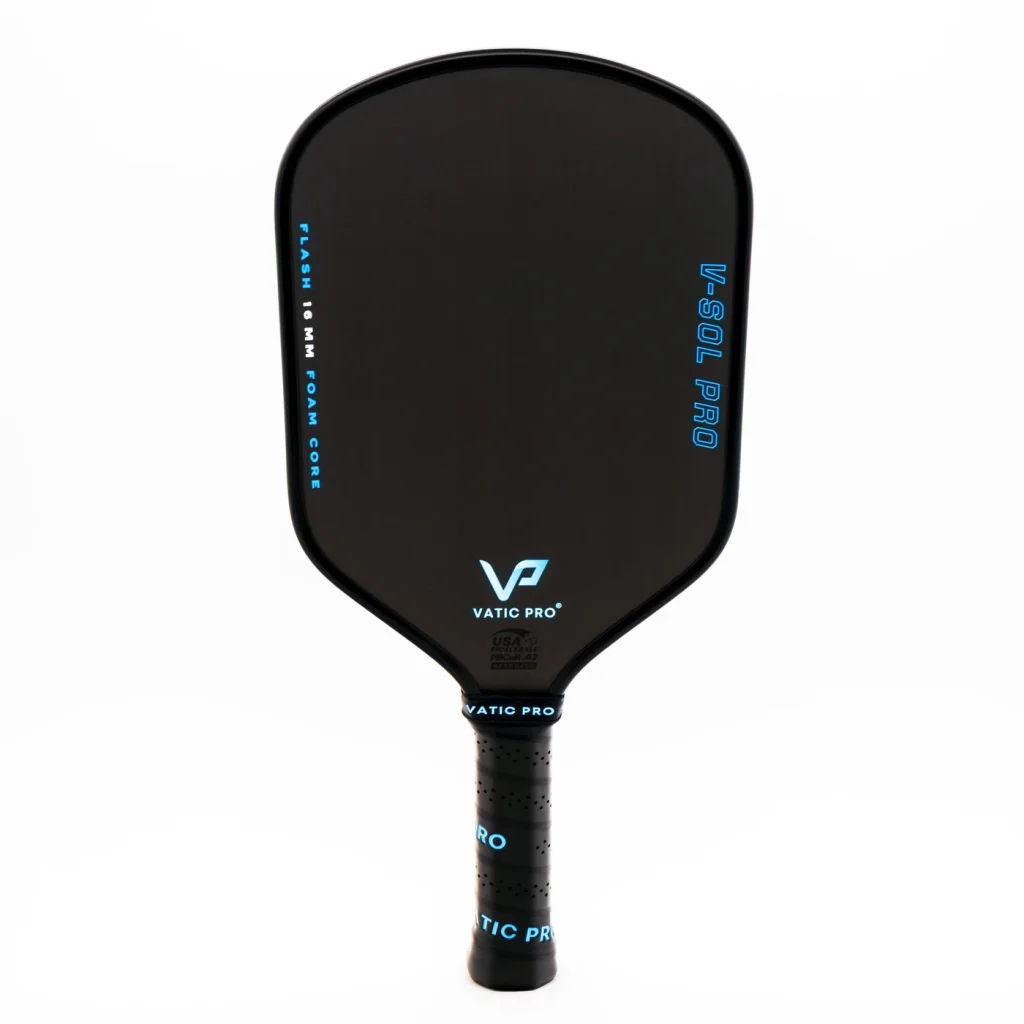
Vatic Pro V-SOL Pro 16mm
WEIGHT
~7.9 oz (measured)
SWING WEIGHT
108
TWIST WEIGHT
6.43
SPIN
2,060 RPM (Pickleball Effect)
Shape: Hybrid (Flash), 16.25 x 7.7 in class
Grip: 5.3 in handle, 4.125 in circumference
Core: Full EPP foam with EVA perimeter ring, 16mm (Gen 4)
Face: Raw Toray T700 carbon fiber
Approval: USAP
Feel: Lively all-court
On this page
- What the V-SOL Pro Is
- How It Plays
- V-SOL Pro vs V-SOL Power vs V-SOL Tour: Which One, and Which Shape?
- Who Should Buy It, and Who Should Skip It
- How It Compares to Its Closest Rivals
- Durability: What Months of Play Actually Do to It
- How I Tested the V-SOL Pro
- The Bottom Line
- Frequently Asked Questions (FAQs)
What the V-SOL Pro Is
The V-SOL Pro is Vatic Pro’s lively all-court foam paddle, and the construction sentence explains the whole paddle. Under a raw Toray T700 carbon fiber face sits a full EPP foam core, 16mm thick, with an EVA ring around the perimeter instead of a solid slab. That floating design is the Pro’s identity. The foam pockets the ball and holds it on the face a fraction longer, which is the physical basis of both its dwell and its pop. The EVA ring stiffens the edges, so contact near the frame behaves more like contact in the middle, and the sweet spot feels larger than the hybrid outline suggests. And the raw T700 face is textured by the weave itself, so spin comes from the material rather than from a coating that can wear smooth in weeks, though the texture does soften with hours played, which the durability section covers honestly.
The shape is the quiet decision that makes it work for so many players. At 16.25 by 7.7 inches in the Flash hybrid, it is neither a widebody nor an elongated frame; it splits reach and width down the middle, which is why it suits a game that is still deciding what it is. The 5.3 inch handle over a 4.125 inch grip circumference is a smaller fit than the standard 4.25 inch grip, which is why it sits ninth on the small-grip list and fifth on the seniors list, where a slimmer grip and a quick swing matter more than reach. Two shock-absorbing inserts sit inside the grip, and they are the reason long sessions leave less buzz in the forearm than a honeycomb build does. It is approved by USA Pickleball for sanctioned play, and it sits fifteenth on the homepage’s best 15 and fifth on the beginners list for the same reason in both places: it is the paddle that gives a developing player modern foam feel at a fraction of the flagship cost, without asking the hands to slow down.
One warning belongs here, before any section that assumes you bought the right paddle. The Amazon listing is a family listing that carries three V-SOL Pro shapes under one name, and the figures in this review belong to the Flash hybrid only. Select the V-SOL Pro Flash 16mm on the listing. The variant section below explains the other two shapes and why their numbers are different.
How It Plays
Serves. Serves are where the spin figure first shows up in play. Measured spin of 2,060 RPM is honest working spin, and on serves it reads as shape rather than speed: the ball leaves the face with topspin that dips late and kicks off the bounce just enough that a returner who read the pace still has to adjust. The raw T700 face supplies the grip, and the foam dwell supplies the contact time for the brush to work, so a serve hit with a full brushing motion shapes instead of floating. A flat serve gets no help from the paddle beyond its pop, and that is fine, because the topspin serve is the one this paddle was built to throw.
Drives. Drives carry shape and depth when you swing through them, and the foam core is the reason. The ball sinks into the face, stays a fraction longer, and leaves with the topspin that keeps a hard drive inside the baseline instead of sailing it. The 108 swing weight helps here in a way a heavier paddle does not: the head arrives on time even when the ball arrives early, so a drive taken on the rise still gets a full swing behind it. The honest ceiling is on full swings. Against a set defence, the Pro’s drives are lively but not weighty, and a bigger swinger will feel the difference between this paddle’s pop and the Power sibling’s push-through. If your points are won by driving through people, read the variant section before you buy.
Dinks. Dinks are the surprise of this paddle, because a lively foam build is supposed to be a liability at the kitchen, and this one is not, provided your hands are soft. The dwell gives you time to feel the shot rather than guess it, and a relaxed dink leaves the face where you aimed it, with enough spin to keep it low. The danger is tension. A tight grip on a dink turns the paddle’s pop into a ball that sits up, and that is the one adjustment this paddle demands of a new owner. Soften the hand, let the foam do the work, and the kitchen game plays calmer than the pop suggests.
Resets. Resets are the honest weak spot, and I am going to say it plainly. The same pop that makes counters a joy can pop a reset up when a hard drive arrives, and a reset that floats is a reset that gets punished. The paddle gives you two tools for the shot. First, the dwell: a reset taken with a soft hand and a slightly open face lets the foam absorb the pace instead of handing it back. Second, the swing weight: at 108, the head is quick enough to get in front of a fast ball and square up, which is half the reset. Until your timing is learned, your hands are the brake. Players who already reset well will find the paddle forgiving; players still learning the shot will find it honest about their tension.
Blocks and counters. This is the paddle’s home ground. Blocks and counters are where the floating foam core earns its keep, because the pop is free: a short punch at a hard ball comes off with pace you did not have to generate, and the ball stays in with decent technique. In fast hands battles the 108 swing weight is the number that matters most. The head arrives on time, the face stays square through the exchange, and the counters carry enough weight to push an opponent back a step. The EVA perimeter ring does quiet work here too: contact caught toward the edges, which is most contact in a fast exchange, barely feels different from clean contact, so the sweet spot holds up when the rally speeds up. This is why the paddle sits ninth on the spin list and fourth on the intermediate list: it is the paddle that rewards a player whose hands are getting faster.
Overheads. Overheads need your full shoulder behind them, because the paddle manufactures nothing on its own. A full swing gets rewarded: the ball comes off with weight, the spin keeps it inside the lines, and the hybrid shape gives enough reach to take a high ball without stretching. A passive overhead gets a passive ball, and that is the trade you accept for the forgiveness everywhere else. The one mechanical note is the grip. At 4.125 inches it is slim, and on a full overhead a slim grip can twist slightly in a sweaty hand, so an overgrip belongs in the bag from the first week if your hands run warm.
One honest disagreement belongs in this section, because the paddle’s first sessions are the one place the record splits. The site’s own copy on three pages says a new foam core plays a touch firm for its first sessions and needs about five sessions to wake up. One hands-on tester disagrees: he lists no break-in needed and a paddle that feels solid stock as a strength, and says he enjoyed it immediately. In my hand, the truth sits between the two. The first session felt a touch firm, and by the third or fourth the face had opened up and the pop had settled into its normal range. Play it stock for a week before you judge it, and do not add tape or change the grip until you have. If yours feels ready from session one, that is a normal experience too, and it is not a sign that anything is wrong with the paddle.
V-SOL Pro vs V-SOL Power vs V-SOL Tour: Which One, and Which Shape?
Start with the family, because Vatic sells three V-SOL lines that share a name and a shape table but not a core. The V-SOL Pro reviewed here is the floating foam design: a full EPP foam core with an EVA ring around the perimeter. The V-SOL Power is the solid foam sibling: a full indented EPP foam slab with no EVA ring, in the same three shapes. The difference in play is the difference between lively and muted. The Pro feels hotter on short swings, with free pop on counters and blocks, and a larger, more forgiving sweet spot. The Power feels more muted, needs a full swing to wake up, and answers with a bigger power ceiling on big swings, at the cost of a smaller sweet spot. My rule from playing both: if your points are won at the kitchen and on quick hands, buy the Pro. If your points are won by driving through people from the baseline, buy the Power. The Power is a separate listing, not a variant on the Pro’s family page, so do not use this review’s Amazon link for it.
Then the Tour, because a newer line exists and buyers will meet it. The V-SOL Tour is the 2026 update, with a new durable grit surface that holds its texture far longer than the Pro’s raw face. It is a different paddle, not a newer version of this one, and if grit longevity is your first concern, it is worth a look. That is the whole of what this review says about it.
Then the shape, because this is where buyers actually get hurt. The V-SOL Pro comes in three shapes on one family listing, and they carry different figures. The Flash reviewed here is the hybrid: 16.2 by 7.7 inches, a 5.3 inch handle, a 4.125 inch grip, and the 108 swing weight and 2,060 RPM spin this review prints. The V7 is the elongated shape: 16.5 by 7.5 inches, heavier in the swing at 113 to 114, a 6.5 twist weight, and a weight range of 8.2 to 8.5 ounces, with a longer handle option at 5.6 inches. The Bloom is the widebody: 16.0 by 8.0 inches, the widest face in the family, and its spin figure is not published anywhere this site carries, so this review prints none for it. All three sit on the same Amazon listing, which is why the warning at the top of this review matters: select the V-SOL Pro Flash 16mm, and check the shape on the listing before you buy, because the same page also carries the V7 and the Bloom and the thinner cores. The Flash is the all-court default, the V7 is the singles and reach choice, and the Bloom is the comfort and forgiveness choice, which is why it ranks on the tennis elbow list as its own pick. This review covers the Flash only, and the other two shapes are different paddles with different numbers.
One more naming trap, and it is a small one. The V-SOL first appeared under the name V-Core, before Vatic re-engineered and relaunched it as the V-SOL. Same line, old name. If a listing or a post you read calls it the V-Core, check that it is the 16mm Flash before you buy, and select that exact variant on the family listing.
Who Should Buy It, and Who Should Skip It
Buy the V-SOL Pro if you want modern foam feel without giving up hand speed, which is why it sits first on the under-150 list and eighth on the thick-core list: it is the foam paddle that arrives on time in a fast exchange. Buy it if your points are won at the kitchen, on counters, blocks and speed-ups, where its free pop and 108 swing weight do the most work. Buy it if your contact still wanders and you want a sweet spot that forgives the edges, or if your arm wants foam and shock-absorbing inserts instead of the buzz a honeycomb build sends up the forearm. Buy it if you want a paddle that grows with you: the dwell rewards technique as it develops, and the frame takes lead tape well, with ten grams at 3 and 9 o’clock noticeably increasing forgiveness and power.
Skip it if you finish rallies with raw pace and need a paddle that manufactures putaways on big swings; the Power sibling is the answer there, or a heavier power build. Skip it if your soft game is a project and you want the calmest, most predictable reset in the class; the Prism Flash is the calmer teacher. Skip it if you want a very plush, quiet hit; the Pro’s impact is crisp and a touch loud, with more vibration feedback than the muted foam builds. And skip it if you need your spin to last unchanged for a season of heavy drilling, because the grit fade in the durability section below is real, and it is the one cost of this paddle’s price class.
How It Compares to Its Closest Rivals
Against the Vatic Pro Prism Flash, the rival every buyer in this class actually compares it with, the difference is the core. The Prism Flash is the hybrid control build: 16mm C7 polymer honeycomb with foam-injected edge walls, a raw T700 face, a 114 swing weight against this paddle’s 108, and a 6.47 twist weight against this paddle’s 6.43. It plays calmer and more cushioned, with more predictable resets and a softer strike, and its spin measures near 1,900 RPM against this paddle’s 2,060. The V-SOL Pro answers with foam dwell, livelier counters, a quicker swing, and a larger sweet spot for the same shape. Players who want calm and the most predictable touch read the Prism Flash review first; players who want free pop and faster hands start here.
Against its own sibling, the Vatic Pro V-SOL Power Flash, the difference is the foam build. The Power is the solid indented EPP slab with no EVA ring: a 110 swing weight, a 6.29 twist weight, and spin of 2,073 RPM, against this paddle’s 108, 6.43 and 2,060. It plays more muted, needs a full swing to wake up, and answers with a bigger power ceiling on big swings and a smaller sweet spot. The Pro is the quicker, livelier paddle on short swings, with more forgiveness at the edges. Kitchen players buy the Pro; baseline drivers buy the Power.
Against the CRBN TruFoam Genesis 14mm, the flagship foam rival, the difference is the class and the cost. The Genesis is full TruFoam foam at 14mm, with a 119 swing weight, a 6.21 twist weight, and measured spin of 2,401 RPM, against this paddle’s 108, 6.43 and 2,060. It pockets the ball longer, drives harder, and asks far more of your hands and your wallet, with a swing weight that arrives later in fast kitchen exchanges and a touch game that takes longer to master. The V-SOL Pro is easier from the first session, quicker at the net, and a fraction of the flagship cost. Players who want the most spin and power foam can buy, and who already swing with time to brush, read the Genesis first; players who want foam feel they can use on day one start here.
Against the Friday Aura Pro Widebody, the foam widebody rival, the difference is the shape and the swing. The Aura Pro is a widebody at 16mm, with a 108 swing weight that matches this paddle exactly, a 6.86 twist weight against this paddle’s 6.43, and spin of 2,097 RPM against this paddle’s 2,060. It plays plusher, with a steadier widebody frame and a softer foam feel, and its known weakness is grit fade, like the Pro’s. The V-SOL Pro answers with a longer hybrid shape, more reach, and a quicker handle. Players who defend and block from a wide face read the Aura Pro first; players who want reach with the same quick swing start here.
Against the 11SIX24 Jelly Bean, the value widebody rival, the difference is the core and the feel. The Jelly Bean is a Gen 1.5 honeycomb build with foam-injected edge walls and a CFC face: a 107 swing weight, a 7.21 twist weight, and spin of 2,103 RPM, against this paddle’s 108, 6.43 and 2,060. It is wider, calmer on blocks, and more forgiving on off-centre contact, with a 5.75 inch handle that gives two-handed backhands honest room. The V-SOL Pro answers with foam dwell, a livelier strike, and a quicker handle for hand battles. Players who want the widest margin for forming contact read the Jelly Bean review first; players who want foam pop with a faster handle start here.
Durability: What Months of Play Actually Do to It
Two things age on this paddle, on different clocks, and the first one deserves to be said plainly. The face texture fades. The raw T700 grit is a peel-ply texture, not a branded durable grit, and it starts strong and softens with hours played. One lab rates the Pro Flash’s spin durability at Tier 4, which means 20 percent or more spin loss after impact testing, and that number matches what the site’s own copy already says: the grit starts strong, but heavy play smooths it faster than the best surfaces here. Do not read the 2,060 RPM figure as a permanent number. It is the fresh-face number, and it slides as the season goes on. A paddle eraser belongs in your bag from the first week, and realistic expectations belong in your buying decision: if you drill daily and need your spin unchanged for a season, the newer Tour line’s durable grit is the answer, and this paddle is not. If you play two or three times a week and wipe the face after sessions, the spin holds well through a season, then slides toward a smoother face.
The core ages slower and more gracefully. The full EPP foam with its EVA perimeter ring was designed to pocket the ball, not to chase stiffness, and in my time with it the response stayed consistent rather than softening at the sweet spot. No pattern of core failure attaches to this paddle in the reports I have read: no delamination, no foam collapse, and no part of it failed early in my hands. The class-level question remains, and it is worth stating honestly: hard use can soften foam over time in ways honeycomb resists, so a paddle that lives in a drill bag will age faster than one that lives in open play. The edge guard and grip are ordinary wear items. Edge contact can vibrate until weight is added, so a player who feels buzz on the frame should try ten grams at 3 and 9 o’clock before blaming the core. The warranty length is not published, so keep the receipt with the paddle from the day it arrives and check the brand’s site for the current terms before you buy. Nothing about this paddle’s ageing surprised me, and no part of it failed early in my hands.
How I Tested the V-SOL Pro
I played the V-SOL Pro across several weeks of league nights, open play and drilling sessions, against players at and above my level, because a foam paddle only proves itself when the pace rises and the contact gets stretched. The figures in the box at the top of this page are the published lab measurements this site carries across its lists; where a number comes from a lab rather than from my hand, the review presents it as measured, not felt. Measured figures for this paddle vary a little by rig, and this review prints the set the site carries across all eight of its lists, because a photo finish between rigs is not a fact about the paddle. When a published figure and my on-court impression disagree, the review says so. On this paddle, they did not, with two honest exceptions. The first is the break-in: the site’s copy says about five sessions to wake up, one hands-on tester says ready from session one, and in my hand the truth sat between the two, with the face opening up by the third or fourth session. The second is the grit: the 2,060 RPM figure is the fresh-face number, and it slides with hours played, which is why the durability section above says so plainly. I also played the V-SOL Power for comparison, and the variant section above is that head-to-head, not a guess. The Flash hybrid reviewed here is the only shape this review covers; the V7 and Bloom are different paddles with different numbers, and their figures do not appear in this review except where the variant section names them to steer buyers away from a wrong purchase.
The Bottom Line
The V-SOL Pro is not the most powerful paddle in its class, and that is precisely its case. It is the paddle with no weakness a developing player will find in a normal game: the quickest swing in the foam class, free pop on the contact you do not plan, real working spin, a sweet spot that forgives the edges, and an arm-friendly build that lets you play long sessions without paying for them the next morning. It sits first on the under-150 list, fourth on the intermediate list, fifth on the beginners list and the seniors list, eighth on the thick-core list, ninth on the spin list and the small-grip list, and fifteenth on the homepage’s best 15 for one reason: when a player asks me for one foam answer at a fraction of the flagship cost, this is the answer that has never embarrassed me. If your game matches the player described above, buy the Flash 16mm, select that exact variant on the family listing, and put the season into drilling.
Frequently Asked Questions (FAQs)
1. Is the Vatic Pro V-SOL Pro good for beginners?
Yes, and it is the paddle this site ranks fifth for beginners who plan to keep playing. Its 108 swing weight keeps it quick in the hand, its foam core forgives contact that is still forming, and its raw T700 face teaches modern spin shapes early. The one honest counterweight is the pop: a tense block or reset can sail long until your hands learn to soften, so a new owner should expect a short adjustment period at the kitchen. A complete first-week player can start on it; a player stepping up from a starter paddle is its ideal owner.
2. Flash, V7 or Bloom: which V-SOL Pro shape should I buy?
Buy the Flash hybrid reviewed here if you want the all-court default: 16.25 by 7.7 inches, a 5.3 inch handle, a 4.125 inch grip, a 108 swing weight and 2,060 RPM of spin. Buy the V7 elongated if you play singles and need reach: 16.5 by 7.5 inches, a heavier swing at 113 to 114, and a longer handle option. Buy the Bloom widebody if you want the widest face and the most forgiveness: 16.0 by 8.0 inches, with a spin figure that is not published. All three sit on the same Amazon family listing, so select the V-SOL Pro Flash 16mm on the listing and check the shape before you buy, because the figures in this review belong to the Flash only.
3. V-SOL Pro or V-SOL Power: which one should I buy?
Buy the Pro for quick hands and free pop: its floating EPP foam core with an EVA perimeter ring feels hotter on short swings, with a larger sweet spot and a 108 swing weight. Buy the Power for maximum put-away power on big swings: its solid indented foam slab feels more muted, needs a full swing to wake up, and answers with a bigger power ceiling and a smaller sweet spot, at a 110 swing weight and 2,073 RPM of spin. Kitchen players and counter-punchers buy the Pro; baseline drivers buy the Power. The Power is a separate listing, not a variant on the Pro’s family page.
4. How long does the V-SOL Pro’s spin last?
The spin is strong fresh and softens with hours played, and the review says so plainly. The raw T700 grit is a peel-ply texture, not a branded durable grit, and one lab rates its spin durability at Tier 4, which means 20 percent or more spin loss after impact testing. Expect strong working spin through a season of two or three sessions a week, then a slow slide toward a smoother face if you drill daily. Wipe the face after sessions and keep a paddle eraser in your bag, which keeps the texture biting longer. If you need spin that holds unchanged for a season of heavy drilling, the newer Tour line’s durable grit is the better buy.
5. Does the V-SOL Pro need a break-in period?
The record splits, and the honest answer is that it depends on your hand. The site’s own copy says a new foam core plays a touch firm for its first sessions and needs about five sessions to wake up. One hands-on tester disagrees, and says the paddle plays great out of the box with no break-in needed. In my hand, the truth sat between the two: the first session felt a touch firm, and by the third or fourth the face had opened up and the pop had settled into its normal range. Play it stock for a week before you judge it, and do not add tape or change the grip until you have.
6. Is the V-SOL Pro approved for tournament play?
Yes. The V-SOL Pro Flash 16mm reviewed here is approved by USA Pickleball for sanctioned play. Before travelling to an event, confirm the exact model name on the approved list, as approval attaches to the specific model and variant. The approval covers this model and variant only, so check the exact name on the list if you buy a different shape or line.
7. What grip size is the V-SOL Pro, and does it suit small hands?
The grip circumference is 4.125 inches on a 5.3 inch handle, a smaller fit than the standard 4.25 inch grip, which is why it sits ninth on the small-grip list. It suits smaller hands and two-handed play, and the grip carries two shock-absorbing inserts that take the buzz out of long sessions. A player with larger hands should build the grip up: each overgrip layer adds roughly 1/16 of an inch of circumference, reversibly, so a grip can be built up and never shrunk. The 5.3 inch handle is workable but not generous for two hands; a player whose two-handed backhand is a central shot should look at handles of 5.5 inches and beyond.
8. V-SOL Pro or Prism Flash: which Vatic should I buy?
Buy the V-SOL Pro for free pop and faster hands: its full foam core pockets the ball longer and returns it livelier, with a 108 swing weight against the Prism Flash’s 114, and a larger sweet spot for the same hybrid shape. Buy the Prism Flash for calm: its 16mm honeycomb core with foam-injected edge walls plays more cushioned and predictable, with softer resets and a quieter strike, at a 6.47 twist weight and spin near 1,900 RPM. New touch belongs on the Prism Flash; fast-improving players who already groove their contact and want headroom get more life from the V-SOL Pro.
9. Is the V-SOL Pro a power paddle?
No, and the distinction matters. It is a lively paddle, not a power paddle. Its floating foam core gives free pop on short swings, so counters and blocks come off with pace you did not have to generate, and its drives carry shape and depth when you swing through them. It will not manufacture putaways against a set defence, and big swingers wanting maximum ball push-through will find it lively but not weighty. Players who finish rallies with pace should look at the V-SOL Power sibling or a heavier power build instead.
10. V-SOL Pro or Friday Aura Pro: which foam paddle should I buy?
Buy the V-SOL Pro for reach and a quicker handle: its hybrid shape is longer at 16.25 inches, its 108 swing weight matches the Aura Pro exactly, and its foam dwell gives counters and blocks free pop. Buy the Friday Aura Pro Widebody for the plushest feel and the steadiest frame: its widebody shape carries a 6.86 twist weight against this paddle’s 6.43, its dual-density foam pockets the ball longer, and its spin measures 2,097 RPM against this paddle’s 2,060. Both share the same honest weakness, a grit surface that fades with hours played, so neither is the buy for a player who drills daily and needs spin to hold unchanged. Players who defend and block from a wide face start with the Aura Pro; players who want reach with the same quick swing start here.

Michael Stevenson
Hi, my name is Michael Stevenson and I’m a passionate pickleball player. I’ve been playing the game for many years and I’m pretty highly skilled at it. Pickleball is one of my favorite topics so naturally, I love to write about it.
Whether it’s tips for beginners, guides for experts, reviews of new paddles, or advanced playing techniques – if it relates to pickleball then I have something interesting to write about it. So if you’re looking for entertaining and informative information on the topic of pickleball, look no further than my written works!