
ATP pickleball shots look like a trick the first time you see one, because the ball never crosses over the net at all.
Instead, the ball travels around the outside of the net post, below the height of the tape, and lands inside the opponents’ court. Around the post is what the letters mean, and the shot is legal, rare and almost impossible to return when it lands.
You will also learn when the chance appears, the five steps that hit it cleanly and the way good teams defend against it. An ATP pickleball shot is not a shot you plan at the start of a rally, because the opponent creates it for you.
On this page
- ATP Pickleball Meaning: A Shot That Goes Around the Post
- The ATP Rules: Why This Shot Is Legal
- When an ATP Is On: The Wide Ball Decides Everything
- How to Hit an ATP: Five Steps From Wide Ball to Winner
- ATP vs Erne: Two Shots Played Beside the Post
- Defending an ATP: How Good Teams Take It Away
- The ATP in Pro Play: A Shot That Keeps Growing
- The Risks: Why Most ATP Attempts Fail
- Frequently Asked Questions (FAQs)
- Conclusion
ATP Pickleball Meaning: A Shot That Goes Around the Post
ATP pickleball terminology confuses new players only until they watch one rally where a dink lands wide and keeps travelling past the sideline. ATP stands for around the post, and the name describes the ball’s path exactly, because the ball passes beside the post itself.
That is the whole ATP meaning in pickleball: three letters for a return that goes around the post instead of over the net. Tennis players hit the same shot around their net posts, so ATP in pickleball is borrowed language for a shared piece of geometry.
Watch the late rounds of a pro event or Nationals and you will see the shot attempted whenever a dink pulls somebody wide. At club level it appears far less often, because the wide ball that creates it needs a sharp angle most rallies never produce.
The shot is a return only, never a serve, because a serve must cross the net into the correct service box under the rules. Any player can attempt it from either side of the court, forehand or backhand, whenever the wide ball gives them the line around.
The ATP Rules: Why This Shot Is Legal
The legality question ends with the ATP in pickleball rules, because the 2026 USA Pickleball rulebook gives this ball its own named subsection.
Rule 13.C says a player may return the ball around the outside of the net post, and the ball need not cross the net. The same rule sets no height restriction on the return, so the ball may legally pass below the height of the net itself.
The return only has to land inside the opponents’ court, on the correct side, before it bounces twice or hits anything beyond the lines. Three paths around the post are faults instead, and knowing them matters because players lose rallies every week by choosing the wrong gap.
- A ball squeezed through the small gap between the net and the post is a fault under Rule 13.D, every single time it happens.
- A ball that travels under the net is a fault under Rule 13.E, because it never legally crossed to the opponents’ side at all.
- A ball that clips the post or the net supports on your own side before crossing is a fault under Rule 13.B as well.
- Touching the net system with your body or paddle while the ball is live is a fault, however clean the return itself looks.
- Stepping onto the opponents’ court while the ball is live is also a fault, and your momentum does not excuse the step afterwards.
You may cross the plane of the net only after contact, on your follow-through, never before the paddle has met the ball cleanly. Most ATP disagreements are settled by the players involved, because partners call faults on themselves and opponents call the net faults they see.
If a ball clearly goes around the post and lands in, the rally simply continues or ends, and no argument changes the geometry involved. One 2026 clarification helps attackers: a ball that lands in and then spins or blows into the post still wins the rally outright.
The full text sits in the official USA Pickleball rulebook, which every player attempting this shot in matches should read at least once.
When an ATP Is On: The Wide Ball Decides Everything
Nobody chooses an ATP before the rally starts, because the shot only exists when the opponents’ ball finishes wide of your sideline completely. The classic trigger is a sharp crosscourt dink that lands inside the kitchen and keeps carrying outward after the bounce lands.
That angle pulls you off the court entirely, past the sideline and often past the post itself, before you can reach the ball. From out there, sending the ball back over the net means bending it around the post anyway, so the direct line is open.
A hard angled drive can create the same picture at the baseline, although the run is longer and the window closes much faster.
ATP pickleball chances belong to the opponent’s best angled ball, and your only job is recognising the picture early enough to use it. Read the chance from the opponent’s paddle face and contact point, because a closed face angled crosscourt is the earliest warning you get.
In singles the same wide ball is even more valuable, because no partner exists to slide across and block the line around the post. In doubles the shot must beat two players, the one pulled wide and the partner whose whole job becomes covering the post area.
How to Hit an ATP: Five Steps From Wide Ball to Winner
Learning how to hit an ATP in pickleball starts with understanding how an ATP works in pickleball: position first, swing second, always.
Step 1: Move Outside the Post Early
Commit to the wide line the moment the angle appears, because late feet leave you reaching back across your body at the ball.
Step 2: Let the Ball Travel Past the Post
Wait until the ball is beside or beyond the post before you swing, because contact made earlier sends the ball into the net.
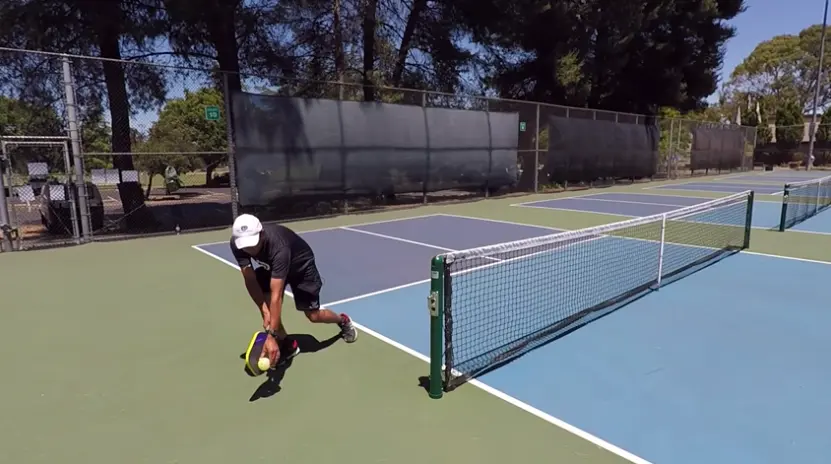
Step 3: Get Low and Open the Paddle Face
Bend your knees until the paddle sits near the height of the ball, since most ATP returns travel below the tape by design.
Step 4: Swing Along the Line, Not Across It
Swing forward along the sideline’s direction with a compact motion, guiding the ball around the post rather than trying to lift it over.
Step 5: Aim Deep Into the Open Court
Aim for the deep half of the opponents’ court, because a short ATP sits up for the one defender who read it early.
The backhand version works the same way from the other side, with the paddle turned over and the same low, compact guiding swing. You can drill the movement on your own, shadowing the run and swing, before you ever try it against a fed wide ball.
ATP pickleball practice should stay patient, because the shot appears in matches only when the opponent’s angle honestly offers it to you.
Start with fed balls from the kitchen line, where the angle is gentle and the run is short enough to groove the footwork pattern. Move the feeds wider over the weeks, and only chase the full line once the low guiding swing stays compact under real pressure.
ATP vs Erne: Two Shots Played Beside the Post
The Erne and the ATP share one address, the space beside the net post, and that shared address is why players confuse them. An Erne is a volley struck beside the post by a player who stepped around the kitchen corner to cut the ball off early.
An ATP is usually struck after the bounce, from further wide, by a player the opponents’ angle has dragged completely off the court.
The Erne attacks a ball that is coming over the net, while the ATP answers a ball that has already gone past it wide. ATP pickleball players learn both shots together, because the same wide dink that offers one often threatens the other on the next rally.
Players attempt Ernies far more often, because cutting a ball off happens weekly, while a true ATP opening needs a rarer wide angle.
Defending an ATP: How Good Teams Take It Away
A clean ATP is almost always a winner, because the ball arrives from outside the court picture the defenders are set up to watch. The defence starts one shot earlier, with the partner of the player who hit the wide angle sliding toward the post to cover it.
That covering partner stands outside the sideline near the post, paddle up, ready to block a ball that never crosses the net at all. The movement is a cousin of poaching, because one partner crosses into space the other partner has just vacated under real pressure.
Teams also defend by refusing the trigger, hitting their dinks toward the middle third of the kitchen where no wide angle exists. ATP pickleball defence is therefore a team habit, not one player’s scramble, and it is coached long before it is needed in matches.
Coaches call that slide the ATP defence, and drilling it for five minutes weekly removes most surprise the shot will ever cause you.
The ATP in Pro Play: A Shot That Keeps Growing
Professional pickleball turned the ATP into a signature moment, because broadcast cameras catch the full run and the low line around the post. Rally highlights from the major tours now feature the shot regularly, which is why newer fans arrive at clubs already knowing its name.
The pros also changed the defence, because tour partners now sprint to the post the moment their own angle leaves the paddle wide. A blocked ATP at pro level often becomes the next highlight, since the block sits up for a counter from the covering partner there.
For club players the lesson is simple: the shot is coached, drilled and defended now, not treated as luck when it occasionally appears.
The Risks: Why Most ATP Attempts Fail
ATP pickleball attempts fail most often at the swing, started too early, which sends the ball into the post or the gap instead. The second failure is aiming too fine, because the deep target shrinks quickly when you are moving at full stretch outside the court.
A failed attempt also leaves you stranded off the court, and the opponents’ next ball into the open space usually ends the rally there.
That is why experienced players treat the shot as an answer, not an ambition, and wait for the wide ball to invite it. Chasing a wide ball also takes you toward fences, benches and court dividers, so the run itself deserves the same respect as the swing.
Frequently Asked Questions (FAQs)
1. What does ATP stand for in pickleball and what does it mean exactly?
ATP stands for around the post, and it names a return that travels around the outside of the net post into the opponents’ court. The shot is legal, it needs no height over the net, and it usually appears when a wide dink pulls a player wide.
2. Is an ATP shot legal in pickleball under the current official rules today?
Yes, Rule 13.C of the 2026 USA Pickleball rulebook allows a return around the outside of the net post, with no height restriction attached.
3. What is the around the net shot called in pickleball and is it legal?
It is called an ATP, short for around the post, because the ball passes around the post rather than travelling over the net itself.
4. What is the difference between an Erne and an ATP shot in pickleball?
An Erne is a volley hit beside the post by a player cutting the ball off, while an ATP answers a ball already wide. The Erne player jumps or steps around the kitchen corner, while the ATP player has been pulled completely outside the sideline by angle.
5. What is an ATP winner in pickleball and why is it so hard to return?
An ATP winner is a successful around-the-post return that lands where the defenders cannot reach it, from outside the court they are watching. The covering partner can block it by sliding to the post early, which is why good teams rarely concede a clean one twice.
6. How do you defend against an ATP shot when your partner gets pulled wide?
Slide toward the post on your partner’s side as soon as their wide ball leaves the paddle, and set your paddle outside the sideline. You are blocking a ball that will never cross the net, so your position and paddle belong beside the post, not behind it.
7. Can you hit an ATP shot on a volley or must the ball bounce first?
Either contact is legal, because the rules govern the ball’s path around the post, not whether it bounced before you struck it cleanly. Most ATPs come after the bounce, because the wide ball needs time and angle to carry a player far enough beyond the post.
8. Does an ATP shot have to travel above the height of the net tape?
No, the return may pass below the height of the net, because Rule 13.C places no height restriction on a ball around the post.
Conclusion
ATP pickleball rewards the player who recognises one picture early: a ball finishing wide enough to open the line around the post itself.
Learn the rules that make it legal, drill the five steps without forcing them, and the shot will find you at the right moment. Defend it as a team, attempt it as an answer, and it stops being a trick and becomes part of your game instead.

Michael Stevenson
Hi, my name is Michael Stevenson and I’m a passionate pickleball player. I’ve been playing the game for many years and I’m pretty highly skilled at it. Pickleball is one of my favorite topics so naturally, I love to write about it.
Whether it’s tips for beginners, guides for experts, reviews of new paddles, or advanced playing techniques – if it relates to pickleball then I have something interesting to write about it. So if you’re looking for entertaining and informative information on the topic of pickleball, look no further than my written works!