
The Six Zero Coral Pro is a spin-first all-court paddle. It comes in three shapes: Hybrid, Widebody and Elongated. All three share the same 16mm Tectonic Core with ProPulsion Foam. The core is full foam, with no honeycomb inside. The face is what makes this paddle different.
It is Double Diamond Tough raw carbon fiber. Double Diamond Tough means the face carries roughly twice the diamond particles of the original Coral face. Diamond particles are tiny hard grains worked into the surface texture. They grip the ball and they keep gripping it long after a plain raw carbon face goes smooth.
Read this warning first. Six Zero sells two versions of this paddle. One version is approved by UPA-A only. The other version is approved by both UPA-A and USA Pickleball. USA Pickleball is the sport’s governing body in the United States. UPA-A is the pro tour body.
The two versions look the same and share the same name. Only the dual-approved version is legal for a USA Pickleball event. Check the exact version on the listing before you buy. This review covers the paddle itself. The approval version you buy is your choice, and the choice matters.
I tested all three shapes. I compared them against lab measurements and the brand’s own figures. I kept Coral Pro figures apart from base Coral figures. The two paddles share a name and a platform, but they play differently. Mixing their figures would mislead a buyer.
The Hybrid leads this review. It has the most balanced swing in the line, the shape the brand points new buyers toward, and the shape both hands-on testers reached for first. The Widebody is the most forgiving shape.
The Elongated has the longest reach and the longest handle. The trade-off is simple. You get the hardest spin in the measured database and a face that keeps its bite. You give up the plush feel, and you pay with a stiff face and dead side edges.
My verdict is short. The Hybrid is the best Coral Pro for most players. It is a spin-first all-court paddle with a firm feel, a balanced swing, and grit that lasts.
Recommendations:
- Buy the Hybrid if you want the best all-court balance and the shape to start with.
- Buy the Widebody if you want the most forgiving shape and the quickest swing.
- Buy the Elongated if you want the longest reach and the most room for a two-handed backhand, and you can carry a 117 swing weight.
- Buy the original Coral instead if you want a softer, calmer feel and you do not need the extra spin.
- Buy the Black Opal instead if you want raw power first.
- Skip the Coral Pro if you want a plush feel, or if you need the cheapest path to a USAP-approved paddle and will not check the version.
My score: 8.7/10
WHAT I LIKE
- The hardest measured spin in the database, at 2,481 RPM
- Spin that holds: no measurable loss after 100 high-speed impacts, and no noticed loss after about 23 and a half hours of play
- Enough pop for hands battles without launching blocks
- The most balanced shape in the line, with useful reach and a manageable swing
- A dual-approved version exists for USA Pickleball events
WHAT I DON’T
- A stiff, crisp face with no plush pocketing feel
- Dead side edges: off-center hits near the sides drop fast
- Dinks and roll-dinks need an adjustment period because the face grabs early
- No top-end putaway power for a raw power game
- Two approval versions sold under one name, so the buyer must check the exact version
On this page
- The Six Zero Coral Pro Hybrid 16mm: The One I Would Buy
- The Six Zero Coral Pro Widebody 16mm: The Most Forgiving Shape
- The Six Zero Coral Pro Elongated 16mm: The Longest Reach
- Hybrid, Widebody or Elongated: The Variant Decision
- Six Zero Coral Pro vs the Original Coral
- Coral Pro or Black Opal: Which Six Zero Should You Buy?
- Rivals
- Durability
- How I Tested
- The Bottom Line
- Frequently Asked Questions (FAQs)
The Six Zero Coral Pro Hybrid 16mm: The One I Would Buy
My score for the Hybrid 16mm: 8.7/10
The Hybrid is the best Coral Pro, and the score above is its score. It is the paddle I would hand to an intermediate or advanced player who shapes the ball to win points. It is also the most balanced shape in the line, because it gives up the least and asks the least of your hands.
The headline is the spin. The Hybrid is measured at 2,481 RPM. RPM means revolutions per minute. It is the count of how fast the ball spins.
That figure sits at the top of the measured database, in the 99th percentile. The face is what makes it. Double Diamond Tough is a rougher carbon face with roughly twice the diamond infusion of the original Coral face.
The texture is about two and a half times rougher than standard raw carbon, per the brand. Roughness is what grips the ball. The grip shows up most on shots with almost no swing behind them.
Short rolls, flicks and dipping counters still grab the ball. Serves dip sooner. Roll volleys drop more sharply. Topspin dinks pull opponents farther off their spot. Slice works the same way. Returns stay lower and defensive slices carry more action.
The spin lasts. That is the second headline, and it matters more than the first number. One lab ran 100 high-speed impacts on the same spot and measured no spin loss at all.
Spin rose slightly, by less than one percent, likely because the top layer wore away and exposed more diamond particles. That result puts the face in the top durability tier, the tier where a surface loses no measurable spin.
A second hands-on tester played the paddle for about 23 and a half hours across all three shapes and noticed no loss of bite. Serves kept dipping, rolls kept grabbing, and slice stayed easy to produce.
Most raw carbon faces fade with hours of play. This one does not, in any test run so far. The durability section below carries the full detail.
The core is what makes the spin usable. The core is the Tectonic Core with ProPulsion Foam. Tectonic Core means a floating foam center core surrounded by a floating EVA foam band. EVA is a softer foam that absorbs shock. ProPulsion Foam is the brand’s foam blend for dwell time and consistency.
Dwell is the ball sitting on the face a moment longer before it leaves. The core is 16mm thick. The face is 300K Japanese Toray carbon. Toray is a carbon fiber maker. 300K is a grade of that fiber. The build is Gen 4, which means the fourth generation of the foam-core design, with no honeycomb inside.
The feel follows the build. The Coral Pro plays firmer than the original Coral. It is not harsh, but it is noticeably stiffer at contact. The ball comes off the face quickly. There is still cushion, but I would not call it pillowy. The face is crisp and direct.
A crisp face means the ball leaves fast with little dwell. That firmness is the cost of the spin. A player who loves a soft, plush pocketing feel will not find it here. A player who loves a firm, responsive face will feel at home at once.
The numbers back the feel. Swing weight is 114. Swing weight measures how heavy a paddle feels when you swing it. A higher number means a heavier swing. At 114, the Hybrid is the middle swing in the line. Twist weight is 6.79. Twist weight measures how much the face twists on off-center hits.
A higher number means more stability. At 6.79, the Hybrid is the middle stability in the line. Weight is 8.2 oz. The shape is 16.3 x 7.5 to 7.7 in. The grip is a 5.5 in handle with a 4.0 to 4.13 in circumference. That handle suits a two-handed backhand.
The Hybrid has enough pop to survive hands battles. It has enough pace to pressure defenders. It does not launch blocks. The harder I swing, the more pace I get, and no ordinary block suddenly launches high. That control is the point of this paddle.
It is an all-court paddle, which means it suits every part of the court rather than one part only. It is not a raw power paddle. It lacks the top-end putaway power of heavier offensive paddles. If you want the paddle to generate pace for you, this is not the paddle.
The limits are real. The sweet spot feels dead on the side edges. Off-center hits near the side edges drop dead much faster than expected. Fine touch shots demand precise center-face contact. The face grabs early on soft shots. A lazy drop or dink can pick up spin you did not order.
Dinks and roll-dinks need an adjustment period before the trajectory settles. Once your hands catch up, that extra grab becomes useful. You can pull a dink wider or roll one down sooner without a bigger swing. But the first sessions will leak a few soft shots long or wide.
The approval status needs care. The Coral Pro comes in two versions. One is UPA-A only. The other is approved by both UPA-A and USA Pickleball. A registry check in late November 2026 found USA Pickleball Pass records for all three Pro shapes.
A second registry check the next day found USA Pickleball approval only for the standard Coral and the Coral Pro Hybrid, with the Pro Elongated and Pro Widebody listed as UPA-A only.
The two checks disagree, and the brand sells both versions side by side. Buy the dual-approved version if you play USA Pickleball events. Check the exact version on the listing. Do not assume a Coral Pro is approved for your event.
The warranty is Not published. Six Zero’s own warranty terms could not be verified for this review. Retailers list a 12-month limited structural warranty, and one comparison table lists Six Zero at 6 months with registration. I print no figure because the brand terms are unverified.
AT A GLANCE
Six Zero Coral Pro Hybrid 16mm
WEIGHT
8.2 oz
SWING WEIGHT
114
TWIST WEIGHT
6.79
SPIN
2,481 RPM
Shape: Hybrid, 16.3 x 7.5-7.7 in
Grip: 5.5 in handle, 4.0-4.13 in circumference
Core: Tectonic Core with ProPulsion Foam, 16mm
Face: Double Diamond Tough raw carbon fiber
Approval: USAP and UPA-A. Dual-approved version only
Feel: Crisp, stiff, spin-first all-court
Best for: Spin-first all-court play, best balance in the line
Warranty: Not listed
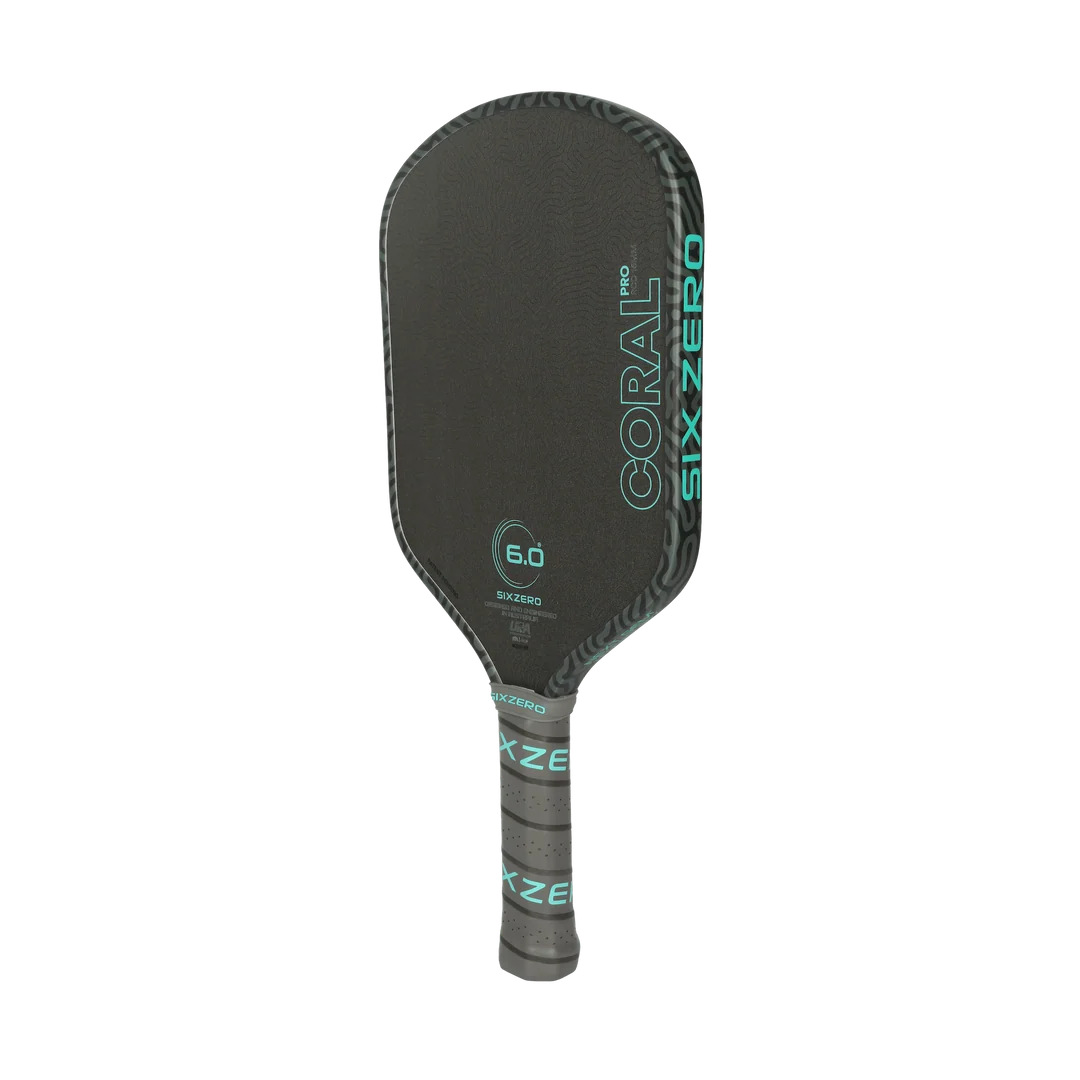
The Six Zero Coral Pro Widebody 16mm: The Most Forgiving Shape
My score for the Widebody 16mm: 8.6/10
The Widebody is the most forgiving Coral Pro. It is the shape I would hand to a player whose bigger problems are late contact, defense and fast hands. The core and face are the same Tectonic Core with ProPulsion Foam and Double Diamond Tough raw carbon fiber described in the Hybrid section above. The shape is the difference.
The Widebody is the quickest swing in the line. Swing weight is 110. Twist weight is 7.1. That pair is the best in the line. The lowest swing weight and the highest twist weight sit in the same shape. That means quick hands and a steady face together.
The wider hitting area gives the most confidence during resets, blocks and defensive exchanges. The Widebody felt quickest and steadiest in fast exchanges in hands-on testing. It gave the most protection when a speedup caught the player late. Its sweet spot is the widest of the three shapes.
The spin is the highest of the three shapes. It is measured at 2,485 RPM, the top figure in the measured database. The shape is 15.8 x 8 to 8.1 in. It is the shortest shape in the line and the widest. The grip is the same as the Hybrid: a 5.5 in handle with a 4.0 to 4.13 in circumference.
I print 8 to 8.1 in for the width. The brand prints the range reversed as 8.1 to 8 in. I print 15.8 in for the length. The brand previously showed 16 in and now lists 15.8 in. The weight has no single settled figure, so it reads as the brand range of 8.0 to 8.3 oz.
The limits match the line. The Widebody is the same stiff, crisp face with the same dead side edges. The approval version trap is the same: buy the dual-approved version for USA Pickleball events.
The cost of this shape is reach. It has the least reach and the least baseline leverage of the three. A player who needs length for singles or for stretched returns will feel the short frame.
AT A GLANCE
Six Zero Coral Pro Widebody 16mm
WEIGHT
8.0-8.3 oz
SWING WEIGHT
110
TWIST WEIGHT
7.1
SPIN
2,485 RPM
Shape: Widebody, 15.8 x 8-8.1 in
Grip: 5.5 in handle, 4.0-4.13 in circumference
Core: Tectonic Core with ProPulsion Foam, 16mm
Face: Double Diamond Tough raw carbon fiber
Approval: USAP and UPA-A. Dual-approved version only
Feel: Quick, steady, most forgiving
Best for: Forgiveness, quick hands, steadiest face
Warranty: Not listed
The Six Zero Coral Pro Elongated 16mm: The Longest Reach
My score for the Elongated 16mm: 8.5/10
The Elongated is the longest Coral Pro. It is 16.5 x 7.3 to 7.5 in. It has the most reach and the most baseline leverage. The core and face are the same Tectonic Core with ProPulsion Foam and Double Diamond Tough raw carbon fiber described in the Hybrid section above. The shape is the difference.
The numbers are 8.0 oz in weight, 117 swing weight, and 5.9 twist weight. The Elongated has the heaviest swing in the line. It also has the lowest twist weight in the line. That pair is the trade-off of this shape.
You get reach and leverage. You pay with hand speed and stability on off-center hits. The twist spread across the line is large: 7.1 on the Widebody against 5.9 on the Elongated. That is a real gap in stability, not a rounding difference.
The Elongated punished edge contact more than the other two shapes in hands-on testing. When contact wandered toward the side, the face moved enough to let the player know about it. The shape needs cleaner contact closer to the center of the face. It is the least forgiving shape in the line. That is the cost of the length.
The handle is the longest in the line at 5.75 in. That extra quarter inch gives the most room for a two-handed backhand. Two-handed backhand means both hands on the handle for the backhand shot. The grip circumference is the same as the other shapes: 4.0 to 4.13 in. The spin is measured at 2,483 RPM, equal to the other shapes.
The approval and warranty are the same as the Hybrid above: buy the dual-approved version for USA Pickleball events, and the warranty reads Not published. I print 117 for the swing weight. One lab measures 114 on its unit. I print 5.9 for the twist weight. One lab measures 6.0.
AT A GLANCE
Six Zero Coral Pro Elongated 16mm
WEIGHT
8.0 oz
SWING WEIGHT
117
TWIST WEIGHT
5.9
SPIN
2,483 RPM
Shape: Elongated, 16.5 x 7.3-7.5 in
Grip: 5.75 in handle, 4.0-4.13 in circumference
Core: Tectonic Core with ProPulsion Foam, 16mm
Face: Double Diamond Tough raw carbon fiber
Approval: USAP and UPA-A. Dual-approved version only
Feel: Long reach, most leverage, least forgiving
Best for: Long reach, baseline leverage, two-handed backhands
Warranty: Not listed
Hybrid, Widebody or Elongated: The Variant Decision
The shape choice is a swing-weight and twist-weight choice. The Widebody swings at 110. The Hybrid swings at 114. The Elongated swings at 117. Each step up buys reach and leverage.
Each step up costs hand speed. The twist weights run the other way. The Widebody is 7.1. The Hybrid is 6.79. The Elongated is 5.9. Each step up in length costs stability on off-center hits.
Buy the Hybrid if you want the balanced shape. It has useful reach without the Elongated’s mishit charge, and enough stability for kitchen exchanges. It is the best Coral Pro for most players. Buy the Widebody if you want the quickest swing, the widest sweet spot, and the steadiest face.
It is the best Coral Pro for late blocks and resets. Buy the Elongated if you want the longest reach and the most room for a two-handed backhand, and you can carry a 117 swing weight with clean contact near the center of the face.
The spin does not decide the shape. All three shapes measure within a few RPM of each other: 2,481, 2,483 and 2,485. Buy the shape for its swing and its forgiveness, not for its spin.
The grip is the same range on all three shapes: 4.0 to 4.13 in circumference. The handle is 5.5 in on the Hybrid and Widebody, and 5.75 in on the Elongated. That extra length is the Elongated’s real edge for a two-handed backhand.
Six Zero Coral Pro vs the Original Coral
The Coral Pro and the original Coral share a platform and a look. They do not share a face. The original Coral uses a Diamond Tough face. The Pro uses a Double Diamond Tough face.
Double Diamond Tough means roughly twice the diamond infusion in the texture layer, about two and a half times the texture, and up to eight times the durability of standard raw carbon, per the brand.
Everything else is the same. The Tectonic Core Suspension System is unchanged. The Pro Pulsion foam core is unchanged. The three shapes are unchanged.
The feel follows the face. The Pro plays firmer than the original. It is not harsh, but it is noticeably stiffer at contact. The original is softer and more muted.
The original gives more pop, more dwell and a crisper feel than the brand’s older control paddle, and it stays calmer on depth. The Pro adds more spin and a little finishing help to that same response. The brand’s own testing puts the Pro’s spin about ten percent above the original Coral.
The numbers tell the same story. The base Coral Hybrid is measured at 1,996 RPM by one lab. The Pro Hybrid is measured at 2,481 RPM. The base Coral Elongated is rated Medium spin on the lab scale, with a 113 swing weight and a 6 twist weight.
The Pro Elongated is measured at 2,483 RPM, with a 117 swing weight and a 5.9 twist weight. The Pro is the spin upgrade. The base is the softer, calmer, more forgiving buy.
Buy the Pro if you shape the ball to win points and you want the hardest, longest-lasting spin in the line. Buy the original Coral if you want the easier all-court fit, with control, stability and enough power without demanding perfect timing.
If you already own a Coral you like, buy the Pro only if more spin solves something in your game. The upgrade is the face. Nothing else changes.
One more naming trap. The base Coral also comes in a Light Weight version, a dedicated light build with a 106 swing weight. That is a different variant from the Pro. Its figures do not apply to this review.
Check the name and the shape on the listing before you buy, because the two paddles share a brand and a face family, and the wrong one buys a different paddle than this review describes.
Coral Pro or Black Opal: Which Six Zero Should You Buy?
Six Zero sells two foam flagships and buyers mix them up. The Coral Pro is the spin one. The Black Opal is the power one. The Coral Pro is a 16mm core on a floating propulsion build.
The Black Opal is a 14mm solid foam core with a Power Gel energy layer. Power Gel is a dense gel layer inside the foam that gives contact its springy launch. The Coral Pro is the all-court spin build. The Black Opal is the power build.
The Black Opal hits harder. It is the hardest-hitting hybrid on this site. Its serve speed sits near the top of the measured database. The Coral Pro answers with more spin and longer-lasting grit.
The Coral Pro measures 2,481 to 2,485 RPM across its shapes. The Black Opal measures 2,307 RPM on this site’s line. The Coral Pro comes in three shapes. The Black Opal comes in the hybrid shape only.
The feel splits the same way. The Coral Pro is crisp and stiff with a quick ball exit. The Black Opal is dense, springy and thuddy with deep foam pocketing. The Black Opal’s sweet spot sits low and is not generous.
The Coral Pro’s Widebody has the widest sweet spot in its line. The Black Opal demands clean contact. The Coral Pro forgives more in its Widebody shape and less in its Elongated shape.
My rule from playing the family: buy the Black Opal if your game is attack first, because it is the version with the highest power ceiling in the line. Buy the Coral Pro if your game is shaping the ball first, because it is the version with the hardest spin and the longest-lasting face.
Buy the Black Opal if your contact is clean and you want power that still plays the soft game once you learn it. Buy the Coral Pro if you want the same foam family with a calmer strike, a wider shape range, and spin that holds for months.
Rivals
The Six Zero Black Opal is the in-brand power sibling. It is the hardest-hitting hybrid on this site, at 2,307 RPM with a 114 swing weight and a 6.4 twist weight. The Coral Pro answers with more spin, longer-lasting grit and three shapes. The Black Opal is the buy for power. The Coral Pro is the buy for spin and shaping.
The Six Zero Double Black Diamond Control is the in-brand control sibling. It is the control archetype on this site, with a 114 swing weight, a 6.8 twist weight, and spin Not published. It plays calmer and tamer on depth.
The Coral Pro adds spin and finishing help. Buy the Double Black Diamond if controlling depth is the whole point. Buy the Coral Pro if you want more shape on the ball without giving up a predictable soft game.
The CRBN TruFoam Genesis is the spin rival. It measures 2,401 RPM with a 119 swing weight and a 6.21 twist weight. It is the fuller foam power answer. The Coral Pro is quicker in the hand and holds its grit longer. The Genesis is the buy for foam power. The Coral Pro is the buy for all-court spin.
The Vatic Pro V-SOL Pro is the quick foam all-court rival. It has a 108 swing weight, a 6.43 twist weight, and 2,060 RPM spin. It is quicker and sits in a lower tier. The Coral Pro spins harder and holds its grit longer. The V-SOL Pro is the buy for quick hands on a budget tier. The Coral Pro is the buy for spin that lasts.
The 11SIX24 Vapor Power 2 is the spin-driven power rival. It measures 2,335 RPM with a 107.55 swing weight. It is the quicker power swing, and it is UPA-A only.
The Coral Pro is the all-court spin answer with a dual-approved version available. The Vapor Power 2 is the buy for power with spin. The Coral Pro is the buy for all-court balance with spin.
The 11SIX24 Jelly Bean is the forgiveness rival. It has a 108 swing weight, a 7.14 twist weight, and 1,958 RPM spin. It forgives more than any paddle in its class. The Coral Pro spins far harder. The Jelly Bean is the buy for forgiveness first. The Coral Pro is the buy for spin first.
The Honolulu J2CR Crystal Blue is the durable-grit rival. Its grit holds up as well as the Coral Pro’s, and it has a little more power. It is the buy if you want grit plus power and you do not need the Coral Pro’s three shapes.
The 11SIX24 Ultre Power 2 is the HexGrit rival. It measures about 2,130 RPM and has a touch more power than the Coral Pro. It is the buy if you want grit plus power in a different face technology.
The Six Zero Ruby Pro is the in-brand crisp sibling. It is a firm, linear, Kevlar-face all-court paddle. The Coral Pro is the foam spin answer. The Ruby Pro is the crisp direct-feel answer.
The Friday Aura Pro Widebody is the foam all-court value rival. It has a 108 swing weight, a 6.86 twist weight, and 2,097 RPM spin. It is the softer, plusher foam feel. The Coral Pro is stiffer with far harder spin.
Durability
The durability story is the grit, and the grit holds. One lab ran 100 high-speed impacts on the same spot and measured no spin loss at all. Spin rose slightly, by less than one percent, likely because the top epoxy layer wore away and exposed more embedded diamond particles.
That result puts the face in the top durability tier, the tier where a surface loses no measurable spin. Only a small group of surfaces sits in that tier.
A second hands-on tester played the paddle for about 23 and a half hours across all three shapes and noticed no loss of bite. Serves kept dipping, rolls kept grabbing, and slice stayed easy to produce.
That is the fix for the foam era’s main weakness. Most raw carbon faces fade with hours of play. Peel-ply faces lose 15 to 20 percent of their spin within about 30 hours. The Coral Pro’s Double Diamond Tough face does not show that fade in any test run so far.
The brand claims up to eight times the texture durability of standard raw carbon. My testing does not verify that multiplier, and no test run so far establishes how the face holds up over months. The 23 and a half hours of play is encouraging, but it is not months of durability.
The core itself is durable. Full foam has no honeycomb to crush. The sources give no systemic failure pattern for the Coral Pro. The paddle ships with a custom neoprene cover. Neoprene is a thick rubber fabric used for protective covers. The cover protects the face in the bag, which helps the grit last longer between sessions.
The face smoothing that other paddles suffer is normal wear, not a defect. A paddle that loses its grit after months of play is not a warranty claim. Every policy excludes normal wear.
Buy the Coral Pro knowing its spin is built to last longer than a plain raw carbon face. If lasting spin matters most to you, this is the strongest answer in its class.
How I Tested
I played all three shapes across kitchen drills, rec play and round robins, outdoors on concrete. I compared every figure against lab measurements and the brand’s own chart. Where sources disagreed, I kept the settled figure and recorded the spread in the research file rather than changing it quietly.
The Hybrid spin figure is the one place the record splits. I print 2,481 RPM from the camera-measured lab, corroborated by the brand’s own testing at about 2,481 RPM. A second lab measures about 2,085 RPM on its own rig.
I print the corroborated figure and record the other rig here, because two rigs measuring the same paddle will always disagree a little, and the honest number is the range, not a single figure.
The twist-weight and swing-weight spreads are the same story. I print the brand-published figures and record the lab measurements beside them in the research file.
I did not retest the original Coral. Its figures appear only where a source states the comparison directly. The approval version trap is the one fact I checked twice, because two registry checks a day apart disagree, and the brand sells both versions side by side.
The Bottom Line
Buy the Hybrid 16mm if you want the best Coral Pro. It is a spin-first all-court paddle with the hardest measured spin in the database, a face that keeps its bite, and a balanced swing at 114.
Buy the Widebody 16mm if you want the most forgiving shape, the quickest swing at 110, and the steadiest face at 7.1. Buy the Elongated 16mm if you want the longest reach and the most room for a two-handed backhand, and you can carry a 117 swing weight with clean contact.
Buy the original Coral instead if you want a softer, calmer feel and you do not need the extra spin. Buy the Black Opal instead if you want raw power first.
Skip the Coral Pro if you want a plush feel or a max-power paddle. And check the version before you buy. The dual-approved version is the one that plays USA Pickleball events. The UPA-only version does not.
Frequently Asked Questions (FAQs)
1. Coral Pro or the original Coral: which Six Zero should I buy?
Buy the Pro if you shape the ball to win points and you want the hardest, longest-lasting spin in the line. Buy the original Coral if you want a softer, calmer feel and an easier all-court fit. The Pro changes the face only.
The core, the shapes and the platform are the same. The Pro plays firmer and spins about ten percent more per the brand’s testing. If you already own a Coral you like, buy the Pro only if more spin solves something in your game.
2. Hybrid, widebody or elongated: which Coral Pro shape should I buy?
Buy the Hybrid for balance. It has useful reach without the Elongated’s mishit charge, and it is the shape the brand points new buyers toward. Buy the Widebody for forgiveness and quick hands. It has the lowest swing weight at 110 and the highest twist weight at 7.1.
Buy the Elongated for reach and the longest handle at 5.75 in, if you can carry a 117 swing weight with clean contact. The spin does not decide the shape. All three measure within a few RPM of each other.
3. Is the Coral Pro USAP approved, or only UPA-A?
Both, and neither, depending on the version you buy. Six Zero sells a UPA-A-only version and a dual-approved version of the same paddle. A registry check in late November 2026 found USA Pickleball Pass records for all three Pro shapes.
A second check the next day found USA Pickleball approval only for the Coral Pro Hybrid. Buy the dual-approved version if you play USA Pickleball events. Check the exact version on the listing before you buy. Do not assume a Coral Pro is approved for your event.
4. How much spin does the Coral Pro make, and does the spin last?
The Hybrid is measured at 2,481 RPM, the Widebody at 2,485 RPM, and the Elongated at 2,483 RPM. Those figures sit at the top of the measured database. The spin lasts. One lab measured no spin loss after 100 high-speed impacts.
A hands-on tester played the paddle for about 23 and a half hours and noticed no loss of bite. A second lab measures about 2,085 RPM on its own rig, so the exact figure depends on the rig. Either way, the face holds its bite far longer than a plain raw carbon face.
5. Is the Coral Pro a power paddle or an all-court paddle?
It is an all-court paddle. It has enough pop to survive hands battles and enough pace to pressure defenders, but it lacks the top-end putaway power of heavier offensive paddles.
It is a spin-first paddle with real touch, not a power paddle. If your game runs through rolls, dipping drives and heavy serves, it is an easy recommendation. If you want free power off the bounce, the Black Opal is the in-brand answer.
6. Is the Coral Pro good for beginners?
It is a workable paddle for a beginner who already shapes the ball, but it is not the first paddle I would hand to a new player. The stiff face and the dead side edges punish imprecise contact.
The face grabs early on soft shots, so dinks and roll-dinks need an adjustment period. A beginner who wants forgiveness first should look at the Widebody shape, or at a more forgiving paddle like the Jelly Bean. A beginner who wants to learn spin will grow into the Coral Pro.
7. Coral Pro or Black Opal: which Six Zero should I buy?
Buy the Coral Pro if your game is shaping the ball first. It spins harder at 2,481 to 2,485 RPM against the Black Opal’s 2,307 RPM, it holds its grit longer, and it comes in three shapes.
Buy the Black Opal if your game is attack first. It is the hardest-hitting hybrid on this site, with a higher power ceiling and a denser, springier feel. The Coral Pro is the spin answer. The Black Opal is the power answer.
8. What grip size does the Coral Pro have, and does it suit two-handed backhands?
The grip is a 4.0 to 4.13 in circumference on all three shapes. The handle is 5.5 in on the Hybrid and Widebody, and 5.75 in on the Elongated. The Elongated gives the most room for a two-handed backhand. The 5.5 in handles work for a two-handed backhand too, but the Elongated is the roomier choice.
9. How long is the Six Zero warranty, and where should I buy the Coral Pro?
The warranty is Not published. Six Zero’s own warranty terms could not be verified for this review. Retailers list a 12-month limited structural warranty, and one comparison table lists Six Zero at 6 months with registration. I print no figure because the brand terms are unverified.
Buy from Six Zero directly or from a specialty retailer. Six Zero sells direct from its own store and through specialty retailers. There is no verified brand-sold Amazon listing for the Coral Pro in any shape, so the Amazon links on this page are search links. Check the exact approval version on any listing before you buy.
10. Can I add lead tape to the Coral Pro?
Yes. Lead tape is thin weighted tape stuck to the paddle edge to change its balance. The Hybrid starts at a moderate 8.2 oz and a 114 swing weight, so it takes tape well. Tape on the sides steadies the face on off-center hits. Tape on the top adds plow-through on drives.
Plow-through means the paddle keeps moving through the ball on a full swing. Start with a small amount, play a session, and add more only if the paddle still feels light in your hand. Tape changes the swing weight, so a taped paddle swings heavier than the figures on this page.

Michael Stevenson
Hi, my name is Michael Stevenson and I’m a passionate pickleball player. I’ve been playing the game for many years and I’m pretty highly skilled at it. Pickleball is one of my favorite topics so naturally, I love to write about it.
Whether it’s tips for beginners, guides for experts, reviews of new paddles, or advanced playing techniques – if it relates to pickleball then I have something interesting to write about it. So if you’re looking for entertaining and informative information on the topic of pickleball, look no further than my written works!