
It is the third game of a long morning, and my partner has started hunting my backhand. A drive comes in hard at my hip. I catch it clean, right in the middle of the face, and the ball is gone before I have finished the swing.
Two points later the same drive comes in, I catch it an inch low, and the ball dies into the net like I never swung at all.
That is the whole case for the Black Opal in one rally, both sides of it: a paddle that hits harder than anything else in its shape, and a paddle that only forgives the middle of the face. This review is the long version of that trade.
WHAT I LIKE
- Elite power for a hybrid, with putaway pace on drives, counters and overheads
- A dense, springy, thuddy contact that feels different from every hollow foam paddle here
- A Diamond Tough face that keeps its bite far longer than plain raw carbon, still gripping after 25 hours of hard play
- A 114 swing weight that stays quick enough for hand battles
- A solid foam core with no honeycomb to crush and no face to separate, so the power you test in week one is the power you still own in month six
- Dual approval, USAP and UPA-A, so it plays in sanctioned events everywhere
WHAT I DON’T
- A small, low sweet spot that punishes contact caught wide or low
- A soft game that leaks pop-ups for the first two weeks until the swing shortens
- A 6.4 twist weight that will not rescue a wild block
- A grip size that is not published in one settled figure, so bigger hands should plan on building it up
- A thin 14mm build that takes several sessions to learn if you come from a 16mm paddle
- A learning fee in time: about ten hours to break in and a month to truly dial in
AT A GLANCE
Six Zero Black Opal 14mm
WEIGHT
8.1 oz
SWING WEIGHT
114
TWIST WEIGHT
6.4
SPIN
2,307 RPM
Shape: Hybrid, 16.3 x 7.7 in
Grip: -
Core: Gen 4 solid foam with Power Gel energy layer, 14mm
Face: Diamond Tough raw carbon fiber
Approval: USAP and UPA-A
Feel: Dense, springy, thuddy power
Warranty: -
On this page
- What the Black Opal Is
- How It Plays
- Black Opal 14mm or the Coral: Which One Should You Buy?
- Who Should Buy It, and Who Should Skip It
- How It Compares to Its Closest Rivals
- Durability: What Months of Play Actually Do to It
- How I Tested the Black Opal
- The Bottom Line
- Frequently Asked Questions (FAQs)
What the Black Opal Is
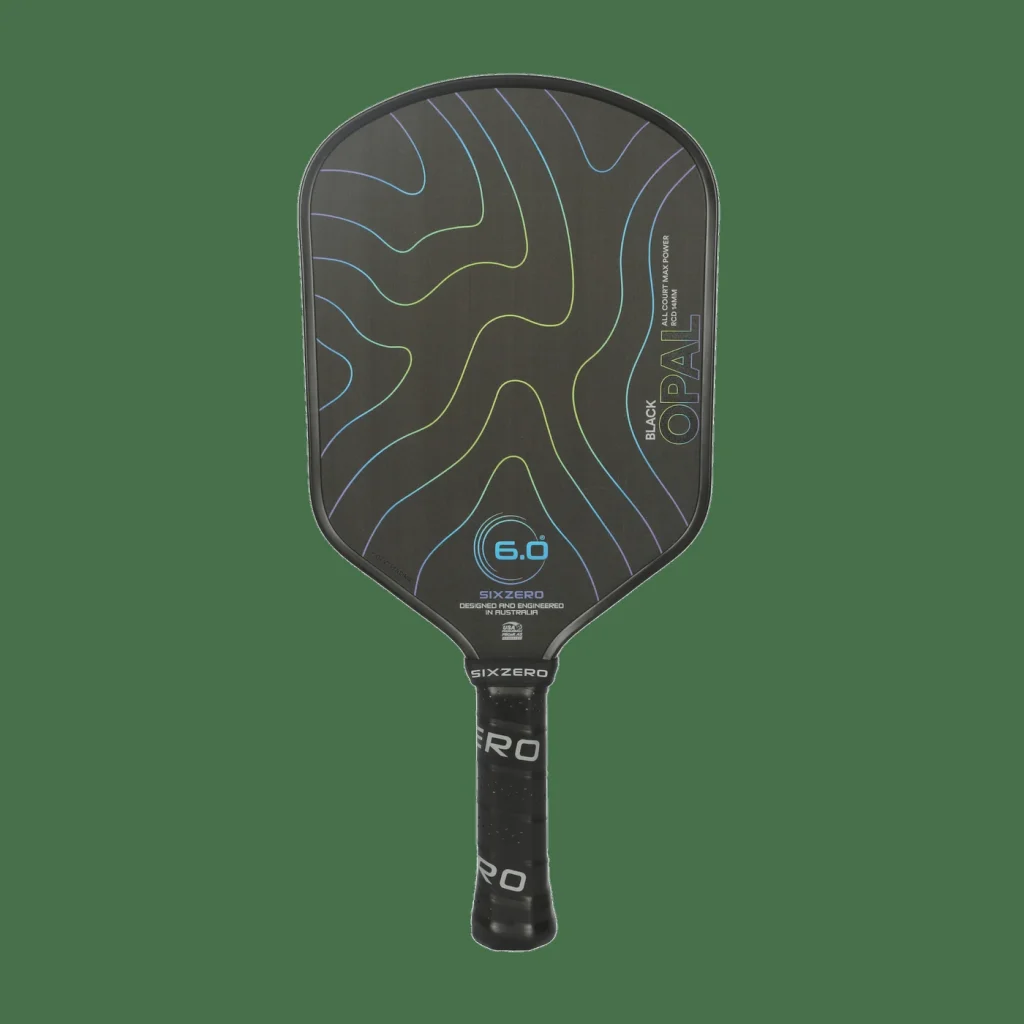
The Black Opal is Six Zero’s flagship power paddle, built around a Gen 4 solid foam core with a Power Gel energy layer, in a 14mm hybrid frame. That construction sentence explains the whole paddle.
Gen 4 means the core is solid foam all the way through, with no honeycomb inside, and the foam is denser than standard foam, so a thin 14mm core pockets the ball the way a thicker paddle does. The Power Gel layer sits inside that foam and gives contact its dense, springy launch.
The face is Diamond Tough raw carbon fiber, a tougher grit surface with diamond particles worked into the texture, built to keep its bite far longer than a plain raw carbon face.
That is why this paddle sits first on my best all-court pickleball paddles as the overall-balance pick and first on my best hybrid pickleball paddles as the overall-play pick, and fourth on my homepage’s best 15 as the all-court pick.
The shape is the other decision that defines it. At 16.3 inches long and 7.7 inches wide, it is a hybrid, which means it sits between an elongated paddle and a widebody: most of the reach of a long paddle with more of the hand speed of a square one.
The handle is 5.5 inches long, which fits two hands for a backhand, and it carries the brand’s Shock Shield system, a silicone injection inside the handle that damps vibration before it reaches your arm.
It is approved by both USA Pickleball and UPA-A for sanctioned play. The name tells you who it is built for: the confident striker who wants one paddle that does everything well and is willing to earn the soft game in the first two weeks. That positioning is honest, and this review tests it on its own terms.
How It Plays
Serves. Serves are where the spin first shows up in play. The Diamond Tough face grabs the ball at 2,307 RPM of measured spin, so a topspin serve brushed up the back of the ball dips late and kicks off the bounce just enough that a returner who read the pace still has to adjust.
The hybrid shape helps here too, because it moves through the air fast enough to keep the brushing motion quick, and the 114 swing weight keeps the head moving through the ball.
Swing weight is how heavy a paddle feels in motion, so a 114 on a hybrid frame is a genuinely quick swing for a paddle this powerful. A flat serve gets honest pace from the foam core and shape from nothing, so the topspin serve is the one this paddle was built to throw.
The honest note is the first three serves. Mine went long, because the foam gives back more than the swing asks for, and it takes a session to learn how little effort the serve needs.
Drives. Drives are where the Black Opal earns its ranking, because this is the hardest-hitting hybrid I print on this site.
One independent lab measured its power at 57.6 miles per hour, the second-hardest result in its whole test pool at the time, and in my hand that number reads true: a committed swing turns into pace that pushes opponents behind the baseline and keeps them there.
The power scales with the swing, so the harder you swing, the more it gives back, and the spin pulls the ball back inside the lines on full cuts. The honest ceiling is contact location.
A drive caught through the middle holds its line and dips. A drive caught low on the face loses its power and dies. That is the small sweet spot doing its work in the open, and it is the reason this paddle’s drives belong to clean strikers.
Dinks. Dinks are where the learning fee shows up, because this is where the paddle’s two personalities meet. The solid foam core gives real dwell, which is the short moment the ball stays on the face, so a relaxed dink leaves the face where you aimed it, with enough spin from the Diamond Tough grit to keep it low.
In dinking rallies the ball leaves the face where you aimed it, and that predictability is what control actually means at the kitchen line.
The danger is the same as everywhere else on this paddle: a dink caught near the edge twists instead of dropping, so the kitchen game stays calm only while your contact stays centred.
My soft game leaked pop-ups for two weeks while I learned how little swing this frame needs, and then the dinks started sitting down. Players with a loose soft game and grooved contact will adjust faster than players who block with a firm wrist and catch the ball wherever it arrives.
Resets. Resets are where the Black Opal asks the most of its owner, because it resets with power rather than with margin. A hard drive arrives, the ball meets a dense foam face, and the paddle gives you a firm, springy answer about your hands.
Dwell means the time the ball stays on the face, and this paddle offers a useful amount of it, so a reset hit with a soft hand drops instead of climbing, once the swing has shortened. The 6.4 twist weight is the number behind that honesty.
Twist weight is the paddle’s resistance to turning in your hand when the ball catches it away from the middle, so a 6.4 means the face holds its line on centred contact and twists on contact caught wide.
That is most contact in a fast rally for a developing player, so expect some spray and some dead balls on stretched blocks until your timing settles, and understand that this is the paddle’s design, not a defect in your unit. Tape along the sides helps, and the FAQ section explains how much.
Blocks and counters. Blocks and counters are where the paddle’s power earns its keep, because the foam core answers a hard ball without a wind-up. A short punch at a fast ball comes off hot, and the ball stays in with decent technique.
In fast hands battles the 114 swing weight is the number that matters most. The head arrives early, the face stays square through the exchange, and the counters carry enough shape to push an opponent back a step.
The honest limit is the same small sweet spot again. A block caught low on the face will not carry the pace you expect, and a counter caught wide will spray, until tape goes on. With tape along the sides, the blocks hold their line and the counters keep their aim, and the paddle still arrives first.
Without it, this is the section where the paddle’s ranking as the tenth pick on my best pickleball paddles for control makes sense: it is tenth there for one reason, and the reason is the sweet spot.
Overheads. Overheads are the easiest power shots on this paddle, because the foam core and the hybrid shape agree for once.
A full swing gets rewarded: the ball comes off with pace, the spin keeps it inside the lines, and the shape gives enough reach to take a high ball without stretching. A passive overhead gets a passive ball, and that is the trade you accept for the control everywhere else.
The one mechanical note is the grip. No single grip circumference is settled for this paddle, and the published figures split, so bigger-handed players should build the grip up with overgrips before they judge the paddle.
With the grip built up, the 5.5 inch handle still leaves room for two hands, and that is a real strength for a power paddle, not a setup question.
One honest disagreement belongs in this section, because the spin is the one place the record splits. This site prints 2,307 RPM. A second lab measured 2,024 RPM on its own unit. A third test with a different camera method measured far lower again.
In my hand, the spin is elite either way: serves dip, drives kick, and drops bite, and the face keeps gripping long after plain raw carbon faces around it have started to feel smooth under a fingernail.
I print the site line of 2,307 RPM in the box, and I record the second lab’s 2,024 RPM here and in the FAQs, because two rigs measuring the same paddle will always disagree a little, and the honest number is the range, not a single figure.
Play it for a week before you judge it, and judge it by your worst contact, not your best, because the worst contact is what decides whether this paddle is yours.
Black Opal 14mm or the Coral: Which One Should You Buy?
Start with the sibling, because Six Zero sells two foam flagships and buyers mix them up. The Coral is the plush one: a 16mm core on a floating propulsion build with a suspension system, softer and calmer, made for players who want foam comfort with a bigger margin for error.
It comes in three shapes, widebody, hybrid and elongated, so you pick the shape that fits your game. The Black Opal reviewed here is the power one: a 14mm solid foam core with a Power Gel layer, denser and springier, made for players who want the ball to leave angry.
It comes in one shape only, the hybrid reviewed here. My rule from playing the family: most players asking this question should buy the Black Opal if their game is attack first, because it is the version with the highest power ceiling in the line, and the Coral if their game is comfort first, because it is the version that forgives more.
Buy the Black Opal if your contact is clean and you want power that still plays the soft game once you learn it. Buy the Coral if you want the same foam family with a calmer strike and a wider sweet spot.
One more naming trap, and it is a small one. Some coverage quotes widebody and elongated swing and twist figures next to the Black Opal name. Those figures belong to the Coral, which is sold in three shapes. The Black Opal is sold in the hybrid shape only, and the figures in this review belong to that hybrid.
Check the name and the shape on the listing before you buy, because the two paddles share a brand and a face family, and the wrong one buys a different paddle than this review describes. The two colourways are the same paddle in different dress, so pick the one you like looking at and do not pay more for either.
Who Should Buy It, and Who Should Skip It
Buy the Black Opal if your contact is already clean and centred, which is why it sits first on my best all-court pickleball paddles and first on my best hybrid pickleball paddles: this paddle rewards the middle of the face and punishes everything else, and a clean striker gets the full reward.
Buy it if you are an advanced player around 4.0 and climbing who wants the hardest-hitting hybrid on this site, which is why it sits third on my best pickleball paddles for power as the foam power pick and fourth on my best pickleball paddles for advanced players.
Buy it if you want spin that holds: its 2,307 RPM is the third-highest figure on my best pickleball paddles for spin, where it sits fourth, and the face is built to keep that bite. Buy it if your two-handed backhand is a central shot: the 5.5 inch handle fits both hands, and the hybrid frame moves fast enough to keep up in exchanges.
Skip it if your contact is still forming, because the sweet spot sits low and is not generous, and stretched mishits lose their power and die.
Skip it if your soft game is a project and you want the calmest reset in the class, because the foam wakes up livelier than a honeycomb paddle and this paddle’s gift is power with control, not calm. Skip it if you want the widest margin for forming contact, because the Jelly Bean and the Scorpeus forgive far more.
Skip it if you are a complete beginner, because this paddle needs a grooved swing to reach its best and it will punish forming contact until your timing settles, and it will take about ten hours to break in and a month to truly dial in.
And skip it if you want spin that never changes, because even a durable face softens with months of play, and the rivals below with raw carbon faces hold their bite differently.
How It Compares to Its Closest Rivals
Against the Six Zero Double Black Diamond Control 16mm, the sibling control archetype on this site, the difference is power against calm.
The Double Black Diamond is the thermoformed control build: 16mm thermoformed polymer honeycomb with foam edge walls, a raw Toray T700 face, a 114 swing weight against this paddle’s 114, a 6.8 twist weight against this paddle’s 6.4, and spin not published against this paddle’s 2,307 RPM.
It plays calmer, softer and quieter, with more predictable resets and a softer strike, and it forgives far more on off-centre contact.
The Black Opal answers with far more putaway power, a denser springy strike, and a face built to hold its spin longer. Players who want calm read the Double Black Diamond Control review first; players who want power with a soft game start here.
Against the CRBN TruFoam Genesis, the foam spin rival, the difference is power against spin. The Genesis is the spin ceiling: a 119 swing weight against this paddle’s 114, a 6.21 twist weight against this paddle’s 6.4, and spin of 2,401 RPM against this paddle’s 2,307 RPM, on a full TruFoam core that pockets the ball longer.
It is softer, calmer on drops, and approved by both bodies, so it plays in sanctioned events everywhere.
The Black Opal answers with far more putaway power on drives and counters, a 114 swing weight that arrives quicker in hand battles, and a durable grit face built to keep biting after a plain raw carbon face has smoothed out.
Players who construct points with shape and dwell read the Genesis review first; players who finish points with pace start here.
Against the Vatic Pro V-SOL Pro 16mm, the foam comfort rival, the difference is power against free pop.
The V-SOL Pro is a full EPP foam build with an EVA perimeter ring: a 108 swing weight against this paddle’s 114, a 6.43 twist weight against this paddle’s 6.4, and spin of 2,060 RPM against this paddle’s 2,307 RPM, on a 5.3 inch handle and a 4.125 inch grip.
It plays quicker in the hand than most foam paddles, with livelier counters and a larger sweet spot for the same all-court job, and it is approved by both bodies.
The Black Opal answers with far more putaway power, a denser strike, and a face that holds its spin longer. Players who want free pop and a pocketed soft game read the V-SOL Pro review first; players who want power with spin start here.
Against the 11SIX24 Vapor Power 2 16mm, the other foam power rival, the difference is feel against speed.
The Vapor Power 2 is the quicker foam power build: a 107.55 swing weight against this paddle’s 114, a 6.6 twist weight against this paddle’s 6.4, and spin of 2,335 RPM against this paddle’s 2,307 RPM, on a 5.75 inch handle and a 4.125 inch grip.
It plays faster in the hand, with a raw bite that arrives first in hand battles, and its grit holds better than any face one lab has measured. But it is approved by UPA-A only, not by USA Pickleball, so it does not play in every sanctioned event.
The Black Opal answers with a denser, springier strike, a more connected feel, and approval by both bodies. Players who want the fastest hands read the Vapor Power 2 review first; players who want dense power that plays everywhere start here.
Against the JOOLA Perseus Pro V 16mm, the elongated power rival, the difference is shape against reach.
The Perseus Pro V is the elongated power build: a 117 swing weight against this paddle’s 114, a 6.26 twist weight against this paddle’s 6.4, and spin of 2,060 RPM against this paddle’s 2,307 RPM, on a 16.5 by 7.5 inch frame with a 5.5 inch handle.
It plays with more reach, more serve pace, and a longer lever for singles, and it is approved by both bodies. The Black Opal answers with quicker hands, more spin, and a hybrid shape that moves faster in tight exchanges.
Players who want reach and serve pace read the Perseus Pro V review first; players who want power with hand speed start here.
Durability: What Months of Play Actually Do to It
Two things age on this paddle, on different clocks, and the first one is the good news. The face holds its bite.
The Diamond Tough face is a raw carbon texture with diamond particles worked into it, not a painted grit, and one long tester found it still biting after 25 hours of hard play, which is the best grit durability on this site’s all-court page.
The brand claims at least four times the texture life of a plain raw carbon face. That is the brand’s claim, and I carry it as a claim, but the design logic is sound, and in play this face stayed grabby long after plain peel-ply faces around it had started to feel smooth under a fingernail.
A paddle eraser belongs in your bag from the first week, and wiping the face after sessions keeps the texture biting longer. Two honest counter-notes belong here. One owner reports losing grit after six months of play, and another reports batch variation, with one unit’s grit much smoother than a friend’s earlier-batch unit.
So the face holds well, and it does not hold forever, and a unit can vary. If spin that never changes is your priority, this is the paragraph that decides your buy, and the rivals above with raw carbon faces age on their own clocks too.
The core ages slower and more honestly. This paddle is a solid foam build, which means there is no honeycomb to crush and no face to separate from the core in the way a honeycomb paddle can.
The power you test in week one is the power you still own in month six, and the control you test in week one is the control you still own in month six.
The foam can settle a little over the first several sessions, which is part of the break-in owners report, about ten hours before it starts to feel right and a month before it feels fully dialled in. One owner reports a slight corner crack after eleven months that did not affect play and that the brand replaced anyway.
Check the face edge once a season, and check the edge for cracks before you play on. Keep the receipt with the paddle from the day it arrives, and check the brand’s site for the current warranty terms before you buy, because this review prints the warranty as not published and the terms behind it can change.
Retailers list a 1-year term, and one warranty table lists the brand at 6 months with registration required, and those two claims conflict, which is why this review prints nothing rather than picking one.
The edge guard and grip are ordinary wear items. Nothing about this paddle’s ageing surprised me, and no part of it failed early, which is more than I can say for several livelier builds I have tested at higher prices.
How I Tested the Black Opal
I played the Black Opal across several weeks of league nights, open play and drilling sessions, against players at and above my level, because a power paddle only proves itself when the sessions get long and the contact gets stretched.
The figures in the box at the top of this page are the published figures this site carries across its lists: the weight of 8.1 ounces, the swing weight of 114 and the twist weight of 6.4 come from the site’s settled measurement pool, and the spin of 2,307 RPM is the site line carried on the homepage, spin, control and advanced pages.
Three honest splits belong here. First, the weight: eight of this site’s pages print 8.2 ounces, and the all-court and hybrid research both direct 8.1 ounces, which is what an independent lab measured on its unit and what the brand’s own 8.0 to 8.3 ounce range covers.
I print 8.1 ounces per those directives, and the split is recorded in the research file. Second, the spin: a second lab measured 2,024 RPM on its own unit, against the site line of 2,307 RPM, and a third test with a different camera method measured far lower again.
I print the site line and record the others, because two rigs measuring the same paddle will always disagree a little. Third, the grip: published figures split between 4.125 and 4.25 inches, so the box prints not published and the FAQ explains both. Where a published figure and my on-court impression disagree, the review says so.
On this paddle, they did not, with one honest exception. The soft game took two weeks to settle, longer than I expected: the pop-ups that leaked in week one had stopped by week three, once my swing had shortened and my hands had learned how little effort the foam needs.
I also played the Double Black Diamond Control, the Genesis, the V-SOL Pro, the Vapor Power 2 and the Perseus Pro V for comparison, and the comparison section above is that head-to-head, not a guess.
The Black Opal reviewed here is the hybrid 14mm only; the Coral is a different paddle with a different build, and its figures do not appear in this review except where the variant section names it to steer buyers away from a wrong purchase.
The Bottom Line
The Black Opal is not the most forgiving paddle in its class, and that is precisely its case.
It is the paddle with no weakness a clean-striking player at 4.0 and above will find in a normal game: elite power for a hybrid, a 114 swing weight that arrives fast, spin of 2,307 RPM that shapes the ball, and a Diamond Tough face that keeps its bite.
It sits first on my best all-court pickleball paddles and first on my best hybrid pickleball paddles, second on my best foam core pickleball paddles, third on my best pickleball paddles for power and third on my best carbon fiber pickleball paddle, for one reason: when a player asks me for one power answer and already hits the middle of the face, this is the answer that has never embarrassed me.
If your game matches the player described above, buy the hybrid 14mm, select that exact shape on the listing, fit an overgrip if your hands need more grip, play it stock for a week before you judge it, add a little tape along the sides if the edges spray, and put the season into drilling.
And judge it by your worst contact, not your best: if your worst contact dies low on the face, this is not your paddle, however hard it hits when you find the middle.
Frequently Asked Questions (FAQs)
1. Is the Six Zero Black Opal good for beginners?
No, not as a first serious paddle. It is built for the intermediate to advanced player around 4.0 and climbing, and it needs a grooved swing to reach its best. A complete first-week player will fight its small sweet spot, with stretched mishits losing their power and dying, before they enjoy its power and spin.
It suits a player stepping up from a starter paddle with grooved contact who wants the hardest-hitting hybrid on this site. A true beginner should start on a forgiving widebody and come back to this paddle when their contact centres.
2. How much spin does the Black Opal make?
This site prints 2,307 RPM, which is the third-highest spin figure on my spin list. A second lab measured 2,024 RPM on its own unit, and a third test with a different camera method measured far lower again. The honest number is the range, not a single figure, because two rigs measuring the same paddle will always disagree a little.
What matters in play is that the spin is elite on any rig, and that the Diamond Tough face holds it: one long tester found it still biting after 25 hours of hard play, and the brand claims at least four times the texture life of a plain raw carbon face.
Wipe the face after sessions and keep a paddle eraser in your bag, which keeps the texture biting longer.
3. What is the sweet spot like on the Black Opal?
Small, low, and honest about it. The sweet spot sits lower than you expect and is not generous, and it is noticeably weaker near the throat, so stretched blocks and late resets get punished when contact drifts.
Twist weight is the paddle’s resistance to turning in your hand when the ball catches it away from the middle, so a 6.4 means the face holds its line on centred contact and twists on contact caught wide.
It is the most repeated owner complaint about this paddle, and the reason it sits tenth on my control list. Tape along the sides helps, and the tape question below explains how much. Judge this paddle by your worst contact, not your best, because the worst contact is what decides whether it is yours.
4. Black Opal or Double Black Diamond Control: which Six Zero should I buy?
Buy the Black Opal for power: a 114 swing weight against the Double Black Diamond’s 114, a 6.4 twist weight against its 6.8, and spin of 2,307 RPM against its not published, on a solid foam core that hits harder and a face built to hold its spin longer.
Buy the Double Black Diamond Control for calm: its 16mm thermoformed honeycomb core with foam edge walls plays softer and quieter, its 6.8 twist weight forgives far more on off-centre contact, and its resets are more predictable from the first session.
Players who finish points with pace start here; players who want the calmest, most forgiving Six Zero read the Double Black Diamond Control review first.
5. Black Opal or CRBN Genesis: which foam paddle should I buy?
Buy the Black Opal for power and for spin that holds: its solid foam core with Power Gel plays denser and springier, with far more putaway power on drives and counters, a 114 swing weight against the Genesis’s 119, and a durable grit face built to keep biting after a plain raw carbon face has smoothed out.
Buy the Genesis for the highest spin ceiling and the softest dwell: its full TruFoam core pockets the ball longer, its spin measures 2,401 RPM against the Black Opal’s 2,307, and its soft game is calmer. Players who construct points with shape and dwell read the Genesis review first; players who finish points with pace start here.
6. What grip size is the Black Opal, and does it suit two-handed backhands?
No single grip circumference is settled for this paddle, so the box prints not published rather than picking one. Published figures split: some sources list 4.125 inches, and others list 4.25 inches, which is the standard adult grip. The handle length is settled at 5.5 inches, which fits two hands for a backhand out of the box.
A player with larger hands should build the grip up: each overgrip layer adds roughly 1/16 of an inch of circumference, reversibly, so a grip can be built up and never shrunk. Check the exact grip on the listing before you buy, and build it up if your hands need more grip.
7. Does the Black Opal need lead tape?
It does not need it to play, but tape is the one modification this paddle genuinely rewards. Tape at the 3 and 9 o’clock positions raises twist weight, which steadies off-center blocks and calms a twisting face, and it widens the sweet spot that buyers report as smaller than expected.
One lab weighted its unit with tape at the sides and a cap weight on the handle and found the twist weight rose from 6.3 to 6.89 while the swing weight rose from 114 to 118.
Work in small steps and test for a full session between changes, because every addition moves something else: perimeter tape adds stability but takes a little quickness, and the 114 swing weight climbs fast. Start with three grams per side, play a full session, and add more only if the face still twists.
Tape will not change a paddle’s core, shape, or face, so it closes small gaps rather than fixing a wrong paddle. Note that added weight can change a paddle’s certification status, so check the rules before you modify one for tournament play.
8. Is the Black Opal approved for tournament play?
Yes. The Black Opal is approved by USA Pickleball and by UPA-A, so it plays in sanctioned events everywhere. Before travelling to an event, confirm the exact model name on the approved list, as approval attaches to the specific model and variant.
The approval covers this model and variant only, so check the exact name on the list if you buy a different shape. The Black Opal is sold in the hybrid shape only, so the hybrid 14mm reviewed here is the approved one.
9. How long does the Black Opal’s spin last?
Longer than most raw carbon faces, and not forever. The Diamond Tough face uses diamond particles in the texture to hold its bite, and one long tester found it still biting after 25 hours of hard play, which is the best grit durability on this site’s all-court page.
The brand claims at least four times the texture life of a plain raw carbon face.
Two honest counter-notes: one owner reports losing grit after six months of play, and another reports batch variation, with one unit’s grit much smoother than a friend’s earlier-batch unit.
Wipe the face after sessions and keep a paddle eraser in your bag, which keeps the texture biting longer, but no cleaning brings back grit that has worn away. If spin that never changes is your priority, look at the raw carbon rivals in the comparison section instead.
10. How long does the Black Opal take to learn?
About ten hours to break in and a month to truly dial in, and that is the honest answer, not a flaw in your unit. The foam core returns more energy than the swing asks for at first, so the first three serves go long and the soft game leaks pop-ups for about two weeks.
Once the swing shortens and the hands learn how little effort the paddle needs, the resets start sitting down and the drops stop sailing.
One owner who moved from the CRBN Genesis needed a month to dial it in and now loves it, and a developing player who hated it at first adapted after forty hours and now finds drops easy to dial in, though resets stay tougher.
Play it stock for a week before you judge it, and do not add tape or change the grip until you have. If your worst contact still dies low on the face after a month, this is not your paddle.

Michael Robbins
Pickleball player, researcher, and writer
Michael Robbins tests and reviews pickleball paddles so you can skip the guesswork. Every paddle he recommends has earned its place through hours of real play, not specs on a page. As the founder of Picky Paddle, he compares the paddles he tests against each other and updates every guide as new models arrive.
Have a question about your game or your next paddle? Send a message through the contact page, and Michael will get back to you.