
The third game of the round robin was the one that told the truth. My feet had swelled a little in the heat, the way feet do by mid-morning, and the shoes I had trusted all week started to press across the ball of my foot. Every split step pushed my toes into the front.
Every hard stop made the outside of my forefoot push against the upper. I finished the game, sat down, and loosened the laces, and I could still feel the outline of the toe box on my foot. That is the moment most women with wide feet know well. The shoe fits in the shop. It fails in the third game.
Women’s wide feet need a different answer from men’s wide feet. A woman’s heel runs narrower relative to her forefoot. Her arch sits and loads differently.
A shoe built on a men’s last and shrunk down gives her a choice between a squeezed forefoot and a swimming heel, and neither one holds up in a rally. So this list is built in women’s sizing from the start.
Every pick below is a women’s listing. Every width is a women’s width. Eight of the ten carry a true letter width in women’s sizing, a D Wide or a 2E Extra Wide.
The other two are wide by design, and the draft says so plainly for each one. My wide-feet list covers the same ground in men’s sizes, and this page answers the women’s half of the question properly.
The 10 Best Pickleball Shoes for Women with Wide Feet in 2027
1New Balance Fresh Foam X 1007 (Women’s): Best Overall Pickleball Shoes for Women with Wide Feet in 2027
AT A GLANCE
Fresh Foam X 1007
WEIGHT
-
OUTSOLE
NDurance rubber, modified herringbone
CUSHIONING
Fresh Foam X, plush with energy return
FIT
True wide last in B, D (Wide) and 2E (Extra Wide); low-arch design
Type: All-court tennis/pickleball shoe (women’s version)
Sizing: Women’s B, D (Wide), 2E (Extra Wide)
Upper: Engineered mesh with synthetic overlays
Midsole: Fresh Foam X
Non-marking: Yes
Stability: Built-in stabilisers; wide base; mild built-in arch support; low-arch design takes an orthotic well
Feel: Plush, roomy and steady; the comfort-first wide shoe
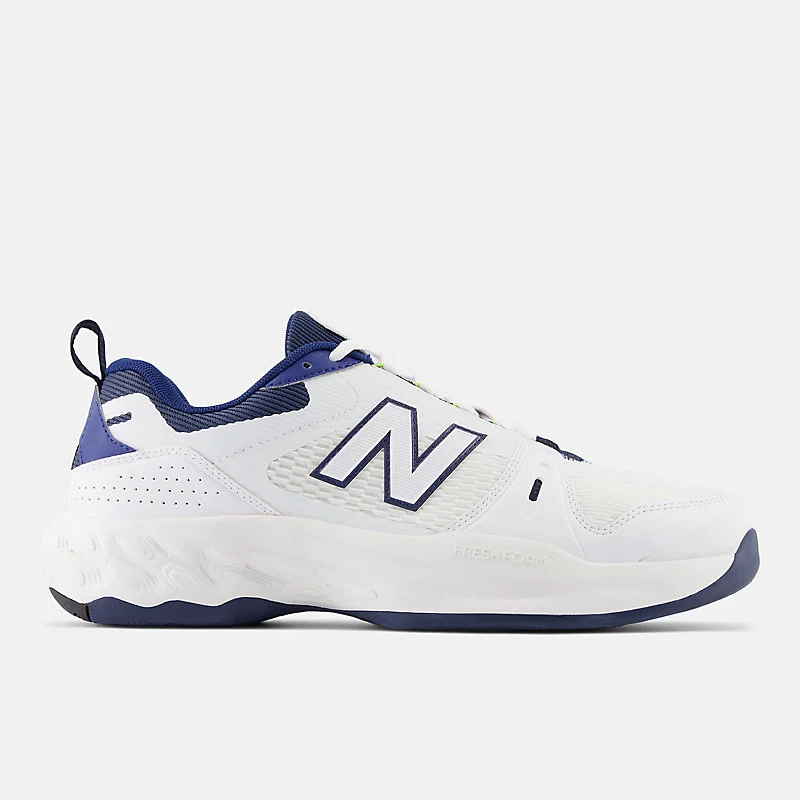
The 1007 is the best overall pick because it treats width as a full sizing system rather than a single roomy model. Women can choose B, D or a genuine 2E, and that ladder matters when your whole foot is broad, not just your toes. Inside, the forefoot has space to settle instead of being tapered into a point.
The low-arch design leaves the shoe feeling open rather than built up under the middle of the foot. That openness is useful in two ways. It keeps the shoe comfortable across a long session. It also gives an orthotic a better chance to sit properly, because the shoe does not fight it with a high built-in arch.
On court, the Fresh Foam X midsole gives the 1007 its plush, steady character. Fresh Foam X is New Balance’s soft foam that cushions each step and returns a little energy as you push off. Hard stops feel cushioned. The wide base keeps plants calm.
The built-in stabilisers stop the extra room from turning into wandering. The NDurance rubber uses a modified herringbone pattern, which is a zigzag tread that grips in every direction, so the shoe still bites when I change direction.
One honest note on the width ladder: recent reports say New Balance may no longer sell the women’s 2E, so the D Wide is the widest women’s option to count on. The other honest weakness is weight.
This is no feather, and you feel that mass during repeated quick steps. A few players have also found the indoor rubber wearing sooner than expected. Buy it if you want the most complete wide fit and a plush ride. Skip it if low weight matters more than maximum room.
2K-Swiss Express Light Pickleball (Women’s Wide): Best Lightweight Pickleball Shoes for Women with Wide Feet in 2027
AT A GLANCE
Express Light Pickleball
WEIGHT
11 oz (women’s size 8.5)
OUTSOLE
AOSTA 7.0 high-density rubber, modified herringbone
CUSHIONING
CMEVA/K-EVA midsole with an Ortholite sockliner
FIT
Dedicated women’s Wide version (D width) with a more spacious toe box
Type: Pickleball-specific court shoe (women’s)
Sizing: Women’s standard and Wide (D), sizes 5-12 in the wide
Upper: Synthetic leather with DuraWrap toe protection and heel-grip lining
Midsole: CMEVA with the 180 PSC (Plantar Support Chassis)
Non-marking: Yes
Stability: 180 PSC thermal-plastic chassis enhances midfoot stability; DragGuard at toe and heel
Feel: Light, breathable and forgiving; the proven women’s wide all-rounder
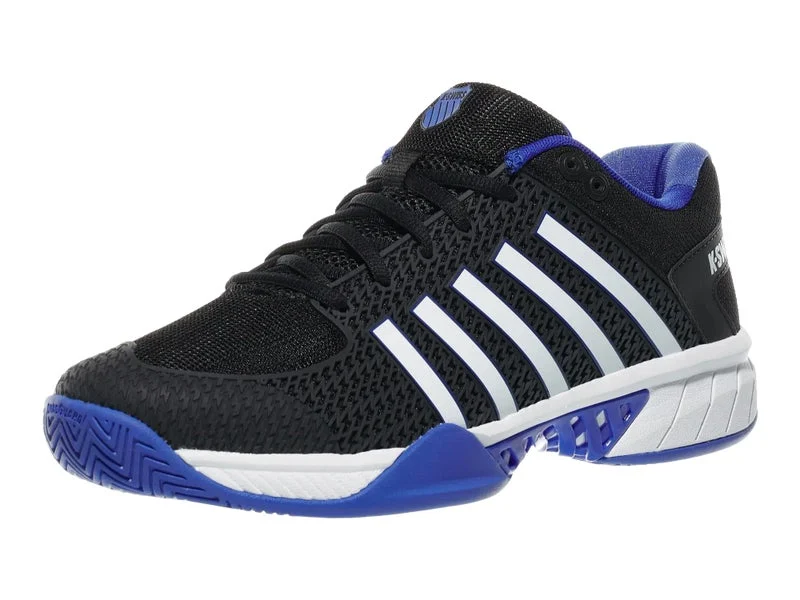
The Express Light Wide is the lightweight pick because it starts with a dedicated Wide version rather than asking women to borrow a men’s last. In women’s sizing, D is the wide width, and this shoe uses it with a more spacious toe box. The result feels balanced when I test the fit. There is room across the front.
A heel-grip lining holds the back. The whole shoe has not simply been made larger in every direction. At 11 ounces in a women’s 8.5, it is one of the easiest shoes here to wear for a full session, and that lightness matters most when your feet are already working hard to fill a wide shoe.
The build underneath is the proven Express Light formula. The synthetic leather upper has DuraWrap toe protection, which is a tough overlay that guards the front against drag. The CMEVA midsole keeps the ride light and forgiving, and the Ortholite sockliner adds a comfortable first step.
A sockliner is the removable layer your foot actually stands on. The 180 PSC chassis is a plastic support frame through the midfoot, and it gives the shoe more stability than its easy feel suggests.
DragGuard reinforces the toe and heel, which are the two places that wear first. The modified herringbone AOSTA 7.0 outsole is non-marking, which makes the shoe a straightforward choice for indoor courts as well as outdoor play. The honest caveat is cushioning. It is thin.
If you play on hard outdoor courts for two hours or more, you will feel the surface by the second session. Buy it if you want a proven, light women’s shoe with a true wide option and balanced court manners. Skip it if your foot needs more than a D width or you want deep cushioning.
3Skechers Viper Court Pro (Women’s, Wide): Best All-Day Comfort Pickleball Shoes for Women with Wide Feet in 2027
AT A GLANCE
Viper Court Pro
WEIGHT
-
OUTSOLE
Goodyear Gold rubber
CUSHIONING
Ultra Flight foam midsole with a removable Arch Fit insole
FIT
Relaxed Fit roomy forefoot as standard; Wide (D) available
Type: Pickleball-specific court shoe (women’s)
Sizing: Women’s medium plus Wide/Extra Wide options depending on colourway
Upper: Breathable mesh with synthetic overlays
Midsole: Ultra Flight cushioning; Arch Fit insole system
Non-marking: -
Stability: Goodyear outsole traction and a supportive heel; the relaxed forefoot trades a little lockdown for room
Feel: Light, cushioned and roomy; the easy-wearing wide option
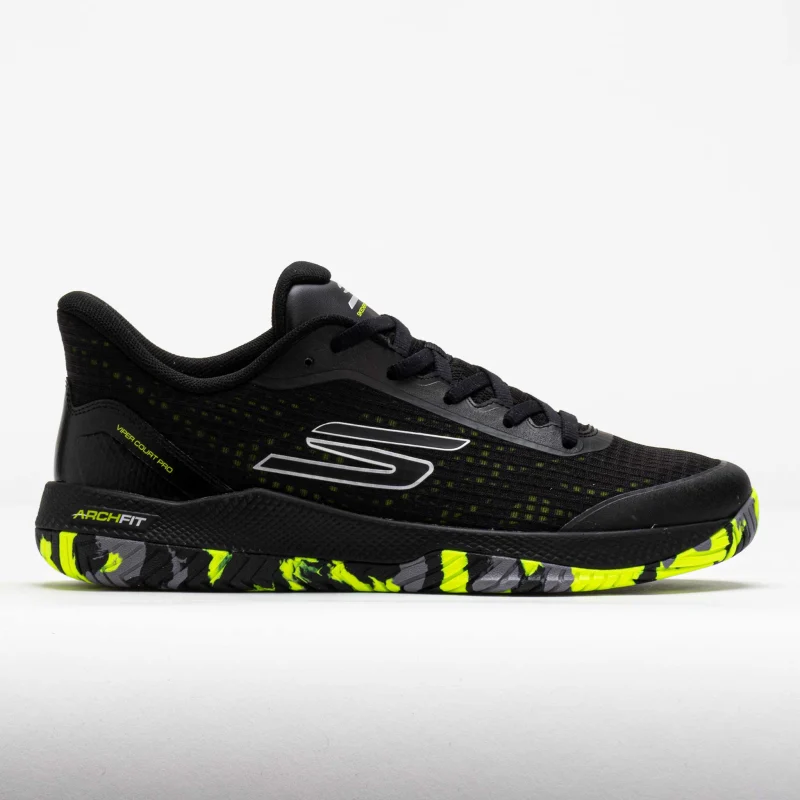
The Viper Court Pro is the all-day comfort pick because it is the wide shoe that feels least like a corrective device.
Its Relaxed Fit forefoot is roomy as standard, and Wide and Extra Wide variants are sold, so many players can get space without moving into the heaviest support shoes on this page. Relaxed Fit is Skechers’ name for a roomier forefoot that still runs true to size.
I like the balance of softness and response. Ultra Flight cushioning takes the sting out of repeated stops, while the removable Arch Fit insole gives the middle of the foot a shaped base. The Goodyear Gold rubber is grippy and durable underfoot, and the supportive heel keeps the back of the shoe from feeling as casual as the forefoot.
In a long session, this is the pair I notice least: no pinch at the front, no heavy swing through a recovery step, and no sense that the shoe is fighting my foot for space. That is exactly what an all-day shoe should do.
Two honest notes. Skechers publishes no weight or non-marking rating for the women’s original Pro, so both boxes say so rather than guessing. The relaxed front also trades away a little lockdown.
If you play with violent lateral cuts and expect the forefoot to hold like a narrow performance last, you may feel more movement across the front.
Width availability can also depend on colourway, so choose the actual wide variant rather than assuming every version is the same. Buy it if you want a light, cushioned shoe with a genuinely roomy forefoot. Skip it if you need the firmest lateral hold or a guaranteed 4E fit.
4K-Swiss Hypercourt Express 2 (Women’s Wide): Best Stability Pickleball Shoes for Women with Wide Feet in 2027
AT A GLANCE
Hypercourt Express 2
WEIGHT
10.8 oz (women’s size 8.5)
OUTSOLE
Non-marking AOSTA 7.0 rubber, modified herringbone
CUSHIONING
Surgelite midsole with Ortholite liner
FIT
Dedicated women’s Wide version (style 96807); generous fit even in standard width
Type: All-court tennis/pickleball shoe (women’s)
Sizing: Women’s standard and Wide
Upper: Seamless synthetic and mesh with DuraWrap Flex; added toe protection
Midsole: Surgelite (CMEVA) with a midfoot shank
Non-marking: Yes
Stability: Midfoot shank controls twisting; DuraWrap Flex upper holds the midfoot
Feel: Plush but connected; supportive without a break-in period
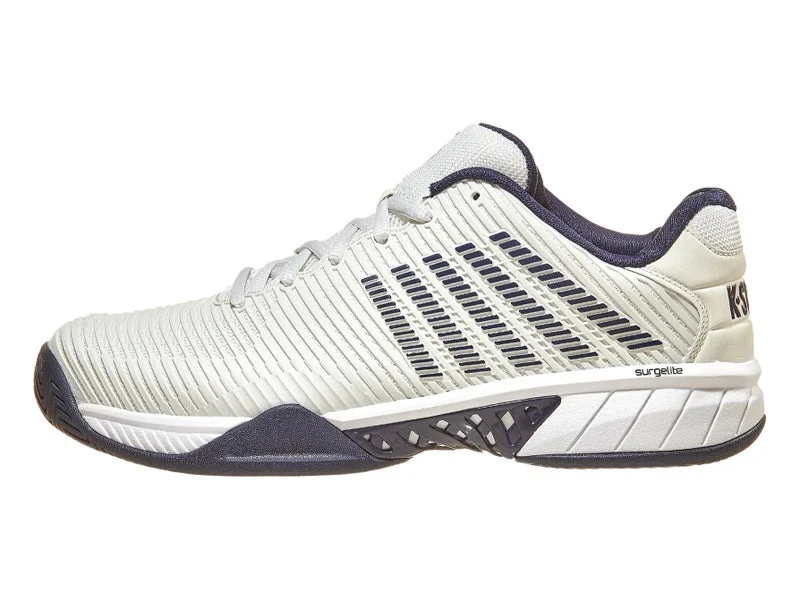
The Hypercourt Express 2 is my stability answer for a wide foot because its extra room does not come with a loose midfoot. The dedicated women’s Wide version gives the forefoot space, while the DuraWrap Flex upper holds the middle of the foot when I plant and turn. That combination is what a wide player actually needs in a fast exchange.
The toes are not squeezed, but the shoe still follows the foot instead of letting it roll toward the edge. A midfoot shank is a stiff strip through the middle of the shoe, and here it controls twisting.
It gives the shoe a connected feel under hard lateral movement. I can push into a wide defensive step and feel the platform stay organised, then recover without the upper stretching into a vague hold.
The Surgelite midsole feels plush enough for long sessions but not so soft that the shoe becomes uncertain. Surgelite is K-Swiss’s light foam that cushions without adding bulk.
The shoe also plays supportively straight away, without asking for a long break-in period. Underfoot, the non-marking AOSTA 7.0 rubber uses a modified herringbone pattern, and the added toe protection answers the drag that follows serves and low volleys.
At 10.8 ounces in a women’s 8.5, it carries useful substance without reaching the heavy end of this list, and it is lighter than the stability shoes that usually sit in this slot. The limitation is simply scope.
This is a Wide shoe, not an extra-wide shoe, and K-Swiss does not back it with the kind of outsole guarantee some court players look for. Buy it if you need a genuine wide fit with the strongest sense of lateral control. Skip it if your foot needs extra-wide volume or you want the softest ride here.
5ASICS Gel-Resolution X (Women’s Wide): Best Durability Pickleball Shoes for Women with Wide Feet in 2027
AT A GLANCE
Gel-Resolution X Wide
WEIGHT
13.5 oz (women’s size 8.5)
OUTSOLE
AHARPLUS high-abrasion rubber
CUSHIONING
FF BLAST PLUS + FLYTEFOAM with forefoot and rearfoot GEL
FIT
Dedicated women’s Wide version (D, style 1042A278); the standard X last runs snug, so the Wide is the pick
Type: Hard-court tennis shoe, baseline/stability class (women’s)
Sizing: Women’s standard and Wide
Upper: Synthetic leather and mesh with DYNALACING adjustable lacing and PGUARD toe protector
Midsole: Two-piece FLYTEFOAM (forefoot) + FF BLAST PLUS ECO (heel), DYNAWALL extending into the heel
Non-marking: Not stated
Stability: DYNAWALL midsole wall wraps the heel; the most structured shoe on this page
Feel: Firm, locked-in and confidence-inspiring; heavy and stability-first
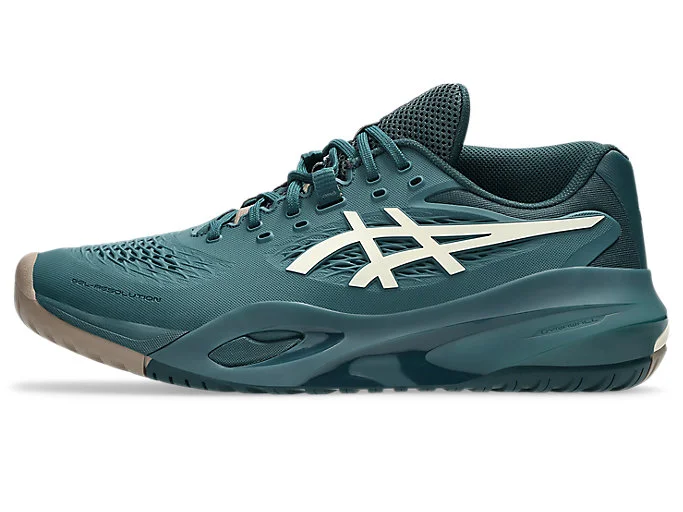
The Gel-Resolution X Wide is the shoe I trust when durability and structure matter more than softness. It has a dedicated women’s Wide version rather than relying on a standard last that happens to feel generous.
That distinction matters here, because the standard X last runs snug. The wide version is the one that belongs on this page, because it gives the forefoot and midfoot proper room while keeping the shoe’s firm, locked-in character.
The structure is visible in the way it moves. DYNAWALL extends into the heel and wraps that part of the foot. DYNALACING lets me adjust the hold across the upper. The PGUARD toe protector stands up to repeated drag. On a hard stop, the shoe does not feel like it is searching for its shape. It plants, holds, and asks me to recover.
The two-piece midsole combines FLYTEFOAM up front with FF BLAST PLUS ECO in the heel, plus GEL in the forefoot and rearfoot, so the ride is cushioned but clearly firm.
GEL is ASICS’s soft gel insert that absorbs impact at the heel and forefoot. The AHARPLUS rubber is ASICS’s high-abrasion compound, built to resist wear on hard courts, and it is the reason this shoe leads on durability.
That firmness is also the warning. At 13.5 ounces in a women’s 8.5, this is one of the heaviest shoes on the page, and players who like a plush, easy flex may find it demanding.
It also needs a short break-in before it feels settled. Buy it if you drag, slide and wear through ordinary court shoes and need a wide version with real structure. Skip it if you want a light shoe or a soft, forgiving step.
6New Balance FuelCell 996 V6 (Women’s D Wide): Best Responsive Cushioning Pickleball Shoes for Women with Wide Feet in 2027
AT A GLANCE
FuelCell 996 V6
WEIGHT
-
OUTSOLE
NDurance rubber
CUSHIONING
Full-length FuelCell, soft and propulsive
FIT
Women’s D (Wide) version is the pick; the standard 996 V6 runs narrow, so standard width does not belong on this page
Type: All-court tennis shoe (women’s)
Sizing: Women’s B and D (Wide). No 2E in this model
Upper: Synthetic and mesh with NDure-style durability overlays and a higher, locked-in heel collar
Midsole: Full-length FuelCell foam
Non-marking: Not stated
Stability: Snug heel/saddle lockdown; wide D base; firmer lateral support than the 1007
Feel: Cushioned but responsive; the sportier New Balance wide shoe
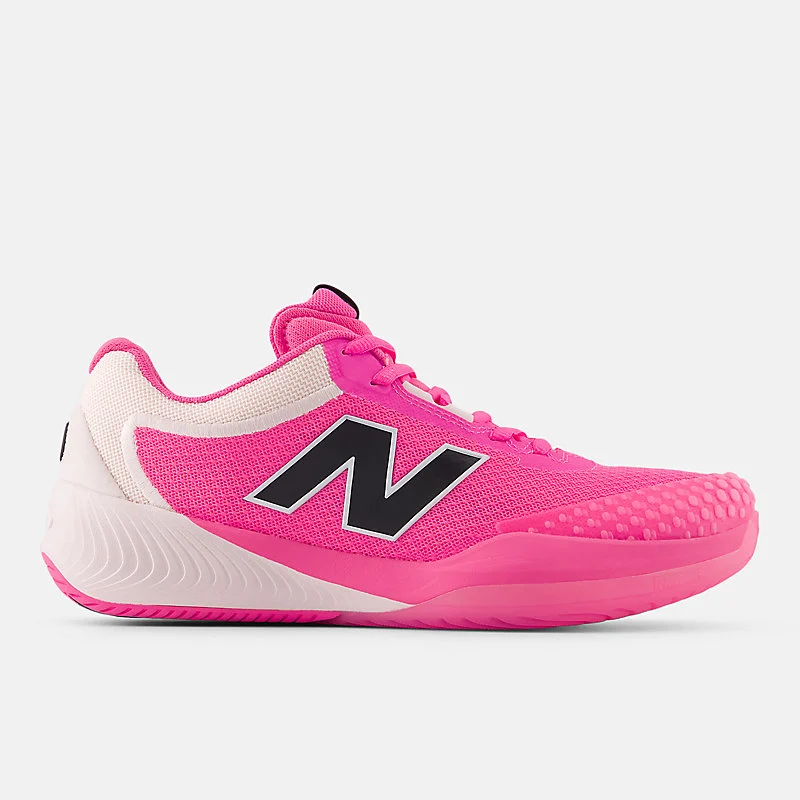
The 996 V6 belongs here only in its women’s D Wide version, and that distinction matters. The standard shoe runs narrow, so it would repeat the exact problem this page is trying to solve. In D Wide, the forefoot has the room a wide player needs while the heel and saddle stay snug.
That split personality is useful. There is space where the foot spreads, and security where the shoe needs to hold it during a lateral plant. Full-length FuelCell gives the 996 a softer and more propulsive ride than its firmer New Balance stablemate at the top of this list.
FuelCell is New Balance’s responsive foam, and it returns energy as you push off. I feel more return when I push from the baseline and more cushion when I land from a stretched stop, but the shoe still feels sportier than the 1007.
The higher heel collar and locked-in saddle help explain that difference. It does not feel like a loose comfort shoe that happens to be wide. It feels like a court shoe whose wide version finally lets the front of the foot participate.
It also has clear boundaries. There is no 2E in this model, so the broadest feet should stay with the 1007 at the top of this list. Fit can run slightly short, which means a wide player should pay attention to length as well as width and avoid solving the problem by guessing.
New Balance does not publish a women’s weight for this shoe, so the box says so rather than borrowing a figure from the men’s version. Buy it if you want responsive cushioning in a true wide with a secure heel. Skip it if you need extra-wide room or prefer a plush, relaxed fit through the whole shoe.
7SQAIRZ XRZ (Women’s): Best Toe Box Pickleball Shoes for Women with Wide Feet in 2027
AT A GLANCE
XRZ
WEIGHT
-
OUTSOLE
SmartTraction multidirectional herringbone rubber
CUSHIONING
EVA NRG Foam midsole with a cushioned removable insole
FIT
Patented squared, roomier toe box built for natural toe splay; one generous width by design (no letter widths)
Type: Pickleball-specific court shoe (women’s)
Sizing: Women’s full/half sizes; no 2E/4E variants, the width comes from the toe-box geometry; some players report needing to size carefully for length
Upper: Breathable mesh with hexagonal hot-melt style overlays and a reinforced silicone toe cap
Midsole: Lightweight EVA NRG Foam
Non-marking: Yes
Stability: TPU heel counter, lateral outriggers, Sta-Put laces
Feel: Stable, grippy and roomy in front; firmer and less plush than the foam shoes here
Warranty: 6-month outsole guarantee (brand)
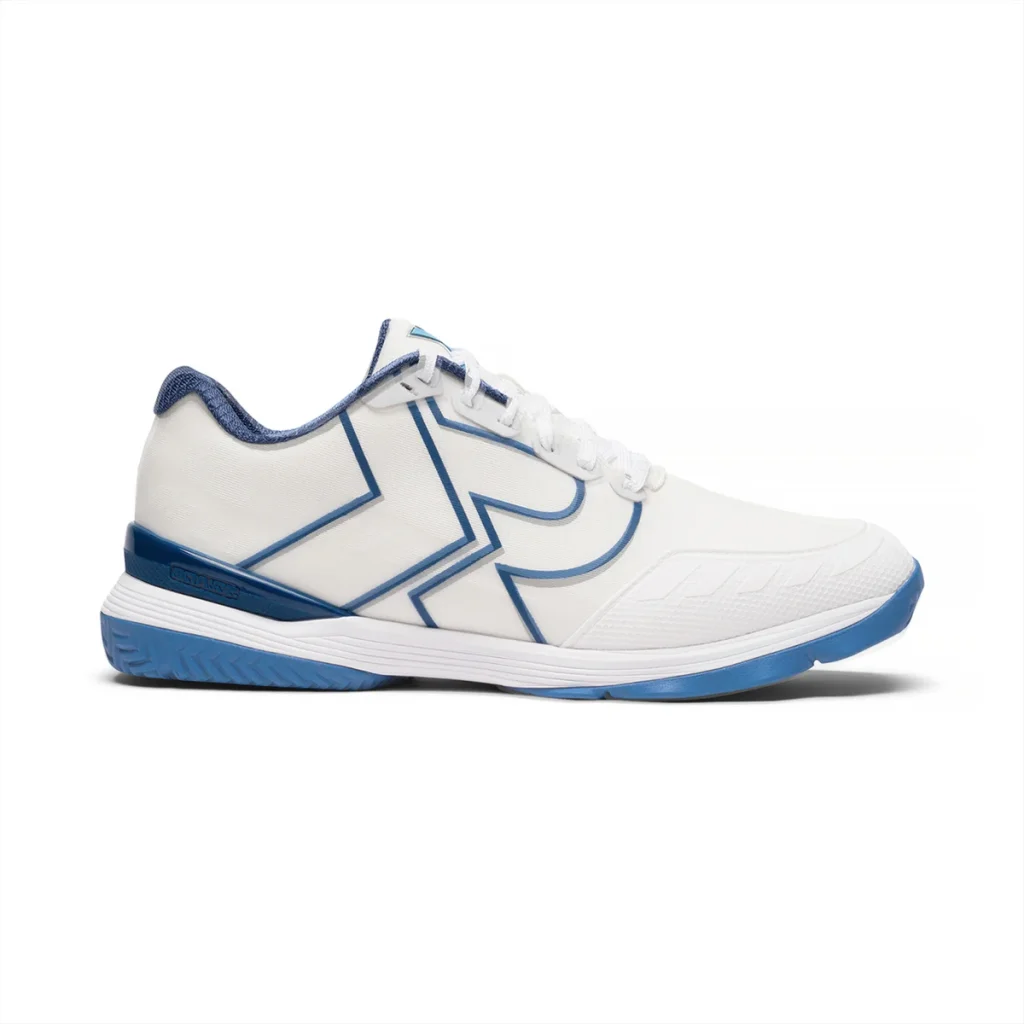
The XRZ solves a narrower problem beautifully, and I say so plainly because the shoe makes no letter-width promise. It does not offer D or 2E versions.
Instead, its squared toe box gives the front of the foot a shape that lets the toes spread instead of tapering them toward the middle. In a size 10 comparison, that toe box measured 110 mm across, the widest figure among the shoes considered here.
If your heel and midfoot are not especially broad but your toes always feel folded into ordinary court shoes, this geometry makes immediate sense. The width here is a shape, not a size, and the copy should be read that way. A player who needs volume through the whole foot should look at the letter-width picks above instead.
On court, the XRZ feels planted and direct. The SmartTraction outsole uses multidirectional herringbone rubber. Lateral outriggers widen the base at the edges, which are small flares that stop the shoe tipping on hard plants.
A TPU heel counter keeps the back of the shoe composed. TPU is a firm plastic that holds the heel in place. The Sta-Put laces help the midfoot stay where I set it, so the spacious front does not become an excuse for the whole foot to travel.
A reinforced silicone toe cap protects the front where the wider shape meets the court during drags. SQAIRZ backs the outsole with a six-month guarantee, the only brand outsole guarantee on this page.
The trade-off is that the feel is firmer and less plush than the foam-heavy shoes here, and length needs care. Some players have had to work to get it right. Buy it if toe splay is your main problem. Skip it if your entire foot is broad or you want maximum softness.
8Wilson Rush Pro Ace Pickler (Women’s): Best 2E Wide Fit Pickleball Shoes for Women with Wide Feet in 2027
AT A GLANCE
Rush Pro Ace Pickler
WEIGHT
12 oz (size basis not stated)
OUTSOLE
Duralast high-density rubber with a medial drag pad
CUSHIONING
R-DST+ midsole foam with a die-cut EVA insole
FIT
Wide Fit (2E) construction, the most generous fit in the Rush Pro line, with a wide toe box
Type: Pickleball-specific version of Wilson’s Rush Pro Ace (women’s Pickler)
Sizing: Women’s sizes in the Pickler’s wide (2E) fit
Upper: Sensifeel minimally layered mesh
Midsole: R-DST+ foam (DF2 geometry, 9 mm heel-toe drop)
Non-marking: Not stated
Stability: 4D Support Chassis limits supination and torsion through pivots
Feel: Roomy, cushioned and stable; a tennis-bred shoe that happens to fit wide feet properly

The Rush Pro Ace Pickler is the 2E pick because Wilson did not simply leave extra space in the toe and call it wide. Its Wide Fit construction is the most generous fit in the Rush Pro line, and the toe box gives the front of the foot room to work.
Yet the shoe still feels like a serious court model when I move sideways, with the 4D Support Chassis limiting torsion through pivots and keeping the platform from twisting underneath me.
Torsion is the twisting of the shoe through the middle, and a chassis is the frame inside the shoe that resists it. That mix suits players who move with force.
The R-DST+ midsole gives a cushioned landing, the die-cut EVA insole keeps the footbed simple and replaceable, and the minimally layered Sensifeel mesh avoids the bulky feel that puts some wide-footed players off support shoes.
The Duralast outsole is Wilson’s high-density rubber, and the medial drag pad is exactly where a player who drags through low balls needs reinforcement. The medial side is the inside edge of the foot, where the shoe meets the court on a lunge. At a listed 12 ounces, the Pickler also avoids the heavy feel of the maximum-support models.
Be careful to choose the Pickler, not the separate tennis version of the Rush Pro Ace. The honest watch-out is outsole wear. Hard draggers should inspect the rubber early rather than assuming the durability compound makes the shoe immune to their movement.
Buy it if you want a roomy 2E fit with proper court stability. Skip it if you want a feather-light shoe or expect the outsole to shrug off constant dragging.
9New Balance 806 V1 (Women’s): Best Maximum Support Pickleball Shoes for Women with Wide Feet in 2027
AT A GLANCE
806 V1
WEIGHT
15.5 oz (size 10.5)
OUTSOLE
Non-marking herringbone rubber with Ndurance in high-wear areas
CUSHIONING
C-CAP midsole with ABZORB cushioning
FIT
Heritage wide last, women’s widths including Wide
Type: Heritage leather tennis shoe (women’s)
Sizing: Women’s widths including Wide
Upper: Full-grain leather with a long-wear drag tip and Lightning Dry lining
Midsole: C-CAP (compression-moulded EVA) with ABZORB; ROLLBAR rearfoot motion-control post
Non-marking: Yes
Stability: ROLLBAR graphitic TPU post controls rearfoot motion, the strongest motion-control shoe on this page
Feel: Firm, supportive and traditional; maximum structure, minimum flash
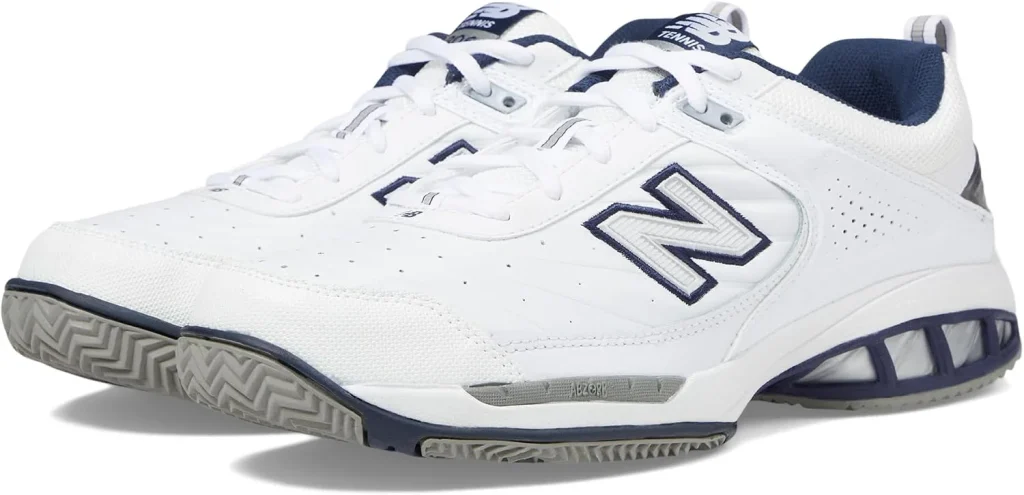
The 806 V1 is the traditional end of wide footwear, and I mean that as a compliment. Its heritage last comes in a full ladder of widths, and the full-grain leather upper gives the shoe a substantial, held feeling that modern mesh models rarely match. When I plant in the 806, the shoe’s answer is structure first.
The ROLLBAR graphitic TPU post controls rearfoot motion, making this the strongest motion-control option on the page.
Motion control is the shoe’s resistance to unwanted rolling at the heel, and the ROLLBAR post is a firm plastic bar under the heel that provides it. For a player whose wide foot also wants the shoe to limit unwanted movement at the heel, the 806 makes a clear case.
The rest of the build follows the same philosophy. C-CAP and ABZORB provide the cushioning, but the ride stays firm rather than plush. ABZORB is New Balance’s impact-absorbing foam in the heel.
The non-marking herringbone outsole puts Ndurance rubber in high-wear areas, the long-wear drag tip protects the front, and the Lightning Dry lining helps the inside feel less swampy during long play. It is heavy at 15.5 ounces, firm underfoot, and visually old-school.
One more fit note matters. A long-time wide wearer can find the current 806 narrower than older New Balance wide lasts, so do not assume every wide label feels identical across generations.
Try the Wide for genuine maximum width rather than treating the label as a guarantee. Buy it if maximum support and a true width ladder matter most. Skip it if you want a light, flexible, modern-feeling shoe.
10Wilson Pickle Pro (Women’s): Best Roomy Toe Box Pickleball Shoes for Women with Wide Feet in 2027
AT A GLANCE
Pickle Pro
WEIGHT
Around 10 to 10.3 oz per shoe (varies by size)
OUTSOLE
Duralast rubber
CUSHIONING
Court EVA with high-density OrthoLite insole
FIT
Roomy toe box, true to size and width; wide-by-design, no letter width
Type: Pickleball-specific (women’s)
Sizing: Women’s
Upper: SecureKnit
Midsole: Court EVA
Non-marking: -
Stability: Contoured midfoot support
Feel: Light and roomy
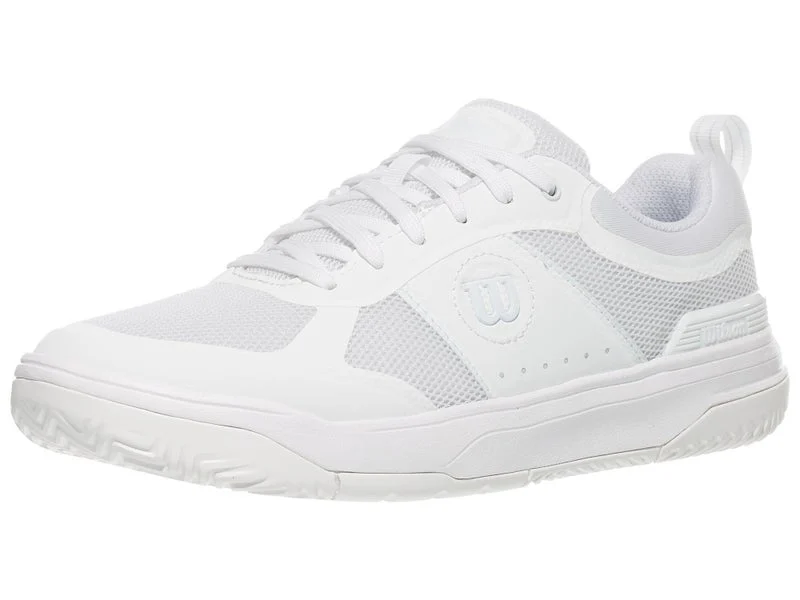
The Pickle Pro closes this list as the light, roomy pick, and I say plainly what it is not. It carries no letter width. There is no D or 2E version to order.
What it offers instead is a genuinely roomy toe box in a standard width, so toes can splay on plants and spread on stops the way feet want to, without the squeezed, stacked feeling narrow shoes give you by the second hour.
That makes it the right pick when your forefoot needs room but your midfoot and heel are close to standard. A full wide last would leave your heel swimming. At around 10 to 10.3 ounces per shoe, it is the lightest feeling shoe on this page.
Wilson keeps the rest of the build purposeful rather than fancy. A SecureKnit upper, a knitted upper that hugs the foot without stiff panels, wraps the midfoot. A contoured midfoot support system holds the foot through lateral movement, and the court EVA midsole with a high-density OrthoLite insole gives a medium, responsive cushion.
It is not plush, not harsh, and ready to play without a break-in period. The Duralast rubber outsole is Wilson’s durable court compound, built for the stop-and-pivot pattern pickleball repeats all session long.
Fit is true to size and true to width in my testing. The honest flip side of the room is that narrow feet may find this shoe too spacious, with the forefoot floating where it should be held.
Wilson does not publish a non-marking rating for the Pickle Pro, so the box says so plainly. Buy it if you want light weight and room for your toes to work. Skip it if your feet are narrow, or if you need a true letter width through the whole shoe.
How to Choose the Best Pickleball Shoes for Women with Wide Feet in 2027
A wide label is only the beginning of fit. Two shoes can carry the same letter and give your foot completely different kinds of room, and the right choice depends on where your foot needs that room.
Work through the points below before you decide which model on this page matches your feet and your game. My women’s shoes list covers the same fit questions for standard-width feet, and my wide-feet list covers them in men’s sizes.
Women’s Width Letters: B, D and 2E
Width letters describe the last a shoe is built on, not just the space in front of the toes. A last is the foot-shaped mould a shoe is built around, and a wider last makes a wider shoe from heel to toe. For women, B is the standard width, D is wide and 2E is extra wide. That is why a women’s D and a men’s D do not mean the same thing.
Men’s widths use a different scale, where D is standard, 2E is wide and 4E is extra wide. A true 2E width adds roughly half an inch across the ball of the foot against a standard B width.
A 4E adds roughly an inch, but dedicated women’s pickleball shoes top out at 2E, so a woman who needs 4E volume has to look at men’s shoes sized down, with the heel trade-offs that brings.
The same letter can still fit differently across brands and even across models from one brand. Last shape, upper material, toe taper and internal volume all change the result. Treat the letter as the starting category, then judge the actual shoe by how your foot sits in it.
A genuine D or 2E version is more useful for a broadly wide foot than a standard shoe that merely markets itself as roomy. Check the listing for the width letter before you buy, because some listings hide the wide variant behind a colour or size menu.
Wide Last or Roomy Toe Box: Which Kind of Room Do You Need
A shoe can be wide at the ball but taper sharply at the toes, or it can offer a broad toe box while keeping the midfoot fairly standard. Those are different fits for different feet.
A wide last widens the whole shoe, from heel to toe, and it suits a foot that is broad through the midfoot as well as the front. A roomy toe box only opens the front, and it suits a foot with a fairly standard heel and midfoot whose toes need room to splay.
The SQAIRZ XRZ and the Wilson Pickle Pro on this page are toe-box shoes. The New Balance 1007, the K-Swiss Express Light Wide and the Wilson Pickler are wide-last shoes.
If your toes feel folded together and need to splay, toe-box shape may be your main issue. If the upper presses across the whole forefoot and midfoot, you probably need a wider last rather than only a squarer front.
Stand in the shoe and load it the way you would on court. Spread your toes, shift sideways and push into a stop. The right kind of room becomes obvious under movement. Your forefoot should feel housed, not compressed, and the shoe should not need excess length to create the illusion of width.
Measure Your Feet Before You Order
Measure both feet before you order, because one is often larger than the other. Trace each foot on paper at the end of the day, when your feet are at working size, then measure the length and the width across the widest part.
Stand on the paper while you trace, because a foot splays slightly under load, and that is exactly how it sits during a split step.
Use the larger foot when you compare those numbers with the brand’s own size chart. As a rough guide for a women’s size 8, under 90 mm across the ball is narrow, 90 to 95 mm is standard, 95 to 100 mm is wide, and over 100 mm is extra wide.
Those bands shift a little by shoe size, and a 2E label from one brand does not mean identical dimensions to a 2E from another.
Match length and width to the chart rather than relying on the size you wear in a running shoe. A running shoe is built on a different last and often fits more forgivingly through the upper.
For wide court shoes, the chart matters even more because the same labelled size can be offered in several widths. If you fall between widths, judge the fit under movement instead of choosing by the label alone.
The sock you play in is part of the shoe’s internal volume too, so test the fit in the socks you actually wear on court. If you use your own insole or orthotic, choose a shoe with a removable footbed and enough internal height to accept it.
Take the shoe’s insole out and stand on it as a quick width check. Your foot should sit within its outline rather than spilling broadly over the edges.
Heel Lockdown: The Women’s Fit Problem
Start with proportion. A typical woman’s foot carries a narrower heel relative to its forefoot than a man’s, which is why a scaled-down men’s last so often produces the same failure.
The forefoot fits, the heel swims, and every split step becomes a small slide followed by friction. Heel slip is not a comfort quirk. It steals the confidence to plant hard, because a foot that moves inside the shoe cannot be trusted at full stretch.
A proper women’s last is the structural fix, shaped for that narrower heel from the start. On top of the last, look for lockdown features with names.
Grip linings that hold your sock, reinforced midfoot panels, and a top eyelet you can use for a runner’s loop when you need the last increment of heel hold. A runner’s loop is a lacing trick where the lace passes through the top eyelet twice to lock the heel down.
The front of the shoe needs the opposite quality, which is room. Aim for a locked heel and midfoot with about a thumb’s width beyond your longest toe, and enough forefoot space for your toes to splay on plants.
Try shoes on late in the day, in your playing socks, and judge them on a hard lateral plant rather than a walk down the aisle. That one movement is the whole job interview. Can women with very wide feet just wear men’s shoes?
Sometimes, with real trade-offs, and my men’s shoes list shows the models involved. A men’s shoe gives you a wider heel cup and an arch set further back, which can misalign with your foot and cause the same heel slip you were trying to escape.
If a women’s wide option fits, it is the better buy. Only when nothing in women’s works is sizing down about 1.5 sizes into a men’s wide the practical path, and even then the ASICS Gel-Resolution X 2E is the usual crossover because its men’s heel cup runs narrower than most.
Cushioning, Stability and Weight: The Trade-Offs
Cushioning is a trade, not a ladder. At the plush end, deep stacks like the Ultra Court’s Surge 7.0 and the 1007’s Fresh Foam X absorb more of every landing and feel kinder across long sessions on hard floors, but they sit you higher off the court and mute the floor a little.
At the lean end, lower builds like the Express Light’s K-EVA and the Pickle Pro’s court EVA keep you close to the ground, and the first step out of a split step feels immediate and precise.
Match the trade to your game and your calendar. Players logging long sessions several times a week, or playing on unforgiving outdoor concrete, usually end up happier at the cushioned end. Players whose game is built on kitchen-line quickness usually prefer the connected end.
Most players land happily somewhere in the middle, which is exactly where shoes like the Viper Court Pro are pitched. My plantar-fasciitis list goes deeper on cushion and arch support for feet that feel every landing.
Stability is what lets you commit to lateral movement without your shoe folding, twisting, or rolling at the edge. Soft foam alone cannot do this job. On a hard cut, an unstructured shoe deforms exactly when you need it to hold a shape. So judge stability by named structure.
A midfoot chassis like K-Swiss’s 180 PSC, a stability wall like ASICS’ DYNAWALL, a support frame like Wilson’s 4D Support Chassis, a midfoot shank like the Hypercourt Express 2, and outriggers flaring at the forefoot are all physical answers to the same moment, which is the plant at full stretch.
Uppers matter here too. Overlays, bootie constructions and reinforced midfoot panels are what stop your foot sliding across the top of the sole. A quick shop test helps. Hold a shoe by the heel and toe and twist. A stable court shoe resists through the middle rather than wringing out like a towel.
Weight follows the same trade. The lightest shoe here is the Pickle Pro at around 10 to 10.3 ounces per shoe, and the heaviest is the 806 V1 at 15.5 ounces. Weight is the first number to check when your arm is not the tired part but your feet are, because a heavy shoe adds up over a long session.
My indoor shoes list covers the outsole question for gym floors, where non-marking rubber decides whether you can play at all. Outdoors, the enemy changes from slip to wear, and harder compounds like Duralast and AHARPLUS survive concrete longer than soft indoor rubber.
One habit protects either kind. Keep court shoes off pavement when you are not playing. Carry your shoes, change at the court, and whichever pair you own will play like itself for far longer. For durability and replacement timing, use two failure signs rather than the calendar alone.
Replace a pair when the tread at the forefoot has worn smooth, or when the midsole foam fails the thumb-press test and stays compressed instead of springing back when you press hard into the heel.
When a Wide Shoe Is the Wrong Answer
A full wide shoe is not always the answer. If your heel is narrow and your forefoot is close to standard, a D or 2E last can leave too much volume through the middle and back of the shoe.
In that case, a standard-last model with a genuinely roomy toe box may hold you better and still give your toes the space they need. The Wilson Pickle Pro on this page is exactly that shoe.
More room should never come with constant sliding. If the heel lifts, the midfoot swims and the toes jam forward despite the width, the shape is wrong for your foot.
Persistent pain is also not a shopping problem to solve by cycling through more models. See a professional fitter or clinician who can look at your feet and movement rather than continuing to guess with another pair.
Frequently Asked Questions (FAQs)
1. What do D, 2E and 4E mean in women’s pickleball shoe sizes?
D means wide, 2E means extra wide and 4E means extra extra wide on the women’s width scale, where B is the standard width. The letters describe the width of the last the shoe is built on, but the exact feel still changes by brand and model.
A true 2E adds roughly half an inch across the ball of the foot against a standard B width. Dedicated women’s pickleball shoes top out at 2E, so a woman who needs 4E volume has to look at men’s shoes sized down, with the heel trade-offs that brings.
2. How do I know if I actually need wide pickleball shoes?
You likely need wide shoes if your toes feel squeezed together, the upper presses or bulges across the forefoot, or you need to loosen the front laces just to get through a session.
Another strong sign is that the correct length feels tight across the ball of the foot. Measure both feet and compare the width with the brand’s chart before you decide.
3. Should I just buy a size up instead of a wide width?
No, not as your first answer. A longer shoe may create space in front of your toes, but it can also let your foot slide forward on hard stops and reduce heel security when you move sideways. Buy the width that matches your foot and keep the length where it belongs.
4. What is the difference between a wide last and a roomy toe box?
A wide last widens the whole shoe, from heel to toe, because the shoe is built on a wider mould. A roomy toe box only opens the front of the shoe, while the midfoot and heel stay close to standard. If your whole foot is broad, you need a wide last. If only your toes need room to splay, a roomy toe box may be enough.
5. Can I wear men’s wide pickleball shoes if I am a woman?
Yes, if the fit works for your feet. As a conversion, order roughly 1.5 sizes below your women’s size, so a women’s 9 starts around a men’s 7.5, and expect a wider heel cup and more forefoot volume than the equivalent women’s last.
Plant hard and push sideways in them before committing. If the heel lifts in the shop, it will lift worse in a rally.
6. Are wide pickleball shoes heavier or slower on court?
Some are heavier, but wide does not automatically mean slow. Support and heritage models on this page carry more weight, while the Pickle Pro and Express Light Wide are built to feel light and easy. Judge the shoe’s actual weight, outsole grip and how securely it moves with your foot rather than assuming the width creates the problem.
7. Do wide court shoes work on both indoor and outdoor courts?
Yes, many wide court shoes can work indoors and outdoors, but the outsole and the venue’s rules decide the details. Check for a non-marking outsole if you play inside, and remember that softer indoor rubber will wear faster on rough outdoor courts. A durable all-court outsole is the practical choice if you regularly play in both places.
8. How much room should I have in front of my toes in a wide shoe?
You should have about a thumb’s width between your longest toe and the end of the shoe, while your heel remains secure. The space should feel deliberate, not like a full size of empty length. If your toes hit the front under movement or your heel lifts as you change direction, the balance of length and width is wrong.
9. Will my foot slide around inside a wide shoe when I move sideways?
It should not if the width matches your foot and the heel and midfoot are properly held. A wide shoe is meant to add room where your foot needs it, not to make every part loose. Look for a secure heel, a midfoot that can be laced into place, and a forefoot that gives space without letting the foot roll across the platform.
10. Can I use my own insoles or orthotics in wide pickleball shoes?
Yes, if the shoe has a removable insole and enough internal volume to hold your insole or orthotic without crowding the top of the foot. The 1007, Viper Court Pro and SQAIRZ XRZ are the clearest examples on this page. Remove the supplied footbed before inserting your own rather than stacking one on top of the other.
11. How long should a pair of wide court shoes last before I replace them?
There is no single timetable because surface, playing hours, body weight, dragging and pivoting all change the wear.
Replace a pair when the tread at the forefoot has worn smooth, the midsole feels flat and unresponsive, or the upper no longer holds your foot securely during lateral movement. A shoe that has lost its platform or grip is no longer doing the job you bought it for.
12. Do I need pickleball-specific shoes, or will wide tennis shoes work?
Wide tennis shoes work for pickleball because both sports use court shoes built for lateral movement, hard stops and pivots. Several picks on this page are tennis shoes chosen for their genuine wide versions and support. Pickleball-specific models may shape the toe box, drag protection and outsole details more directly around this sport.
Author

Michael Stevenson
Picky Paddle was founded by Michael Stevenson, a lifelong racket player who grew up on the tennis courts of Honiton in Devon and now lives on the North Cornwall coast.
Michael switched from tennis to pickleball and tests every paddle, ball, shoe, and accessory himself in real games with his local group, Breakers Pickleball, before it earns a place on the site.
Picky Paddle runs no ads, accepts no free products, materials, or experiences, and every review score comes only from testing, research, and first-hand experience. Michael also writes about pet care.
When he is not drilling third shots or testing new gear, Michael walks the coastline with Ted, his flat-coated retriever.