
The serve that convinced me spin deserved its own list was not a fast one. It left my paddle at a speed my opponent read easily, then dipped late, clipped the kitchen line, and kicked sideways off the bounce just enough that her return floated long.
Nothing about the swing was special. The brush was. The ball came off a gritty face with enough rotation to change what happened after it crossed the net, and that is the shot this page is about.
So this list is built on measurement, not opinion. Every paddle below carries a spin figure that a lab actually recorded, and wherever the measuring source is on record, the box beside each paddle prints it next to the number.
There are no spin scores out of ten here, because a score cannot tell you how a paddle compares, and comparing is the whole point.
I also hold each pick to an honesty standard the old version of this page never attempted: where the grit is a wear surface, I say so, and where a paddle’s number is ordinary, I print it anyway and explain what it does well instead.
I played these paddles the way spin players actually use them: heavy topspin serves, drives that need to dip inside the baseline, third shots that have to fall, and roll volleys at the kitchen. Ranked by the numbers, sorted by the player each one suits.
The 10 Best Pickleball Paddles for Spin in 2027
1CRBN TruFoam Genesis 14mm: Best Overall Pickleball Paddle in 2027
AT A GLANCE
CRBN TruFoam Genesis 14mm
WEIGHT
7.9-8.3 oz
SWING WEIGHT
119
TWIST WEIGHT
6.21
SPIN
2,401 RPM
Shape: Elongated class
Grip: -
Core: Full TruFoam foam, 14mm
Face: T700 raw carbon fiber
Approval: USAP and UPA-A
Feel: Soft dwell
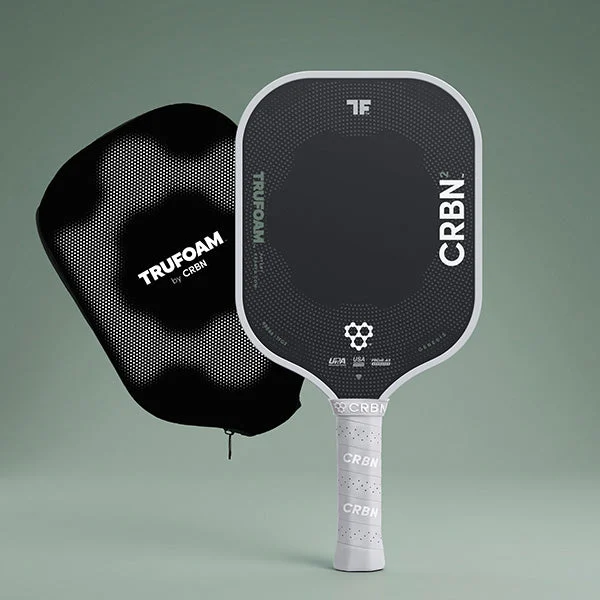
The Genesis sits at the top of this list because it posts the highest measured spin figure on this site, 2,401 RPM, and because I can feel where the number comes from. The full TruFoam core lets the ball sink in and stay on the face a fraction longer than a honeycomb build allows.
That dwell is working time. The T700 raw carbon holds the ball while my swing brushes up the back of it, and the result is a drive that keeps climbing over the net tape and then drops as if it changed its mind.
One piece of honesty about the figure itself: spin in this family is shape specific, and the other Genesis shapes measure lower. Treat 2,401 as this paddle’s number, not a promise printed across the whole range, and pick your shape knowing its own figure differs.
The trade-offs are real. A 119 swing weight is the heaviest swing on this page, and my hands feel it in fast kitchen exchanges, where the Genesis arrives a touch later than the light paddles below.
The raw carbon texture is also a wear surface, so the bite is strongest early and softens over months of play. Grip dimensions are not published, which matters if you size handles carefully.
Buy it if spin is the first thing you shop for and you swing with time to brush. Skip it if hand speed at the kitchen is your whole game.
2Engage Axiom Elongated 16mm: Best Elongated Spin Pickleball Paddle in 2027
AT A GLANCE
Engage Axiom Elongated 16mm
WEIGHT
7.94 oz
SWING WEIGHT
116
TWIST WEIGHT
6.08
SPIN
2,394 RPM (STS)
Shape: Elongated, 16.5 x 7.5 in
Grip: 5.5 in handle, circumference -
Core: Gen 3 polymer honeycomb, 16mm
Face: Durable Grit carbon fiber
Approval: USAP and UPA-A
Feel: Lively pop
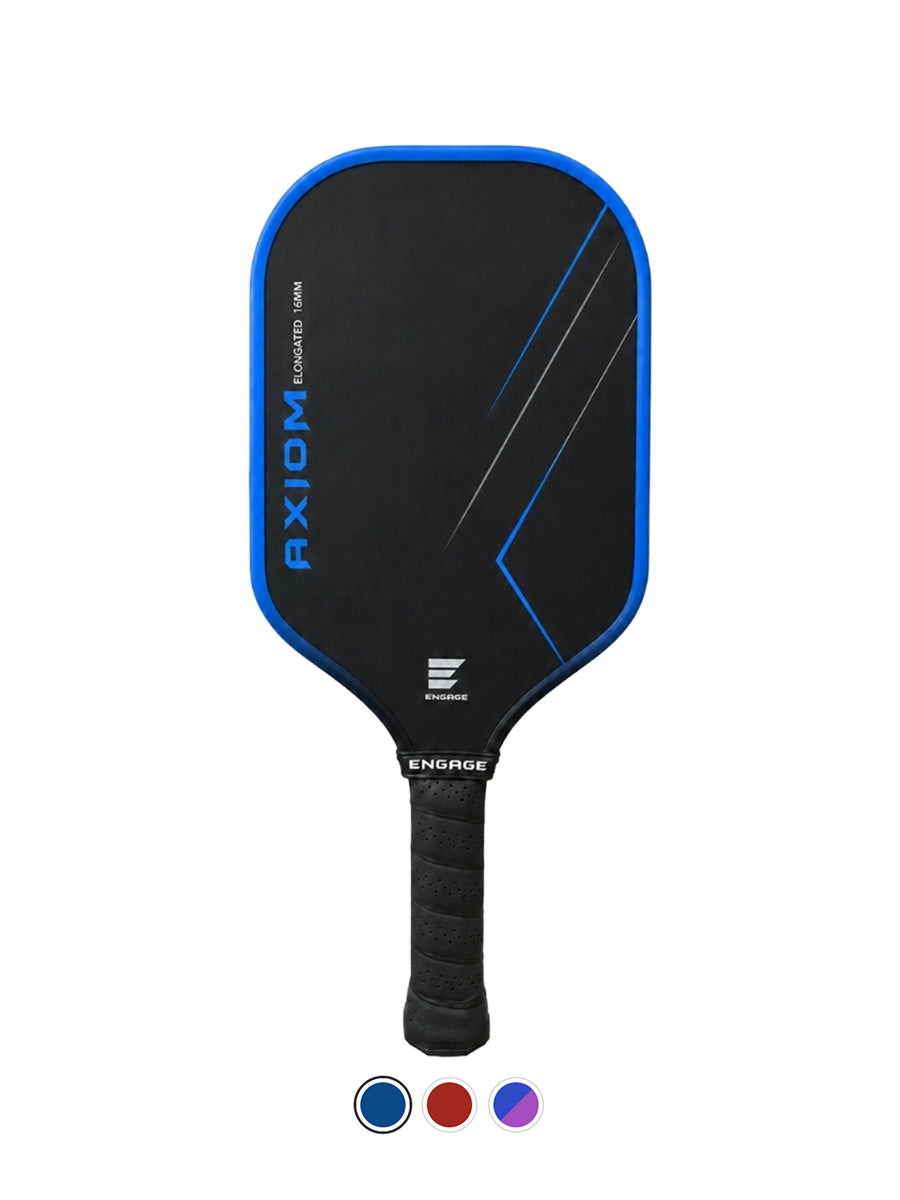
The Axiom is the surprise of this list: 2,394 RPM, the second-highest figure here, from a plain polymer honeycomb core with no foam anywhere in the build. The spin comes from the face.
Engage’s Durable Grit carbon does the gripping, and the elongated 16.5 inch frame gives my brush a longer lever to work with, so serves take off with visible dip and drives from the baseline bend down inside the line instead of sailing.
The face deserves a careful word. Durable Grit is Engage’s design aim made literal: a grit built to keep its texture longer than a standard raw carbon surface.
Every grit wears, including this one, but the intent here is a slower fade, and in my testing the bite stayed consistent across the sessions I logged with it. It is approved by both bodies, so it plays anywhere.
What it does not give you is dwell. Contact feels lively and direct, with pop that helps counters and hurts delicate resets until your hands adjust.
The 6.08 twist weight is mid-pack, so off-center contact twists more than the widebody picks below forgive, and the grip circumference is not published, which makes sizing a small leap of faith.
Buy it if you want elongated leverage and elite measured spin without a foam core. Skip it if a soft, pocketed feel is how you control the ball.
311SIX24 Vapor Power 2 16mm: Best Spin and Power Pickleball Paddle in 2027
AT A GLANCE
11SIX24 Vapor Power 2 16mm
WEIGHT
8.0-8.3 oz
SWING WEIGHT
107.55
TWIST WEIGHT
6.6
SPIN
2,335 RPM (Matt’s Pickleball)
Shape: Hybrid
Core: Gen 4 full foam, MPP
Face: HexGrit textured carbon
Approval: UPA-A only, not USAP
Feel: Raw bite
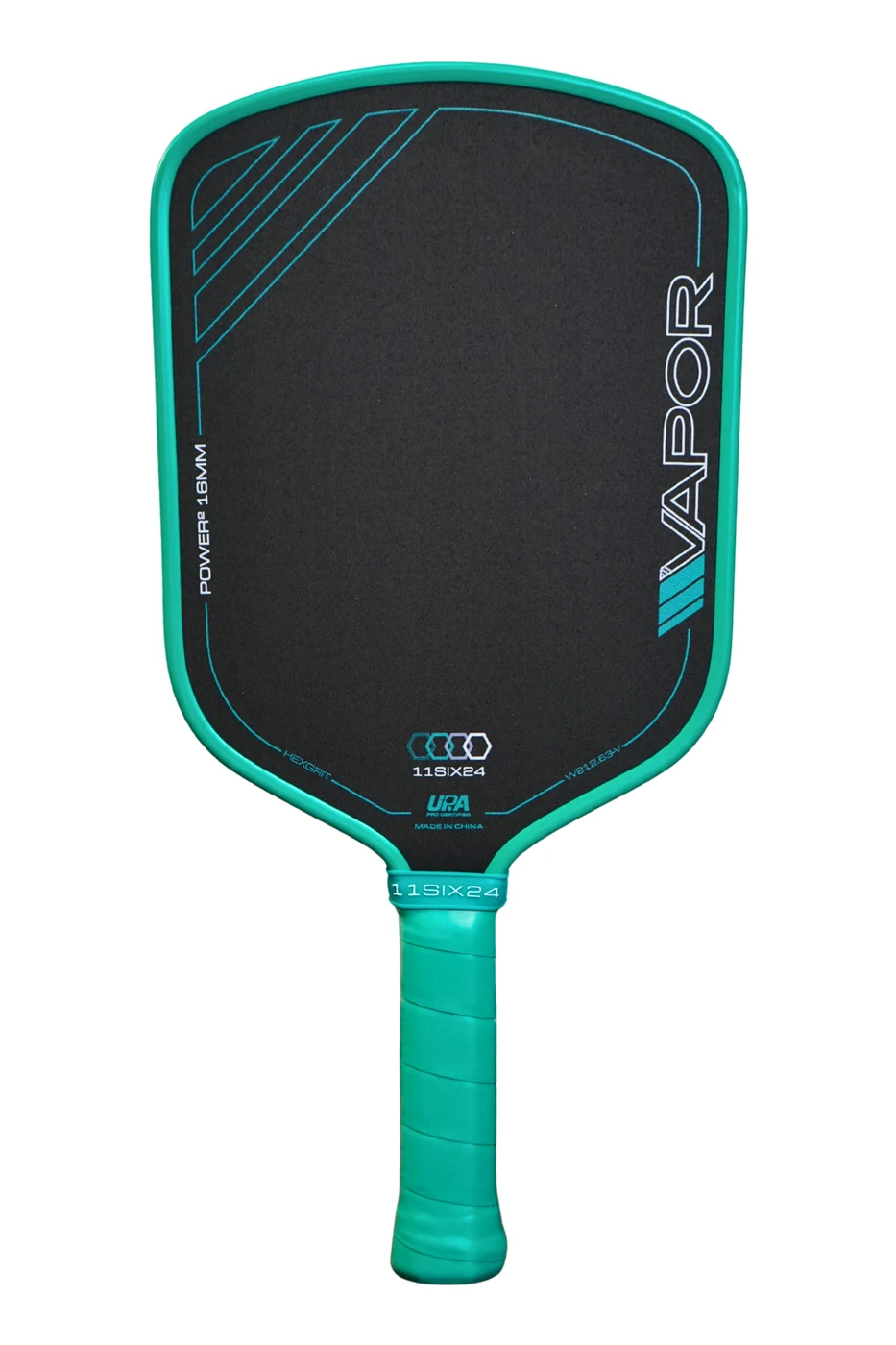
The Vapor Power 2 treats spin as a power weapon. Its HexGrit face carries silicon carbide particles embedded in the surface, and the bite at contact is immediate: 2,335 RPM measured, with a full foam core behind it that launches the ball instead of absorbing it.
What makes the combination dangerous is the 107.55 swing weight. The head comes through fast, my brush speed stays high even late in a rally, and topspin drives leave with both pace and dip, the two things a baseline player actually needs together.
The embedded-particle design is also this paddle’s answer to grit fade. A texture that sits in the surface rather than on it should hold its bite longer than a sprayed or peel-ply finish, and the face still felt sharp at the end of my testing block.
Now the caveat that decides this pick for many readers, stated plainly: the Vapor Power 2 is approved by UPA-A only. It is not on the USA Pickleball approved list, so it is not legal for USAP-sanctioned tournament play.
Open play, leagues that do not require USAP approval, and UPA-A events are fine. I include it because its spin is real and openly measured, but the approval line is part of the product, and I am not going to bury it in a footnote.
Buy it if you play outside USAP-sanctioned events and want spin with genuine power. Skip it if your calendar includes sanctioned tournaments.
4Six Zero Black Opal 14mm: Best All-Court Spin Pickleball Paddle in 2027
AT A GLANCE
Six Zero Black Opal 14mm
WEIGHT
8.2 oz
SWING WEIGHT
114
TWIST WEIGHT
6.4
SPIN
2,307 RPM
Shape: Hybrid
Grip: -
Core: G4 solid foam with Power Gel
Face: Diamond Tough raw carbon fiber
Approval: USAP and UPA-A
Feel: Dense spring
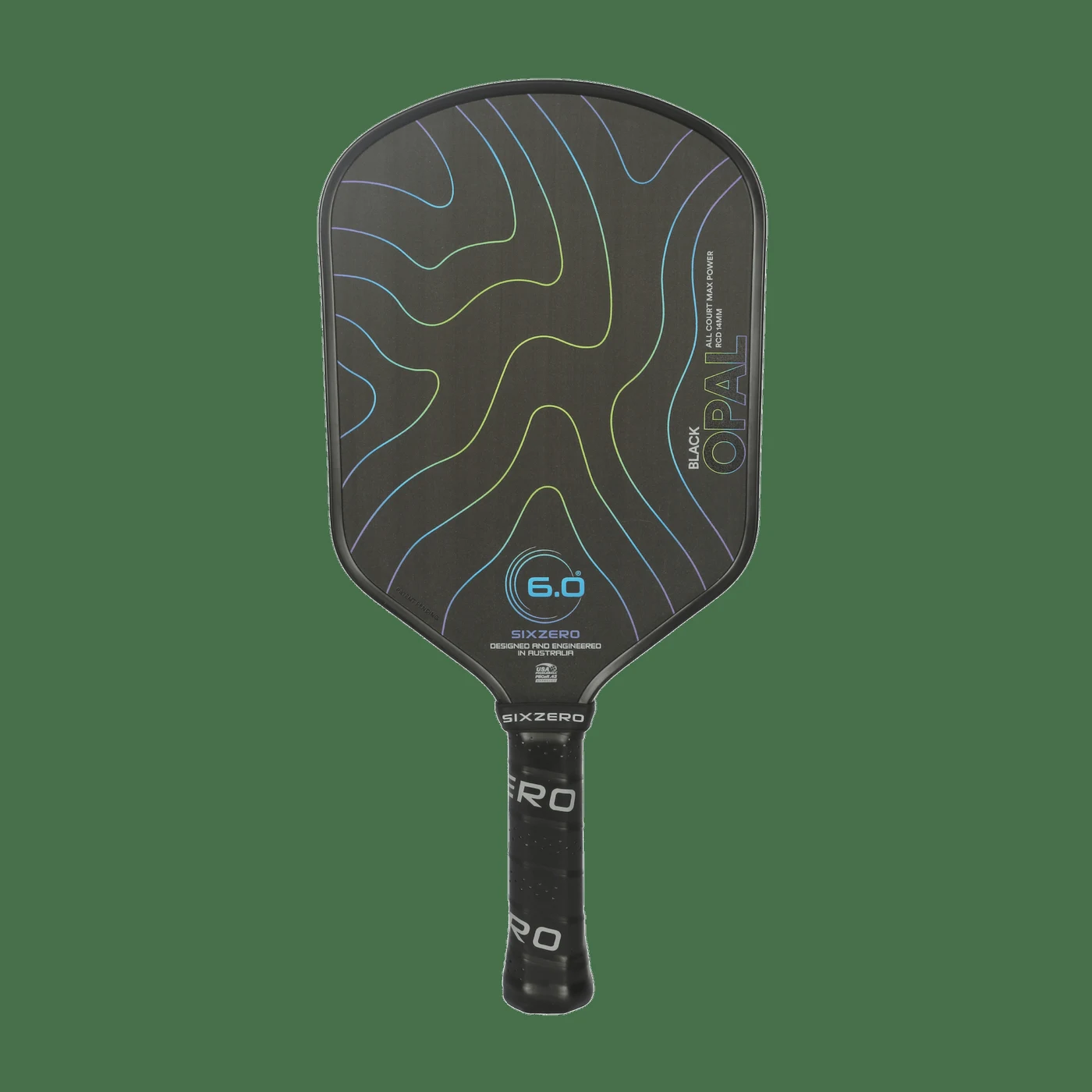
The Black Opal is the all-court version of the spin argument. Its 2,307 RPM is the third-highest figure on this page, but the number alone is not why it ranks here.
The hybrid shape and a 6.4 twist weight keep that spin available on the contact real rallies produce: stretched, slightly late, a little off center. The pure elongated spinners above punish that contact. The Opal still bites, still dips the ball, and still gives the shot back its shape.
Six Zero built the face for this page’s other theme. Diamond Tough is the brand’s durable-grit answer to raw carbon fade, a tougher texture meant to keep biting after a plain raw carbon face has smoothed out.
Matched with the dense, springy response of the solid foam core, the whole paddle feels like it was designed by someone tired of spin that disappears by the second season.
The trade is hand speed. At 8.2 ounces with a 114 swing weight, it is solid rather than quick, and players who win hands battles on reflex will feel the difference against the lighter picks here. The feel is also firm and dense, which I like on drives and have to manage on soft resets. Grip dimensions are not published.
Buy it if you want elite spin that survives imperfect contact. Skip it if feather-fast hands are your identity at the kitchen.
5Engage Pursuit Pro1 6.0 Elongated: Best Touch and Spin Pickleball Paddle in 2027
AT A GLANCE
Engage Pursuit Pro1 6.0 Elongated
WEIGHT
8.0 oz
SWING WEIGHT
118.6
TWIST WEIGHT
5.95
SPIN
2,267 RPM
Shape: Elongated, 16.5 x 7.5 in
Grip: 5.875 in handle, circumference -
Core: MachPro polymer with Variable Release 2.0
Face: Raw Toray T700 carbon fiber
Approval: USAP
Feel: Connected touch
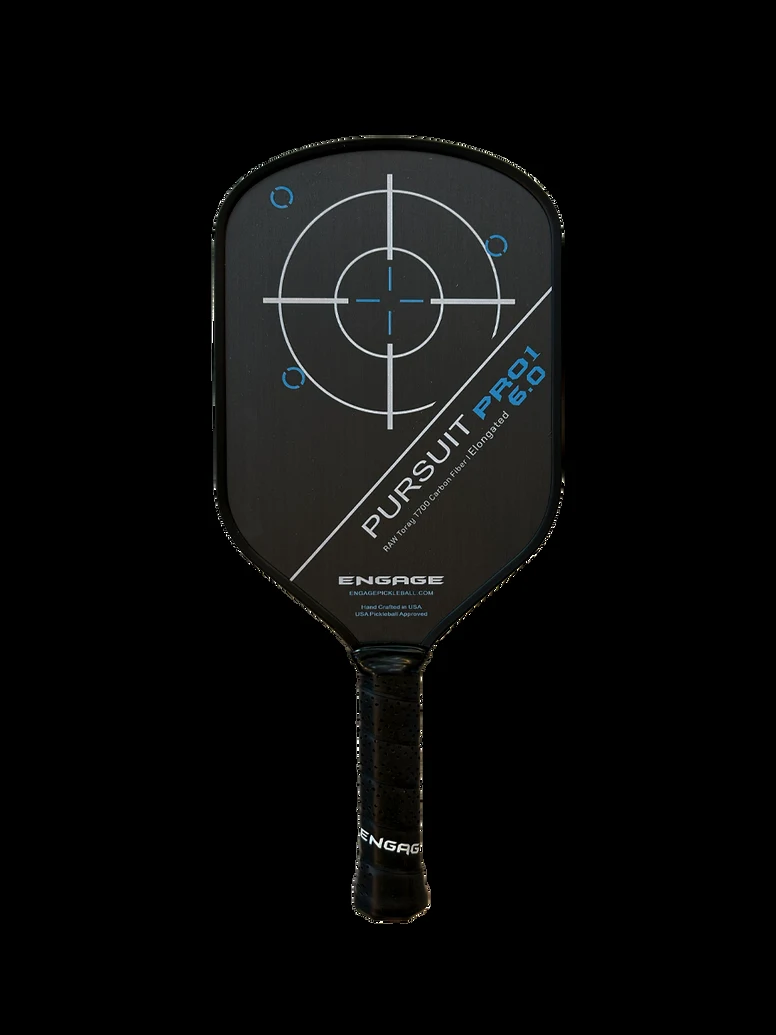
The Pursuit Pro1 is the proof on this page that spin is a control statistic, not only a power one.
It measured 2,267 RPM, a figure most power paddles would happily claim, on a paddle players buy for the soft game: roll volleys that climb and then dive at the feet, third-shot drops with enough topspin to fall instead of float, dinks that pull a half-step wider than they look.
The raw Toray T700 face grips without grabbing, and the MachPro core keeps contact connected, so I feel the brush happen rather than guessing at it.
The long 5.875 inch handle is part of the spin story too. It leaves room for a two-handed backhand, and two hands turn a defensive block into a rolled counter with real rotation on it.
The honest trade-off sits in the twist weight: 5.95, the lowest on this page. This paddle asks for centered contact, and stretched or off-center hits twist in the hand and lose both pace and spin.
The 118.6 swing weight also means the head arrives with momentum you have to manage in fast exchanges. And the raw carbon texture wears like every raw carbon texture, so the bite softens over months of play. This is a technician’s paddle, and it rewards exactly that player.
Buy it if your spin shows up in rolls, drops and dinks rather than serves. Skip it if your contact still wanders across the face.
6JOOLA Scorpeus Pro IV 16mm: Best Widebody Spin Pickleball Paddle in 2027
AT A GLANCE
JOOLA Scorpeus Pro IV 16mm
WEIGHT
8.24 oz
SWING WEIGHT
114.95
TWIST WEIGHT
7.4
SPIN
2,221 RPM (Matt’s Pickleball)
Shape: Widebody
Grip: 5.25 in handle, 4.25 in circumference
Core: Gen 3 Propulsion Core
Face: Peel-ply carbon fiber
Approval: USAP and UPA-A
Feel: Stable plush
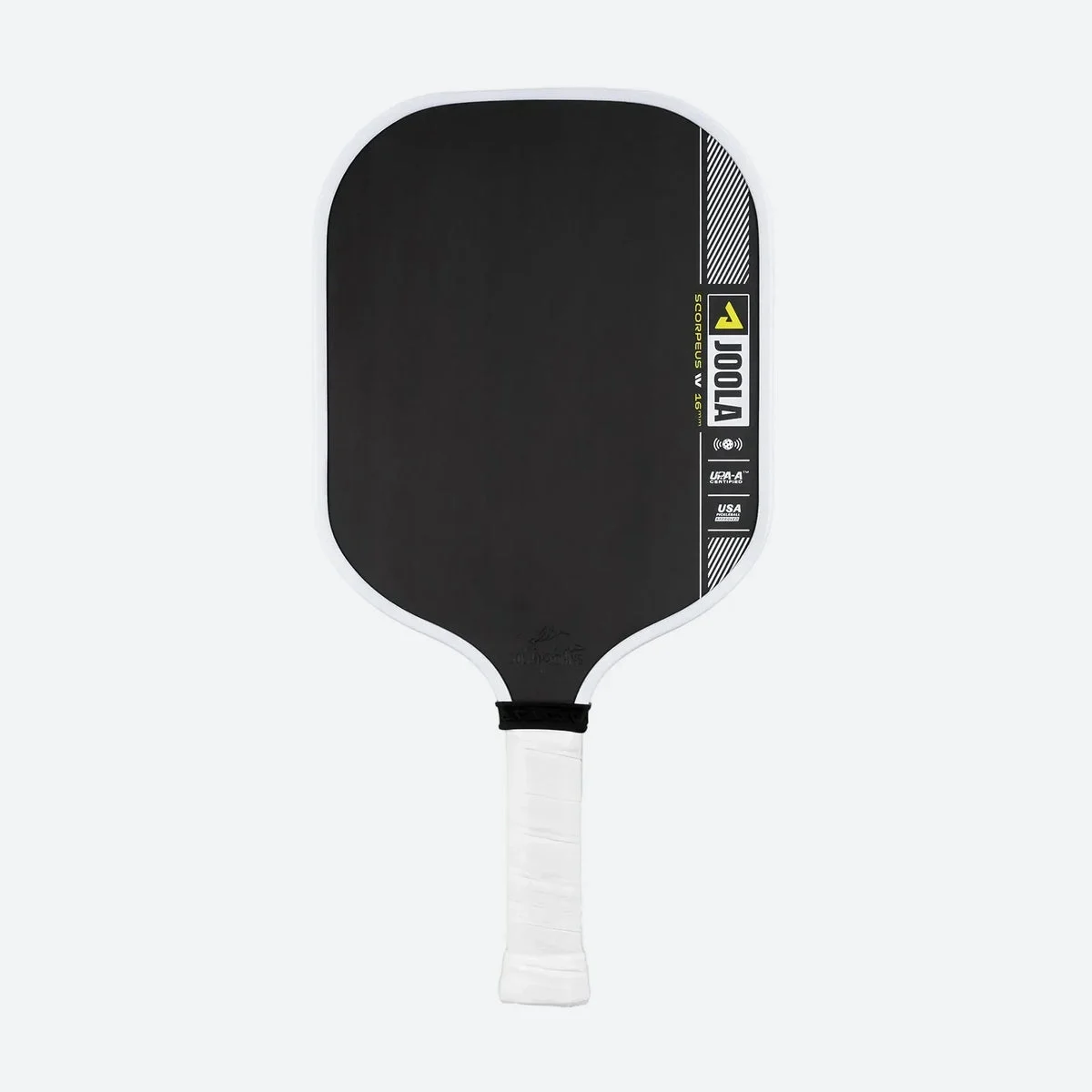
The Scorpeus makes the widebody argument for spin, and the argument is arithmetic. Its measured 2,221 RPM actually beats its elongated sibling on this page, and it pairs that figure with a 7.4 twist weight, the highest here.
Twist weight is what decides whether spin survives real contact. When a drive catches the Scorpeus near the edge at the kitchen, the face stays square, the brush still happens, and the roll volley still dips. On the narrower spinners, that same contact twists open and the ball floats.
The feel is stable and plush rather than sharp. The Propulsion Core gives counters a firm push without turning resets into a lottery, and the wide face is a genuinely bigger target in hands battles, where most points at the kitchen are actually decided.
I reach for this paddle when I want my spin to show up under pressure, not only on clean practice swings.
What the widebody gives back is reach and leverage. Serves and baseline drives get less help from the frame than the elongated picks provide, so its spin comes from the face and the brush rather than from swing length.
At 8.24 ounces and a 114.95 swing weight it is also a substantial paddle to whip, and the peel-ply texture is a wear surface like the other carbon faces here.
Buy it if you want spin that survives off-center contact at the kitchen. Skip it if reach and serve leverage lead your game.
7JOOLA Perseus Pro V 16mm: Best for Serves Pickleball Paddle in 2027
AT A GLANCE
JOOLA Perseus Pro V 16mm
WEIGHT
8.1 oz
SWING WEIGHT
117
TWIST WEIGHT
6.26
SPIN
2,060 RPM (Pickleball Effect)
Shape: Elongated, 16.5 x 7.5 in
Grip: 5.5 in handle, 4.25 in circumference
Core: Propulsion Core, polypropylene with EVA foam
Face: Raw carbon fiber
Approval: USAP and UPA-A
Feel: Firm consistency
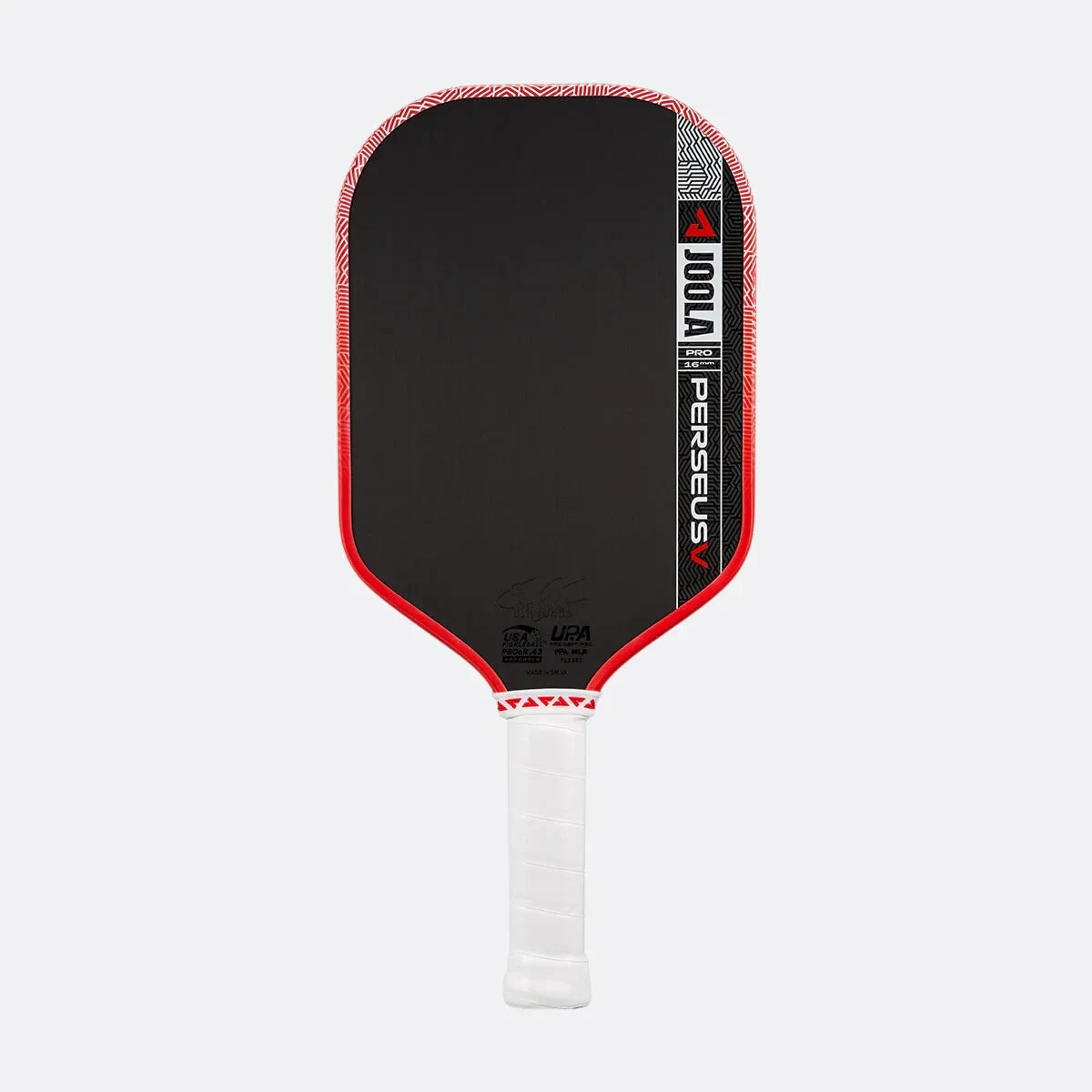
Let me be plain about the number first: at 2,060 RPM, the Perseus Pro V sits mid-list on this page for measured spin, and I am not going to dress it up as the spin king. It earns the serve slot on the combination no other pick matches: a genuinely grippy raw carbon face on an elongated Propulsion build with the pace to weaponize it.
A topspin serve is spin plus speed. The dip only matters if the ball is also arriving fast enough to rush the returner, and this paddle, the one Ben Johns plays, delivers both in the same swing.
That shape is the rest of the story. The 16.5 inch frame gives the brush a long lever, the 117 swing weight puts momentum behind the ball, and the firm, consistent response means the serve I grooved in warm-up is the serve I get in the third game. Drives benefit the same way: hard, dipping, repeatable.
The trade-offs are the elongated trade-offs. The narrow face forgives less than the widebody picks when contact drifts, the firm feel asks for softer hands on resets than the plush paddles here require, and a developing player will produce less spin with it than the raw figure suggests, because the brush has to be earned.
This is a serve weapon for a player whose mechanics are already in place.
Buy it if your serve is a planned point starter, not a rally starter. Skip it if forgiveness matters more than leverage.
811SIX24 Jelly Bean 16mm: Best Forgiving Spin Pickleball Paddle in 2027
AT A GLANCE
11SIX24 Jelly Bean 16mm
WEIGHT
8.0-8.3 oz
SWING WEIGHT
107
TWIST WEIGHT
7.21
SPIN
2,103 RPM (Pickleball Studio)
Shape: Widebody (Pegasus), 16 x 8 in
Grip: 5.75 in handle, 4.125 in circumference
Core: 16mm polymer honeycomb, thermoformed
Face: CFC: two layers of Toray T700 raw carbon fiber over one fiberglass layer
Approval: USAP
Feel: Soft forgiveness
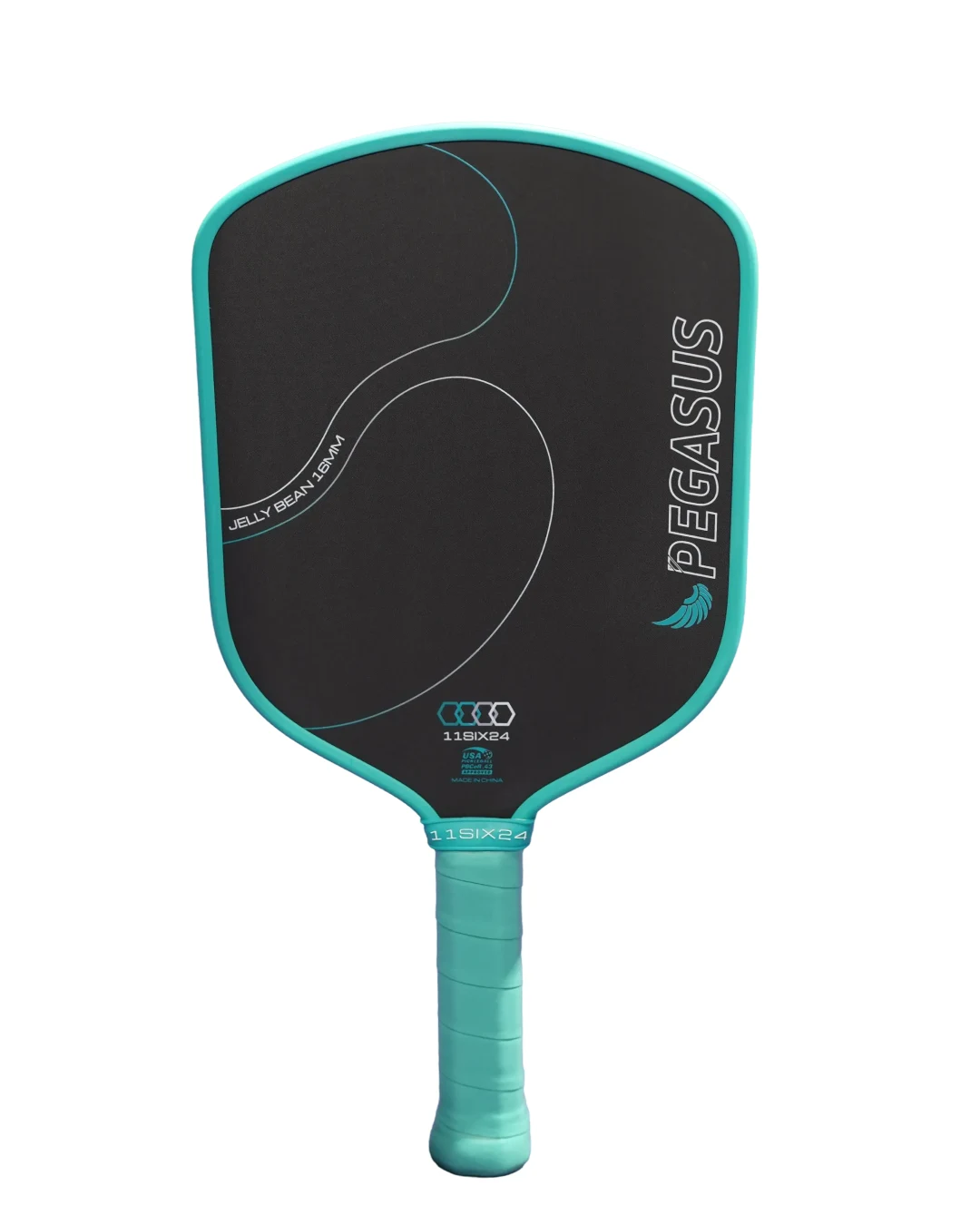
The Jelly Bean is the proof that spin is not only a flagship game. It measured 2,103 RPM, higher than the Perseus above it, and it pairs that figure with the friendliest handling numbers on this page: a 107 swing weight, the joint lowest here, and a 7.21 twist weight in a wide Pegasus frame.
That combination matters more than the headline number. Spin needs brush speed, and brush speed is exactly what a developing player cannot produce with a heavy, head-loaded paddle. This one lets the wrist and forearm actually swing up the back of the ball.
The layered face does the gripping: two layers of T700 raw carbon over a fiberglass layer, on a thermoformed honeycomb core that keeps contact soft and settled.
Off-center hits stay playable because the twist weight holds the face, so the spin survives the messy contact that learning players make most often. It is the same paddle this site trusts as its beginner spin pick, and this page is its natural step up.
The limits are reach and ceiling. The widebody gives back the elongated leverage on serves, putaway power is modest, and a strong player will eventually want more plow-through than the light swing provides. The raw carbon texture also softens with wear, like every face of its kind.
Buy it if you are building a spin game on real mechanics. Skip it if you already swing fast and want leverage and pace first.
9Vatic Pro V-SOL Pro 16mm: Best Foam-Core Spin Pickleball Paddle in 2027
AT A GLANCE
Vatic Pro V-SOL Pro 16mm
WEIGHT
~7.9 oz (measured)
SWING WEIGHT
108
TWIST WEIGHT
6.43
SPIN
2,060 RPM (Pickleball Effect)
Shape: Hybrid (Flash)
Grip: 5.3 in handle, 4.125 in circumference
Core: Full EPP foam with EVA perimeter ring, 16mm (Gen 4)
Face: Raw carbon fiber
Approval: USAP
Feel: Lively all-court
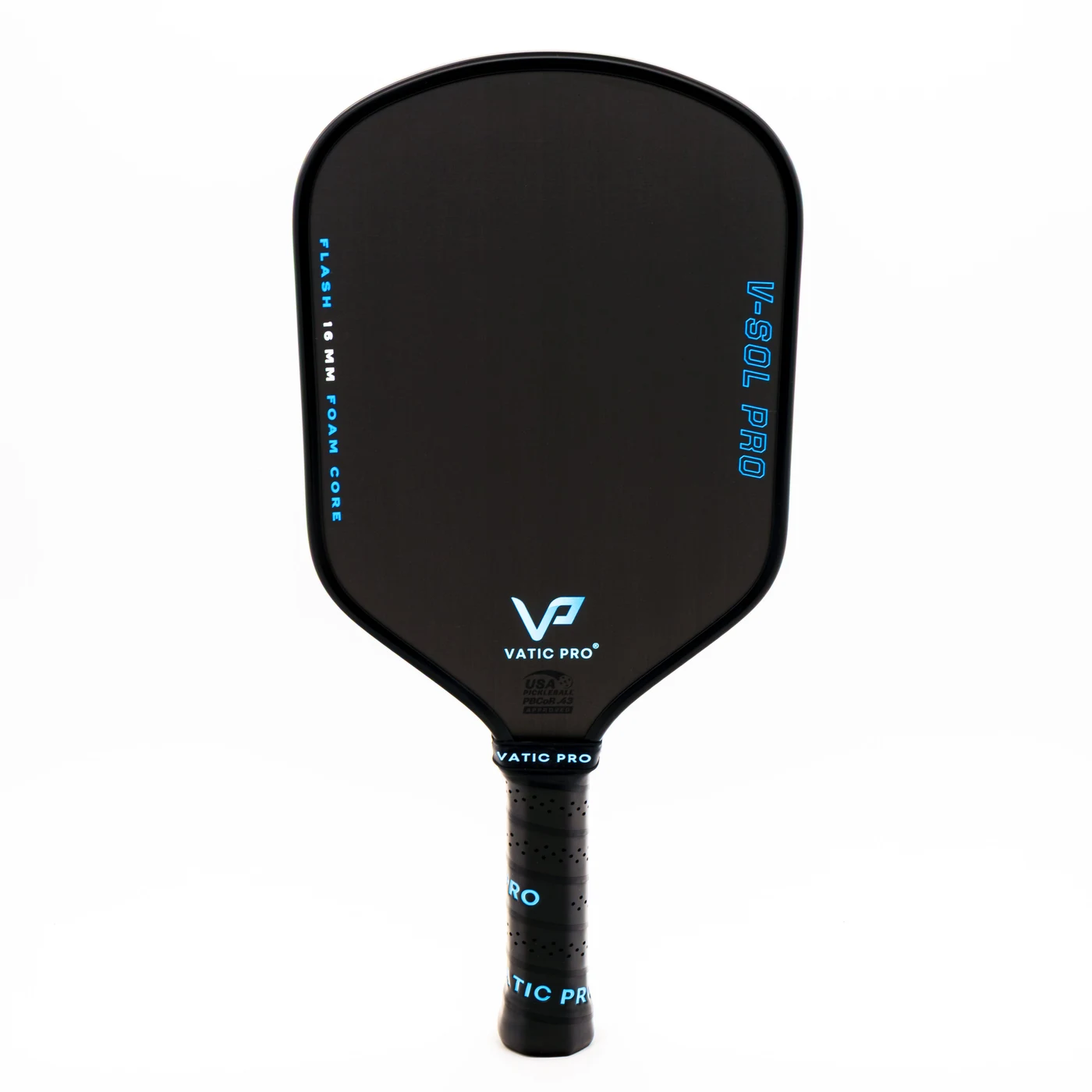
The V-SOL Pro is the foam-core route to spin at the Vatic end of this list. The full EPP foam core holds the ball on the raw carbon face a moment longer than honeycomb does, and that dwell is where its measured 2,060 RPM comes from: more contact time for the brush to work, on serves, dipping drives and rolled counters alike.
The 108 swing weight keeps the head moving quickly, so the brush speed a spin swing needs is easy to find even late in a long rally.
The hybrid Flash shape keeps the face wide enough for kitchen work, and the EVA perimeter ring firms up the edges, so contact away from center stays livelier than a soft core usually allows. In my sessions it held its own in the same drills as the foam builds above it on this page, and it never felt like the rung below them.
The honesty note, carried from this site’s beginners page: this is the livelier Vatic. The foam gives pace back on blocks and counters, which is welcome until a hard drive arrives and the reset pops up.
Players who want calm first and spin second should read the Prism Flash below before choosing this one. It is a spin paddle with a pulse, and it asks your hands to be the brake.
Buy it if you want foam dwell and real spin with quick hands. Skip it if your resets need the calmest face on the page.
10Vatic Pro Prism Flash 16mm: Best Control and Spin Pickleball Paddle in 2027
AT A GLANCE
Vatic Pro Prism Flash 16mm
WEIGHT
7.9-8.2 oz
SWING WEIGHT
114
TWIST WEIGHT
6.47
SPIN
~1,900 RPM (Pickleball Studio)
Shape: Hybrid, 16.25 x 7.7 in
Grip: 5.3 in handle, 4.25 in circumference
Core: 16mm C7 polymer honeycomb with foam-injected edge walls
Face: Raw carbon fiber, T700 class
Approval: USAP
Feel: Plush control
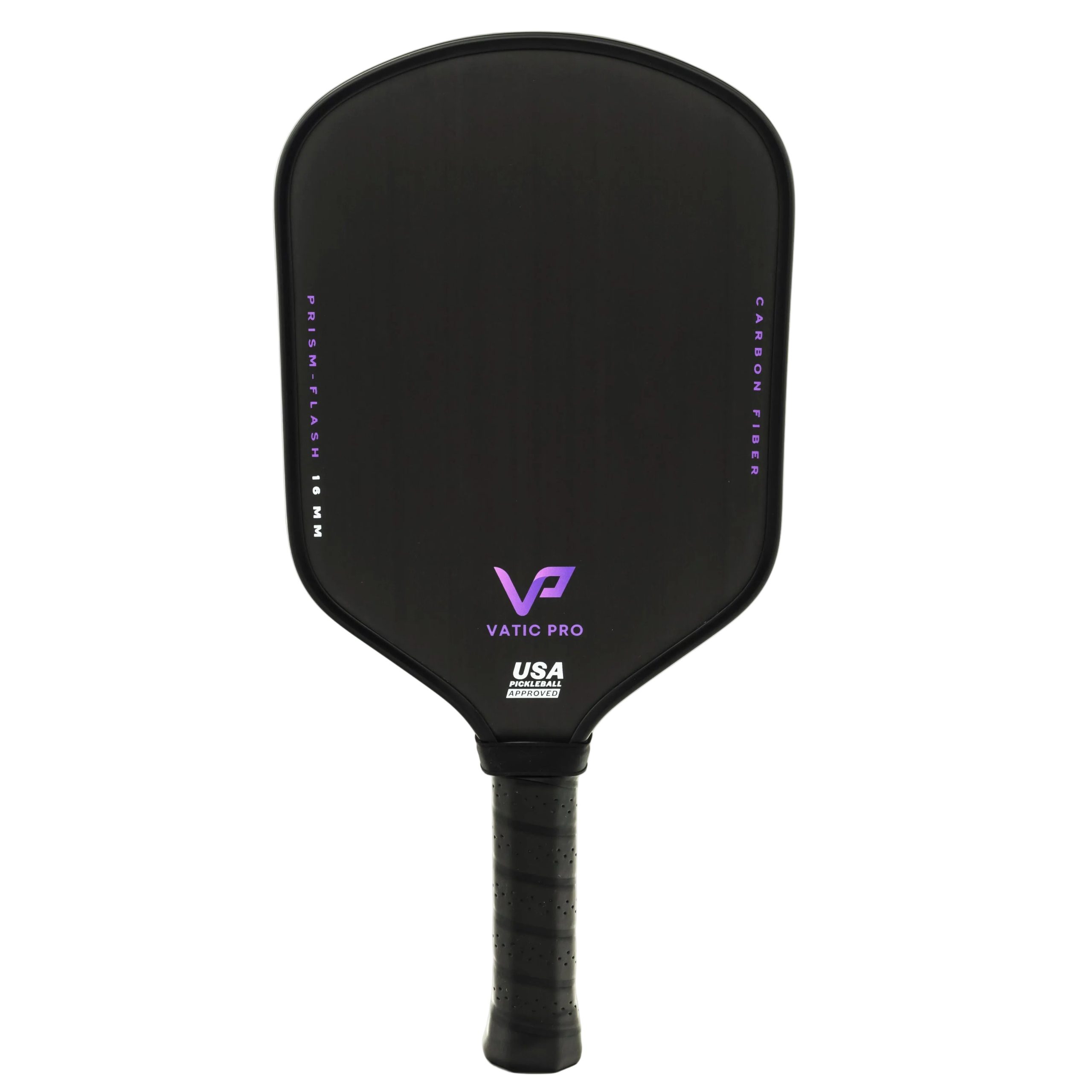
This closes the list, so let me start with the number and not pretend: at roughly 1,900 RPM, the Prism Flash posts the lowest measured spin figure here. What it offers instead is the spin a control player will still be using in month six.
The raw carbon face grips honestly, the thick C7 core with foam-injected walls keeps contact plush and quiet, and the result is spin in service of placement: third shots that dip instead of floating into the strike zone, resets that fall off the tape, drops that pull the opponent a step wider than the ball looked.
That is why this is the paddle I recommend more than any other on this site. Most players do not lose points because their drives lacked rotation.
They lose them on the fifth shot, the reset, the drop that sat up. A paddle that adds shape to those balls without adding chaos to any of them changes more results than a bigger number on a serve does.
The limits are plain. The power ceiling is the lowest on this page, putaways need full swings and good position, and a player chasing maximum serve spin will outgrow the face’s bite. The grit also softens with wear, though the plush game it supports ages better than most.
Buy it if your spin is a control tool and your points are won at the kitchen. Skip it if headline spin is the whole reason you are shopping.
How to Choose the Best Pickleball Paddle for Spin in 2027
Spin looks simple from the stands: the ball curves, dips, or kicks, and someone misses. Choosing the paddle behind it is less simple, because spin is produced by a face, a core, and a swing working together, and it is regulated by a rule most buyers have only half heard.
The sections below cover where spin actually comes from, how to read the numbers on this page without being misled by them, what the 2,100 RPM rule does and does not say, and why the spin you buy is not always the spin you keep.
Where Spin Actually Comes From
Spin comes from three ingredients working together: a face texture that grips the ball, enough dwell for that grip to act, and a swing path that brushes rather than strikes flat.
Remove any one of the three and the ball comes off flat no matter what the other two do. A gritty face hit with a stabby, level swing produces a drive with no dip. A foam core that pockets the ball cannot create rotation if the face is smooth.
The technique itself is a brush: up the back of the ball for topspin on drives and serves, with the face angled to keep the ball down, and across or under it for slice.
When you test a paddle, judge the combination, not the face alone. Hit your real serve and your real third shot, and watch what the ball does after the bounce, because that is where spin either exists or does not.
How to Read Spin Numbers
An RPM figure is a measurement from one tester, on one rig, with one ball and one swing, and it is only safe to compare against figures from that same tester. Different labs measure differently, so the same paddle can legitimately read several hundred RPM apart between rigs without anyone being wrong.
That is why the boxes on this page print the measuring source beside the figure wherever the source is on record: a 2,394 from one lab and a 2,335 from another are close cousins, not a ranking decided by 59 revolutions.
Compare within a source, treat cross-source gaps of a few hundred RPM as noise, and be suspicious of any list that mixes numbers from several testers and ranks to the single revolution.
What a measured figure does tell you reliably is the tier a paddle lives in: above roughly 2,000 RPM is elite company on any rig, and the honest differences between those paddles show up in shape, stability, and feel.
The 2,100 RPM Rule, Explained
From 1 October 2026, every paddle submitted for USA Pickleball certification must measure 2,100 RPM or less in the USA Pickleball Spin Rate Test, a camera-based test that fires a marked ball at a stationary paddle and films the rotation. Nothing in the rule reaches backward.
Paddles certified before 1 October 2026 keep their approval under the standards in force when they were certified, with no retroactive retest, so a paddle already on the approved list stays legal. The separate UPA-A body, which certifies paddles for its own tour events, has applied the same 2,100 RPM cap since 2024.
Two warnings matter for buyers. First, a review-lab RPM figure is not a certification result: the test methods differ, so a paddle reading 2,335 RPM on a review rig has not failed anything, and legality is set by its certification date and body, not by a magazine number.
Second, almost every paddle on sale today was certified before the rule took effect, so the practical check is simple: confirm the paddle is on the official approved list of the body whose events you play.
Grit Fade: The Spin You Keep vs the Spin You Buy
A raw carbon face gets its grip from a fine surface texture, and texture is a wear surface. Every ball strike polishes it a little, grit breaks down fastest where contact concentrates, and over months of regular play the spin a paddle produces falls, sometimes by a lot.
This is not a defect and it is not brand specific; it is the physics of the dominant face technology in the sport.
The industry answers are durable-grit designs: textures embedded into the surface, tougher carbon weaves, and coated grit systems all aim to slow the fade rather than promise it away, and several picks on this page use one of those approaches.
You can check your own face two ways: drag a fingernail lightly across the hitting zone and compare the scratch against the area near the edge, or press a ball into the face and twist to feel how the grip has changed.
Clean grit with a rubber eraser style block or a damp cloth, never with solvents or abrasive pads, which strip what texture remains. When the center of the face feels smooth under a thumbnail and your dipping drives stop dipping, the paddle has not broken. It has worn, and replacement is the honest fix.
Spin by Shot
Different shots use spin differently, and the traits on this list serve them unequally. On serves, topspin buys dip and a kicking bounce, and elongated leverage with a grippy face is the combination that produces it, which is why the serve slot on this page goes to a long, firm build.
On drives, spin is margin: rotation pulls a hard ball down inside the baseline, so a high measured figure turns pace you would otherwise hit long into pace you can use.
Third-shot drops come in two spin flavors, a backspin floater that stays up and drifts, and a topspin dipper that falls fast and low; dwell and a face that holds the ball serve the second kind.
Roll volleys at the kitchen are brush shots played at close range, where twist weight decides whether the roll survives contact that is slightly off center. Slice dinks and chops reward a face that grips at low speed. Match the paddle to the shot you hit most, not to the biggest number on the page.
Shape, Swing Weight and Approval Checks Before You Buy
Shape decides how easily you can brush. An elongated frame lengthens the swing lever, which helps serves and baseline drives, while a widebody shortens it and adds the stability that keeps kitchen rolls honest on off-center contact.
Swing weight is brush speed in disguise: the low swing weight picks on this page, around 107 to 108, let the head accelerate upward through the ball, while figures up near 119 add plow-through and ask for a stronger, earlier swing.
Handle length matters if you hit a two-handed backhand, because the second hand needs room to join the brush. Then run the approval check before anything else is decided: find the paddle on the official list of the body whose events you play.
This page contains one worked example, a paddle approved by UPA-A only and not listed by USA Pickleball, included openly because its spin is elite and its status is stated in its box, its section, and the answers below. A spin figure is only useful to you on a paddle you are actually allowed to play.
Frequently Asked Questions (FAQs)
1. What pickleball paddle gives the most spin?
On this page, the CRBN TruFoam Genesis, with a measured figure of 2,401 RPM, the highest spin number published anywhere on this site. Its full foam core holds the ball on the T700 raw carbon face long enough for the brush to work, which is the mechanism behind the figure.
Treat any single number as one tester’s measurement, though: several other picks here sit within a few hundred RPM of it, and shape, stability, and approval may matter more to your game than the last slice of rotation.
2. How is paddle spin measured, and why do RPM numbers differ between testers?
Spin is measured by striking a ball with the paddle under controlled conditions and recording the ball’s rotation, in revolutions per minute, usually with high-speed cameras or marked-ball tracking.
The numbers differ between testers because the rigs differ: ball type, swing or launch speed, strike point, and equipment all move the result.
The same paddle can read several hundred RPM apart across two labs with both measurements honestly taken. Compare figures only within one tester’s results, and use them to place a paddle in a tier rather than to settle arguments of fifty RPM.
3. What is the 2,100 RPM spin rule, and does it affect a paddle I already own?
The rule says that paddles submitted for USA Pickleball certification from 1 October 2026 must measure 2,100 RPM or less in the USA Pickleball Spin Rate Test. It does not affect a paddle you already own.
Paddles certified before that date keep their approval under the standards in force when they were certified, there is no retroactive retest, and an already approved paddle stays legal. The rule governs new submissions, not existing bags.
4. A review measured my paddle above 2,100 RPM. Is it illegal for tournaments?
No. A review measurement is not a certification result, and the two are not comparable: the official spin test uses its own camera-based method, its own ball, and a stationary paddle, while review rigs test differently.
Legality is decided by the paddle’s certification, meaning which body approved it and under the standards in force on its certification date. If your paddle is on the official approved list for the events you play, a magazine or lab number above 2,100 RPM changes nothing.
5. Does more spin actually help a recreational player, or only advanced players?
It helps a recreational player, mostly in ways that do not look spectacular. Topspin on a drive pulls the ball down, which turns would-be long balls into balls that land in, and that margin is the single biggest gift rotation gives a developing game.
Spin on a third shot makes the ball fall faster and lower, and a dipping serve rushes returners who are still learning to read bounce.
What spin does not do is fix contact: a player who mishits the center of the face often will benefit more from a forgiving, high twist weight paddle with a strong figure, like the widebody picks on this page, than from the single highest number.
6. Why has my paddle’s spin faded after a few months of play?
Because the texture that creates the grip is a wear surface. A raw carbon face bites through fine surface grit, and thousands of ball strikes polish that grit down, fastest in the center of the face where contact concentrates. Heat, grit from outdoor courts, and over-cleaning with harsh products speed the process up.
The paddle’s core and structure are usually fine; it is the face’s bite that has gone. Every raw carbon paddle does this eventually, which is why durable-grit designs exist and why this page notes the face technology on every pick.
7. Can I restore the grit on a worn paddle face?
Not in any way that restores the original texture or keeps the paddle legal for sanctioned play. Cleaning helps when the problem is buildup rather than wear: ball residue and court grit sitting in the texture can be lifted with a rubber eraser style cleaning block or a damp cloth, and that can bring back some bite.
Sanding, resurfacing, or applying aftermarket grit products alters the face, does not reproduce the factory texture, and can remove a paddle from approved condition. Once the texture itself has worn smooth, replacement is the real answer.
8. Raw carbon or a coated grit face: which keeps its spin longer?
Coated and embedded grit designs generally keep their spin longer. A plain raw carbon face starts with excellent bite, but its texture sits at the surface and polishes down with play.
Durable-grit approaches, such as particles embedded in the face or tougher woven textures, are built specifically to slow that fade, and the picks on this page using them are noted in their sections.
The trade is feel: raw carbon usually gives the most connected, longest-dwell contact when new, while durable-grit faces can feel firmer. Either way, no face keeps its day-one spin forever.
9. Is an elongated or a widebody paddle better for spin?
Neither, on the measured evidence of this page: the top of this list contains both, and the highest widebody figure here beats several elongated picks.
Elongated frames add swing leverage, which helps brush speed and serve spin, while widebody frames add twist weight, which keeps the face square so the brush survives off-center contact in kitchen exchanges.
Choose by where your spin is played. Serves and baseline drives lean elongated; roll volleys and hands battles lean widebody. The swing itself creates more of the difference than the outline does.
10. How do I put more topspin on my serve and drives?
Brush up the back of the ball instead of hitting through its middle. Drop the paddle head below the ball before contact, swing low to high, and let the face angle keep the ball down rather than scooping it upward.
On the serve, toss consistently, strike as the paddle is rising through the ball, and finish across your body rather than straight ahead.
On drives, the same path with a fuller swing produces a ball that climbs over the tape and dips. A grippy face multiplies the result, but the paddle cannot substitute for the path: flat swings produce flat balls from every paddle on this page.
11. Is a slice legal in pickleball, and which paddle traits help it?
Yes, slice is legal on every shot except one: the serve must be struck below the server’s waist, so a chopped undercut serve that contacts too high is a fault, while slice groundstrokes, dinks, and returns are all fully legal.
Traits that help are a face that grips at low swing speed, since slice is a glancing contact, and enough dwell for the ball to stay on the face through the chop. Control oriented raw carbon picks, like this page’s closing paddle, serve slice games well because the bite works at the gentle speeds a chop uses.
12. Do I need a USA Pickleball approved paddle to play spin in local leagues and open play?
No, not for open play or most local leagues, which rarely check equipment lists. You need an approved paddle for sanctioned tournaments, where the event’s governing body requires paddles on its official list.
That distinction is why this page includes one UPA-A-only paddle openly: it is not on the USA Pickleball list, so it cannot be played in USAP-sanctioned events, but it is legal for open play and for UPA-A events. Check your league’s own rules once, and check the official list before entering anything sanctioned.

Michael Stevenson
Hi, my name is Michael Stevenson and I’m a passionate pickleball player. I’ve been playing the game for many years and I’m pretty highly skilled at it. Pickleball is one of my favorite topics so naturally, I love to write about it.
Whether it’s tips for beginners, guides for experts, reviews of new paddles, or advanced playing techniques – if it relates to pickleball then I have something interesting to write about it. So if you’re looking for entertaining and informative information on the topic of pickleball, look no further than my written works!