
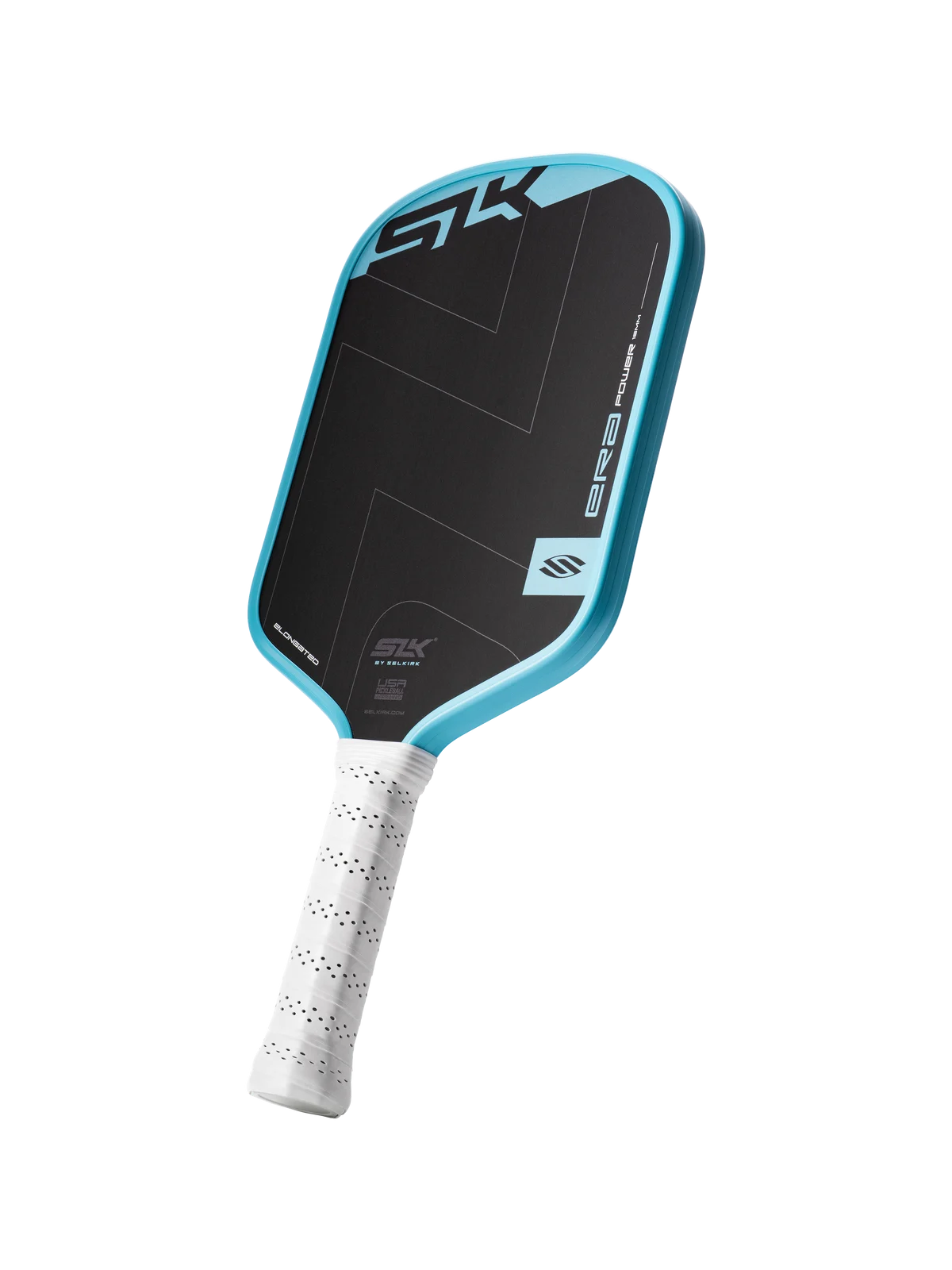
Midway through the second game of a league night, my partner and I are down 6-8 and the other side has started leaning on my backhand. A deep return comes to my backhand corner, high enough to drive and low enough to punish me if I miss. I take a full swing.
The ball leaves the face with a deep thud, dips late, and lands on the baseline. Two rallies later I hit the same shot with the same swing, and it lands in the same place. That is the ERA Power Elongated in one sentence: the same swing gives the same drive, every time.
WHAT I LIKE
- The same drive, every time: a linear response with no surprises
- Spin around 2,020 RPM from a face that grips and shapes the ball
- A 5.8 inch handle with honest room for two hands
- Resets and dinks you can trust on a power frame
- Approved by USA Pickleball and UPA-A, with a one-year limited warranty
WHAT I DON’T
- A 117 swing weight taxes hand speed in fast kitchen exchanges
- Mid-pack firepower for a paddle sold on power
- A 6.28 twist weight gives only mid-pack help on wild off-centre blocks
- The face texture fades with play, like every peel-ply face
- The thin, firm handle feels spare if you like a fuller grip
AT A GLANCE
Selkirk SLK ERA Power Elongated 16mm
WEIGHT
7.9-8.4 oz
SWING WEIGHT
117
TWIST WEIGHT
6.28
SPIN
~2,020 RPM
Shape: Elongated, 16.5 x 7.45 in
Grip: 5.8 in handle, 4.25 in circumference
Core: Dynamic Fusion Core, polymer honeycomb with EVA foam, 16mm
Face: T700 carbon fiber and woven fiberglass
Approval: USAP and UPA-A
Feel: Linear power
Warranty: 1-year limited warranty
On this page
- What the ERA Power Elongated Is
- How It Plays
- Elongated or Widebody: Which ERA Power Should You Buy?
- Who Should Buy It, and Who Should Skip It
- How It Compares to Its Closest Rivals
- Durability: What Months of Play Actually Do to It
- How I Tested the ERA Power Elongated
- The Bottom Line
- Frequently Asked Questions (FAQs)
What the ERA Power Elongated Is
The ERA Power Elongated is Selkirk’s Gen 3 power paddle in the long shape, built around a 16mm Dynamic Fusion Core. Gen 3 means the core and face are pressed together under heat into one sealed build, which firms up the edges and steadies the response.
Inside that core sits a polypropylene honeycomb, a grid of small plastic cells that gives the strike its pop, wrapped in low-density EVA foam around the perimeter and the handle.
EVA foam is the soft, closed-cell foam used in shoe soles, and here it calms the honeycomb down. The face is a three-layer blend of T700 raw carbon fiber and woven fiberglass, laid over that core.
T700 is a grade of carbon fiber, and raw means the woven fiber itself is rough, so the spin comes from the material rather than from a coating that can wear smooth in weeks.
The shape is the long one in Selkirk’s new two-shape system: 16.5 inches long and 7.45 inches wide, with a 5.8 inch handle. Elongated means the face is stretched long and narrow, which adds reach and leverage.
The handle is the story for a lot of buyers. At 5.8 inches it is one of the longest handles in the class, and the grip is an octagonal shape, eight flat sides instead of a round tube, which feels firm and stops the paddle turning in the hand.
It sits fourth on my elongated list for the same reason it sits fifth on my power list: the shape and the core work together, and neither one apologises for the other.
How It Plays
Power and predictability. This is the paddle’s whole case, and it is real. A full swing gives a full drive, a three-quarter swing gives a three-quarter drive, and the tenth drive of a long rally behaves like the first.
The foam layer around the honeycomb takes the trampoline randomness out of the response, so the ball leaves the face the way your swing shaped it. Serves carry with weight.
Overheads finish. But the honest number sits underneath the feel: lab firepower lands in the middle of the all-court class, not at the top of the power class. This paddle does not manufacture pace.
It repeats the pace you give it, faithfully, and that is a different promise. Players who want the hardest-hitting paddle on the market should read the pure power picks instead.
The soft game. Here the foam layer earns its keep. Drops land with shape instead of hope, because the core holds the ball a fraction longer than a plain honeycomb core does. Resets sit down low. Blocks absorb pace instead of handing it back.
The response is linear rather than soft, which is a real distinction: a soft paddle pockets the ball and swallows pace, while this paddle answers the same way at every speed, so your touch has to be honest.
If your soft game depends on a pocketing, dwell-heavy feel, this paddle plays firmer than you want. If your soft game is built on clean contact and a steady hand, it rewards you for it.
Spin. Measured spin around 2,020 RPM is honest working spin. It dips drives at the baseline’s feet, shapes roll volleys, and bites on serves without turning any of them into a trick shot.
The face does not feel super gritty under the thumb, and that is worth knowing before you buy: the grip is there, but it is quieter than the roughest faces in the class.
The three-layer blend is the reason it works at all. The carbon grips and shapes the ball, while the fiberglass adds the pop that finishes counters and speed-ups. Check the face twice a season by dragging a fingernail across it and by pressing a ball in and twisting. A face that still grabs turns the ball with it.
Forgiveness. A twist weight of 6.28 is mid-pack, and I am not going to dress it up as more. Twist weight is the number that says how much the face stays square when you miss the middle. On this paddle, contact near the edges stays playable but not rescued. Stretched defensive stabs hold their line more often than they spray.
Blocks against hard drives need your hand behind them. The elongated shape is part of the trade: the sweet spot sits higher and smaller than on a widebody, and the foam perimeter helps, but it cannot repeal the geometry. Players who miss the middle often should read the Widebody version first.
Hand speed. A swing weight of 117 sits toward the heavier end of the all-court class. Swing weight is how heavy a paddle feels mid-swing, and it is the number that decides hand speed.
In fast hands battles at the kitchen, this paddle asks you to be on time, and by the third game players who win purely on reaction speed will feel it. It is the one number on this paddle I would change if I could, and it is the reason the faster, lighter picks exist on the lists where this paddle also appears.
Elongated or Widebody: Which ERA Power Should You Buy?
The ERA Power comes in two shapes only, Elongated and Widebody, and both share the same 16mm Dynamic Fusion Core, the same three-layer face, and the same spin. There is no 14mm version and no Hybrid shape, so the choice is the shape, not the technology.
Buy the Elongated for reach, leverage, and serve power: the 16.5 inch frame drives from the baseline and finishes from mid-court, and the 5.8 inch handle gives two hands honest room.
Buy the Widebody for forgiveness and hand speed: the shorter, wider frame carries a higher twist weight and a bigger sweet spot, and answers quicker at the net.
On the lab sheets this site uses, the Widebody measures a 111.7 swing weight and a 7.2 twist weight with spin around 2,237 RPM, against this paddle’s 117 and 6.28 with spin around 2,020 RPM, and its handle runs 5.75 inches. Drivers and finishers start with the Elongated.
Defenders and kitchen players start with the Widebody, which sits tenth on my thermoformed list. Most players asking this question should buy the shape that matches where their points are won, and it is the Elongated that is ranked across this site.
Who Should Buy It, and Who Should Skip It
Buy the ERA Power Elongated if your drives fly long on one paddle and fall short on the next, and you want the guessing to stop. Buy it if you swing big and want the result to match the swing.
Buy it if you play a two-handed backhand and need a handle with real room: it sits third on my tennis players list and fourth on my two-handed backhand list for exactly that reason, and eighth on my large-hands list too.
Buy it if you are an intermediate or advanced player stepping up from a first paddle and want power you can trust rather than power you have to tame.
Skip it if hand speed is your whole game; lighter, quicker paddles exist and this one’s 117 swing weight will tax you. Skip it if you finish rallies with raw pace and need a paddle that manufactures putaways, because the lab numbers put this one in the middle of the all-court class.
Skip it if your touch game runs on softness and dwell, because this paddle answers firm and linear. And skip it if you miss the middle often and need the widest possible margin; the Widebody sibling forgives more, and it sits eighth on my advanced players list in its own right for the same reason this one does.
How It Compares to Its Closest Rivals
| Paddle | Swing wt | Spin (RPM) | How it plays | Pick it if |
|---|---|---|---|---|
| Selkirk SLK ERA Power Elongated (this review) | 117 | ~2,020 | Steady, linear response with a firm strike | You want the same drive on the tenth rally as the first |
| JOOLA Perseus Pro V | 117 | ~2,060 | Livelier face, more pop, plush soft game | You want a lively, plush feel |
| 11SIX24 Vapor Power 2 | 107.55 | ~2,335 | Quicker swing, textured face that bites harder | You build points with spin |
| Engage Pursuit Pro1 6.0 Elongated | 118.6 | ~2,267 | Connected polymer core, talkative strike | You want feedback on every shot |
Against the JOOLA Perseus Pro V, the reference elongated power paddle on this site, the difference is the response. The Perseus carries the same 117 swing weight and spin around 2,060 RPM against this paddle’s 117 and 2,020, so the numbers are close and the choice is the feel.
The Perseus answers with a livelier face, more pop on short swings, and a plush feel that makes its soft game easier. The ERA Power answers the same way every time, with a firmer strike and a longer handle for two hands.
Players who want every drive to behave identically read the ERA Power first; players who want the paddle to supply pace read my Perseus Pro V review.
Against the 11SIX24 Vapor Power 2, the spin-first power rival, the difference is the ceiling. The Vapor Power 2 spins around 2,335 RPM against this paddle’s 2,020, on a quicker 107.55 swing weight, and its textured face bites harder on every shot.
The ERA Power answers with a steadier response and a more honest soft game, and with approval for sanctioned play that the Vapor Power 2 does not carry. Players who construct points with spin read my Vapor Power 2 review first; players who want the same drive on the tenth rally as on the first start here.
Against the Engage Pursuit Pro1 6.0 Elongated, the connected-touch rival, the difference is the core. The Pursuit Pro1 measures a 118.6 swing weight and spin around 2,267 RPM, and its polymer core with a variable release gives a more connected, talkative strike that tells you exactly where contact happened.
The ERA Power plays quieter and more linear, with the foam layer smoothing out the response instead of reporting it. Players who want feedback on every shot read my Pursuit Pro1 6.0 review; players who want calm and repeatability stay here.
Durability: What Months of Play Actually Do to It
Two things age on this paddle, on different clocks. The face texture fades first, across a season or two of regular play, fastest if you drill daily; the fingernail and ball-grab checks in the spin section above will tell you where yours stands.
The core ages slower and more gracefully: honeycomb can soften at the sweet spot over long use, and the foam perimeter is built to resist exactly that, which is why this generation holds its feel longer than the plain honeycomb builds before it.
The edge guard and grip are ordinary wear items. Nothing about its ageing surprised me, and no part of it failed early. It carries a one-year limited warranty, so register the paddle when it arrives and keep the receipt with it, because registration plus receipt is what turns a problem into a covered claim instead of an argument.
How I Tested the ERA Power Elongated
I played the ERA Power Elongated across several weeks of league nights, open play and drilling sessions, against players at and above my level, because a power paddle only proves itself under pace.
The figures in the box at the top of this page are the published lab measurements for this paddle, from the same measurement sources used across this site; where a number comes from a lab rather than from my hand, the review presents it as measured, not felt.
Other rigs measure this paddle slightly differently: the brand’s own averages are a 118 swing weight and a 6.6 twist weight, and one independent rig measures 119.2 and spin at 2,155 RPM. The box prints the site’s settled line, 117 and 6.28 with spin around 2,020 RPM, and it is the figure the listicles on this site use.
When a published figure and my on-court impression disagree, the review says so. On this paddle, they did not: the mid-pack firepower, the linear response, and the long handle all played exactly as the numbers said they would.
The Bottom Line
The ERA Power Elongated is not the hardest-hitting paddle on the market, and that is precisely its case. It is the paddle that gives you the same drive every time you ask for it: linear power, working spin, a handle built for two hands, and a soft game you can trust on a power frame.
It sits fourth on my elongated list, fourth on my Selkirk list, fifth on my power list and sixth on my control-and-power list for one reason: when a player asks me for power they can repeat, this is the answer that has never embarrassed me.
If your game matches the player described above, buy the Elongated, and put the season into drilling.
Frequently Asked Questions (FAQs)
1. Is the SLK ERA Power Elongated good for beginners?
No, not as a first paddle. It is built for intermediate to advanced players who already swing with intent. A beginner will find its 117 swing weight heavy, its firm response unforgiving on soft shots, and its power hard to tame.
A player stepping up from a first paddle is its ideal owner, once the swing is built and the soft game is steady. The paddle this site ranks first for beginners is a control build with a far wider margin for forming contact.
2. Elongated or Widebody: which ERA Power should I buy?
Buy the Elongated for reach, leverage, and serve power: the 16.5 inch frame drives from the baseline and finishes from mid-court, and the 5.8 inch handle gives two hands honest room.
Buy the Widebody for forgiveness and hand speed: the shorter, wider frame carries a higher twist weight, a bigger sweet spot, and a quicker answer at the net.
Both shapes share the same 16mm Dynamic Fusion Core, the same three-layer face, and the same spin. The choice is the shape, not the technology. Drivers and finishers start with the Elongated; defenders and kitchen players start with the Widebody.
3. Is the ERA Power a power paddle or an all-court paddle?
It is a power-leaning all-court paddle, and the lab numbers say so plainly. Its firepower sits in the middle of the all-court class, not at the top of the power class, and its serve speed lands near the middle of the tested range.
What it does better than the pure power frames is repeat itself: the same swing gives the same drive, rally after rally. Players who want the hardest-hitting paddle on the market should read the pure power picks instead. Players who want usable power they can trust should start here.
4. What is the Dynamic Fusion Core?
It is Selkirk’s Gen 3 core for this paddle: a polypropylene honeycomb wrapped in low-density EVA foam around the perimeter and the handle, with composite edge reinforcements, pressed into a thermoformed build at 16mm.
The honeycomb supplies the pop. The foam layer calms the response, so the ball leaves the face the same way on the tenth drive as on the first. In play it reads as a firm, linear strike with more dwell than a plain honeycomb core gives.
5. What are the ERA Power Elongated’s weight and swing weight?
The settled lab line on this site is 7.9 to 8.4 ounces, a 117 swing weight, and a 6.28 twist weight, with spin around 2,020 RPM. The weight is a range because individual paddles vary: one tested unit weighed 8.0 ounces.
Other rigs read this paddle slightly differently, with the brand’s own average at a 118 swing weight and a 6.6 twist weight, and one independent rig at 119.2 and 2,155 RPM of spin. The box at the top of this page prints the site’s settled line, and it is the figure the listicles on this site use.
6. What grip size is it, and does it suit a two-handed backhand?
The grip circumference is 4.25 inches on a 5.8 inch handle, the standard fit most hands know, on one of the longest handles in the class.
The handle is generous for two hands, with honest room for the second hand to sit without crowding the first, and the elongated shape puts the sweet spot high, where a two-handed stroke already meets the ball.
A player whose two-handed backhand is a central shot will manage comfortably. You cannot make a grip smaller, but you can build one up: each overgrip layer adds roughly 1/16 of an inch of circumference, reversibly, so a player who wants a fuller grip can dial it in.
7. Is the ERA Power Elongated approved for tournament play?
Yes. It is approved by USA Pickleball and certified by UPA-A, so it is legal for sanctioned play and for pro tour events. Before travelling to an event, confirm the exact model name on the approved list, as approval attaches to the specific model and variant.
8. How long does the ERA Power’s spin last?
The spin is strongest fresh and softens with hours played, and the review says so plainly. The face grips because the woven fiber itself is rough, a raw texture pressed onto the face, and that texture fades across months of regular play, faster under heavy drilling.
Expect strong working spin through a season or two, and check the face twice a season by dragging a fingernail across it and by pressing a ball in and twisting: a face that still grabs turns the ball with it.
9. ERA Power Elongated or JOOLA Perseus Pro V: which should I buy?
Buy the ERA Power for repeatability: the same drive every time, a longer handle for two hands, and a calmer response that never surprises you. Buy the Perseus Pro V for a livelier face and more pop on short swings, with a plush feel that makes the soft game easier.
The Perseus carries a 117 swing weight and spin around 2,060 RPM against this paddle’s 117 and 2,020, so the numbers are close and the choice is the feel. Players who want every drive to behave identically read the ERA Power first; players who want the paddle to supply pace start with the Perseus.
10. What warranty does the ERA Power carry?
It carries a one-year limited warranty from Selkirk. Register the paddle when it arrives and keep the receipt with it, because registration plus receipt is what turns a problem into a covered claim instead of an argument.
Inspect the core response in the first month, and check the face texture twice a season, so any issue shows up while the warranty still covers it.

Michael Stevenson
Hi, my name is Michael Stevenson and I’m a passionate pickleball player. I’ve been playing the game for many years and I’m pretty highly skilled at it. Pickleball is one of my favorite topics so naturally, I love to write about it.
Whether it’s tips for beginners, guides for experts, reviews of new paddles, or advanced playing techniques – if it relates to pickleball then I have something interesting to write about it. So if you’re looking for entertaining and informative information on the topic of pickleball, look no further than my written works!