
The return came back faster than I hit it. I had driven a third shot hard at the net player, expecting a block, and instead the ball was past my shoulder before my paddle came up. That is the Boomstik Elongated in one rally. It does not ask for your best swing.
It takes an ordinary swing and hands the ball back with pace you did not put into it. The question this review answers is whether you can live with everything that pace brings with it, because the pop that ends points also makes the soft shots harder, and the paddle never lets you forget the trade.
My score: 8.6/10
WHAT I LIKE
- Power at the top of the market: one lab ranks its firepower in the 98th percentile, and serves clocked at 60.8 mph on one protocol
- A twist weight of 6.7 on an elongated frame, so off-centre contact still leaves on the line you chose
- A sweet spot that forgives far more than an elongated power paddle should, with a 16.5 inch frame that still reaches
- Spin around 2,294 RPM from a durable grit face, enough to shape drives and dip drops
- A 5.8 inch handle with real room for a two-handed backhand, and a limited lifetime warranty behind it
WHAT I DON’T
- The pop makes dinks and resets harder: the ball jumps off the face even when you do not swing
- Spin is good, not elite, and the grit face loses bite faster than the best durable grits over months of play
- The stiff, hollow, loud feel gives a hard, direct strike with little softness in it
- The edge guard is the most common owner complaint, with guards coming loose near the weight clips
- The weights are semi-permanent, so you cannot tune the weighting yourself, and there is no verified brand-sold listing on the usual marketplace, so you buy direct
AT A GLANCE
Selkirk LABS Project Boomstik Elongated
WEIGHT
8.2 oz (measured; brand range 8.0-8.3 oz)
SWING WEIGHT
117
TWIST WEIGHT
6.7
SPIN
~2,294 RPM
Shape: Elongated 16.5 x 7.45 in
Core: 16mm BoomCore PureFoam with EVA Power Ring
Face: 3-layer Multistrata T700 carbon fiber with InfiniGrit
Grip: 5.8 in handle, 4.25 in circumference
Approval: USAP (UPA-A version without MOI clamps available by request)
Warranty: Limited lifetime
Feel: Stiff, crisp, hollow, loud
Power: 60.8 mph serve speed on one protocol
On this page
- What the Boomstik Elongated Is
- How It Plays
- Elongated or Widebody: Which Boomstik Should You Buy?
- Who Should Buy It, and Who Should Skip It
- How It Compares to Its Closest Rivals
- The Boomstik ST: A Different Paddle
- Durability: What Months of Play Actually Do to It
- How I Tested the Boomstik Elongated
- The Bottom Line
- Frequently Asked Questions (FAQs)
What the Boomstik Elongated Is
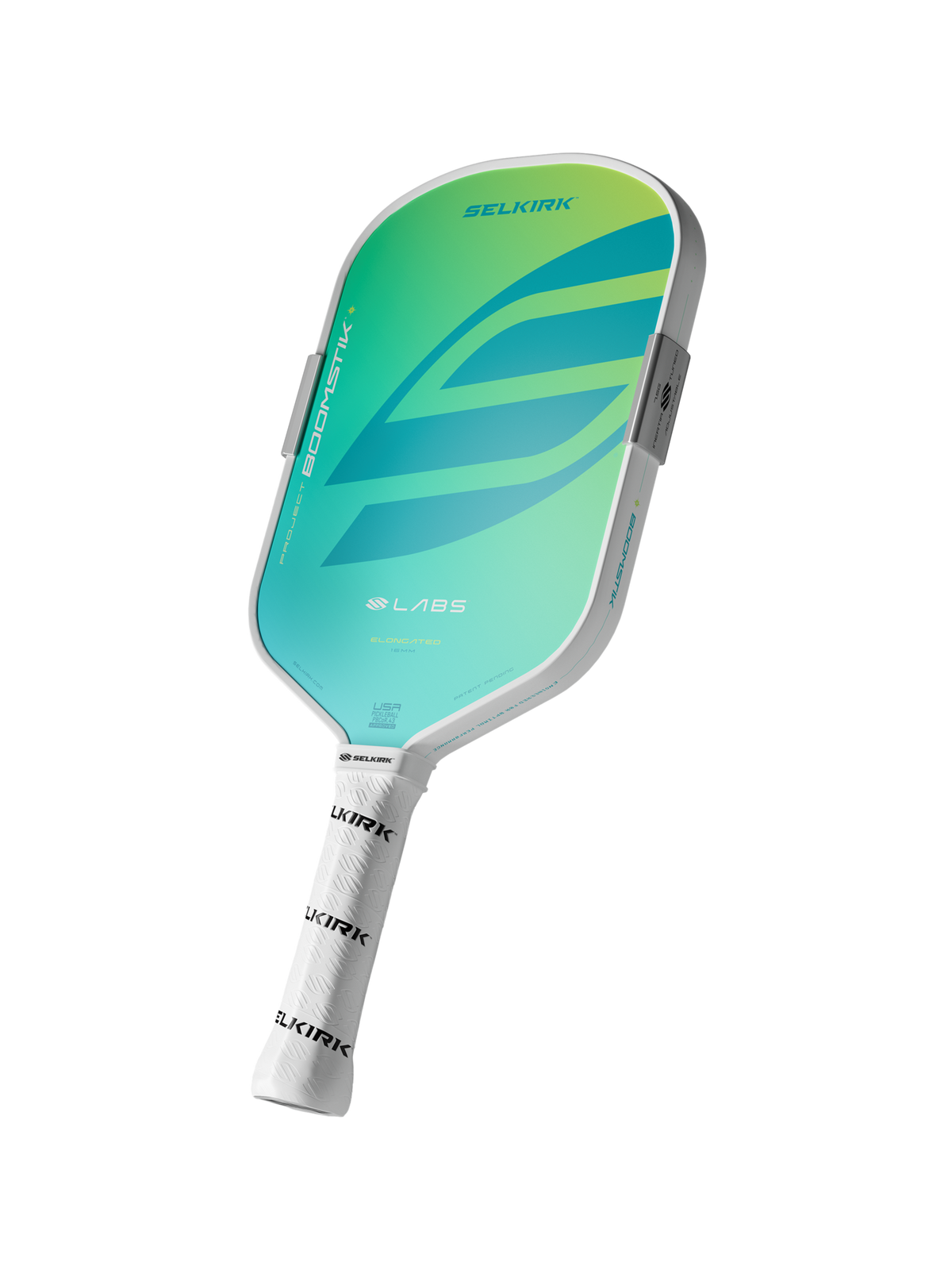
The Boomstik Elongated is Selkirk’s all-foam power paddle, built around a 16mm BoomCore with a three-layer T700 carbon face. That construction sentence explains the whole paddle. The core is foam all the way through, with a PureFoam centre ringed by an EVA Power Ring and fused into one piece, with no honeycomb cells inside it.
Foam that is fused this way returns energy instead of absorbing it, which is how a normal swing becomes a fast ball. The face is three layers of T700 carbon fiber, which is a strong, light carbon weave, with Selkirk’s InfiniGrit texture on top, and the texture is what grips the ball for spin.
The second decision that defines it is the weighting. Two weights of about 7.5 grams each are clamped to the edge guard at the factory, and Selkirk calls this the MOI Tuning System. MOI means moment of inertia, which is how much a paddle resists turning, and the weights raise the twist weight to 6.7.
Twist weight is how much the face resists turning when you hit away from the centre, and this number says the face holds its line on a long frame, which is the hard part of an elongated paddle.
The weights are semi-permanent, which means they are fitted to stay, and removing them can damage the parts. One measured unit lost about 10 points of swing weight and about 1.4 points of twist weight when the weights came off, so the weighting is not a garnish.
It is a large part of why the paddle plays the way it does. Buy the paddle for the weighting it ships with, not for a weighting you plan to change.
The shape is the third decision. Elongated means long and narrow, which gives reach and leverage, and it is the shape that ends points. The trade is hand speed and forgiveness at the tip. A widebody forgives more and moves quicker at the net. This one reaches further and hits harder, and it does not pretend to be the forgiving shape.
One warning belongs here before anything else, because the family naming confuses buyers. This review is of the original Project Boomstik, launched in August 2025. There is no Boomstik Air and no 2024 Boomstik, and a listing that names either one is naming something that does not exist.
The family has three members: the original reviewed here, a Raw Carbon edition sold only in Asia, and the Boomstik ST, launched November 10, 2026, which keeps the same core and adds a new grit surface, a grooved face and weights you can move by hand.
The ST is a different paddle with a different face and a different weighting system, and it gets its own section later in this review. Nothing from the ST’s figures appears in this review.
The build carries the rest of Selkirk’s premium line. The core is a Gen 4 build, which is Selkirk’s current foam generation. The InfiniGrit face is built to keep biting after plain raw carbon faces have smoothed out with play.
It is made for intermediate to advanced players, and it carries USAP approval, with a UPA-A version available without the weight clips for players who compete in pro events. The warranty is a limited lifetime warranty for the original buyer in the United States, which is the strongest warranty Selkirk offers.
How It Plays
Power. This is the paddle’s home ground, and the reason it leads my Selkirk power thinking. One lab ranks its firepower in the 98th percentile of about 300 scored paddles, and one protocol measured serves at 60.8 mph with punch volleys at 39.0 mph.
Drives carry deep with less effort than any other Selkirk on this site. Counters have real putaway pace.
Overheads benefit from the mass and the reach together, because the 16.5 inch frame and the 117 swing weight move through the ball rather than stopping at it. The honest note is that the power is no longer unique.
Several newer foam-core paddles can match or beat its maximum pace, and this paddle’s lasting edge is not the top speed. It is how much of that speed stays available across the whole face, because the perimeter weights keep mishits fast and straight instead of dying or spraying.
Pop and control. Pop is the quick jump the ball gets off the face on volleys and blocks, and this paddle has more of it than almost any elongated I have played. That pop is the whole trade. On drives and counters it is the reason points end.
On dinks, drops and resets it is the reason points leak, because the ball jumps off the face even when you do not swing. A controlled swing still produces a controlled ball, and the response is more linear than on many extreme power paddles, so a strong player can place the ball well.
But a developing soft game will spend more time suppressing power than building touch. One hands-on tester scored control at 56 out of 100 on the elongated, against 70 on the widebody, and that gap is the honest size of the problem.
If your drops and resets are already low and quiet, this paddle will not wreck them. If they are still a work in progress, it will make them worse.
Spin. Measured spin of around 2,294 RPM is strong working spin, right around the average for its class on the rig that produced it. It dips drops at the kitchen line, shapes roll volleys, and bites on serves without turning any of them into a trick shot. The honest note is that spin is good, not elite, and the number depends on the rig.
Two other rigs read lower, near 1,989 and 2,041 RPM, and all three agree on the judgement even though they disagree on the number. The face is a durable grit, not raw carbon, so the texture is built to last longer than a plain peel-ply face.
But it still wears. Over months of heavy play it loses bite faster than the best durable grits, so a player whose whole game is spin should look at a paddle with a higher measured figure and a longer-lasting face.
Forgiveness. A twist weight of 6.7 is strong for an elongated frame, and it is the number this whole review turns on after power.
The long face is a genuinely bigger target than most elongated power paddles offer, and the two together mean contact caught toward either edge still leaves on the line you chose. Stretched defensive stabs stay playable.
Blocks against hard drives hold their shape instead of wobbling. This is the paddle I hand to a player who wants maximum pace but cannot accept a paddle that punishes every mishit, because it is the most direct fix on this site for that exact problem.
The widebody forgives even more, with a sweet spot one hands-on tester scored at 98 out of 100, but the elongated is the shape that keeps the power.
Hand speed. A swing weight of 117 sits above average for an elongated paddle, and it is the session cost of this much power. Swing weight is how heavy a paddle feels when you swing it, and this one moves through the air with real mass behind it.
In fast hands battles it asks you to be on time, and players coming from paddles in the low 110s will notice slower redirection in close exchanges.
The narrower 7.45 inch face moves through the air better than the widebody, which helps, but it does not make this a quick paddle. It is a planted paddle, and planted is the right word for it: it carries momentum through serves, drives and counters, and it does not flick.
Two-handed backhand. The 5.8 inch handle is the longest among the Selkirk power paddles on this site, and it serves a two-handed backhand properly.
My second hand fits without crowding the first, and the extra length shows on serves and overheads, where the leverage makes drives feel more authoritative than on the shorter-handled power builds.
The standard 4.25 inch grip circumference suits the shot’s mechanics. A player whose two-handed backhand is a central shot will find real room here, which is rare in a power elongated, though players with larger hands should check the grip space in person before buying.
Elongated or Widebody: Which Boomstik Should You Buy?
The Boomstik comes in two shapes, and they are the same paddle with a different frame. The Elongated reviewed here is long and narrow, with a 117 swing weight and a 6.7 twist weight, and lab-measured spin of 2,294 RPM.
The Widebody is short and wide, with a 113 swing weight and a 7.8 twist weight, and lab-measured spin of 2,188 RPM. Same core, same face, same foam, same grip. Only the shape changes, and the shape changes the game.
Buy the Elongated if you play singles, poach often, use a two-handed backhand as a weapon, or simply want the most power Selkirk makes. Its firepower sits in the 98th percentile against the widebody’s 92nd, and its pop is the highest of the two.
Buy the Widebody if you play mostly doubles and want quick exchanges, consistent contact and the biggest sweet spot of any USAP-approved paddle, because one hands-on tester scored its sweet spot at 98 out of 100, the largest he had measured on an approved paddle.
You will give up a good bit of the Elongated’s power and pop, so players who finish points with pace will feel the widebody soften their best shots.
My rule from playing both shapes: if you have a clear reason for the elongated shape, buy the Elongated. If you do not, buy the Widebody, because forgiveness you use every rally beats reach you use twice a game.
Most players asking this question should buy the Widebody, and the Elongated is the specialised tool for the player who knows why they need it.
When you buy, check the listing names the shape you want, because both shapes share one listing family, and buy direct from Selkirk or an authorised retailer, since there is no verified brand-sold listing on the usual marketplace.
Who Should Buy It, and Who Should Skip It
Buy the Boomstik Elongated if your points are won by pace and you want the most powerful Selkirk you can buy, with a face that forgives mishits instead of punishing them.
Buy it if you are an advanced or confident intermediate player whose offense starts with serves, returns, drives, speed-ups and aggressive counters, and your soft game is already finished.
Buy it if you play singles, value court coverage and first-strike pace, or use a two-handed backhand as a weapon, because the 5.8 inch handle and the long frame serve that game properly.
Skip it if your drops and resets are still a work in progress, because the pop will make them worse before it makes them better.
Skip it if you are a beginner or a new player, because this paddle rewards touch you have already built, not touch you are still developing. Skip it if you want a soft, quiet, muted feel, because the strike is stiff, crisp and loud.
Skip it if you want to tune the weighting yourself, because the factory weights are semi-permanent and removing them can damage the parts.
And skip it if you play UPA-A events without checking first, because the standard elongated carries its approval only in the version without the weight clips, and you should confirm your exact model on the current approved list before travelling.
How It Compares to Its Closest Rivals
Against the Selkirk OMNI Elongated, the premium all-court sibling in the same LABS foam family, the difference is the job. The OMNI is the more adaptable all-court option for most doubles players: it is slightly softer, a little quicker, and it offers weights you can move by hand to tune it, while the Boomstik keeps its weights fixed.
The OMNI measures 2,270 RPM of spin, a 60.5 mph serve speed, a 6.9 twist weight and a 122 swing weight on the elongated, so it gives up some of the Boomstik’s pop and pace and answers with more control and a steadier face.
Players who want Selkirk foam without the Boomstik’s pop read the OMNI section of my Selkirk list. Players who want raw pace stay on this page.
Against the Selkirk SLK ERA Power Elongated, the value power sibling in the same brand, the difference is the construction and the commitment.
The ERA Power is the easier and cheaper entry into Selkirk’s power family: a 7.9 to 8.4 ounce frame, a 117 swing weight, a 6.28 twist weight, and measured spin of around 2,020 RPM, built on a polymer honeycomb core with an EVA foam layer that gives a linear, repeatable response.
It gives up some peak output, sweet-spot authority and premium construction, but it asks less of the soft game and it carries both USAP and UPA-A approval. Players who want predictable power for a smaller commitment read my power list, where the ERA Power ranks fifth. Players who want the maximum Selkirk power start here.
Against the Selkirk Vanguard Power Air Epic, the flagship edgeless power paddle, the difference is the frame and the weight. The Power Air Epic is lighter and quicker, at 7.7 to 8.1 ounces in a 15.75 by 8 inch edgeless Epic frame with a thin 13mm core, and it moves through the air with less mass behind it.
Its swing weight, twist weight and spin are not published on this site, so I do not compare numbers I do not have. Players who want Selkirk power in a fast, edgeless frame read the Power Air Epic section of my Selkirk list. Players who want the heaviest, most planted power Selkirk makes stay on this page.
Against the JOOLA Perseus Pro IV 16mm, the power flagship from the other big brand, the difference is the core. The Perseus Pro IV is a thermoformed honeycomb build at 8.1 ounces, a 118 swing weight, a 6.3 twist weight and 1,971 RPM of spin, and one hands-on comparison found the Boomstik hits harder than it.
The Boomstik answers with a full foam core, more spin, and a twist weight a step higher on the same shape. Players who want the thermoformed honeycomb answer read my power list. Players who want the foam answer start here.
Against the Six Zero Black Opal 14mm, the hardest-hitting hybrid on this site, the difference is the shape. The Black Opal plays at 8.2 ounces, a 114 swing weight, a 6.4 twist weight and 2,307 RPM of spin.
It is the hybrid-shape power rival for players who want reach without a full elongated frame. The Boomstik answers with more pace, a bigger sweet spot, and a longer handle. Players who want hybrid power read my Six Zero Black Opal review. Players who want elongated power stay on this page.
Against the Friday Aura Pro Widebody 16mm, the fast-hands foam power rival, the difference is the hand speed. The Aura Pro is the quicker foam paddle: a 7.85 ounce frame, a 108 swing weight, a 6.86 twist weight and 2,097 RPM of spin, built for counters and speed-ups at the kitchen.
The Boomstik answers with more power, more reach, and a twist weight that holds the face squarer on a longer frame. Players who want foam speed read the Aura Pro section of my widebody list. Players who want foam power stay on this page.
The Boomstik ST: A Different Paddle
The Boomstik ST launched on November 10, 2026, ten days before this review, and it is not the paddle reviewed on this page.
It keeps the same BoomCore, the same 16mm thickness and the same two shapes, and it changes three things: a new InfiniGrit Ultra surface that Selkirk says gives four times the friction and twice the grit durability of the original InfiniGrit, a Sharktooth Groove face design that Selkirk says adds dwell time and control, and an adjustable MOI Tuning System whose weights move by hand instead of staying semi-permanent.
The ST is USAP-listed in both shapes, and its UPA-A status was unpublished at the time I read the sources for this review.
One lab measured 2,214 RPM of spin on the ST against 1,989 RPM on the original on the same rig, and another measured about 2,610 RPM against about 2,306 RPM on the original, so the early numbers point the same way even though the rigs disagree on the size of the gap.
I have not played the ST, and this review does not score it. If you are about to buy, look at the ST first, because it is the newer paddle with the newer face and the tunable weights. If you already own the original and love it, there is no reason to switch on the strength of a launch announcement alone.
Durability: What Months of Play Actually Do to It
Three things age on this paddle, on different clocks. The edge guard is the first question, and the honest answer is that it is the most reported owner complaint on this paddle.
Owners report guards coming loose or separating near the weight clips, and the reports continued after Selkirk said it had changed its equipment and adhesives in September 2025. Two review samples developed the issue early, one after roughly 30 games and another after only a few sessions, while continuing to play normally.
Selkirk’s limited lifetime warranty lists loose edge guards and cracking among the covered manufacturer defects for the original buyer, so a guard that lifts is a warranty claim, not a repair you do yourself.
Check the guard where the weight clips sit every few weeks, and do not try to remove the weights or scrape the clamp area, because that is where the reports cluster.
The face is the second question. InfiniGrit is built to outlast plain raw carbon, and one lab rates it a tier above a standard peel-ply surface for grit durability, but it is still a wear surface.
Its spin is strongest early and softens over months of heavy play, and at least one extended-use follow-up reported visible smoothing and reduced spin against newer durable-grit competitors.
I check mine the same way I check every textured face: I drag a fingernail across it and press a ball in and twist, twice a season. A face that still grabs turns the ball with it. When yours finally feels polished under your thumb, that is the paddle telling you its spin service is done.
Do not use a rubber or carbon eraser on InfiniGrit, because the care guidance warns that it can damage the coating. A lightly damp cloth with water or a small amount of mild soap is the right cleaning.
The foam core ages slower, and differently from honeycomb. Selkirk says the fused foam core has no break-in period and no core crush, and one lab saw no break-in drift after 10 hours of play. There are no honeycomb cells to delaminate, which is the foam core’s advantage over a season.
I found no first-hand reports of a dead core in the sources read for this review. The grip is an ordinary wear item. Nothing about the core’s ageing surprised me, and no part of it failed early except the edge guard, which is the item to watch.
How I Tested the Boomstik Elongated
I played the Boomstik Elongated across several weeks of league nights, open play and drilling sessions, against players at and above my level, because a power paddle only proves itself under pace.
I tested it the way its owners will: serves with shape, third shot drives from the baseline, speed-ups at the net, counters against hard drives, resets under pressure, long dinking rallies, and overheads from the elongated frame’s reach. The figures in the box at the top of this page are the settled figures used across this site.
The swing weight of 117, the twist weight of 6.7 and the spin of around 2,294 RPM are one camera-measured rig’s figures for the Elongated test unit, and they may vary a little from unit to unit.
Where no trustworthy source publishes a number, the review says Not published, and where my on-court impression and the published figures disagree, the review says so.
On this paddle, they did not. The lab’s top-tier power numbers match exactly what I felt: pace comes easily, the face stays square when your contact wanders, and the soft shots need a finished hand.
The Bottom Line
The Boomstik Elongated is the most powerful Selkirk I have played, and the reason is simple: an all-foam core that turns a normal swing into real pace, factory-fitted perimeter weights that hold the face square at a 6.7 twist weight on a long frame, and a sweet spot that forgives far more than an elongated power paddle should, with a 5.8 inch handle and a limited lifetime warranty behind it.
It is not a paddle for everyone.
It wants a finished soft game, a full swing, and a player who values pace over patience. If your game matches the player described above, buy the Elongated direct from Selkirk, check the listing names the Elongated shape, and put the season into drilling.
If you are about to buy and the newer ST is on the shelf next to it, look at the ST first, because it is the same core with a newer face and weights you can move.
Frequently Asked Questions (FAQs)
1. Is the Selkirk Boomstik good for beginners?
No. It rewards touch you have already built. The lively core gives the ball back with more energy than a control paddle would, so dinks and resets jump off the face until you learn to soften your hands.
A new player will get more from a control paddle that teaches the soft game first, and will come back to the Boomstik once drops and resets stay low without thinking. Improving intermediates can handle it against similarly skilled opponents, but it is not a first paddle.
2. Elongated or widebody: which Boomstik should I buy?
Buy the Elongated if you play singles, poach often, use a two-handed backhand as a weapon, or want the most power Selkirk makes. Its firepower sits in the 98th percentile against the widebody’s 92nd, and its pop is the highest of the two.
Buy the Widebody if you play mostly doubles and want quick exchanges, consistent contact and the biggest sweet spot of any USAP-approved paddle, because one hands-on tester scored its sweet spot at 98 out of 100.
You give up a good bit of the Elongated’s power and pop, so players who finish points with pace will feel the widebody soften their best shots. If you have no clear reason for the elongated shape, buy the Widebody.
3. How much power does the Boomstik have?
It has the most power of any Selkirk on this site. One lab ranks its firepower in the 98th percentile of about 300 scored paddles, and one protocol measured serves at 60.8 mph with punch volleys at 39.0 mph. Drives carry deep with less effort than any other Selkirk I have played, and counters have real putaway pace.
The honest note is that the power is no longer unique: several newer foam-core paddles can match or beat its maximum pace, and this paddle’s lasting edge is how much of that pace stays available across the whole face, because the perimeter weights keep mishits fast and straight.
4. How much spin does the Boomstik produce?
One camera-measured rig recorded spin of around 2,294 RPM on the Elongated, which is right around the average for its class. That is strong working spin: it dips drops, shapes roll volleys, and bites on serves. It is not a spin-first paddle.
Two other rigs read lower, near 1,989 and 2,041 RPM, and all three agree on the judgement even though they disagree on the number.
A player whose whole game is spin should look at a paddle with a higher measured figure and a longer-lasting face, because the InfiniGrit surface loses bite faster than the best durable grits over months of play.
5. Is the Boomstik approved for tournament play?
Yes, for USA Pickleball play. Both shapes are on the USA Pickleball approved list, first approved in June 2025. The UPA-A picture is different: the elongated is listed only without the MOI clamps, so a player entering a PPA or UPA-A event needs the no-clamp version from Selkirk rather than modifying a retail paddle.
The widebody was not on the UPA-A list at the time of the sources read for this review. Check your exact model on the current approved list before travelling, as approval attaches to the specific model and variant.
6. Boomstik or OMNI: which Selkirk premium paddle should I buy?
Buy the Boomstik Elongated if your game is power: it hits harder in both shapes, it is more forgiving, and it is quicker in your hands. Buy the OMNI if your game is all-court: it is slightly softer, a little quicker, and it offers weights you can move by hand, with less pop and more control.
The OMNI measures 2,270 RPM of spin, a 60.5 mph serve speed, a 6.9 twist weight and a 122 swing weight on the elongated, so it gives up some of the Boomstik’s pace and answers with a steadier face.
The two paddles are the LABS line’s two answers, power and all-court, and most players should choose by where their points leak, not by which name sounds stronger.
7. Boomstik or ERA Power: which Selkirk power paddle should I buy?
Buy the Boomstik Elongated if you want the maximum Selkirk power: a full foam core, a 6.7 twist weight, measured spin of around 2,294 RPM, and a limited lifetime warranty.
Buy the ERA Power Elongated if you want predictable power for a much smaller commitment: a 7.9 to 8.4 ounce frame, a 117 swing weight, a 6.28 twist weight, and measured spin of around 2,020 RPM, built on a polymer honeycomb core with an EVA foam layer that gives a linear, repeatable response.
The ERA Power asks less of the soft game and carries both USAP and UPA-A approval. Most recreational players are better served by the ERA Power. Players who genuinely live on offense get more from the Boomstik.
8. Can I remove the Boomstik’s weights, or add lead tape?
You should not remove the weights. Selkirk describes them as semi-permanent and warns that removing them can damage the parts, and one measured unit lost about 10 points of swing weight and about 1.4 points of twist weight when they came off, so the paddle you get back is a different paddle.
The weights are a large part of why the face stays square.
Lead tape is the same story in reverse: the paddle ships pre-tuned with a 6.7 twist weight, so tape at the sides of the face adds little stability you do not already have. If you add tape, add it gradually, a little at a time, and play with each change before adding more.
Tape near the top raises swing weight and power, but it slows hand speed. Tape will not turn this paddle into a control paddle, so decide first which limit you are fixing: stability, which it already has, or pace, which it already has in full.
9. What is the Boomstik ST, and should I buy it instead?
The Boomstik ST is the next evolution of the Boomstik, launched November 10, 2026. It keeps the same BoomCore and the same two shapes, and it adds a new InfiniGrit Ultra surface, a Sharktooth Groove face design, and an adjustable MOI Tuning System whose weights move by hand.
It is USAP-listed in both shapes, and its UPA-A status was unpublished at the time I read the sources for this review.
Early lab numbers point to more spin than the original on the same rigs. If you are about to buy, look at the ST first, because it is the newer paddle with the newer face and the tunable weights. If you already own the original and love it, there is no reason to switch on the strength of a launch announcement alone.
10. How long does the Boomstik last?
No reviewer has published long-term wear data yet, because the paddle launched in August 2025.
What is known: the all-foam core is designed not to crush, one lab saw no break-in drift after 10 hours of play, and Selkirk backs it with a limited lifetime warranty for the original US buyer that covers defects like face cracks and edge-guard looseness.
The open question is the edge guard, which is the most reported owner complaint, with guards coming loose near the weight clips even after the maker’s 2025 fix.
The InfiniGrit texture outlasts plain raw carbon but still wears with play, so check the face twice a season with the fingernail test in the Durability section. When the face finally feels polished under your thumb, that is the paddle telling you its spin service is done.

Michael Stevenson
Hi, my name is Michael Stevenson and I’m a passionate pickleball player. I’ve been playing the game for many years and I’m pretty highly skilled at it. Pickleball is one of my favorite topics so naturally, I love to write about it.
Whether it’s tips for beginners, guides for experts, reviews of new paddles, or advanced playing techniques – if it relates to pickleball then I have something interesting to write about it. So if you’re looking for entertaining and informative information on the topic of pickleball, look no further than my written works!