
My two-handed backhand was born in tennis, and for my first pickleball season it lived on borrowed room. My bottom hand sat where it belonged, low on the grip, but my top hand had nowhere to go: two fingers wrapped the handle and the rest rode up onto the throat, so every drive was part swing, part improvisation.
The shot worked often enough to keep and failed often enough to frustrate, usually on the balls I most wanted to drive. The fix was never a lesson. It was a longer handle.
That is why this page ranks on one verified measurement before anything else: handle length, read from a brand spec block or a lab’s spec list, never from overall paddle length and never from marketing talk about leverage. The ladder is plain.
At 5.5 inches and up, both hands fit fully on the handle for most players, with room to spare at 5.75 and beyond; that is the genuine class, and all ten picks below live in it.
At 5.25 inches a two-hander is playable with the top hand riding the throat, so paddles at that length are reserves here, not picks. Anything shorter was excluded outright, no matter how good the paddle is at everything else.
The second number I refused to hide is swing weight. Two hands add leverage and stability, and they also move more mass through a longer arc, so a heavy-swinging paddle punishes this shot specifically.
Every box below carries its swing weight or an honest Not published, and the one pick above 120 is labelled as the heavy exception rather than buried. Where labs have measured twist weight and spin, those figures are in the boxes too. Handle first, then the numbers, then everything else: that is the order this list was built in.
The 10 Best Pickleball Paddles for a Two-Handed Backhand in 2027
1Engage Pursuit Pro1 6.0 Elongated: Best Overall Pickleball Paddle in 2027
AT A GLANCE
Pursuit Pro1 6.0
WEIGHT
8.0 oz
SWING WEIGHT
118.6
TWIST WEIGHT
5.95
SPIN
2,267 RPM
Shape: Elongated, 16.5 x 7.5 in
Grip: 5.875 in handle, 4.25 in circumference
Core: MachPro polymer with Variable Release 2.0
Face: Raw Toray T700 carbon fiber
Approval: USAP
Feel: Connected touch
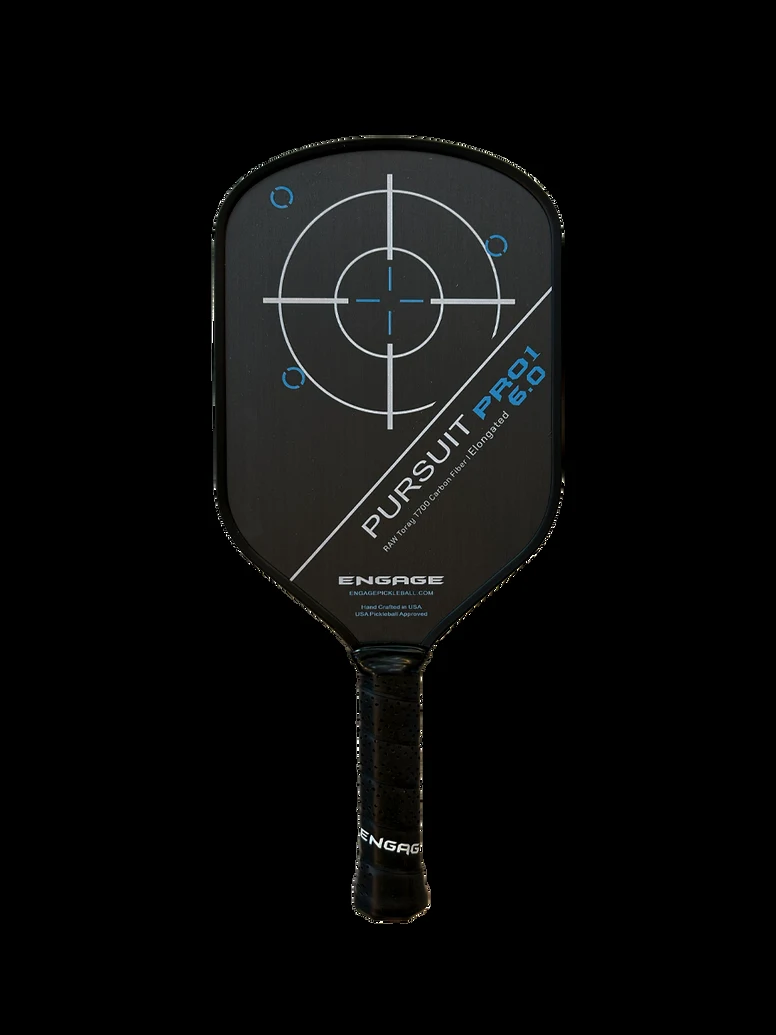
Start with the handle, because on this page the handle is the review. At 5.875 inches, both of my hands sit fully on the grip, the bottom hand low, the top hand stacked above it, nothing borrowed from the throat. It is the longest handle on any USAP approved pick here, and it never once asked me to regrip mid rally.
That fit is why it leads a list whose longest handle belongs to pick 2: the near-longest handle arrives with the most complete verified data line here, a 118.6 swing weight, a 5.95 twist weight and 2,267 RPM of measured spin.
On court the two-hander feels planted. The MachPro core and raw T700 face give contact a connected, honest answer, so driven backhands leave the face on the line I chose, and two-handed blocks at the kitchen hold steady against pace.
The elongated head adds reach on balls pulled wide to the backhand side, where this shot earns its keep most, on stretched returns and wide dinks alike.
The honest trade is the swing weight, and on this shot it counts double: two hands add leverage, and leverage moves more mass through a longer arc. At 118.6 this is a grooved, committed swing, not a wrist flick.
Drives power through the ball beautifully, but hands battles at the net demand early preparation, and I would not hand it to a player building their first two-hander. Pick 5 swings far more easily while the shot is learned.
Buy it if you want the longest verified handle on an approved paddle with a full lab line behind it. Skip it if your two-hander is still new.
211SIX24 Hurache-X Power 2: Best for the Dedicated Two-Hander Pickleball Paddle in 2027
AT A GLANCE
Hurache-X Power 2
WEIGHT
8.0-8.3 oz
SWING WEIGHT
116
TWIST WEIGHT
5.9
SPIN
2,354 RPM (STS)
Shape: Elongated, 16.5 x 7.5 in
Grip: 6.0 in handle, 4.125 in circumference
Core: Gen 4 floating foam (MPP), 16mm
Face: HexGrit textured carbon
Approval: UPA-A only, not USAP
Feel: Raw bite
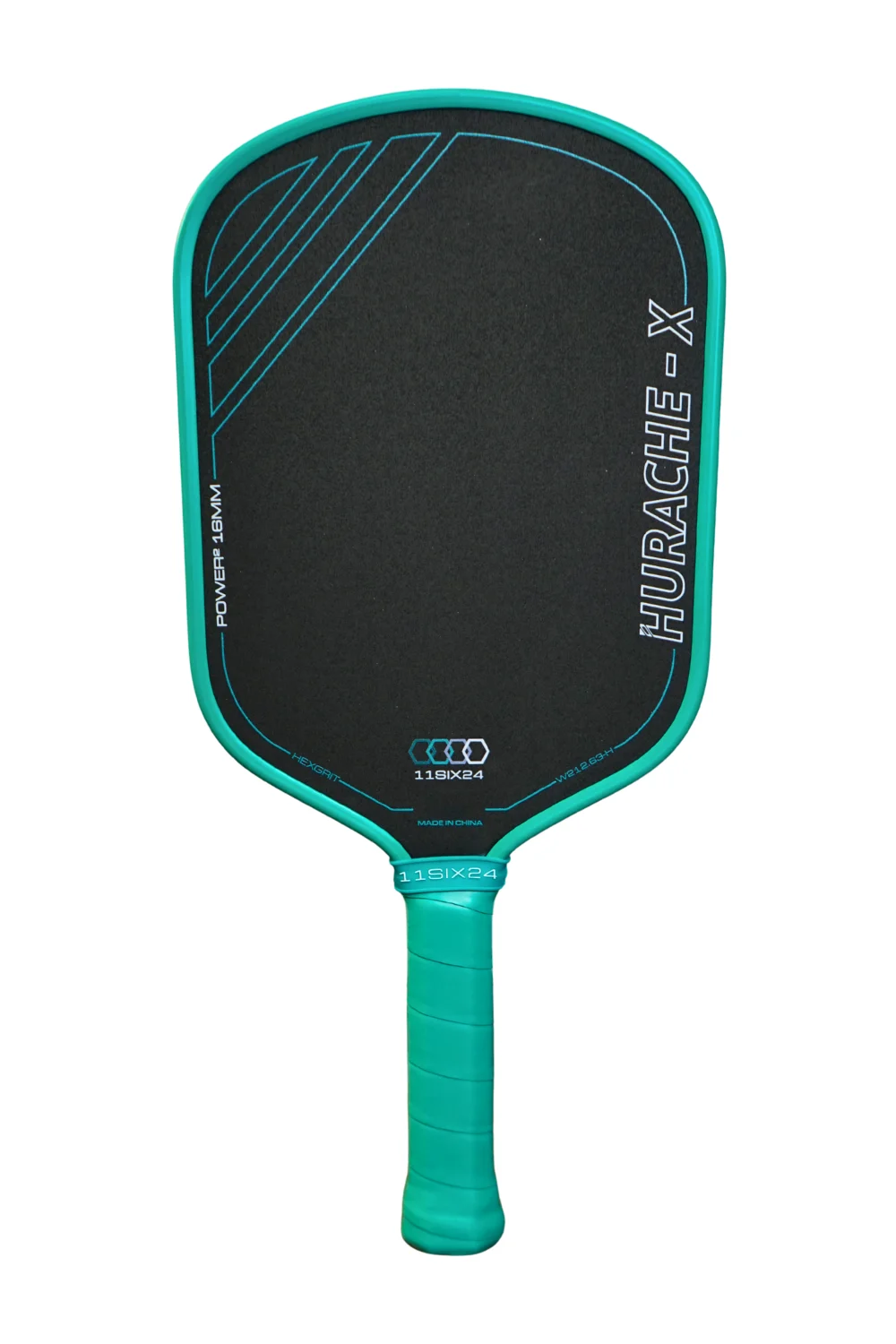
This is the fullest fit on the page. Six full inches of handle means both hands sit entirely on the grip with space left over, even for large hands, and the 4.125 inch circumference lets both hands close without crowding each other.
11SIX24 built this elongated shape around the two-handed game, and it shows in the one place other paddles compromise: my top hand never hunts for room, so the shot I rehearse in drilling is the shot that shows up in games.
The rest of the paddle keeps up. Its 2,354 RPM is the highest measured spin figure here, and the textured carbon face bites hard enough that two-handed drives dip late and serves kick off the bounce.
The 116 swing weight sits in the workable band for this shot, planted without dragging, and the foam core gives contact a firm, direct answer. Its 5.9 twist weight is the second lowest here, though, so contact away from center twists more than it does on the stability picks below.
One fact stands in front of everything else, stated plainly: this paddle is approved by UPA-A only and is not USAP approved. Open play and UPA-A events are unaffected, and nobody at a public court will ever ask.
But a reader who plays USAP sanctioned tournaments cannot use it there, and that is the only reason it ranks second instead of first. On handle length and spin alone, it is the maximum this page has.
Buy it if your two-hander is your main backhand and you play open or UPA-A events. Skip it if you need USAP approval for sanctioned tournaments.
3Six Zero DBD Elongated 15mm: Best Control Pickleball Paddle in 2027
AT A GLANCE
DBD Elongated 15mm
WEIGHT
8.1 oz
SWING WEIGHT
118 (retailer-published)
TWIST WEIGHT
5.85
SPIN
-
Shape: Elongated, 16.6 x 7.4 in
Grip: 6.0 in handle, 4.25 in circumference
Core: Polypropylene honeycomb with foam edge injection, 15mm
Face: Japanese Toray 700K raw carbon fiber
Approval: USAP
Feel: Cushioned control
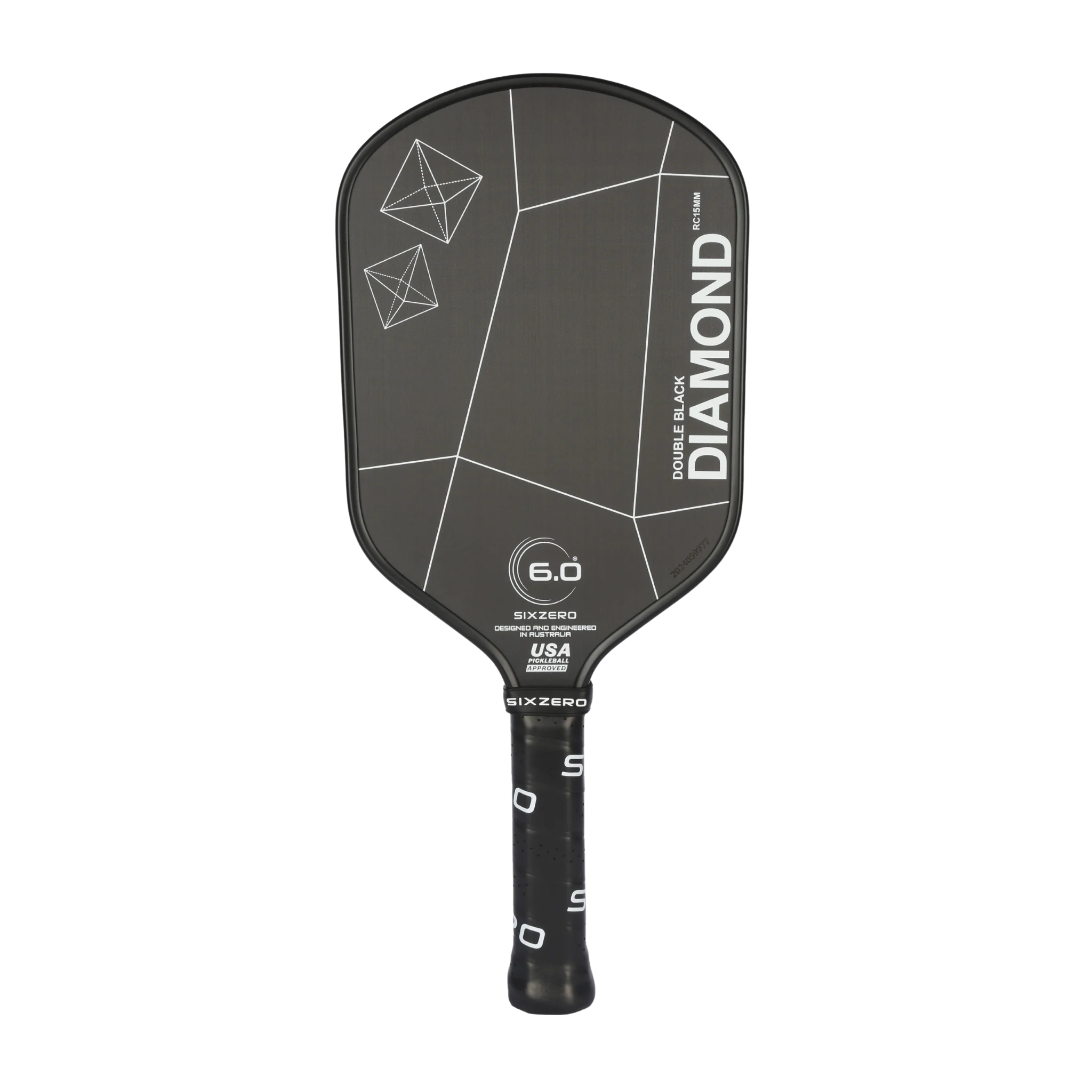
The control brief gets a 6.0 inch handle too.
Both hands sit fully on the grip with room to spare, joint-longest on this page, on the paddle I reach for when the two-hander is a placement shot rather than a weapon: resets that die at the kitchen line, blocks that absorb pace instead of returning it, and driven backhands I can steer rather than unload.
The cushioned feel is real. Contact pockets softly, and the ball leaves when I tell it to.
Two pieces of data honesty belong up front. The 118 swing weight is a retailer-published figure, not a lab measurement, and it reads high for a control paddle; the soft contact is the counterweight, and in play the paddle feels composed rather than sluggish.
And no spin figure is published for this variant, so the box leaves it unpublished rather than borrowing the hybrid Double Black Diamond Control’s number. The raw carbon face still grips the ball in play; it simply carries no figure I can print.
At 16.6 inches overall it is also the longest paddle here, which is reach, a separate thing from handle length, and the two should never be blurred. This is the elongated sibling of the hybrid DBD Control that appears elsewhere on this site, a different variant with its own figures, and nothing crosses between them.
Buy it if your two-hander is built on resets, blocks and placement. Skip it if you shop by lab-measured spin.
4Selkirk SLK ERA Power Elongated: Best Power Pickleball Paddle in 2027
AT A GLANCE
SLK ERA Power Elongated
WEIGHT
7.9-8.4 oz
SWING WEIGHT
117
TWIST WEIGHT
6.28
SPIN
~2,020 RPM
Shape: Elongated, 16.5 x 7.45 in
Grip: 5.8 in handle, 4.25 in circumference
Core: Dynamic Fusion Core, polymer honeycomb with EVA foam
Face: T700 carbon fiber and woven fiberglass
Approval: USAP + UPA-A
Feel: Linear power

The power brief, with both hands fully on the handle.
At 5.8 inches the ERA’s grip sits a tenth behind pick 1 and ahead of the whole 5.75 inch class, and it is built for the two-hander who drives first: the elongated head, the fusion core and the carbon and fiberglass face blend send the ball through the court with a linear, honest launch.
Dual approval, USAP and UPA-A both, means nobody has to think about eligibility with this one.
The 6.28 twist weight is what makes the power usable two-handed. A two-handed drive loads the face off center by design, and this face holds its line on contact out toward the edges instead of twisting open.
Measured spin around 2,020 RPM gives the drive its dip, so the pace arrives with shape on it rather than as a flat ball that sails long.
The 117 swing weight is the deliberate trade for that leverage, and it behaves exactly as the number promises. Drives and serves carry real plow-through, hands battles ask for earlier preparation than the light-swing picks, and resets need genuinely soft hands or the ball floats.
None of that is a flaw; it is the specification of a power paddle, printed here instead of discovered after the fact.
Buy it if your two-hander is a drive weapon and you want dual approval. Skip it if most of your backhands are dinks and resets.
511SIX24 Pegasus Power 1 (Gen 3): Best Widebody Forgiveness Pickleball Paddle in 2027
AT A GLANCE
Pegasus Power 1 (Gen 3)
WEIGHT
8.0-8.3 oz
SWING WEIGHT
107
TWIST WEIGHT
7.21
SPIN
2,103 RPM
Shape: Widebody (Pegasus), 15.8 x 8.12 in
Grip: 5.75 in handle, 4.125 in circumference
Core: 16mm polypropylene honeycomb with EVA foam perimeter (Gen 3 thermoformed)
Face: CFC carbon/fiberglass/carbon
Approval: USAP
Feel: Stable power

This is the proof that a two-hander is a handle story, not a shape story. A 5.75 inch handle under the widest face on this page means both hands fit fully, and the face forgives what a developing two-hander does to contact.
Its 7.21 twist weight is the highest among the USAP approved picks here, so two-handed blocks and drives struck away from center stay on line instead of twisting toward the sideline.
It is also the friendliest swing here. At a 107 swing weight it moves like a much smaller paddle, which is why I call it the first-two-hander pick: a player grooving the shot can swing it all session without the stroke getting heavy, and the measured 2,103 RPM of spin lets a new two-hander learn to dip a drive from day one.
The 4.125 inch circumference lets both hands close fully, with no crowding between them.
The generation honesty from its other page on this site carries over unchanged: the Power 1 is the previous-generation line, sitting below the Power 2 in the brand’s catalogue, kept here because it plays complete and measures well, not because it is the newest flagship.
Its reach is also honestly shorter than the elongated picks above. Neither fact stops it being the easiest place on this list to learn the shot.
Buy it if you are building a two-hander and want forgiveness with a full-length handle. Skip it if you want the current flagship generation or maximum reach.
6Selkirk SLK Halo Control XL: Best for Two-Handed Touch Play Pickleball Paddle in 2027
AT A GLANCE
SLK Halo Control XL
WEIGHT
7.7-8.0 oz
SWING WEIGHT
-
TWIST WEIGHT
-
SPIN
-
Shape: Elongated (XL)
Grip: 5.75 in handle, 4.25 in circumference (brand figure)
Core: Rev-Core polymer, 16mm
Face: T700 raw carbon fiber
Approval: USAP
Feel: Calm control with reach
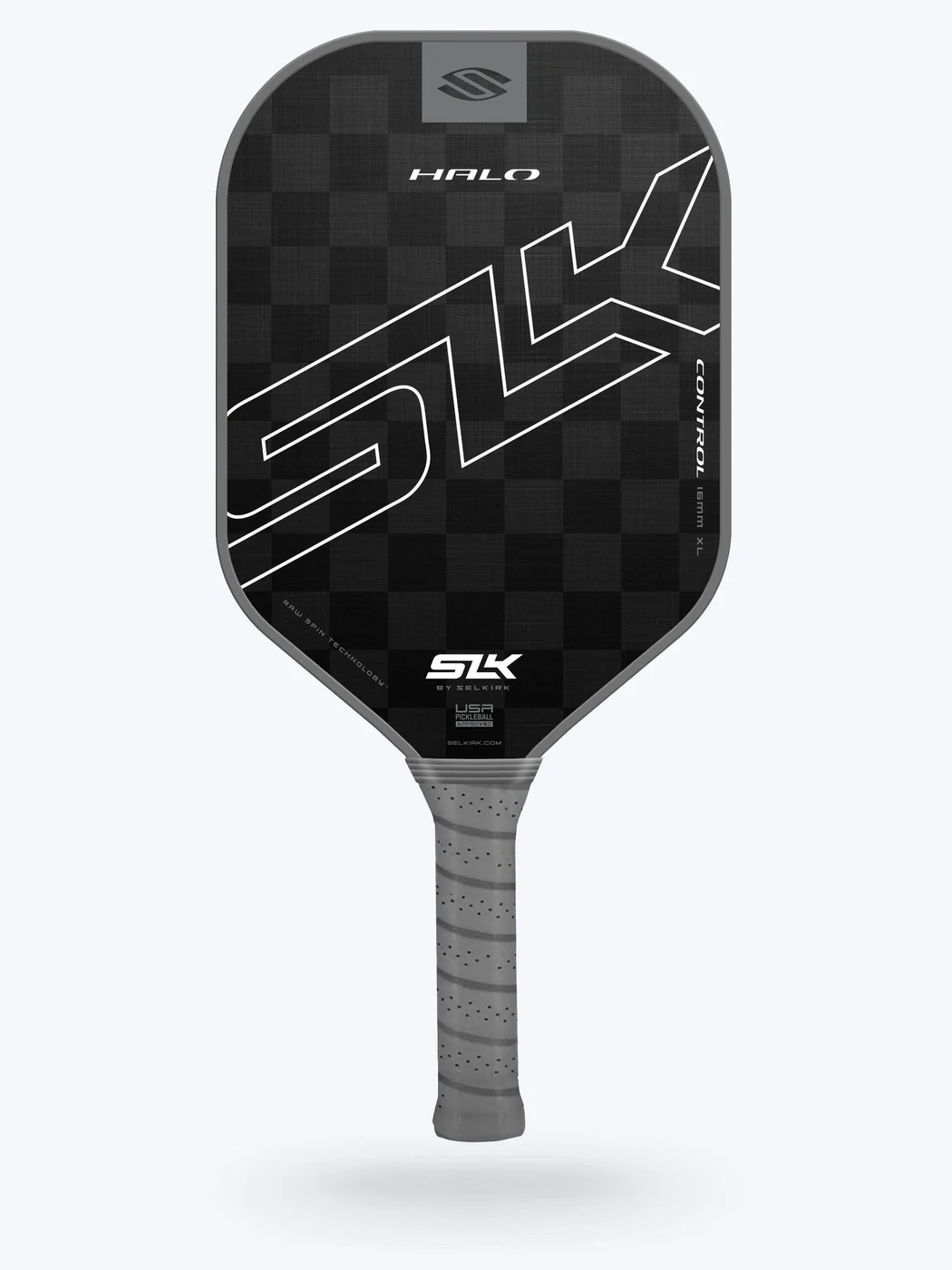
The touch brief converts through the handle. At 5.75 inches, the XL’s grip is this variant’s reason to exist: both hands fit fully, and a control paddle becomes a genuine two-hander for the soft game, two-handed dinks that stay low, resets that absorb pace quietly, and blocks at the kitchen that hold their line without a swing.
Where the power picks on this page are built from the baseline, this one is built at the net.
Its data honesty is the plainest here. No lab has published a swing weight, twist weight or spin figure for the XL that I can stand behind, so the box leaves all three unpublished rather than borrowing the standard Halo’s numbers, which belong to a different paddle.
The brand’s 7.7 to 8.0 ounce weight range is what the box prints, and in play the paddle feels calm and light enough in the hand for long touch exchanges.
Two limits, stated plainly. Putaway power is modest: drives need a full, committed swing, and this will never be a baseline weapon.
And circumference is not its brief: the grip prints at the standard 4.25 inches, so players shopping for a slim grip should look at pick 9 instead. Length is what the XL sells, and on length it delivers completely.
Buy it if your two-hander lives at the kitchen in dinks, resets and blocks. Skip it if you want published lab figures or baseline power.
711SIX24 Vapor Power 2: Best for Fast Hands Pickleball Paddle in 2027
AT A GLANCE
Vapor Power 2
WEIGHT
8.0-8.3 oz
SWING WEIGHT
107.55
TWIST WEIGHT
6.6
SPIN
2,335 RPM (Matt’s)
Shape: Hybrid
Grip: 5.5 in handle, 4.125 in circumference
Core: Gen 4 full foam, MPP
Face: HexGrit textured carbon
Approval: UPA-A only, not USAP
Feel: Raw bite
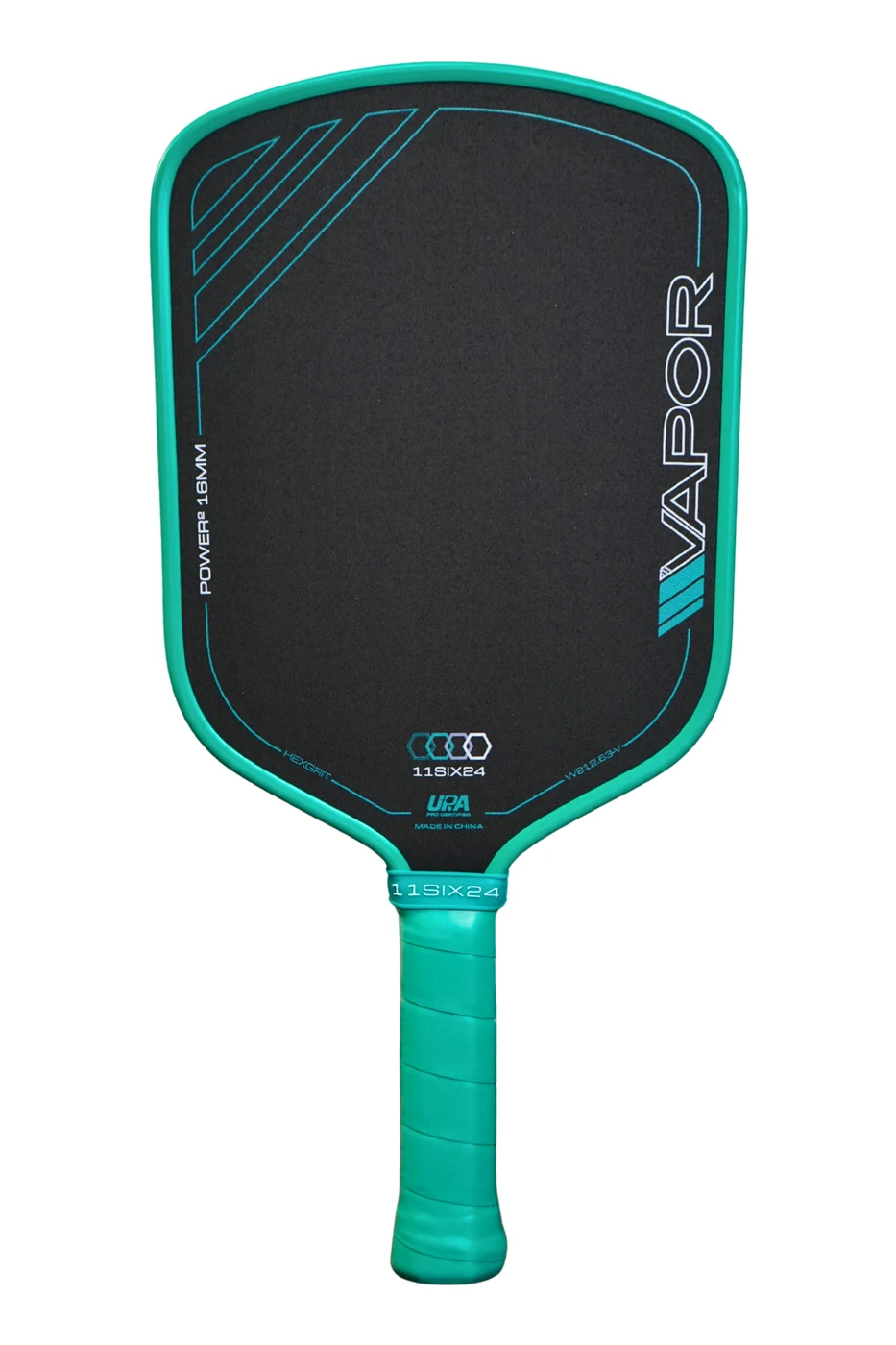
The second proof that this shot is a handle story: a hybrid shape, not an elongated one, carrying a 5.75 inch measured handle. Both hands fit fully, the 4.125 inch circumference lets them close without crowding, and at a 107.55 swing weight this is the quickest long-handle paddle here.
My two-hander with it is a counterpunch: compact, fast through the hitting zone, and built for hands battles where the heavy picks are still loading.
The face matches the brief. The textured carbon surface produces one of the highest measured spin figures on this page, 2,335 RPM, so two-handed drives dip hard and serves jump off the bounce.
The full foam core answers contact firmly and directly, which I love on counters and which asks for genuinely soft hands on resets, because a lively face floats a careless block. Twist weight at 6.6 keeps off-center contact honest without slowing the head down.
The approval fact stands in front, as it does for pick 2: UPA-A only, not USAP approved. Open play and UPA-A events are unaffected; USAP sanctioned tournaments are closed to it. Readers who need the sanctioned game should start at pick 1. Everyone else gets the fastest hands in the genuine class.
Buy it if your two-hander is a quick counterpunch and you play open or UPA-A events. Skip it if you need USAP approval.
8Paddletek Bantam TKO-CX 14.3: Best for Power Two-Handers Pickleball Paddle in 2027
AT A GLANCE
Bantam TKO-CX 14.3
WEIGHT
7.8-8.2 oz
SWING WEIGHT
123
TWIST WEIGHT
7.35
SPIN
1,910 RPM
Shape: Elongated, 16.5 x 7.5 in
Grip: 5.75 in handle, 4.25 in circumference
Core: Bantam PolyCore honeycomb, 14.3mm, steel perimeter weighting
Face: PT-700 raw carbon fiber with glass epoxy
Approval: USAP + UPA-A
Feel: Heavy stability
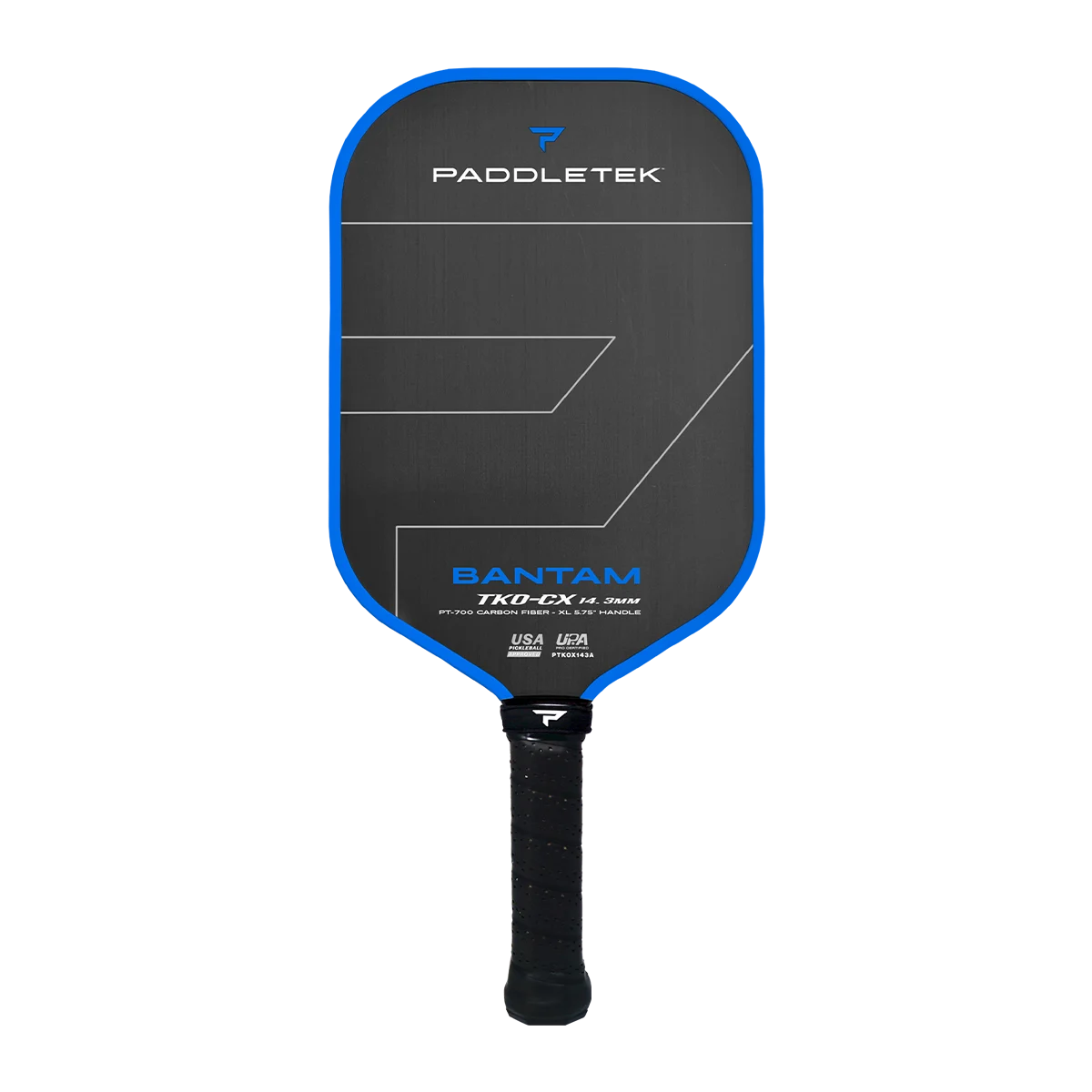
The swing weight goes first, because with this paddle it is the story: 123, the highest figure on this page by a wide margin and the highest this site has published.
A two-handed stroke adds leverage of its own and moves mass through a longer arc, so that number is a genuine load, and this pick is framed honestly for the players who can carry it: strong, committed power players whose two-hander is a drive weapon, swung with the legs and the trunk rather than the wrists.
What the load buys is stability under fire. The 7.35 twist weight is the highest here, so the face barely notices off-center contact, and two-handed drives struck toward the edges hold their line and their pace.
The 5.75 inch handle is there for exactly this shot: the CX is Paddletek’s extended-handle build, the variant its tour two-handers asked for, and both hands sit fully on it. Measured spin of 1,910 RPM gives the drive enough dip to stay in.
Variant discipline matters with this name: the CX is a different paddle from the standard TKO-C, whose 5.25 inch handle appears elsewhere on this site, and no figure crosses between them.
Beginners should not start here, and neither should players who feel a heavy swing in the arm by the third game; picks 5 and 7 swing far lighter and teach the shot without the load.
Buy it if your two-hander is a full-power drive and you want maximum stability behind it. Skip it if you are learning the shot or want a light swing.
9Gearbox CX14E: Best Small Grip Pickleball Paddle in 2027
AT A GLANCE
Gearbox CX14E
WEIGHT
8.0 oz
SWING WEIGHT
-
TWIST WEIGHT
-
SPIN
-
Shape: Elongated, 16 5/8 x 7 3/8 in
Grip: 5 5/8 in handle, 3 5/8 in or 3 15/16 in circumference (two factory grip sizes)
Core: 14mm SST carbon fiber chambers (T-700)
Face: 3K woven carbon fiber
Approval: USAP
Feel: Solid span control

The pairing no other pick offers: a 5 5/8 inch handle, squarely in the genuine class, carrying the smallest grip circumferences in the industry. Gearbox builds this paddle with two factory grip sizes, 3 5/8 inches and 3 15/16 inches.
A small-handed two-hander’s problem is doubled, because two hands must both close around the grip, and this is the only paddle that solves both halves at once: both hands fit along the handle, and both hands can actually wrap it without the top hand prying the bottom one open.
The carbon chamber core answers contact with a solid, spanned feel, stable and muted, and the elongated head adds reach on the backhand side.
It is also the one legacy pick from the old version of this page whose claims survived verification, surviving here on a different brief than the old page gave it. The edgeless frame scuffs on outdoor courts, so fit a strip of protective tape along the rim from the first session.
Its data limits are plain. No lab swing weight, twist weight or spin figure has been adopted for this paddle on any pass, so the box leaves all three unpublished, and at 8.0 ounces under a narrow 7 3/8 inch face, the margin for error is smaller than the widebody picks offer.
You are choosing the grip system and the shape, and for the right hands that choice is the whole game.
Buy it if small hands have kept your two-hander cramped on standard grips. Skip it if you shop by lab numbers or want a wide, forgiving face.
10JOOLA Perseus Pro IV 16mm: Best Pro Flagship Pickleball Paddle in 2027
AT A GLANCE
Perseus Pro IV 16mm
WEIGHT
8.1 oz
SWING WEIGHT
118
TWIST WEIGHT
6.3
SPIN
1,971 RPM
Shape: Elongated, 16.5 x 7.5 in
Grip: 5.5 in handle, 4.25 in circumference
Core: Gen 3 Propulsion Core
Face: Raw carbon fiber
Approval: USAP + UPA-A
Feel: Plush power
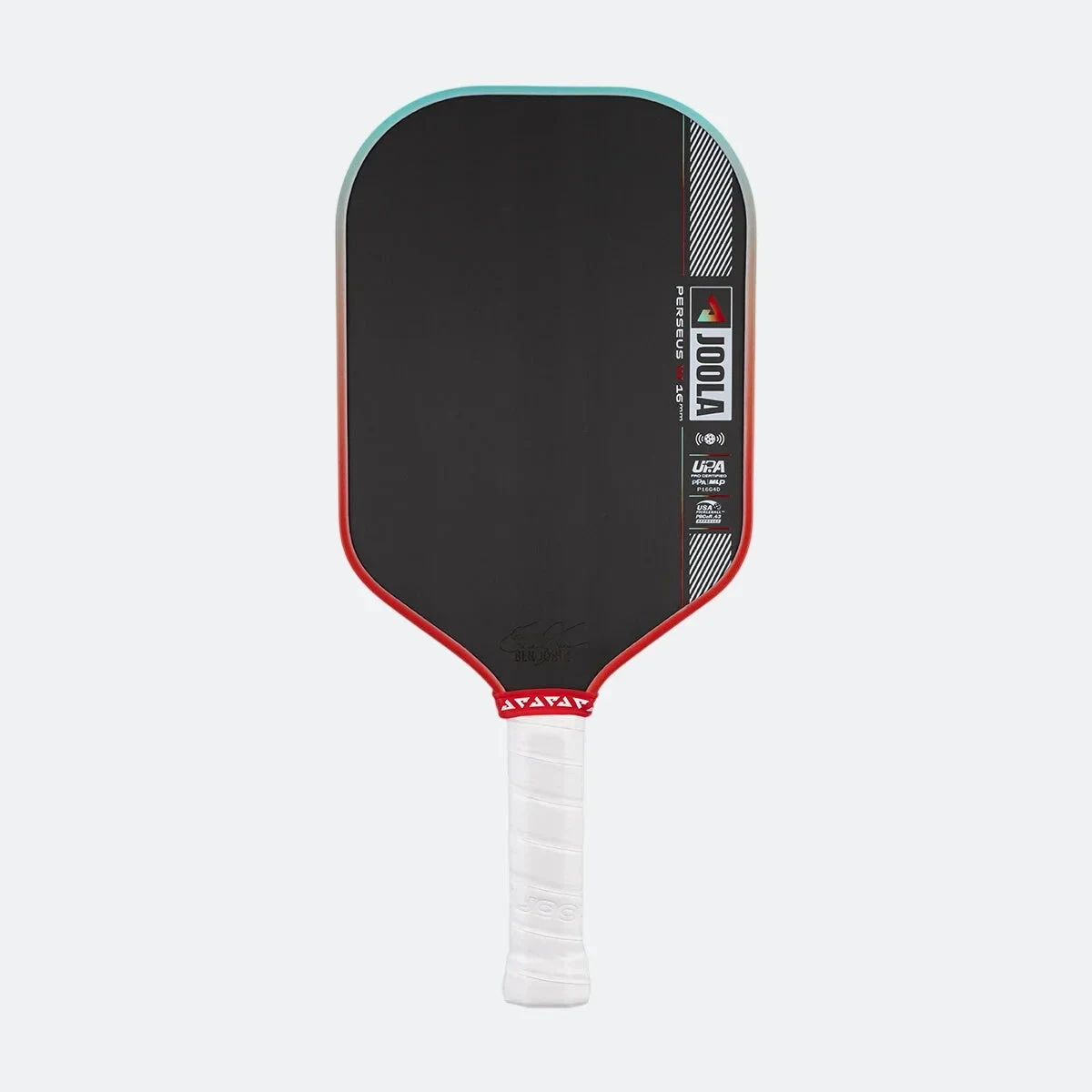
The floor of the genuine class, stated as plainly as it plays. At 5.5 inches both hands fit, and the top hand sits high with its top fingers resting on the throat taper.
That is the compromise most tour two-handers accept, on the flagship those same players actually use, and the copy here will not dress 5.5 inches up as roomy. Readers who want space to spare should start further up this list; readers who want the flagship fit exactly as the pros accept it are home.
Everything behind the fit is verified and complete: a 118 swing weight, a 6.3 twist weight and 1,971 RPM of measured spin, dual approval from USAP and UPA-A, and a listing this site has checked across many builds.
The propulsion core and raw carbon face give the two-hander a plush, powerful answer: drives that jump off the face, and blocks that hold against pace.
The trades are the flagship trades. The 118 swing weight asks for a grooved swing and early preparation in hands battles, the same story as pick 1, and the fit is the tightest here, so large hands will feel the top hand riding high on every ball.
It closes the list because it is the only 5.5 inch candidate with a full lab line, dual approval and a verified listing: the anchor pick.
Buy it if you want the pro flagship and accept the snug, high top-hand fit. Skip it if you want room to spare on the handle.
How to Choose the Best Pickleball Paddle for a Two-Handed Backhand in 2027
Handle Length Is the Whole Decision
Shop this one number first and let everything else argue for second place. The ladder, from this list’s own verified figures: at 6.0 inches both hands sit fully on the handle with room to spare.
At 5.75 to 5.875 inches both hands still fit fully, which is where most of this list lives. At 5.5 inches both hands fit with the top hand high and its top fingers on the throat taper: the floor of the genuine class, workable and honest, but a fit with nothing left over.
At 5.25 inches the top hand rides onto the throat and the shot becomes a compromise, and under 5.25 inches a paddle is not a two-hander, whatever its listing claims. Then the measurement trap, named plainly: overall paddle length is not handle length.
A 16.5 inch paddle can hide a 5.0 inch handle, and several famous ones do. The handle figure lives in the spec block, not in the headline dimensions, and it is the only length that decides this purchase.
Fit Your Hands Before You Fit the Paddle
Fit is testable in ten seconds, so test it before reading a single review. Take your two-handed grip on any paddle: bottom hand low on the handle, top hand stacked directly above it, both hands closed the way they would be at contact.
Then look at the top hand. If its fingers are forced onto the throat, the face or the edge guard, the handle is too short for your hands, full stop, and no other specification can rescue the fit.
Hand size runs the ladder differently for everyone: the rough math is the width of both hands as they stack, held against a tape or a ruler the way you would grip the paddle, checked against the handle lengths above.
And learn the choke-up reality early. Gripping higher buys control at the kitchen and trades away reach on every other ball, so a handle that only works when you choke up is the wrong handle wearing a disguise.
Swing Weight and the Two-Handed Swing
Two hands add leverage and stability, and they also move more mass through a longer arc, so swing weight bites this shot harder than it bites a forehand.
The load of a heavy paddle lands across the shoulder and arm through that longer path, which is why this list prints the figure for every pick instead of hiding it. The workable bands, from this list’s own data: a swing weight of 107 to 112 suits most players and every learner (picks 5 and 7).
The 116 to 119 band rewards strong, grooved swings and punishes late preparation (picks 1 to 4 and 10). And 123, pick 8, is the labelled exception, a load for committed power players only.
One more piece of context: elongated paddles average a materially higher swing weight than widebodies, which is precisely why the widebody pick 5 exists on a page dominated by elongated heads.
Shape and Throat: Reach Versus Forgiveness
Elongated heads put the sweet spot farther from the hands: more leverage, more reach, and a smaller margin when contact drifts.
Widebody heads answer with twist weight, the figure that decides whether off-center two-handed contact holds its line; pick 5 posts 7.21 and pick 8 posts 7.35, with very different swings attached to those numbers. The throat matters more than most guides admit.
A tapered throat gives the top hand somewhere honest to go on a 5.5 inch handle, softening the tightest fit in the genuine class. A straight, full-length handle removes the question entirely, which is what picks 2 and 3 do at 6.0 inches.
Hybrid shapes split the difference, reach without the full elongated swing weight, and pick 7 is this list’s middle answer. Choose the shape by where your contact actually happens, not by which silhouette looks faster.
Grip Circumference With Two Hands on It
Length decides whether both hands fit; circumference decides whether both hands can close.
Two hands double the crowding problem, so the small-circumference class earns its place here: picks 2, 5, 7 and 9 run 4.125 inches and under, down to the CX14E’s 3 5/8 inch factory option, and both hands wrap fully at those sizes. The standard 4.25 inches works for most hands and covers most of this list.
The 4.5 inch class crowds two average hands off the grip, which is why a well-known paddle with a 5.6 inch handle was excluded from this page: length alone never makes a two-hander fit.
The overgrip math from the small-grip pages applies unchanged: one overgrip adds roughly 1/16 of an inch of circumference, so build a small grip up if you need to. Wrapping over the butt cap adds a little effective length; tape wound up the throat adds none, and it is not a handle extension.
Approval, and When a Two-Hander Earns Its Place
Approval in plain terms: sanctioned tournaments check for USA Pickleball approval, UPA-A runs its own approved list for its own events, and open play checks nothing.
This list’s honesty up front: two of the best handles here, picks 2 and 7, are UPA-A only and not USAP approved, so a USAP tournament player starts at picks 1 and 3 and loses nothing that matters. Then the trade nobody should hide.
A two-hander buys drive power, topspin and backhand-side stability that a one-hander cannot match. It trades away reach on wide balls, slows hand-switching in kitchen exchanges, and makes backhand dinks and rolls harder to disguise.
That is why most two-handed players keep the shot for drives, returns and counters and go one-handed at the net. Played that way, it is a second shot with known strengths and known limits, and the handle is what decides whether yours works.
Frequently Asked Questions (FAQs)
1. What handle length do I need for a two-handed backhand?
You need 5.5 inches of handle or more for a full fit. At that length both hands sit on the grip for most players, the top hand high with its fingers near the throat taper. At 5.75 to 6.0 inches both hands fit with room to spare.
At 5.25 inches the shot is playable but compromised, with the top hand riding the throat, and below that the top hand has nowhere honest to go. Every pick on this list measures 5.5 inches or longer.
2. Can I hit a two-handed backhand with a standard 5-inch handle?
Yes, you can, and many players do. The top hand will ride partly onto the throat, because a 5 inch handle cannot hold two full hands, so the shot works as a compromise: playable on drives and returns, cramped on anything that asks for a full grip.
It is exactly the fit problem long-handle paddles exist to solve, which is why every pick on this list starts at 5.5 inches.
3. Is a two-handed backhand legal in pickleball?
Yes, completely legal. No rule in pickleball restricts how many hands hold the paddle on any shot, and players switch between one and two hands as they like within the same rally.
The only equipment rules that touch this page are the standard ones: the paddle must be approved for sanctioned play and stay within the 17 inch overall length limit.
4. Is a two-handed backhand better than a one-handed backhand?
Better at some jobs, worse at others, and honest players keep both. The two-hander wins on drives, returns of serve and backhand-side stability, where the second hand adds leverage and keeps the face quiet.
The one-hander wins on reach, on wide balls, and at the net, where dinks, rolls and quick hand-switching all favor a single hand. Most two-handed players drive two-handed and dink one-handed, and that split is the mature version of the shot.
5. Do any professional players use a two-handed backhand?
Yes. Riley Newman is the best-known two-handed backhand on tour, and the shot is common among professionals who arrived from tennis, where the two-hander is a standard stroke.
Tour usage is part of why long-handle paddles exist at all: manufacturers build extended handles because the players at the top of the sport asked for room for both hands.
6. Does a longer handle make the hitting area smaller?
Yes, within the rules it cannot be helped. A paddle may measure 17 inches overall at most, so every inch given to the handle is an inch taken from the face.
Picks 2 and 3 pair their 6.0 inch handles with elongated faces to keep the hitting area long, but the trade is real: a long-handle paddle will always carry a slightly smaller hitting zone than a short-handle paddle of the same overall length.
7. Will a long-handle paddle slow my hands down at the net?
The handle itself, no; the swing weight that usually travels with it, yes, it can. Length adds no meaningful resistance in a quick exchange, but long-handle paddles tend to be elongated and heavier-swinging, and that mass is what slows hands at the net.
The standard answer is to choke up for kitchen exchanges, which shortens the lever and speeds the head, then slide back down for drives. The swing-weight section of the guide above covers the numbers.
8. What grip size is best for a two-handed backhand?
A circumference of 4.0 to 4.25 inches suits most two-handed players. Both hands must close fully around the grip, so the smaller circumferences, 4.0 to 4.125 inches, are the comfortable class for average and smaller hands, and the standard 4.25 inches works for larger ones.
What fails is the 4.5 inch class, which crowds two average hands. Pair the circumference answer with the length answer: 5.5 inches and up, in a grip both hands can wrap.
9. Should a beginner learn a two-handed backhand?
It depends where the beginner starts. A beginner arriving from tennis should keep the two-hander, because it is already grooved and it stabilises the weakest side early.
A beginner with no racket background is usually better served learning the one-hander’s reach first, then adding the two-hander for drives once the basics hold. Either way, pick 5 on this list, with its wide forgiving face and easy swing weight, is the place to practise the shot.
10. Is an elongated paddle always better for a two-handed backhand?
No. Handle length is the specification that decides the fit, not the silhouette. Most long handles happen to sit on elongated paddles, which is why the two ideas blur, but this list carries a widebody at pick 5 and a hybrid at pick 7, both with handles of 5.5 inches or more and both fully fitted for two hands.
An elongated paddle with a 5.0 inch handle, and several famous ones exist, fits a two-hander worse than either.
11. Can I make my current paddle’s handle longer?
Not really, no. Overgrip wound over the butt cap adds a sliver of effective length at the very bottom, and that is the whole of the honest answer: after-market extenders change the paddle’s balance, can affect its approval status, and still leave the top hand short of a real grip.
A longer handle is chosen when you choose the paddle, not added later, which is why this page ranks verified handle lengths instead of fixes.
12. Are all the paddles on this list approved for tournament play?
No, and the exceptions are named rather than hidden. Eight of the ten picks are USAP approved, and three of those, picks 4, 8 and 10, also carry UPA-A approval.
The two exceptions are pick 2, the Hurache-X Power 2, and pick 7, the Vapor Power 2, which are approved by UPA-A only and cannot be used in USAP sanctioned events. Open play checks nothing; sanctioned tournaments check for their own body’s approval.

Michael Stevenson
Hi, my name is Michael Stevenson and I’m a passionate pickleball player. I’ve been playing the game for many years and I’m pretty highly skilled at it. Pickleball is one of my favorite topics so naturally, I love to write about it.
Whether it’s tips for beginners, guides for experts, reviews of new paddles, or advanced playing techniques – if it relates to pickleball then I have something interesting to write about it. So if you’re looking for entertaining and informative information on the topic of pickleball, look no further than my written works!