
Your first weeks on a pickleball court follow a script, and I know because I lived it. You hit a crosscourt forehand that feels perfect, full swing, clean contact, nice shape on the ball, and you watch it sail two feet past the baseline. Twice.
Then a short ball floats up, every tennis instinct you own says step in and put it away, and you do, from two feet inside the one place you are not allowed to volley from. The kitchen violation gets called, your partner smiles the smile, and you understand: this game looks like tennis’s little sibling and plays like its own animal.
Here is the honest version of the switch. Your groundstrokes, your serve, your overhead and your footwork are a genuine head start; converts with real strokes rally well within days.
What does not transfer is the soft game and the patience, and no paddle fixes those. What a paddle can do is stop fighting your habits while you rebuild them.
The ten below are picked for exactly that: racket-like swing feel instead of flyswatter lightness, handles long enough for a two-handed backhand, and spin that lets a topspin game survive the move to a plastic ball. The guide after the list covers the adjustments themselves, including the ones nobody warns you about.
The 10 Best Pickleball Paddles for Tennis Players in 2027
1JOOLA Perseus Pro V 16mm: Best Overall Pickleball Paddle for Tennis Players in 2027
AT A GLANCE
JOOLA Perseus Pro V 16mm
Weight
8.1 oz
Swing Weight
117
Twist Weight
6.26
Spin
2,060 RPM
Shape: Elongated, 16.5 x 7.5 in, 5.5 in handle
Core: Propulsion Core, 16mm
Face: Textured raw carbon fiber
Grip: 4.25 in
Approval: USAP and UPA-A
Feel: Firm consistency
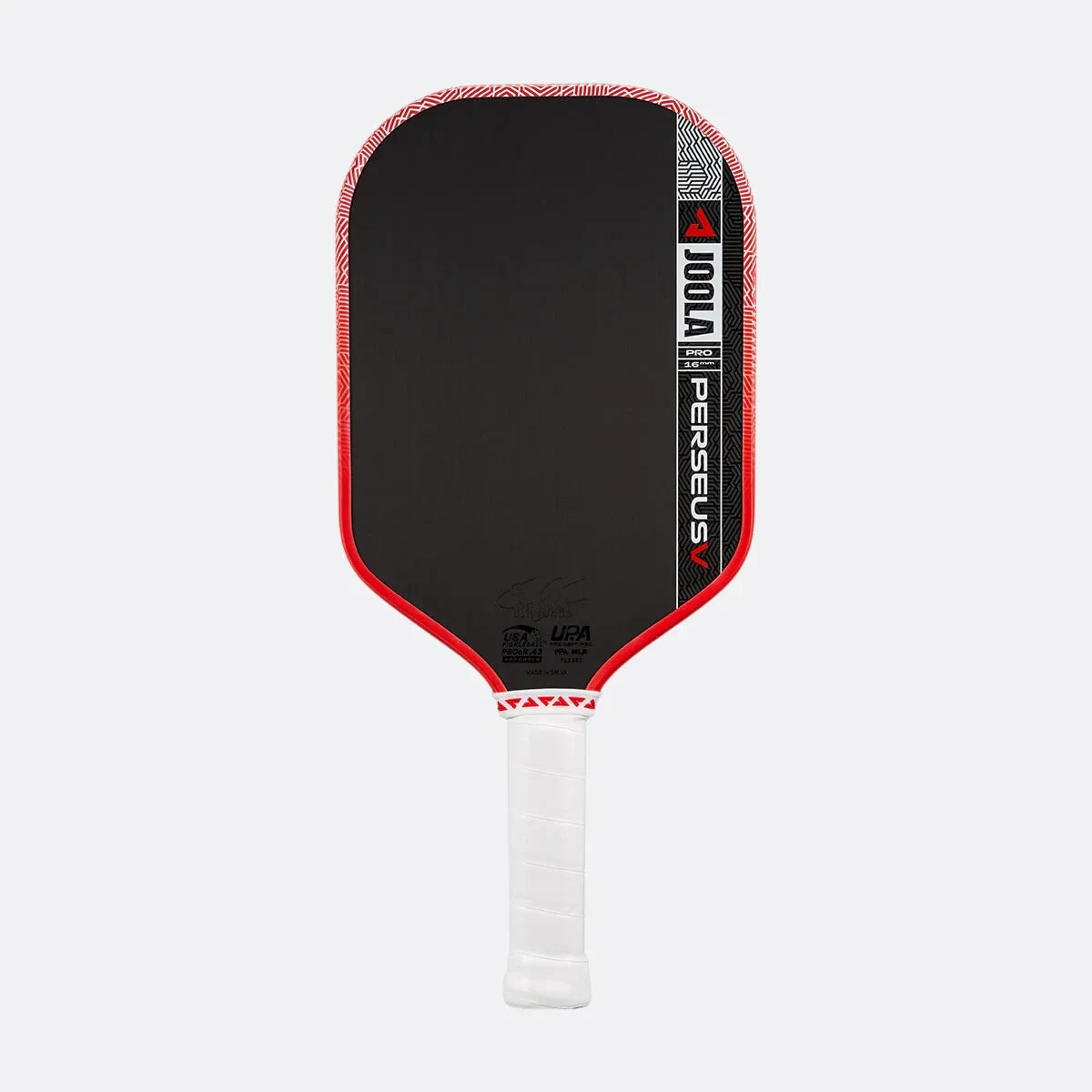
If you can only buy one paddle for the switch, buy the one that swings most like the racket you are coming from, and that is the Pro V. At a 117 swing weight with its mass carried toward the head, it drives through the ball with the plow-through a tennis player expects.
A full groundstroke swing gets rewarded here instead of punished: serves come off heavy, drives hold their line through the court, and the ball does not balloon the way it does off the light, head-light paddles most beginners get handed.
It asks something of you first. My opening sessions with it felt muted and short, the ball dying off the face while I wondered what the fuss was about.
Then the core broke in and the consistency arrived: the same response at the center of the face and an inch above it, which matters because tennis players contact the ball high, where this elongated face is built to work.
Spin at 2,060 RPM keeps a hard, brushing drive dipping instead of sailing, which is the shot that decides whether a convert’s baseline game survives.
The trade for the plow-through is hand speed. Frantic exchanges at the kitchen are not its home, and passive blocks land short. Takes a full swing? This is your paddle. Want the paddle to supply the pace? Look further down the list.
2JOOLA Agassi Pro V 16mm: Best Designed Pickleball Paddle for Converts in 2027
AT A GLANCE
JOOLA Agassi Pro V 16mm
Weight
8.1 oz
Swing Weight
118
Twist Weight
6.25
Spin
-
Shape: Elongated, 16.5 x 7.5 in, 5.5 in handle, tapered throat
Core: Propulsion Core with Hyper-Foam Edge Wall, 16mm
Face: Textured carbon fiber
Grip: 4.25 in
Approval: USAP and UPA-A
Feel: Plush power
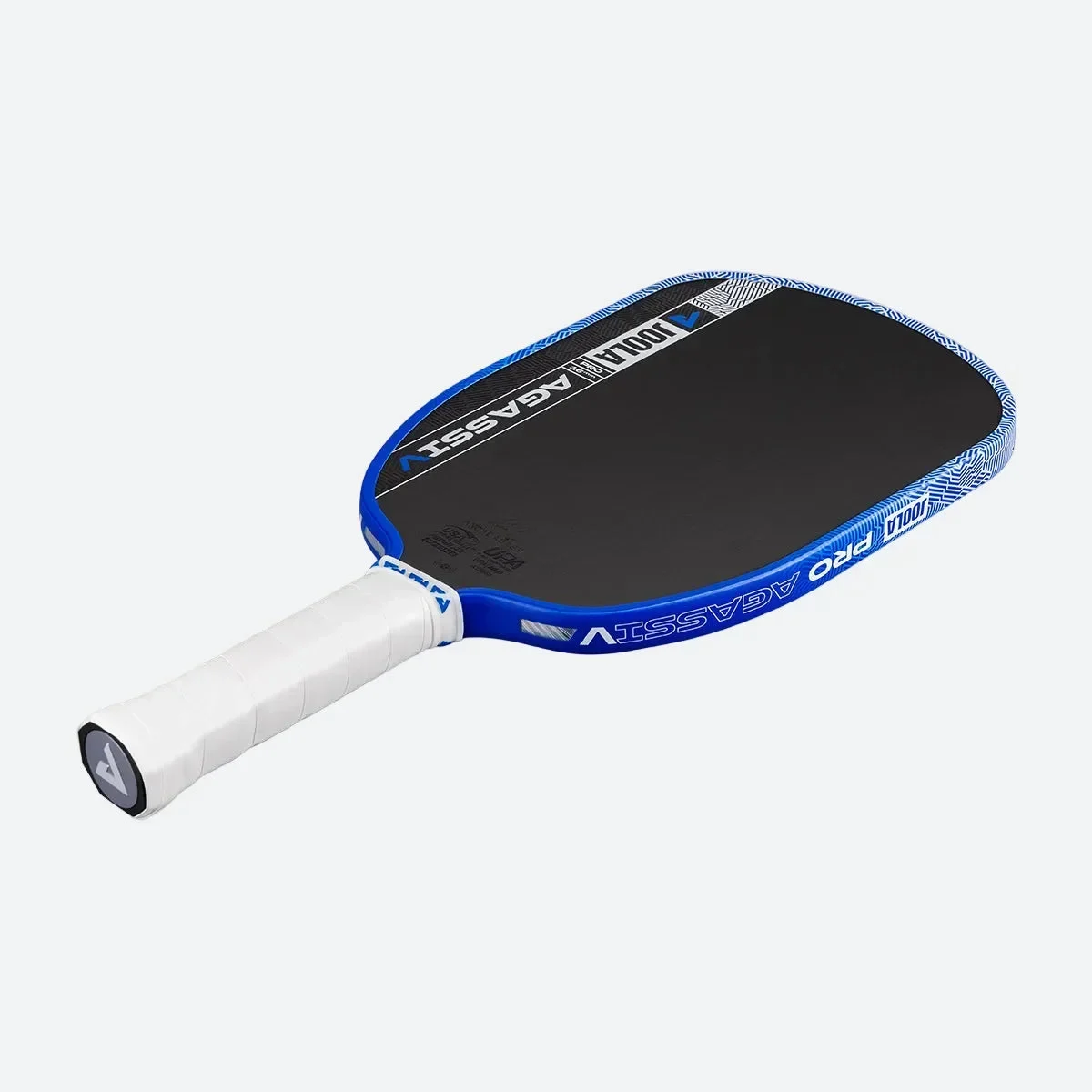
Plenty of paddles get marketed at tennis players. This one was actually developed with one: JOOLA built the Agassi line with Andre Agassi, and the design brief shows up in the one place that matters for a convert.
The throat is tapered and the sweet spot sits high on the face, up where a tennis stroke naturally meets the ball. Most paddles ask you to move your contact point down and relearn your timing. This one starts closer to where your contact point already lives.
Underneath the shape is the same Propulsion Core and foam edge wall as the flagship Perseus above it, so the power and the plow-through are familiar: an 118 swing weight, heavy drives, and a 5.5 inch handle with honest room for a two-handed backhand.
Contact feels a touch plusher than the Perseus Pro V, which softens the first month, when your touch shots are still calibrated for a string bed and everything at the kitchen runs hot.
One honest gap: I do not have a lab spin figure I trust for this exact model, so the box above leaves it unpublished rather than borrowing a number from a sibling.
The face texture is the same family as the Perseus, and on court my topspin drives dipped and bit the way they should, but you are buying this paddle for where it lets you make contact, not for a headline number.
Buy it if your contact point is your identity as a player. Skip it if you defend low and stretched, where the high sweet spot stops helping.
3Selkirk SLK ERA Power Elongated: Best Long Handle Power Pickleball Paddle in 2027
AT A GLANCE
Selkirk SLK ERA Power Elongated
Weight
7.9-8.4 oz
Swing Weight
117
Twist Weight
6.28
Spin
2,020 RPM
Shape: Elongated, 16.5 x 7.45 in, 5.8 in handle
Core: Dynamic Fusion Core, 16mm
Face: T700 carbon fiber and woven fiberglass
Grip: 4.25 in
Approval: USAP and UPA-A
Feel: Linear power
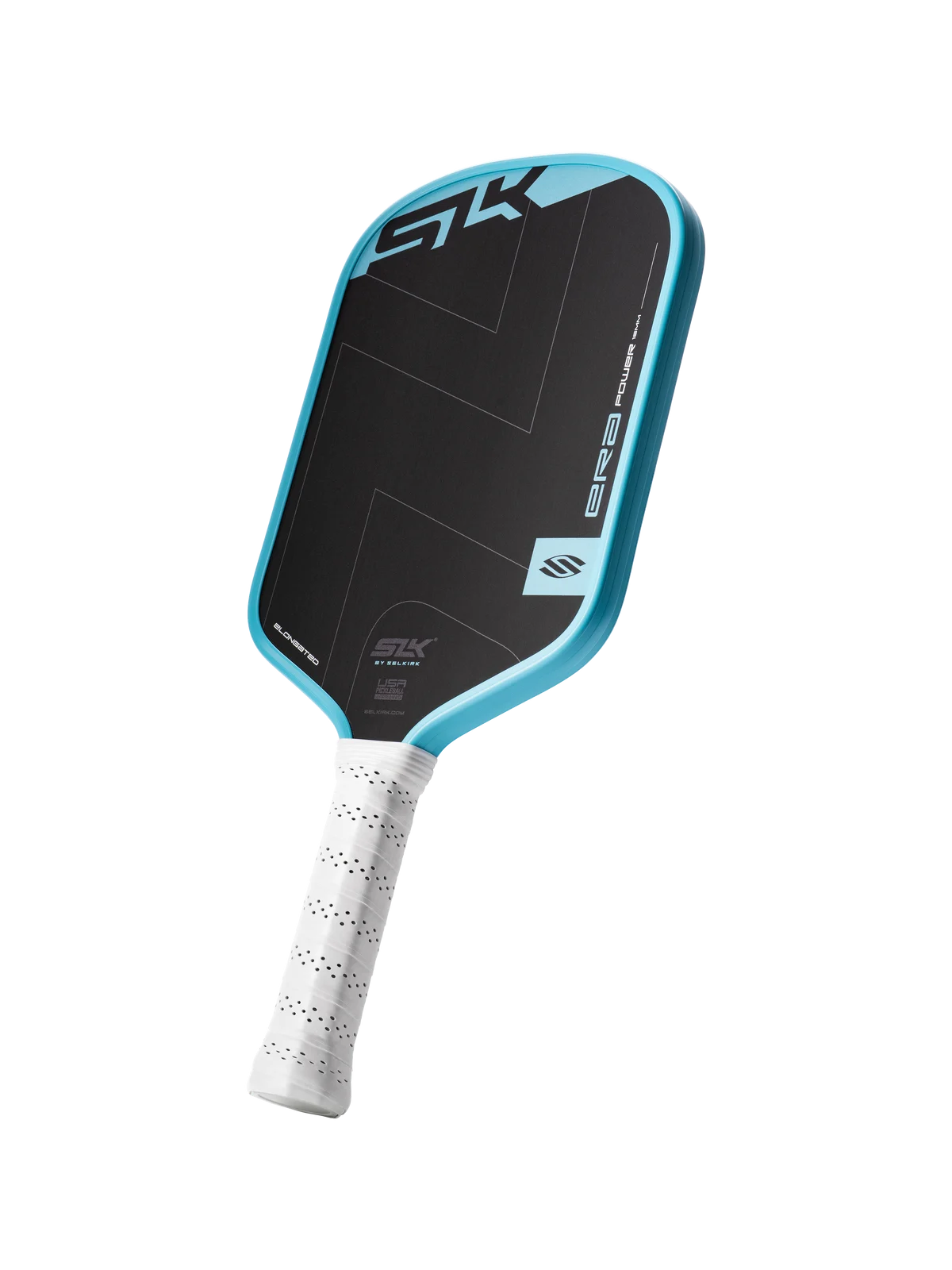
Start with the handle, because for a tennis player it might be the whole argument. At 5.8 inches, the ERA Power’s grip is the longest on this list that carries full USAP approval, and it changes the two-handed backhand from a squeeze into a stroke.
Both hands sit on the grip with room to spare, the top hand stops crowding the throat, and the shot most converts abandon in month one becomes a shot you can actually build.
The rest of the paddle suits a convert’s first problem, which is keeping a full swing in the court. Selkirk’s Dynamic Fusion Core surrounds the honeycomb with EVA foam, and the response is strikingly linear: swing at three-quarter effort, get a three-quarter drive, every time.
There is no trampoline surprise waiting in the middle of the face. Spin measured at 2,020 RPM gives a brushing drive the dip it needs, and at a 117 swing weight the elongated frame carries baseline pace the way a racket does.
What it will not do is soften your hands for you. Resets behave because the response is predictable, not because the face is plush, and players whose soft game depends on pocketing dwell will find it firm. Counters and stretched blocks get mid-pack help from the 6.28 twist weight.
Buy it if your two-hander and your baseline drives are coming with you. Skip it if touch is your first language.
4JOOLA Perseus Pro IV 16mm: Best Forgiving Flagship Pickleball Paddle in 2027
AT A GLANCE
JOOLA Perseus Pro IV 16mm
Weight
8.1 oz
Swing Weight
118
Twist Weight
6.3
Spin
1,971 RPM
Shape: Elongated, 16.5 x 7.5 in, 5.5 in handle
Core: Propulsion Core, 16mm
Face: Textured raw carbon fiber
Grip: 4.25 in
Approval: USAP and UPA-A
Feel: Plush power
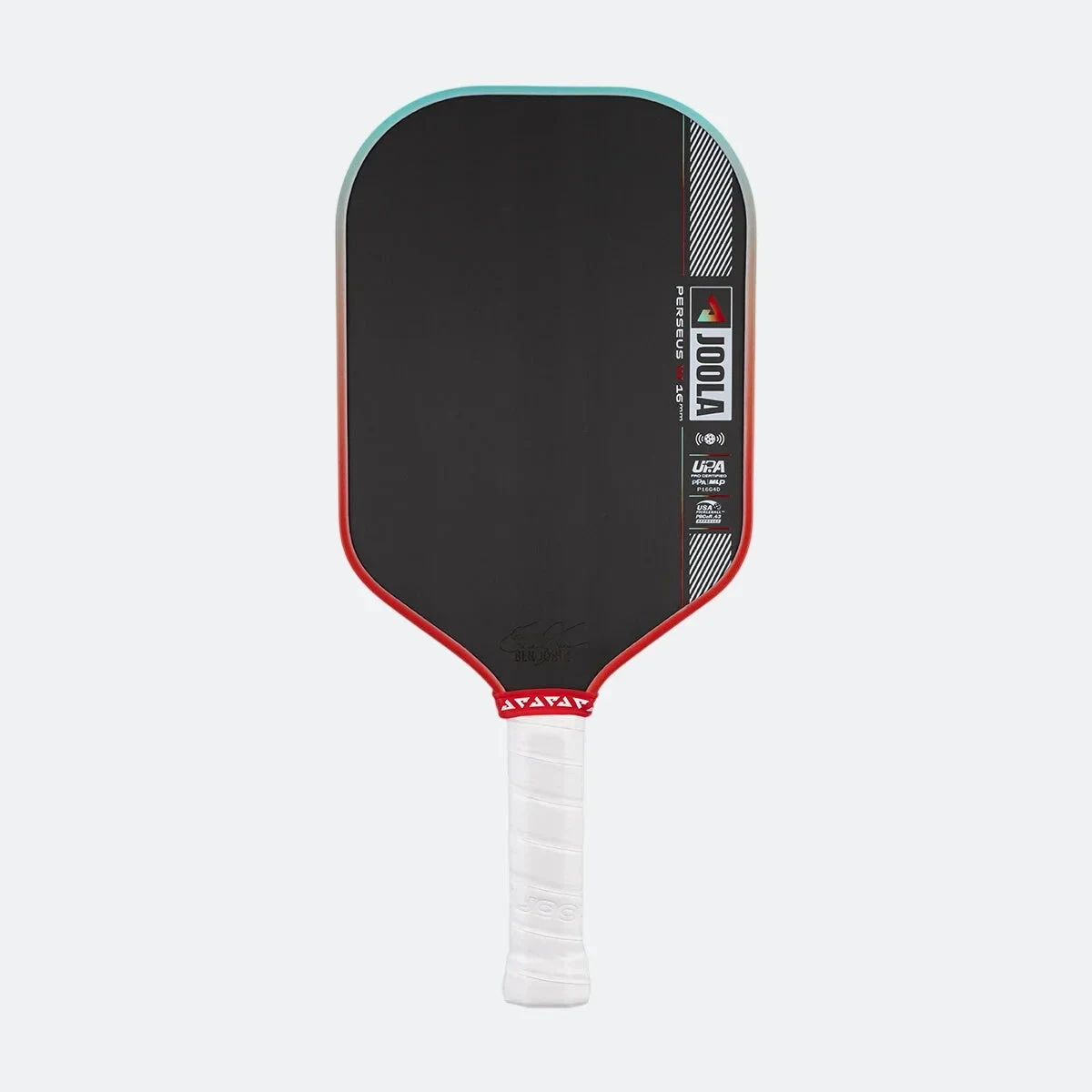
Think of the Pro IV as the flagship that meets a convert halfway. It has the same racket-like recipe as the Pro V at the top of this list, an elongated 16.5 inch frame, a 118 swing weight, and a 5.5 inch handle your two-hander fits on.
The difference is what happens at contact: this 16mm core lets the ball sink in and sit for a fraction longer, and that dwell forgives the timing errors every tennis player brings to a new game.
That forgiveness shows up exactly where converts bleed points. Third shot drops, the shot with no tennis equivalent, come off calmer because the ball pockets instead of pinging.
Drives still carry real weight through the court, because the swing weight does the work your shoulder used to, and serves jump off the face without a full shoulder turn. Spin at 1,971 RPM is a step below the newest faces, but it is honest spin, enough to shape a topspin drive down into the court.
Two honest notes. Contact sounds stiffer and hollower than the Pro V, a crack some players love and I merely tolerate, and frantic hand battles at the kitchen are not won at a 118 swing weight. This generation also carries core durability complaints, so register the warranty when it arrives and keep the receipt.
Buy it if you want flagship power with training wheels for your touch. Skip it if you already strike clean and want the sharpest tool: that is the Pro V.
5CRBN TruFoam Genesis Elongated: Best Pickleball Paddle for Topspin Drives in 2027
AT A GLANCE
CRBN TruFoam Genesis Elongated
Weight
8.0 oz
Swing Weight
117
Twist Weight
5.64
Spin
2,151 RPM
Shape: Elongated, 16.5 x 7.35 in, 5.5 in handle
Core: TruFoam full foam, 14mm
Face: T700 raw carbon fiber with fiberglass layer
Grip: 4.125 in
Approval: USAP and UPA-A
Feel: Soft dwell
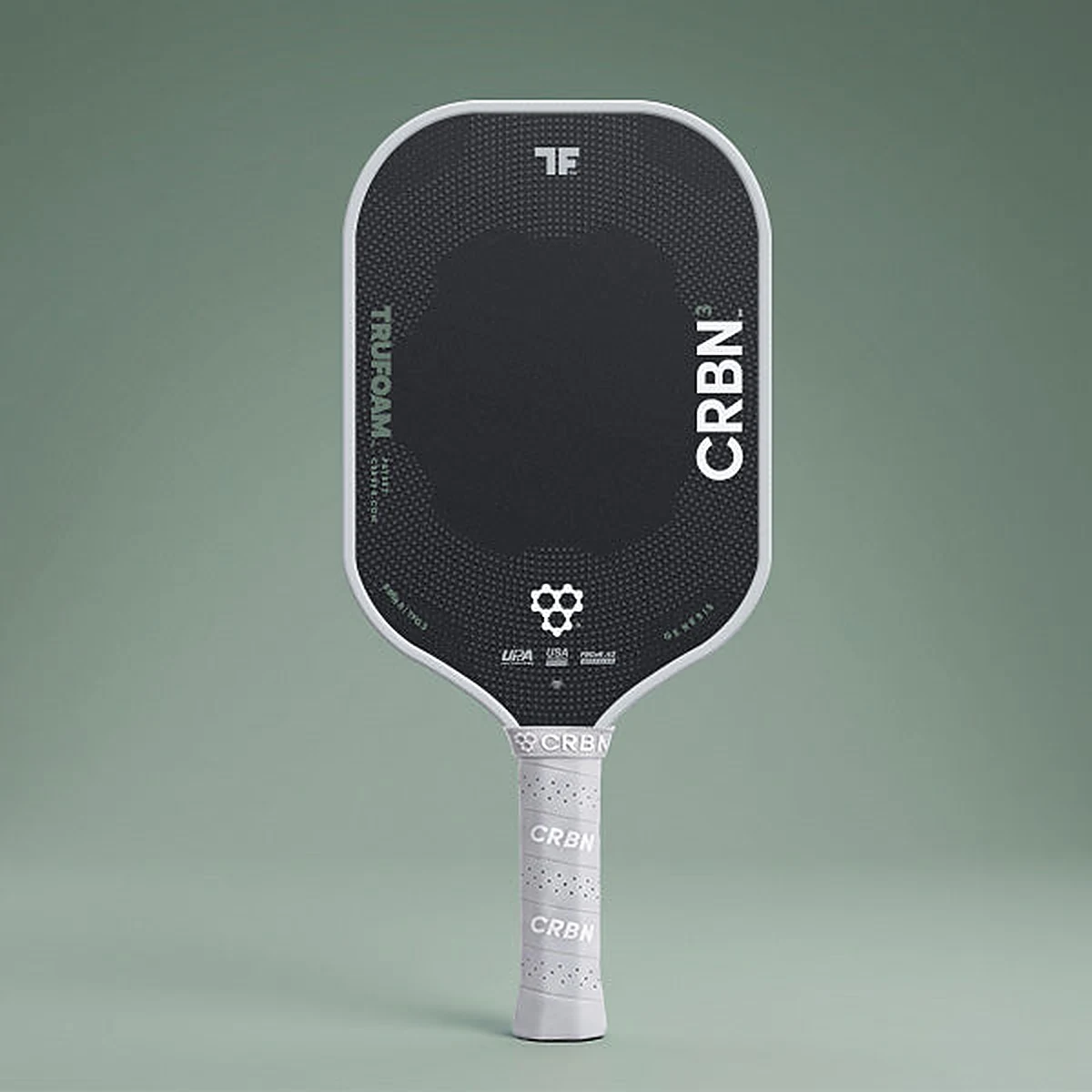
A tennis player’s best friend in this sport is dwell time, the fraction of a second the ball stays on the strings while topspin gets built. No pickleball paddle has strings, but the Genesis comes closest to the sensation.
It is a 14mm paddle with a full foam core and no honeycomb at all, and the ball pockets like it would on a 16mm, holding on the face long enough for a brushing swing to grab it and shape it.
The numbers back the feel. Measured spin of 2,151 RPM in this narrow elongated frame is the highest verified figure on this page, and on court it is not subtle: topspin drives dip late and hard, serves kick off the bounce, and roll volleys curve instead of floating.
For a convert whose whole baseline identity is heavy topspin, this is the paddle that lets the identity survive. The foam also swallows vibration, so long drilling sessions left my arm fresher than power paddles usually do, a real consideration for elbows trained on string beds.
The shape takes its tax in stability. A 5.64 twist weight is the lowest here, so stretched, messy defensive contact twists more than it does on the widebody version, and early resets launched higher than I meant until my grip learned to soften around the fiberglass layer in the hitting zone.
Buy it if topspin is how you win. Skip it if your defense is built on scramble and reach.
6Engage Pursuit Pro1 6.0 Elongated: Best Pickleball Paddle for Big Swings in 2027
AT A GLANCE
Engage Pursuit Pro1 6.0 Elongated
Weight
8.0 oz
Swing Weight
118.6
Twist Weight
5.95
Spin
2,267 RPM
Shape: Elongated, 16.5 x 7.5 in, 5.875 in handle
Core: MachPro polymer with Variable Release 2.0
Face: Raw Toray T700 carbon fiber
Grip: 4.25 in
Approval: USAP
Feel: Connected touch
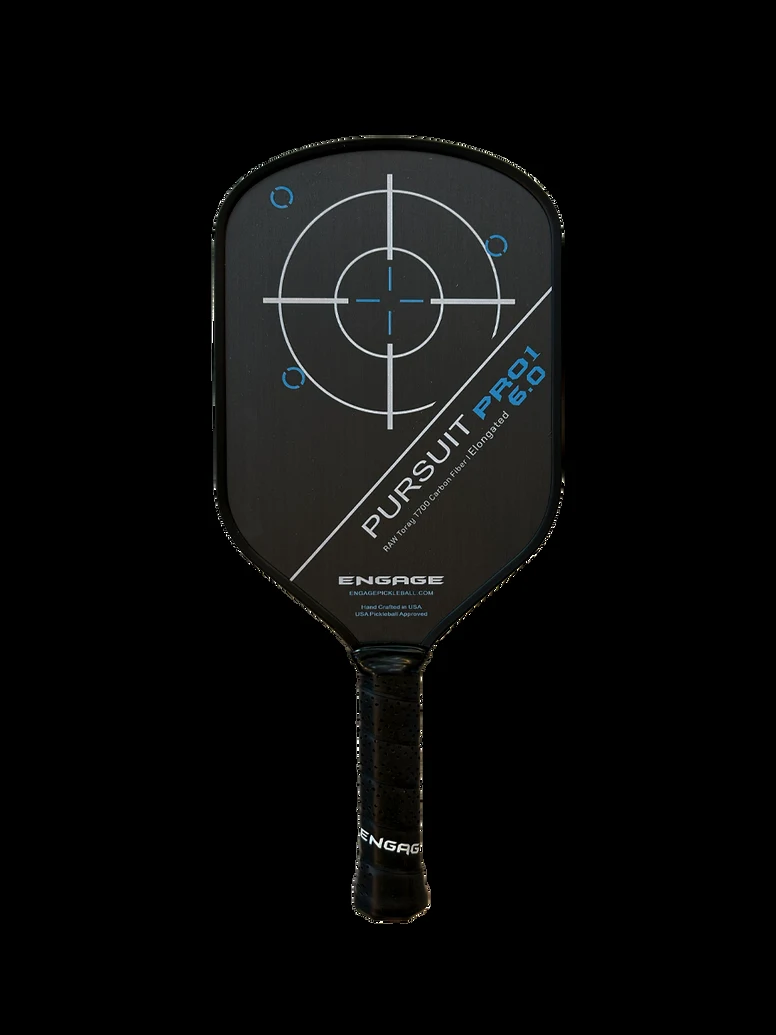
Every convert gets the same advice in week one: shorten your swing, take the racket back less, stop swinging like that. The Pursuit Pro1 is the paddle for players who would rather not.
Its handle runs 5.875 inches, long enough for a real two-handed backhand, and its face is built around Variable Release 2.0, which flexes more as your swing speed rises. Swing soft and it plays soft. Commit to a full cut and it loads, which is as close as a paddle gets to respecting a tennis stroke.
It is built the old way, layers pressed cold instead of thermoformed in a mould, and contact tells you so immediately. The ball sits, the face talks to your hand, and dinks and drops go where your fingers decided.
Then the coarse raw Toray T700 texture, measured at 2,267 RPM, lets the full swing produce dipping drives and serves that carry and drop. The dwell even lets you hold a shot a beat longer and wrong-foot players at the kitchen, an old tennis trick that works beautifully here.
The trade lives in the swing weight. At 118.6 with a head-heavy feel, it will not win frantic hands battles at the net, and off-center contact twists more than the 5.95 twist weight suggests, so stretched blocks need a firm wrist.
Buy it if your swing is your weapon and your touch is real. Skip it if you want pace supplied for you.
7Paddletek Bantam TKO-CX 14.3mm: Best Pickleball Paddle for Two-Handed Backhands in 2027
AT A GLANCE
Paddletek Bantam TKO-CX 14.3mm
Weight
7.8-8.2 oz
Swing Weight
123
Twist Weight
7.35
Spin
1,910 RPM
Shape: Elongated, 16.5 x 7.5 in, 5.75 in handle
Core: Bantam PolyCore honeycomb, 14.3mm, steel perimeter weighting
Face: PT-700 raw carbon fiber with glass epoxy
Grip: 4.25 in
Approval: USAP and UPA-A
Feel: Heavy stability
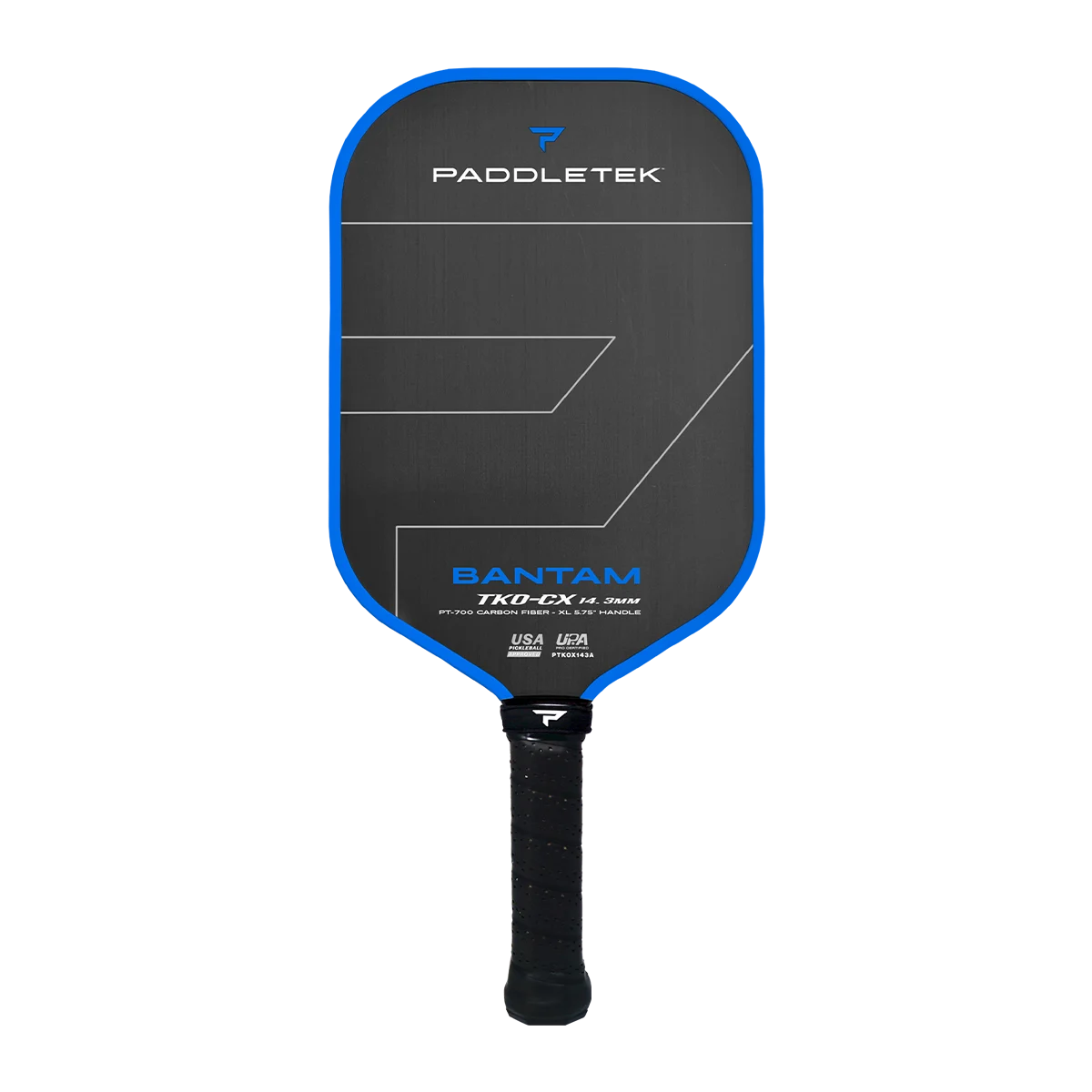
The CX in this paddle’s name means extended handle, and Paddletek built it for one reason: the two-handed backhand. At 5.75 inches, the grip gives your top hand a real home, and what sits behind that grip is the most racket-like stability on this page.
The swing weight of 123 is the heaviest swing here, and the twist weight of 7.35 is the highest, because steel weighting runs inside the core at the 3 and 9 o’clock positions, exactly where a racket’s stability lives.
On court, a two-handed drive through this paddle feels like the shot you already own. The face does not flutter on contact, the ball leaves heavy, and off-center hits that would twist a lighter frame stay on line.
Spin measured at 1,910 RPM is the modest number in the box, but it is enough to keep a driven ball dipping, and the crisp PT-700 carbon face gives you clean feedback on every contact, which a tennis player reads instinctively.
Be honest with yourself about the trade before you buy it. A 123 swing weight is a commitment: your kitchen hands will be the slowest on this list, counters come from positioning rather than reflexes, and a long singles session will load your forearm. This is a baseliner’s paddle in a sport that keeps dragging you to the net.
Buy it if the two-hander is non-negotiable. Skip it if your doubles game lives on quick hands.
8Six Zero Double Black Diamond Elongated 15mm: Best Six-Inch Handle Pickleball Paddle in 2027
AT A GLANCE
Six Zero Double Black Diamond Elongated 15mm
Weight
8.1 oz
Swing Weight
118
Twist Weight
5.85
Spin
-
Shape: Elongated, 16.6 x 7.4 in, 6.0 in handle
Core: Polypropylene honeycomb with foam edge injection, 15mm
Face: Japanese Toray 700K raw carbon fiber
Grip: 4.25 in
Approval: USAP
Feel: Cushioned control
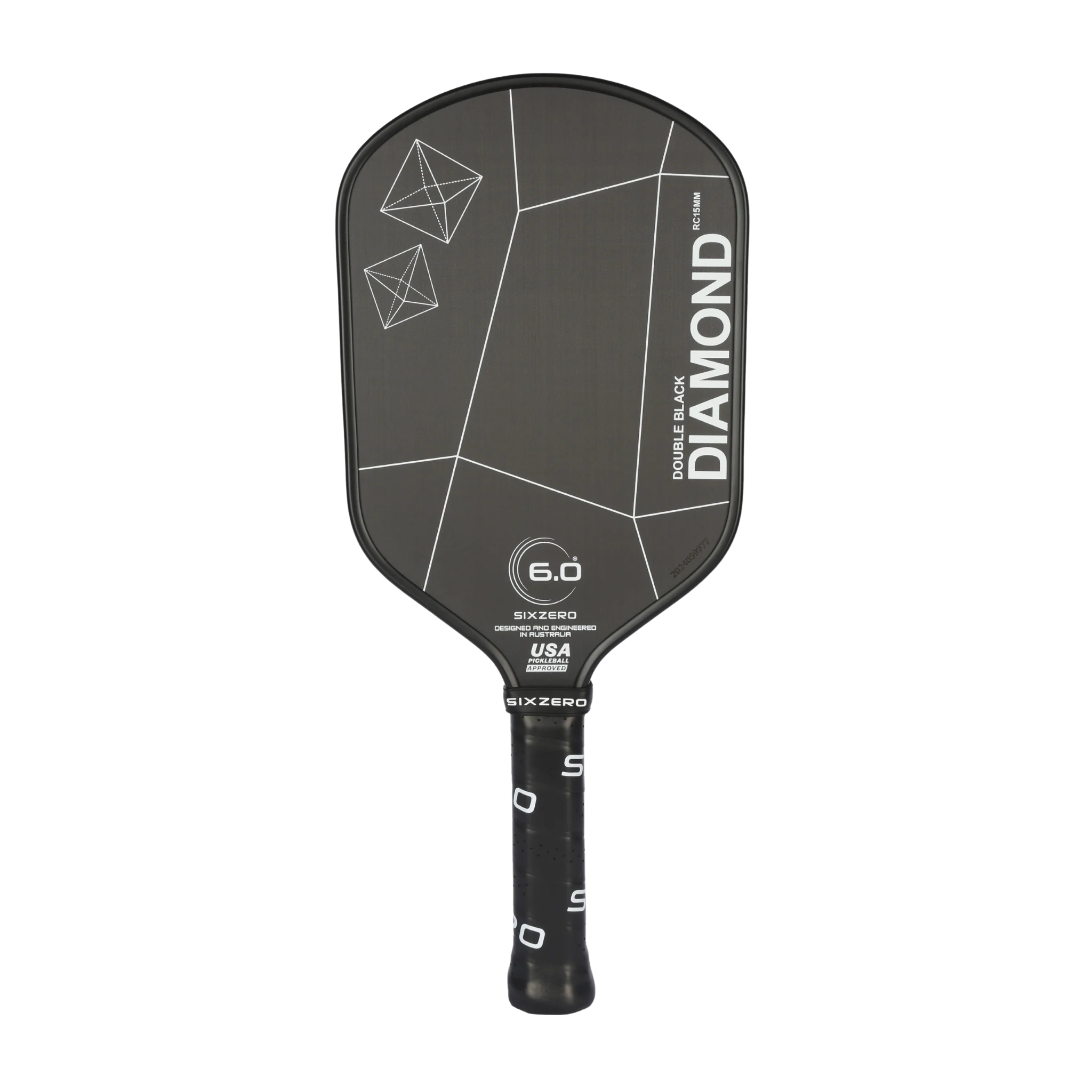
Six inches. That is the handle on this paddle, the longest on this page, and if you play a two-handed backhand it is worth reading the rest of this section just for that.
The grip is long enough that both hands stack the way they do on a racket, no fingers hanging off the top, no knuckles grinding into the throat, and the tapered neck means the transition from two hands to one at the kitchen does not snag. Converts I play with describe it as the first handle that stopped asking them to change their grip.
The paddle behind the handle is a longer, narrower take on Six Zero’s Double Black Diamond recipe: a 15mm honeycomb core with foam injected around the edges, a thermoformed unibody handle, and a raw Toray 700K carbon face.
It plays like the family does, plush and predictable, with the ball pocketing a fraction before it leaves, and the thermoformed handle build damps the buzz that wrists raised on string beds notice immediately in stiffer paddles. The 118 swing weight keeps drives honest.
One gap, stated plainly: I have no lab spin figure for this elongated version that I trust, so the box shows a dash rather than borrowing the hybrid’s numbers. The raw carbon face bites on court, but you are buying the handle and the feel here, not a verified spin headline.
Buy it if grip room is your first filter. Skip it if you play one-handed and want your mass in the head instead.
9Franklin C45 Dynasty 16mm: Best Predictable Power Pickleball Paddle in 2027
AT A GLANCE
Franklin C45 Dynasty 16mm
Weight
7.6-8.0 oz
Swing Weight
116
Twist Weight
6.3
Spin
-
Shape: Elongated, 16.4 x 7.6 in, 5.6 in handle
Core: PowerFlex polymer with inner foam layer, 16mm
Face: T700 carbon fiber at 45 degrees
Grip: 4.3 in
Approval: USAP and UPA-A
Feel: Linear response
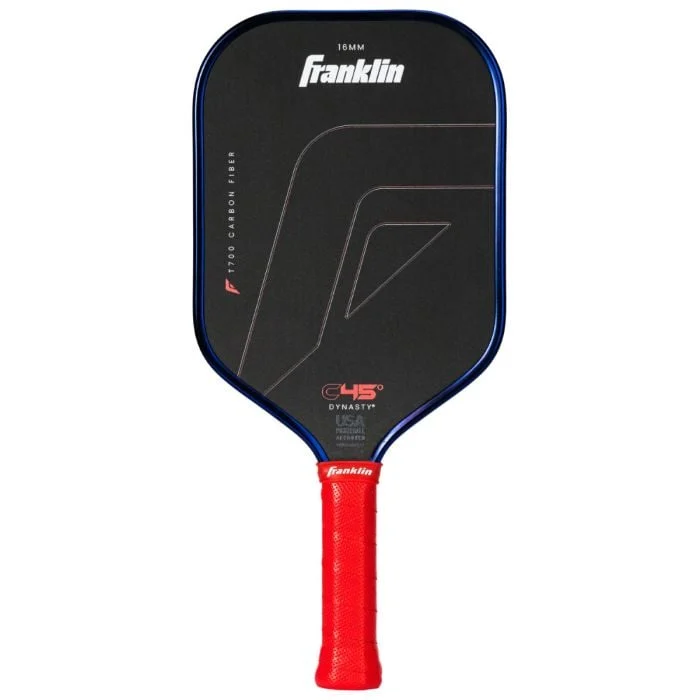
First, a clarification that saves converts a common mistake. The C45 name tennis fans know belongs to Anna Leigh Waters, but her Aurelius shape is a short, wide paddle with a 5.1 inch handle, built for hand speed, and it fails every test on this page.
The Dynasty is the C45 built for you: an elongated 16.4 inch frame with a 5.6 inch handle, the same carbon face laid at a 45 degree angle, and a response tuned for players who swing like you do.
That response is the argument. The C45 line’s signature is linearity: swing at 60 percent, get 60 percent of the power, with no hot spot in the middle of the face and no trampoline patch near the edge. In a convert’s first months, when every lively paddle turns a confident drive into a fence ball, predictability is a performance feature.
You rebuild your depth control around a paddle that answers the same way every time, and your misses become calibration instead of chaos. Franklin publishes a 116 swing weight and a 6.3 twist weight for it, comfortable middle numbers for a full swing.
I have no lab spin figure for the Dynasty itself, so the box leaves it unpublished; the angled carbon face bites on court, but I will not borrow the hybrid’s measurement. Buy it if your drives are flying long and you want them diagnosed, not amplified.
10Six Zero Black Opal: Best Spin Ceiling Pickleball Paddle in 2027
AT A GLANCE
Six Zero Black Opal
Weight
8.1 oz
Swing Weight
114
Twist Weight
6.3
Spin
2,024 RPM
Shape: Hybrid, 16.3 x 7.7 in, 5.5 in handle
Core: G4 solid foam with Power Gel layer
Face: Diamond Tough raw carbon fiber
Grip: 4.125 in
Approval: USAP
Feel: Explosive spring
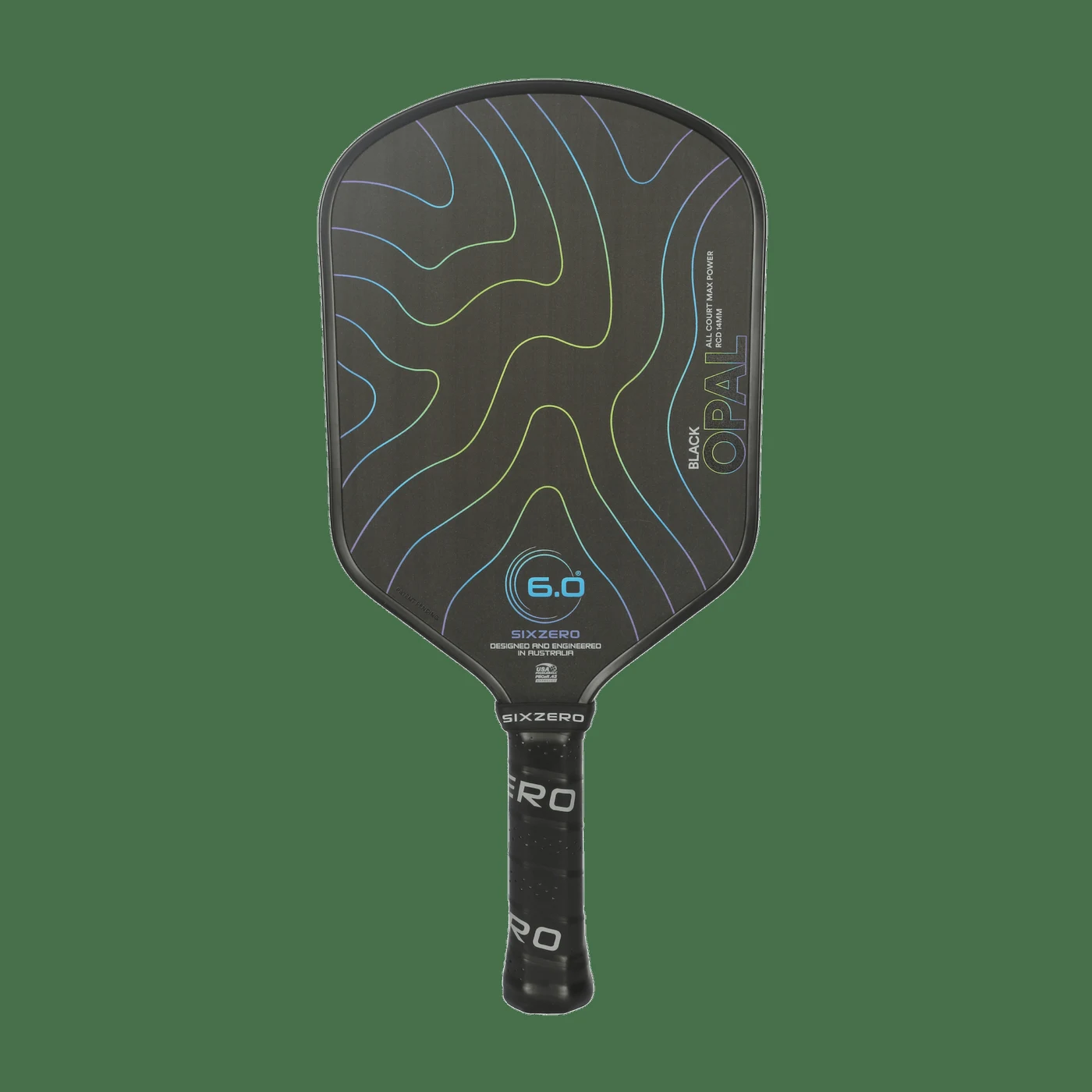
Every other paddle on this page is elongated. The Black Opal is the exception that earns its place, because for one kind of convert it answers the only question that matters: how much of my topspin game survives?
The Diamond Tough face uses diamond particles in the raw carbon texture to hold its bite, and where plain raw carbon faces go smooth across a season of brushing, this one keeps gripping. Measured spin of 2,024 RPM with that durability behind it is the highest ceiling a spin-first convert can buy here.
Under the face sits a solid foam core with Six Zero’s Power Gel layer, and contact is dense, springy, almost thuddy, then the ball is simply gone. Counters jump without a wind-up, speed-ups leave early, and in lab power testing this paddle hit near the very top of the charts.
The handle carries Six Zero’s Shock Shield, a silicone injection system that damps vibration, which matters for arms coming off string beds. At a 114 swing weight it is also the quickest swinger among the power picks here.
The honest catch: the sweet spot sits lower than a tennis player expects and it is not generous, so your high contact point needs a genuine adjustment, and my soft game leaked pop-ups for two weeks while I learned how little swing this paddle needs.
Buy it if heavy topspin is your identity. Skip it if forgiveness matters more right now.
How to Choose a Pickleball Paddle as a Tennis Player in 2027
You already know how to hit a ball, which means your paddle decision is not the beginner’s decision. You are not shopping for forgiveness in the abstract; you are shopping for a tool that fits strokes you already own while you learn the parts of this game tennis never taught you.
Six things decide that fit: the handle, the swing weight, the face, your touch calibration, your grip habits, and your arm. Work through them in that order and the list above reads very differently.
Handle Length First: The Two-Hander Filter
If you play a two-handed backhand, handle length is not a preference, it is a filter, and it should be applied before you look at a single other spec.
You need 5.5 inches of handle at minimum so your top hand sits on the grip instead of crowding the throat, and 5.75 to 6 inches is where the stroke starts feeling like the one you own. Squeezing two hands onto a short handle changes your grip pressure, shortens your swing, and quietly turns a weapon into a block.
Apply the filter honestly and this page sorts itself: the Double Black Diamond Elongated at 6.0 inches, the ERA Power at 5.8, the TKO-CX at 5.75, and everything else at 5.5 or above, while popular paddles like the C45 Aurelius, with its 5.1 inch handle, fall away no matter how famous they are.
One caution: published handle length can understate usable room on tapered necks and overstate it on flared throats, so if you can hold a paddle before buying, put both hands on it and take your actual backswing.
One-handed backhand players should still read the number, just differently. A longer handle shifts balance toward the head and adds leverage on serves and rolls, but it also parks your hand lower on the grip for kitchen work. If your game is one-handed, 5.5 inches is plenty, and extra length buys you little.
Shape and Swing Weight: Buy Plow-Through, Not Ounces
Forget the weight printed on the paddle. A scale cannot tell you how a paddle swings, and how it swings is the entire question for a tennis player. Swing weight measures resistance in motion, and it is the number that decides whether a paddle feels like a racket or like a flyswatter.
Tennis converts are happiest between about 113 and 120: enough mass moving through the ball for drives to feel heavy and familiar, not so much that the kitchen turns into a weight room. Everything on this list lives in or near that window on purpose.
Shape is how you spend that swing weight. An elongated frame, 16.5 inches long and about 7.5 wide, puts the mass up high, adds reach and leverage, and shrinks the sweet spot. A hybrid gives some of the reach back in exchange for a friendlier face and quicker hands.
A widebody is the fastest and most forgiving and will feel the least like tennis. Most converts should start elongated or hybrid, because the baseline game is where their confidence lives, then let their results at the kitchen argue for a change.
Twist weight is the quiet third number: it measures how much the face resists rotating on off-center contact. Narrow elongated faces need it more than wide ones. Around 6.3 and up feels stable to most players; down near 5.6, stretched defensive blocks will twist unless your hand supplies the stability.
Spin and the Topspin Game
Topspin transfers to pickleball, but it transfers at a discount, and honest expectations will save you a frustrating month. A tennis ball is fuzzy, light for its size, and wrapped around strings that pocket and snap back. A pickleball is smooth plastic with holes.
It grips the face less, dips less for the same rotation, and slows down faster in the air. Your brushing swing still works; it just produces a drive that bends rather than dives, which is why converts who swing for tennis-level dip watch balls sail until they recalibrate.
What the paddle controls is how much of your brush becomes rotation and how long that lasts. Raw carbon fiber faces bite because of their texture, and lab numbers around 2,000 RPM and above mark the strong spin paddles on this list.
The catch is wear: plain raw carbon slowly goes smooth, so a spin-first player should care about durable grit surfaces as much as week-one numbers.
Note also that the rules now police the ceiling: under a USAP rule from October 2026, newly certified paddles must measure no more than 2,100 RPM in the official spin test, with paddles approved before that change grandfathered in. The era of ever-rougher faces is over; technique is the remaining spin upgrade.
Your part of the bargain is contact point and swing path. Brush up the back of the ball, finish like you mean it, and aim lower over the net than your tennis instincts suggest. The dip you get is real. It is just rationed.
The Touch Adjustment: Resets, Drops and Dinks
Here is the part of the switch nobody can buy their way out of. Tennis has no shot like the third shot drop, no rally that lives six inches over a net cord, and no rule that keeps you out of the kitchen while the ball bounces.
Your strokes will get you to the net. What happens there, the dinks, the resets, the blocks that must die instead of drive, is a new skill, and in my experience it is a three-month skill, not a three-week one.
Equipment can make the learning curve kinder. A 16mm core dwells longer and absorbs pace instead of returning it, which is why so many picks above run thick. Foam cores pocket the ball in a way that feels closer to a string bed than crisp honeycomb does.
A paddle with linear, predictable power, like the C45 Dynasty, removes one variable while your hands learn the other ten. What equipment cannot do is soften a firm grip for you: most convert pop-ups are a grip-pressure problem wearing a paddle costume. Loosen your hand until the paddle feels almost insecure, then dink. That is the drill.
Expect the sequence I lived: your drives work in week one, your kitchen game embarrasses you in week three, and somewhere around month three the soft shots start landing where your hands sent them. The players who quit in the gap are the ones who bought a power paddle to win the wrong argument.
Grip and Technique Carryover
Your grips need one edit, not a rebuild. Tennis players arrive with a wardrobe of grips and a habit of changing them between shots; pickleball runs best on one default, the continental grip, hammer-style, for almost everything at the net, because there is no time to regrip in a hands battle.
Many converts keep a mild eastern backhand grip for drives from the baseline, and that is fine. What matters is that your kitchen grip stops changing. Pick continental, live there for a month, and let your drives adjust around it instead of the other way around.
The swing needs the opposite treatment: keep the shape, cut the size. Your backswing is calibrated for a ball that comes slower and bounces higher, against opponents twenty feet further away. In pickleball the ball arrives sooner and the court forgives less, so a full tennis wind-up produces late contact and long balls.
Shorten the take-back, move your contact point in front of your body, and let the paddle’s swing weight do the work your shoulder used to do. Groundstroke mechanics, weight transfer, shoulder turn, all of it still applies; it just happens in a smaller space.
One carryover is pure profit: your serve. A tennis serve motion, shortened, with the pickleball underhand rule respected, gives converts a deep, heavy serve from the first week. Use it. It is the one shot where the head start is exactly as big as it feels.
Arm Care for Converts
Tennis players bring strong arms to this game and a specific set of risks.
The pickleball is lighter than a tennis ball, but the paddle is stiffer than a string bed, the court invites hundreds more contacts per session, and the classic convert habits, wristy flicks at the kitchen, a death grip on the handle, late contact whipped with the forearm, load the elbow tendon in exactly the way that produces tennis elbow in its new home.
Players who never had arm trouble in tennis get it in pickleball, and the technique is usually the first suspect.
Equipment plays a supporting role. Foam cores and damped handle systems send less shock into the arm than a stiff, light honeycomb paddle does, a slightly built-up grip with an overgrip stops you squeezing to keep hold, and a swing weight in the middle of the range lets the paddle’s mass do work your forearm otherwise does.
What equipment cannot do is outrun volume: three-hour sessions, every day, on a sore arm will beat any paddle on this page.
Treat pain as information, not as a shopping trigger. Soreness that fades between sessions is training; pain that lingers, sharpens, or starts showing up off the court means rest, load changes, and, if it persists, a medical professional who can actually examine the arm.
No paddle on this list, or any list, is a treatment, and a page that tells you otherwise is selling you something.
Frequently Asked Questions (FAQs)
1. What is the best pickleball paddle for a tennis player?
For most converts, the JOOLA Perseus Pro V 16mm, because its 117 swing weight and head-forward balance reproduce the plow-through of a tennis racket while its raw carbon face keeps a full swing dipping into the court.
Players who contact the ball very high should look at the Agassi Pro V, built with a tapered throat and a higher sweet spot. Whoever you are, filter first for an elongated or hybrid shape, a handle of 5.5 inches or more, and a swing weight between 113 and 120; those three traits matter more than any brand name.
2. What is the best pickleball paddle for a two-handed backhand?
The one with the longest handle that still plays the way you want: the Six Zero Double Black Diamond Elongated gives you a full 6.0 inches, the Selkirk SLK ERA Power Elongated 5.8, and the Paddletek Bantam TKO-CX 5.75 with the highest twist weight on this page behind your stroke.
Anything under 5.5 inches crowds your top hand against the throat and changes your grip pressure. If the two-hander is a real part of your game, treat handle length as a filter you apply before comparing anything else.
3. Is an elongated paddle better for tennis players?
Usually, yes, because the elongated shape preserves the two things tennis players rely on: reach and leverage through a full swing. The longer face adds plow-through on serves and drives and its handles tend to run long enough for a two-handed backhand.
The trade is a smaller, higher sweet spot and slower hands in kitchen exchanges, which is why some converts settle on a hybrid like the Black Opal after a season. Start elongated if your baseline game is your identity; start hybrid if you already know you will live at the net.
4. Do tennis skills transfer to pickleball?
Most of them do, and faster than you expect. Groundstrokes, serves, overheads, volley technique, footwork patterns and court positioning all carry over, which is why converts rally competently within days.
What does not transfer is the soft game: dinking, resetting hard balls at your feet, and the patience to build a point six inches over the net have no tennis equivalent. Expect your strokes to make you dangerous quickly and your touch to take a few months to catch up.
5. What is the biggest adjustment for tennis players switching to pickleball?
The kitchen, in every sense: the non-volley zone you cannot step into, the dinking rallies you cannot blast your way out of, and the shorter backswing the smaller court demands.
Most converts lose their early points the same three ways: drives sailing long off a full tennis swing, volleys hit from inside the kitchen line, and soft shots popped up by a grip that is still squeezing like a racket handle. All three are habits, not talent gaps, and all three fade with a few months of regular play.
6. Can I use a two-handed backhand in pickleball?
Yes, and more players at every level are doing it, because a two-hander adds stability and topspin on drives and returns. The requirements are physical: a handle of at least 5.5 inches so both hands fit without crowding, and the acceptance that two hands trade away a little reach on wide defensive balls.
Several picks on this list were chosen with exactly this shot in mind, up to the Double Black Diamond Elongated’s full 6.0 inch handle. One-handed players give up nothing by choosing the same paddles; the room is simply there if you want it.
7. Why do my drives keep flying long in pickleball?
Because three things stack against you: a full tennis swing, a ball that carries less drag and dip than a tennis ball, and paddles that add pop a string bed never would. The fix is layered: shorten your backswing, brush up the back of the ball so topspin pulls it down, and aim at a lower window over the net.
Equipment helps at the margin: a high-spin face gives your brush something to bite, and a linear-response paddle like the C45 Dynasty stops amplifying calibration errors while your depth control rebuilds.
8. Does topspin work the same in pickleball as in tennis?
No, it works at a discount: the smooth plastic ball grips the face less than a felt ball grips strings, so the same swing produces rotation that bends the ball rather than diving it.
A textured raw carbon face and a genuine brushing swing still produce drives that dip and serves that kick, just with less margin, which is why converts swing harder and miss long until they recalibrate.
The rules also cap the arms race now: under a USAP rule from October 2026, newly certified paddles must measure no more than 2,100 RPM in the official spin test, while paddles approved earlier keep their certification.
9. How heavy should my first pickleball paddle be if I play tennis?
Ignore the scale weight and shop the swing weight: look for 113 to 120, which is where a paddle feels like it has a racket’s plow-through without turning kitchen exchanges into labour. In static terms that usually means a paddle around 7.9 to 8.2 ounces with its mass carried toward the head.
Very light paddles feel fast for a week and then start feeling like toys against your full swing, while anything swinging above the low 120s will tax your forearm and slow your hands at the net.
10. Is pickleball singles or doubles better for tennis players?
Singles will feel like home first, because it rewards the exact skills you brought: baseline drives, passing shots, serves and court coverage. Doubles is where the sport actually lives, though: it is the social and ranked default, it fills the courts, and it forces the soft-game learning that makes you a complete player.
My honest advice is to use singles to build confidence and doubles to build your game, and to expect your doubles results to lag your singles results for the first few months.
11. Can pickleball give me tennis elbow if I use tennis technique?
Yes, it can, and converts are a classic case: wristy flicks at the kitchen, squeezing the grip too hard, and whipping late contact with the forearm load the same tendon your tennis habits trained. A lighter plastic ball does not protect you when the paddle is stiff and the session runs to hundreds of contacts.
Reduce the load with relaxed grip pressure, contact in front of your body, a damped foam-core or cushioned-handle paddle, and sensible session lengths, and treat lingering pain as a reason to rest and see a medical professional, not as a reason to buy another paddle.
12. How long does it take a tennis player to get good at pickleball?
You will rally and win points against casual players within days, because your strokes and footwork are a real head start. Allow a few months of regular play to become genuinely good: that is how long the soft game, the kitchen rules, and shot selection against the bounce take to become instinct rather than concentration.
Most converts plateau briefly when their baseline game stops carrying them, somewhere in the intermediate range, and the players who push through are the ones who drill dinks and resets instead of just playing games.