
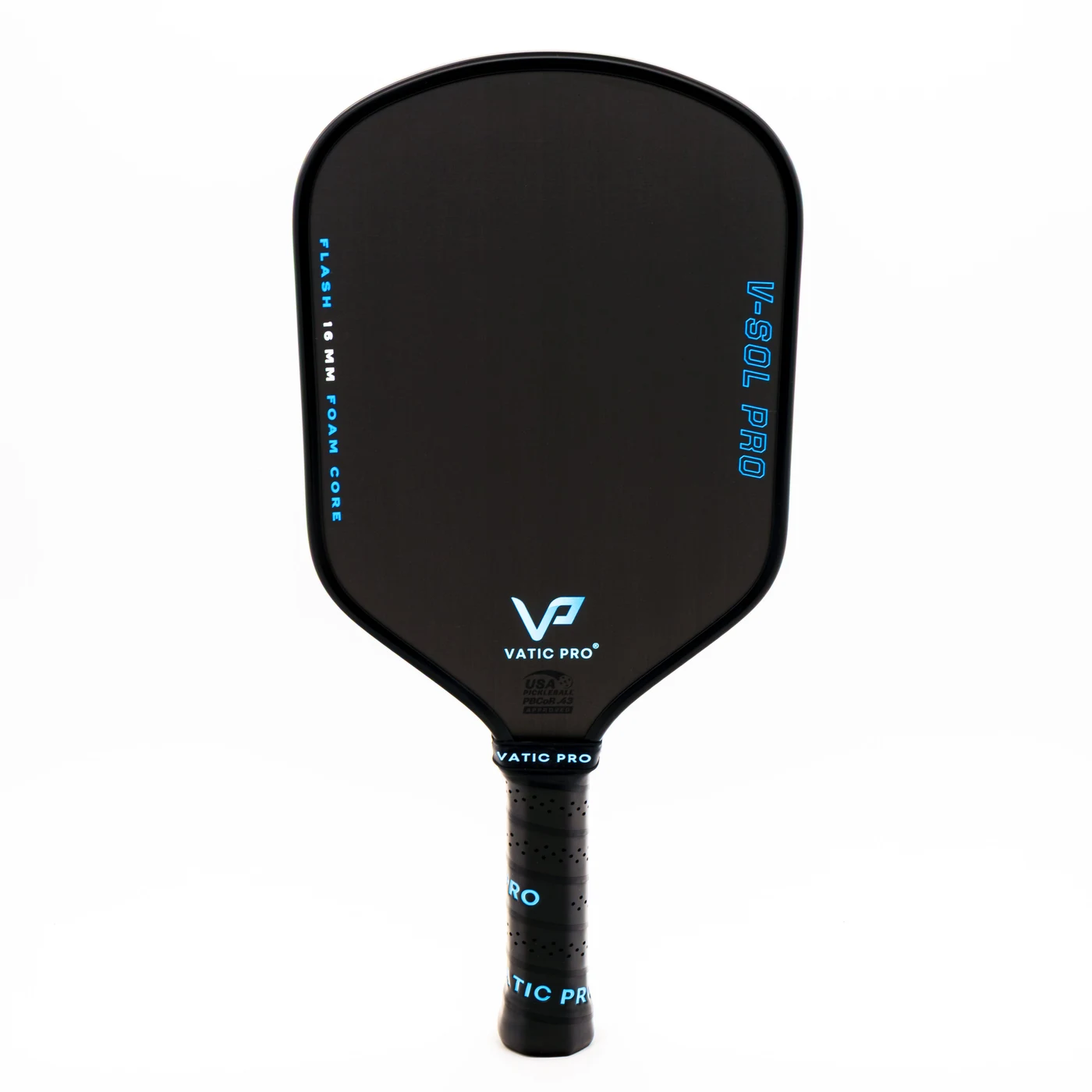
Best pickleball paddles under $150 are the middle tier where construction catches up: foam cores, carbon faces and real lab numbers appear here.
I tested every paddle on this list on court myself and checked the figures, so the ranking follows real games, not price tags. Each pick has one clear job, like best control or most forgiveness, and every pick is approved for league and tournament play here.
My number one pick is the Vatic Pro V-SOL Pro 16mm, the best pickleball paddle under $150 because its foam holds balls longer. It scored 8.4 out of 10 in my testing, and its full foam core keeps the ball on the face a moment longer.
So your drops land softer, your resets sit down low, and your drives leave with a heavy shape instead of a crack. Check the Vatic Pro V-SOL Pro on Amazon if you want the under $150 paddle I recommend first for a complete game.
The 10 Best Pickleball Paddles Under $150 in 2027
1. Vatic Pro V-SOL Pro 16mm: Best Overall Pickleball Paddle in 2027
AT A GLANCE
Vatic Pro V-SOL Pro 16mm
WEIGHT
~7.9 oz (measured)
SWING WEIGHT
108
TWIST WEIGHT
6.43
SPIN
2,060 RPM
Shape: Hybrid (Flash), 16.25 x 7.7 in class
Grip: 5.3 in handle, 4.125 in circumference
Core: Full EPP foam with EVA perimeter ring, 16mm (Gen 4)
Face: Raw carbon fiber
Approval: USAP
Feel: Lively all-court
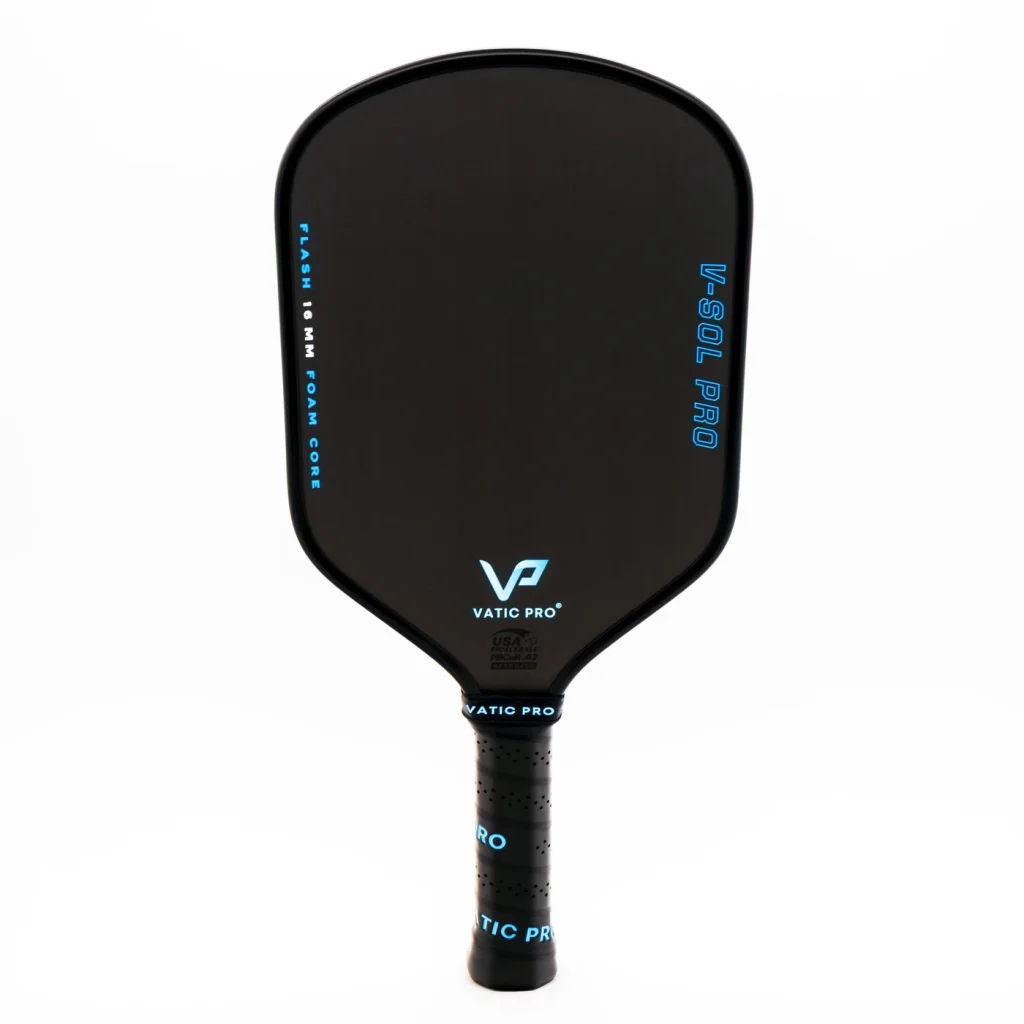
The first thing the V-SOL Pro teaches you is patience, and it teaches it kindly. Its full EPP foam core holds the ball a fraction longer than a honeycomb core does, and in that extra dwell the shot organises itself: drops land softer, resets sit down instead of climbing, and drives leave with a heavy shape rather than a crack.
Across my sessions it was the paddle I reached for when the game sped up, because it never once felt rushed.
The measured profile backs the feel. At about 7.9 ounces with a swing weight of 108, it moves quicker than its stability suggests, and a twist weight of 6.43 keeps off-center contact honest on the hybrid Flash shape.
Spin measured at 2,060 RPM is genuine working spin, enough to dip drives and shape roll volleys, and the raw carbon face delivers it without the harshness thinner builds can carry. The 4.125 inch grip circumference suits a relaxed hold and a loose wrist through long sessions.
The honesty foam demands: a new foam core plays a touch firm for its first sessions before it settles in, and the liveliness that makes counters so easy can push a tense block long until your hands learn its timing.
Foam builds also carry the class question about long-term core durability that honeycomb does not, which the guide below takes up directly. None of it stopped this paddle finishing top of the list.
Buy it if you want the most complete modern build on this page. Skip it if you prefer the settled, predictable strike of a plain honeycomb core.
2. Vatic Pro Prism Flash 16mm: Best Control Pickleball Paddle in 2027
AT A GLANCE
Vatic Pro Prism Flash 16mm
WEIGHT
7.9-8.2 oz
SWING WEIGHT
114
TWIST WEIGHT
6.47
SPIN
~1,900 RPM
Shape: Hybrid, 16.25 x 7.7 in
Grip: 5.3 in handle, 4.25 in circumference
Core: 16mm C7 polymer honeycomb with foam-injected edge walls
Face: Raw carbon fiber, T700 class
Approval: USAP
Feel: Plush control
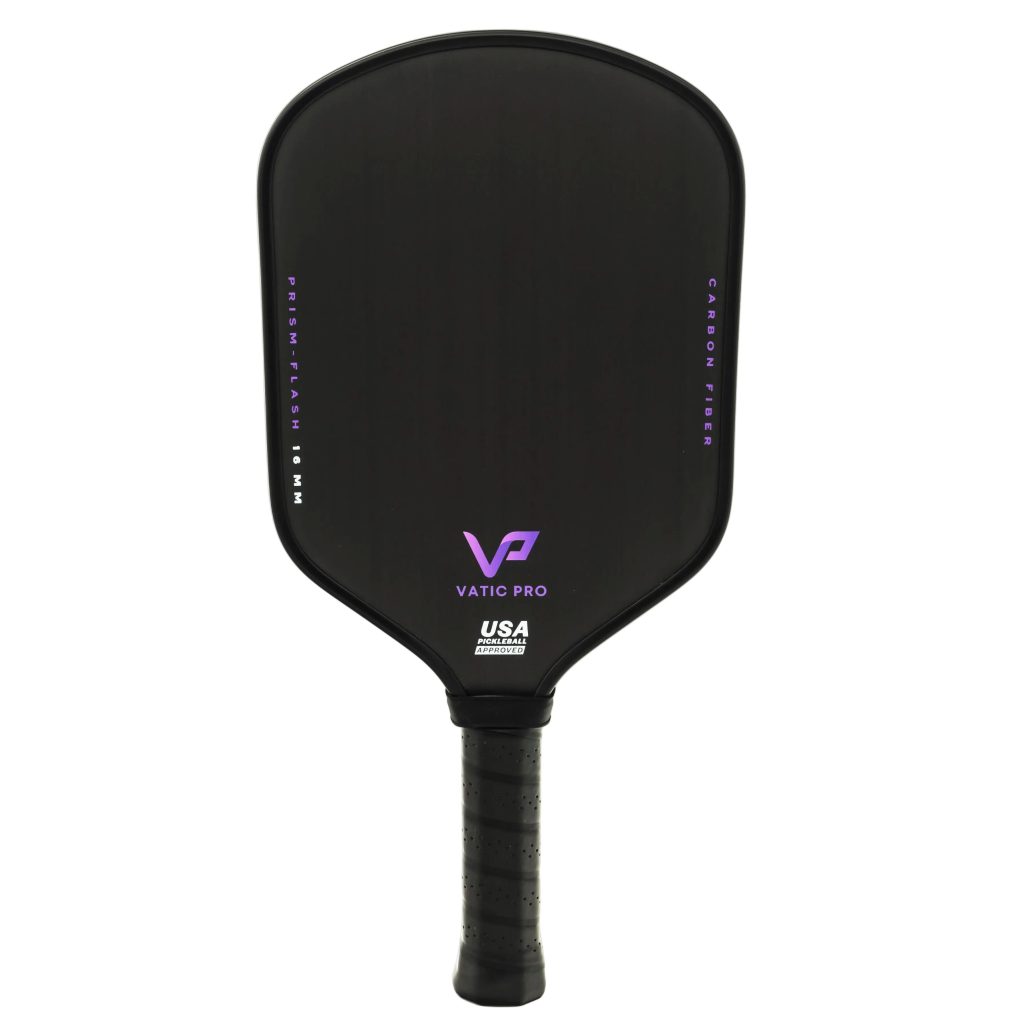
If the V-SOL Pro is this page’s idea of modern, the Prism Flash is its idea of calm, and calm wins a remarkable number of points.
The 16mm C7 polymer honeycomb core, its edge walls injected with foam, answers contact with a plush, settled strike: blocks absorb pace instead of returning it, resets drop low and stay low, and the third shot drop becomes a shot you aim rather than a shot you hope survives the net.
The numbers describe a control paddle that still plays a full game.
A swing weight of 114 gives it enough presence to hold its line against hard hitters, a twist weight of 6.47 keeps the hybrid face steady when contact strays, and spin around 1,900 RPM from the raw carbon face is honest working spin, enough to dip a drive and shape a roll volley.
The 5.3 inch handle and standard 4.25 inch grip fit the widest range of hands on this page, and at 7.9 to 8.2 ounces it asks little of your arm across a long session.
The trade is pace, and it is real. This is not the paddle that ends rallies from the baseline: putaways need your own swing and good court position, and against the foam and thermoformed power builds here it gives away outright pop.
Players who win by patience will call that a fair exchange. Players who win by force will feel the ceiling within a game.
Buy it if your points are built on resets, drops and placement. Skip it if you want a paddle that supplies its own finishing power.
3. Six Zero Quartz: Best Entry-Level Raw Carbon Pickleball Paddle in 2027
AT A GLANCE
Six Zero Quartz
WEIGHT
7.6-8.2 oz (avg 7.9 oz)
SWING WEIGHT
108
TWIST WEIGHT
6.4
SPIN
1,950 RPM
Shape: Standard, 16 x 7.9 in
Grip: 5 in handle, 4.25 in circumference
Core: 15mm polypropylene honeycomb
Face: Raw carbon fiber (T300)
Approval: USAP
Feel: Light control
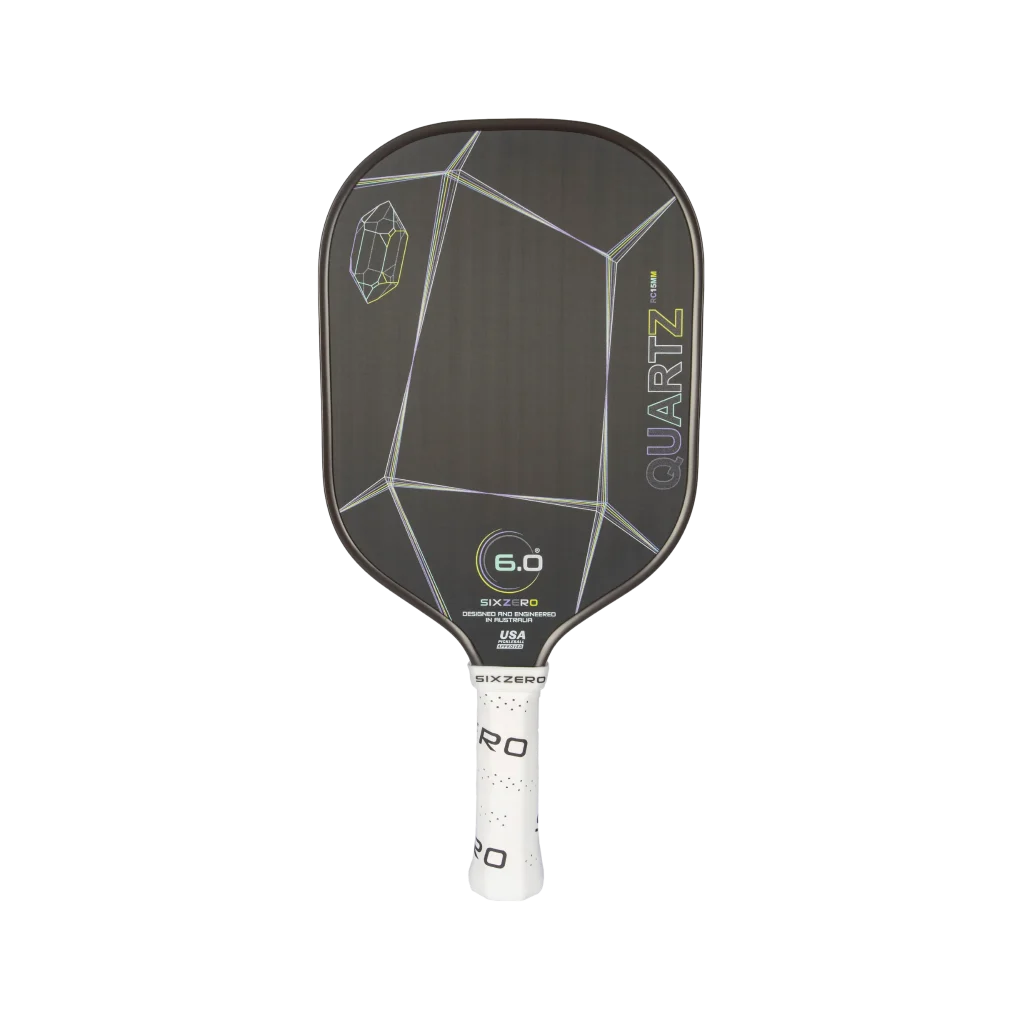
The honest way into raw carbon. The Quartz’s face is genuine raw carbon fiber, not a painted finish pretending to be one, which is the trap this tier of the market usually hides. The grade is stated plainly, here and in the box: T300, a softer, lower-modulus carbon than the T700 class most of this page’s carbon faces use.
Six Zero sells it openly as its Gem-series entry build, and I would rather print a true T300, plainly labelled, than a vague carbon headline that hopes you never ask which grade you bought.
In play it is light control.
The published line reads a 108 swing weight, a 6.4 twist weight and 1,950 RPM of spin, respectable figures for a standard-shape paddle averaging 7.9 ounces, and they matched what I felt across my sessions: counters arrive on time, drives dip enough to stay aggressive, and the 15mm honeycomb core gives contact a livelier, more informative edge than the thick control builds give.
The step down is real and should be named rather than smoothed over. T300 texture and stiffness sit below the T700 class, so the spin ceiling and the face’s bite start lower, and there are no foam walls or unibody claims here: it is a one-piece build with a real carbon face and honest numbers. Approval is USA Pickleball only.
Buy it if you want your first carbon face to be a real one, honestly graded. Skip it if you are chasing flagship texture and stiffness.
4. 11SIX24 Jelly Bean 16mm: Best for Beginners Pickleball Paddle in 2027
AT A GLANCE
11SIX24 Jelly Bean 16mm
WEIGHT
8.0-8.3 oz
SWING WEIGHT
107
TWIST WEIGHT
7.21
SPIN
2,103 RPM
Shape: Widebody (Pegasus), 16 x 8 in
Grip: 5.75 in handle, 4.125 in circumference
Core: 16mm polymer honeycomb, thermoformed
Face: CFC: two layers Toray T700 raw carbon fiber over one fiberglass layer
Approval: USAP
Feel: Soft forgiveness
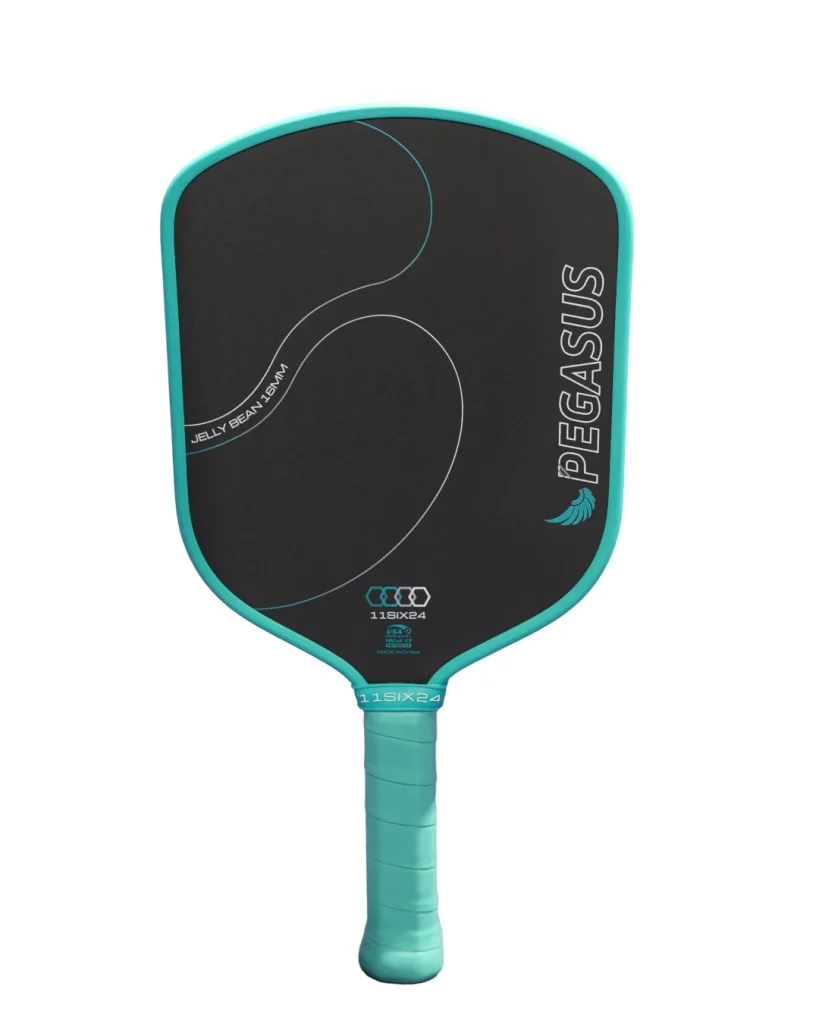
Every class has a paddle I hand to a newer player without a moment’s hesitation, and in this one it is the Jelly Bean. The reason sits in a single number: a twist weight of 7.21, one of the highest figures on this page.
Twist weight is the measure of how much a paddle resists turning in your hand when contact lands off center, and for a player whose contact point still wanders, that resistance is the difference between a block that holds its line and one that sprays into the net or the sky.
The rest of the build supports the same lesson.
The widebody Pegasus shape, a full 16 by 8 inches, gives a developing swing the biggest target here, the thermoformed honeycomb core keeps the response even across the face, and the CFC face, two layers of raw carbon over a fiberglass layer, grips the ball well enough for a measured 2,103 RPM.
That last figure matters for a learner: spin that arrives early teaches the shapes of the modern game while the strokes are still forming.
The limits are the widebody’s own. There is less reach than the elongated paddles here offer, so balls at full stretch stay a stretch, and at 8.0 to 8.3 ounces it is not the lightest paddle in the group, even if its low swing weight of 107 keeps it quick in the hand.
Advanced players chasing outright power will also find its ceiling sooner than the foam builds above it.
Buy it if you are learning and want the most forgiving face in this class. Skip it if reach and finishing power already lead your game.
5. Engage Pursuit Pro1 6.0 Elongated: Best for Touch Play Pickleball Paddle in 2027
AT A GLANCE
Engage Pursuit Pro1 6.0 Elongated
WEIGHT
8.0 oz
SWING WEIGHT
118.6
TWIST WEIGHT
5.95
SPIN
2,267 RPM
Shape: Elongated, 16.5 x 7.5 in
Grip: 5.875 in handle, 4.25 in circumference
Core: MachPro polymer with Variable Release 2.0
Face: Raw Toray T700 carbon fiber
Approval: USAP
Feel: Connected touch
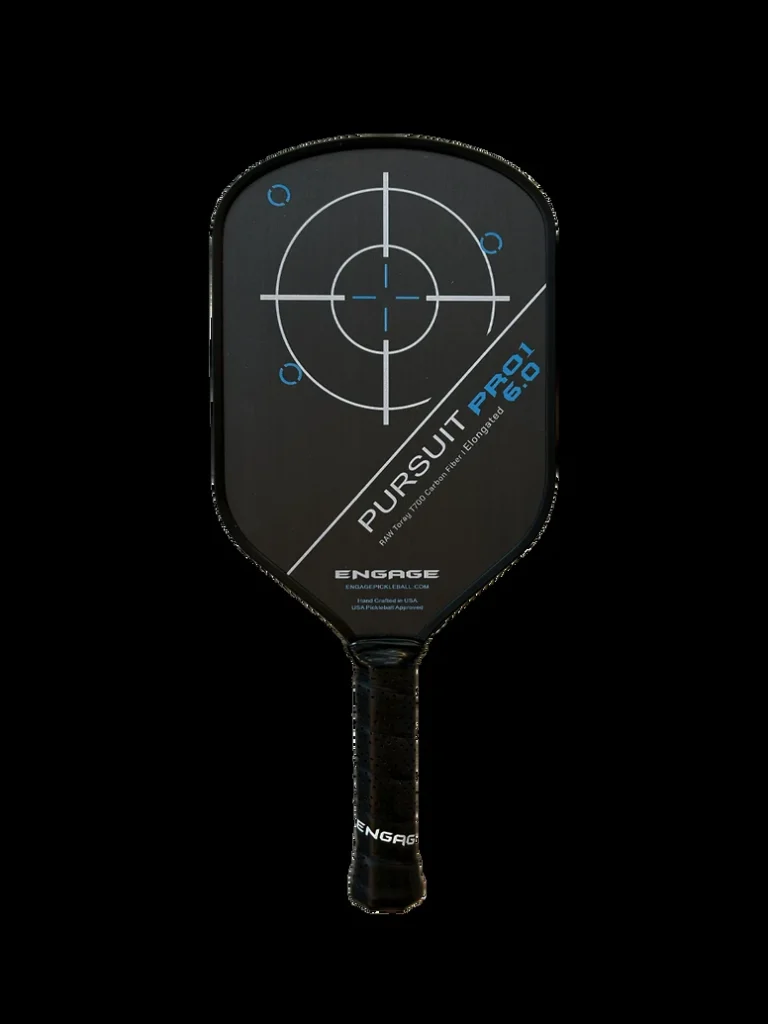
Some paddles mute contact; the Pursuit Pro1 reports it. Engage builds this elongated flagship around a raw Toray T700 face over its MachPro polymer core, and the strike is the most connected on this page: you feel exactly where on the face the ball landed and how it left, which is the information a touch game runs on.
Dinks stay on a string, drops land where the swing sent them, and the feedback never gets vague when the rally slows down and precision takes over.
The measured profile is a player’s profile. Spin at 2,267 RPM is the highest figure on this page, real shape on drives and serves, and the 5.875 inch handle is the longest here, giving two-handed backhands genuine room and one-handers extra leverage on rolls.
The elongated 16.5 by 7.5 inch frame reaches balls the widebodies make you lunge for, and at 8.0 ounces the static weight stays manageable across a long session.
The bill comes due in swing weight. At 118.6, the highest on this page, the head carries real momentum: late hands in a fast kitchen exchange get punished, and a twist weight of 5.95 means off-center contact turns the face more than the widebodies here allow.
One buying warning belongs in this section rather than a footnote: Engage’s Pursuit generations share names and listings, so confirm the exact Pro1 model before sanctioned play, because approval belongs to the precise paddle.
Buy it if your game is built on feel, placement and spin. Skip it if your hands are still learning to be on time at the kitchen.
6. Vatic Pro Saga Flash 16mm: Best All-Court Pickleball Paddle in 2027
AT A GLANCE
Vatic Pro Saga Flash 16mm
WEIGHT
8.0-8.3 oz (range across Saga shapes; Flash measured ~8.1 oz)
SWING WEIGHT
114-116 (brand-published)
TWIST WEIGHT
6.45 (brand-published)
SPIN
-
Shape: Hybrid (Flash), 16.3 x 7.7 in
Grip: 5.3 in handle, circumference -
Core: 16mm polypropylene honeycomb power core (10mm cells)
Face: Multi-layer composite with Toray T700 carbon top layer
Approval: USAP (most versions; verify variant)
Feel: Balanced all-court
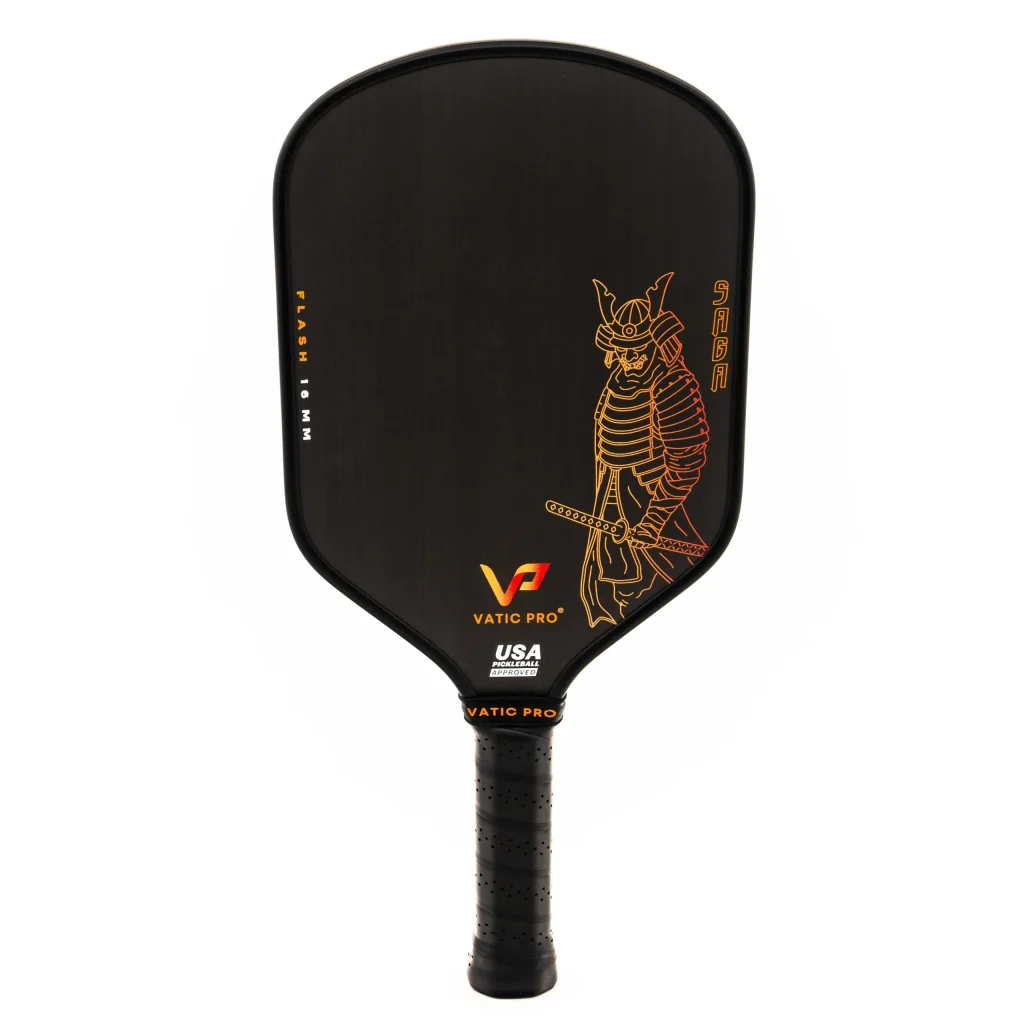
The Saga Flash is the livelier Vatic option, built for players who like the Prism shape but want a firmer push from the baseline.
Its power core and layered face give drives a cleaner launch, while the hybrid outline keeps enough width for blocks and counters. I can lean on a serve, step in behind it, then soften my hands for a fifth shot without feeling that I brought the wrong tool.
The balance is what earns it the all-court label. Published figures put swing weight at 114 to 116, so it carries useful plow-through without turning into a slow hammer.
Contact feels less muted than the Prism Flash and a little more direct at impact. That makes counters satisfying, though resets need slightly softer hands when the ball arrives with pace.
Two pieces of honesty belong here. Spin is not published in a figure I can stand behind, even though the carbon top layer gives the ball useful bite in play.
More importantly, most Saga versions appear on the USAP approved list, but one recent check could not find this exact 16mm standard-handle Flash by name, and other records leave its status unconfirmed. Treat the approval line as a variant check before sanctioned play, not a blanket promise.
Buy it if you want Vatic balance with a firmer all-court response. Skip it if you need approval certainty for a specific sanctioned event without checking the exact variant first.
7. 11SIX24 Pegasus Power 1 (Gen 3): Best Power Pickleball Paddle in 2027
AT A GLANCE
11SIX24 Pegasus Power 1 (Gen 3)
WEIGHT
8.0-8.3 oz
SWING WEIGHT
107
TWIST WEIGHT
7.21
SPIN
2,103 RPM
Shape: Widebody (Pegasus), 15.8 x 8.12 in
Grip: 4.125 in circumference, 5.75 in handle
Core: 16mm polypropylene honeycomb with EVA foam perimeter (Gen 3 thermoformed)
Face: CFC carbon/fiberglass/carbon
Approval: USAP
Feel: Stable power
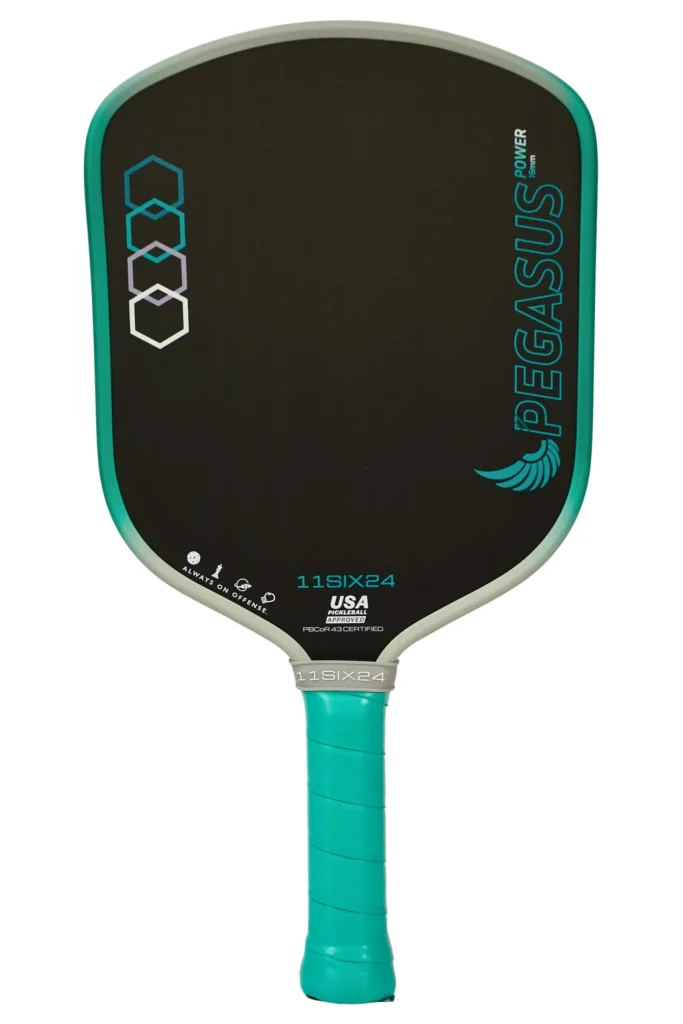
Start with the honesty this pick owes you: the Power 1 is the previous-generation line. 11SIX24’s current flagship is the Power 2, and the Power 1 stays in the catalogue beneath it.
I am putting it on this page anyway, because a previous generation from a serious maker, still sold new and still approved, is not the same thing as an old paddle, and on court this one plays like the modern power build it is.
The shape tells the story. The Pegasus widebody, 15.8 by 8.12 inches, pairs a twist weight of 7.21, one of the highest here, with a swing weight of only 107, and that combination is rare: a paddle that refuses to twist on off-center drives yet still comes around quickly in a hands battle.
The Gen 3 thermoformed core with its EVA foam perimeter supplies the pop, the CFC face (carbon, fiberglass, carbon) grips to a measured 2,103 RPM, and counters leave the face with a heavy, driving shape. The 5.75 inch handle gives two-handed backhands room, on a slim 4.125 inch grip.
The trades are reach and novelty. A widebody this short gives back the stretch balls the elongated paddles here collect, the slim grip will want an overgrip under a larger hand, and a player who simply wants the newest thing its maker sells should look at the current line instead. Judged on play rather than birthdays, it earns its place.
Buy it if you want stable, quick power on a widebody frame. Skip it if you need elongated reach or the current flagship generation.
8. Volair Mach 2 Forza 16mm: Best Widebody Pickleball Paddle in 2027
AT A GLANCE
Volair Mach 2 Forza 16mm
WEIGHT
8.0 oz avg (brand-published)
SWING WEIGHT
112 (brand-published)
TWIST WEIGHT
7.37 (brand-published)
SPIN
-
Shape: Widebody (patented), 15.88 x 8.12 in
Grip: 5.5 in handle, 4.15 in circumference (brand-published)
Core: 16mm polypropylene honeycomb with foam-injected walls, thermoformed unibody
Face: T700 carbon fiber
Approval: USAP
Feel: Plush control, very large sweet spot
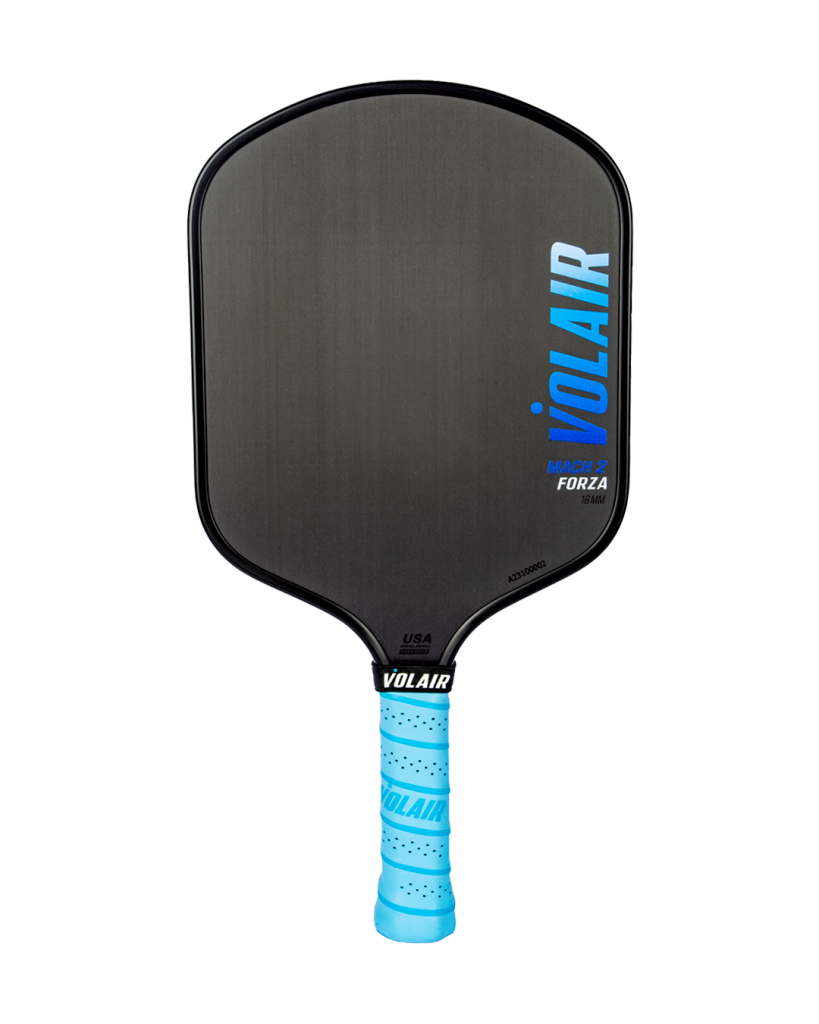
The Mach 2 Forza is built around a single idea, executed without apology: the sweet spot is the paddle. Volair’s patented widebody, 15.88 by 8.12 inches, is the broadest face here, and the twist weight on the brand’s own figures, 7.37, is the highest on this page.
In play that reads as calm: contact that lands toward the edges, the contact every player makes under pressure, comes back playable instead of twisting away, and blocks hold their line against pace that turns narrower paddles in the hand.
The feel matches the shape. The thermoformed unibody wraps a 16mm honeycomb core with foam-injected walls, and contact is plush rather than crisp: resets sit down, drops land soft, and the paddle absorbs the rally’s pace instead of reflecting it.
The T700 carbon face gives the strike its shape, the 5.5 inch handle is a genuine two-handed length, and the 4.15 inch grip sits a touch under standard, suiting a relaxed hold.
The honesty here is about evidence. Every figure in this box is Volair’s own, published on its product page and labelled as such, because no settled lab line exists for this paddle in the figures I can stand behind; spin reads Not published for the same reason, since reviewer figures circulate without a lab attribution I can verify.
The widebody also gives back some manoeuvrability in the fastest hands battles. None of that changes how it plays: as a stability-first widebody, it is the strongest answer here.
Buy it if off-center contact is where your rallies go to die. Skip it if you only trust lab-measured numbers or live on quick hands battles.
9. Friday Challenger 16mm: Best Elongated Pickleball Paddle in 2027
AT A GLANCE
Friday Challenger 16mm
WEIGHT
8.0 oz
SWING WEIGHT
122 (brand-published)
TWIST WEIGHT
6.38 (brand-published)
SPIN
1,890 RPM (brand-published)
Shape: Elongated, 16.5 x 7.5 in
Grip: 5.5 in handle, 4.25 in circumference
Core: 16mm polypropylene honeycomb, thermoformed with foam-injected walls
Face: Double-layer T700 raw carbon fiber
Approval: USAP
Feel: Firm power
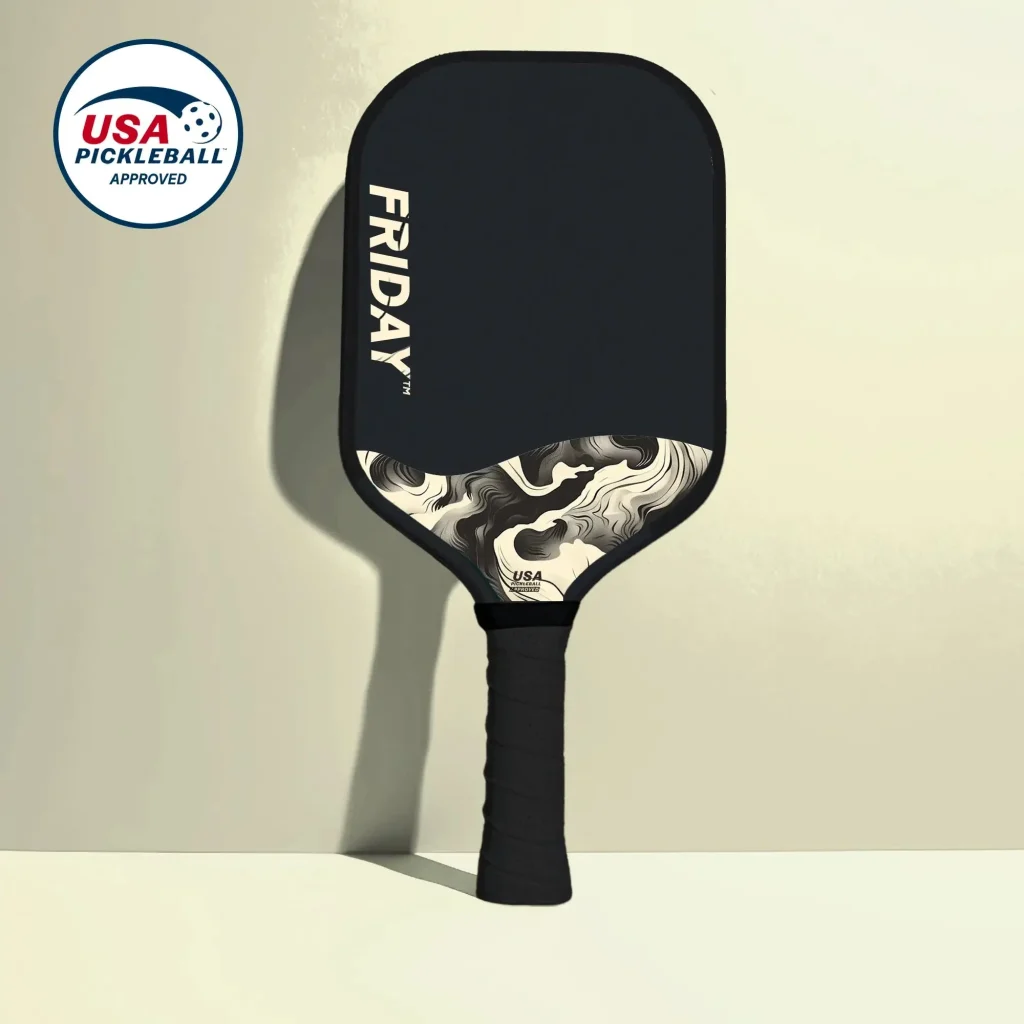
The Challenger is the heavy artillery of this page, and it does not pretend otherwise.
On Friday’s own published figures its swing weight is 122, the highest here by a clear margin, and you feel every point of it the way you are supposed to: drives leave with a heavy, dipping shape, overheads finish rallies, and balls at full stretch come back with interest because the elongated 16.5 by 7.5 inch frame got there with momentum behind it.
This is a paddle for players who hit through the ball.
The build is a driver’s build. The thermoformed honeycomb core has foam-injected walls, the face is a double layer of T700 raw carbon, and Friday publishes a spin figure of 1,890 RPM alongside a twist weight of 6.38, which keeps the long frame steadier on off-center contact than its swing weight might suggest.
The 5.5 inch handle gives a two-handed backhand honest room, and the standard 4.25 inch grip is the familiar hold.
Now the other side of a 122 swing weight. In a fast hands battle at the kitchen, this is the slowest paddle on the page to redirect, and the firm feel returns less of the softness the control picks here trade in; resets need early preparation and soft hands of your own.
The figures are also the brand’s own, published and labelled as such, not a lab’s. If your game is built from the baseline and the serve, none of that will trouble you.
Buy it if you play a driving game and want reach with real weight behind it. Skip it if your points are won in fast exchanges at the kitchen line.
10. Franklin Signature Pro 16mm: Best Durability Pickleball Paddle in 2027
AT A GLANCE
Franklin Signature Pro 16mm
WEIGHT
7.9-8.3 oz
SWING WEIGHT
116 (retailer-published)
TWIST WEIGHT
6.95 (retailer-published)
SPIN
-
Shape: Elongated, 16.5 x 7.3 in
Grip: 5.6 in handle, 4.5 in circumference
Core: 16mm polypropylene
Face: Fiberglass with MaxGrit surface
Approval: USAP
Feel: Solid power

The Signature Pro is the exception that tests this page’s taste in faces: the only fiberglass face in the ten, in a list otherwise built on carbon. It earns its place on a different strength.
Across seasons of heavy play, this model has built its name on holding together: the build shrugs off the schedule that wears lighter paddles smooth, and its MaxGrit surface keeps biting long after tamer textures have polished. For a player who plays daily and replaces paddles reluctantly, that staying power is the whole argument.
The shape and hold suit a particular player. The elongated frame, 16.5 by 7.3 inches, reaches and drives, the 5.6 inch handle is a genuine two-handed length, and the 4.5 inch grip circumference is the largest on this page, filling a bigger hand the way the slim grips here cannot.
On published retailer figures it carries a swing weight of 116 and a twist weight of 6.95, a stable, weighty profile, and Franklin publishes no spin figure for it, so the box shows a dash rather than guessing at one.
The caveats are about fit, not quality. A narrow elongated face forgives less than the widebodies here, so a developing contact point will wander off its edges more often.
The feel is firm rather than plush, and a fiberglass face, however well textured, does not match the raw carbon spin ceiling of the Vatic and Engage picks above it. Players with grooved strokes and big hands will find it the most honest workhorse here.
Buy it if you play often, hit hard and want a paddle that lasts. Skip it if forgiveness or a soft touch leads your game.
How to Choose the Best Pickleball Paddle Under $150 in 2027
What This Class Adds
Here is the honest baseline for the step up: construction and information. Full EPP foam cores appear, as in the V-SOL Pro. Gen 3 thermoforming wraps honeycomb cores in foam-injected walls and EVA perimeters, as in the Pegasus Power 1 and the Challenger.
Faces move to raw T700 carbon and layered carbon builds. And most makers in this class publish, or allow to be measured, the swing weight, twist weight and spin figures that the classes below mostly leave blank.
What that changes on court is specific rather than magical. Foam dwell softens the short game while keeping pop for counters. Thermoformed perimeters widen the working sweet spot. Woven and raw carbon faces hold their texture longer and grip harder.
None of it fixes footwork or shot selection, and a player whose contact point still wanders will get more from the forgiving widebodies here than from the fastest flagship shape. Choose the construction that answers your actual weakness.
Foam vs Polymer Honeycomb Cores
Foam first. A full EPP foam core, the V-SOL Pro’s build, holds the ball longer at contact: dwell rises, resets soften, and the strike feels dense rather than hollow. Foam plays a touch firm when new and settles over its first sessions, a break-in behaviour honeycomb does not have.
The open question with foam-enhanced builds is long-term: hard use can soften or crush foam structures over time in ways a plain honeycomb grid resists, which is why the honest brands discuss it and the honest buyer weighs how hard they play.
Polymer honeycomb is the known quantity: a grid of hexagonal cells, consistent from the first session to the last, with a response you can predict blindfolded.
The middle path dominates this page: honeycomb cores with foam-injected walls and foam perimeters, which borrow some of foam’s dwell and perimeter stability while keeping the honeycomb spine. The Prism Flash, Pegasus Power 1 and Forza all live on that middle path, and for most players it is the right place to live.
Face Materials at This Level
Raw carbon is the default face of this class, and the T700 class of it appears on the Vatic pair, the Pro1, the Forza and the Challenger.
A raw unidirectional face grips through its peel-ply texture: it bites the ball hard, shapes drives and rolls, and wears by that same texture gradually smoothing with heavy play. It is the spin face, and the connected, direct strike touch players describe comes from it.
Layered carbon answers in a third way. The Saga Flash lays a T700 carbon top layer over supporting layers, and the strike comes back balanced rather than purely raw: bite from the carbon surface, with a slightly softer, more forgiving release than a single raw layup gives.
Spin arrives through that top layer’s texture, and the layered build is how several makers tune feel without giving up carbon’s grip.
Approval, Stated Plainly
Approval decides where a paddle may play, and the two systems are not interchangeable. USAP approval is the list that sanctioned leagues, clubs and tournaments under USA Pickleball work from: if your paddle’s exact model and variant appear there, it is legal for that play.
UPA-A certification belongs to the professional tour side of the sport, the PPA and MLP game, and a paddle certified only under UPA-A is not thereby legal for USAP sanctioned events.
That is why every pick on this page carries USAP approval, and why the exact variant is the unit that matters. Approval belongs to a specific paddle, not to a brand and not to a family name: a redesigned model, a different thickness or a sibling shape is a separate entry.
Before any sanctioned event, check your precise model name against the approved list. It takes a minute and it removes the only equipment surprise check-in can hold.
Shape, Swing Weight and Twist Weight
Three shapes divide this page. Widebodies (the Jelly Bean, Pegasus Power 1 and Forza) trade reach for the widest faces and the highest twist weights here, 7.21 to 7.37: off-center contact stays playable, which is why learners and blockers love them.
Elongated paddles (the Pro1, Challenger and Signature Pro) add reach and leverage, paid for in swing weight. Hybrids (the V-SOL Pro, Prism Flash and Saga Flash) split the difference and suit players who refuse to declare a shape allegiance.
Read the two weight numbers together. Swing weight is the effort of swinging: this page runs from 107 on the widebodies to 122 on the Challenger, and the higher figures drive through the ball while asking more of your timing at the kitchen.
Twist weight is stability at contact: above roughly 6.4, a paddle resists turning on mishits. Grip completes the fit: circumferences here run from 4.125 to 4.5 inches, and handles from 4.85 to 5.875 inches, the long ones giving two-handed backhands their room.
The Upgrade Path
Above this class sits the flagship tier, and honesty about it helps rather than hurts this page. What the flagship step actually buys is dual approval under both systems, the deepest published lab lines in the sport, pro-signature builds tuned around named players, and the newest materials generations a season before they arrive here.
It does not buy a different sport, and for most league and open-play players a paddle from this page stays competitive for years.
A paddle in this class fades rather than dies: face texture smooths until drives stop dipping, foam perimeters soften, an edge guard cracks or lifts. Those are the honest replacement signals.
The upgrade signal is your own game: when a specific, nameable limitation, resets popping up, drives lacking shape, blocks folding against heavy hitters, keeps costing points against stronger opposition, the flagship tier has an answer built for exactly that limitation.
Move up when you can name what you are removing, and stay while the paddle in your hand is still answering.
Frequently Asked Questions (FAQs)
1. What is the best pickleball paddle in this class overall?
The Vatic Pro V-SOL Pro 16mm. Its full EPP foam core gives it the most modern strike on this page: dwell for the soft game, pop for counters, and a measured profile, swing weight 108, twist weight 6.43, spin 2,060 RPM, that no other pick here matches for balance.
It plays a complete all-court game at a quick swing weight, and it carries USAP approval for sanctioned play. The Prism Flash runs it closest for players who prefer a settled honeycomb feel.
2. Is a paddle in this class good enough for league and tournament play?
Yes. Every pick on this page carries USAP approval, which is what sanctioned leagues and tournaments require, and the construction in this class, foam cores, thermoformed unibodies, raw and woven carbon faces, is the same construction the level above is built from.
Approval belongs to the exact model and variant, so confirm your precise paddle name appears on the approved list before you travel to a formal event, and there will be no surprises at check-in.
3. Foam core or polymer honeycomb: which should I choose?
Choose foam for dwell and honeycomb for predictability. A full foam core, like the V-SOL Pro’s, holds the ball longer at contact, softening resets and adding pop to counters, and it plays a touch firm until it breaks in.
A polymer honeycomb core answers the same way in its first session and its fiftieth, which many players find easier to trust. The middle path, honeycomb with foam-injected walls, as in the Prism Flash and Forza, borrows some of foam’s stability and dwell while keeping the honeycomb spine, and it suits most players best.
4. What is the difference between USAP and UPA-A approval?
USAP approval is USA Pickleball’s list, the one sanctioned leagues, clubs and tournaments work from. UPA-A certification belongs to the professional tour side of the sport, the PPA and MLP game.
The two are separate systems: a paddle certified only under UPA-A is not legal for USAP sanctioned events, and a USAP-approved paddle is not automatically certified for the pro tour. Every pick on this page is USAP approved, and approval always belongs to the exact model and variant, never to a brand as a whole.
5. Raw carbon or layered carbon face: does it actually matter?
Yes, in feel more than in figures. A raw carbon face, the T700 class on most of this page, grips through its peel-ply texture and strikes direct and connected, which suits spin and touch players.
A layered carbon face, like the Saga Flash’s T700 top layer over its supporting layers, strikes a touch softer and more forgiving, with bite that comes from the carbon surface rather than a single raw layup.
Both generate real spin and both wear by their texture smoothing over time. Choose raw for maximum bite and feedback, layered for balance.
6. Which shape is best: widebody, hybrid, or elongated?
It depends on where your points are won. Widebody paddles, the Jelly Bean, Pegasus Power 1 and Forza here, offer the widest faces and the highest twist weights, so off-center contact stays playable; they suit blockers, learners and hands players.
Elongated paddles, the Pro1, Challenger and Signature Pro, add reach and driving leverage at a higher swing weight. Hybrid shapes, the Vatic picks, split the difference and fit players who move between the baseline and the kitchen all match long.
7. How much spin can I honestly expect from a paddle in this class?
Real, working spin, a clear step above the classes below. On the paddles here that labs have measured, spin runs from about 1,900 RPM on the Prism Flash to 2,267 RPM on the Pursuit Pro1, with most of the list between 2,000 and 2,100. That is enough to dip drives below the tape, shape roll volleys and bend serves.
Two honest caveats: a lab figure is a measurement on one rig, not a certification result, and technique still decides most of the outcome. Brush up the back of the ball and these faces will bend it; swing flat and no face will save the shot.
8. How long will the face grit last before it fades?
Expect the texture to do its best work across the first season or so of regular play, then fade gradually rather than fail at once. Raw carbon’s peel-ply texture smooths microscopically with every contact, so drives dip a little less month by month; applied and woven surfaces wear on their own timelines.
Two simple checks tell you where yours stands: drag a fingernail across the face and feel for bite, and see whether a ball still grabs when you roll it over the surface.
Clean the face with a paddle eraser to remove ball residue before judging it, because a dirty face feels smoother than a worn one. When the texture has genuinely gone, that is the honest replacement signal.
9. Is a previous-generation flagship better than a current mid-tier paddle?
Sometimes, and this page carries the proof in both directions. The Pegasus Power 1 is a previous-generation line that still outsplays most current paddles at its level, because its thermoformed build and measured profile remain modern.
But generation gaps in this sport are real: cores, faces and approvals all move, and an older flagship can carry a superseded construction or an approval entry that no longer matches the paddle being sold. Judge the exact model on its build and its current listing, not on the flag it once flew.
10. What swing weight and twist weight should I look for?
Start from the middle of this page’s range and adjust by feel. Swing weights here run from 107 to 122: figures up to about 113 keep the paddle quick for hands battles and developing timing, while higher figures add plow-through on drives and demand earlier preparation.
Twist weight is stability at contact: above roughly 6.4, mishits stop turning the paddle in your hand, and the widebodies here reach 7.21 to 7.37. If your blocks spray, chase twist weight. If your counters arrive late, chase a lower swing weight.
11. Can a beginner start with a paddle in this class?
Yes, and one pick here is built for exactly that reader. The Jelly Bean pairs one of the highest twist weights on the page with a widebody face and a soft, forgiving strike, so a new player’s contact point gets margin while their strokes form, and its measured spin teaches modern shapes early.
The wider lesson holds across the class: a beginner is not held back by a well-chosen paddle at this level, because footwork, positioning and consistent contact decide a new player’s points, and a forgiving, approved paddle supports all three.
12. When does it make sense to move up to a flagship paddle?
Move up when you can name the specific limitation you want removed. The flagship tier buys dual approval under both systems, the deepest published lab lines in the sport, pro-signature builds and the newest materials a season early.
It makes sense when your game has grooved to the point that one of those things answers a real, recurring problem: a tour schedule that needs the second approval, a weakness a flagship shape addresses, or a face worn smooth on the paddle you own. Until one of those signals shows up, a paddle from this class is not holding you back.

Michael Stevenson
Hi, my name is Michael Stevenson and I’m a passionate pickleball player. I’ve been playing the game for many years and I’m pretty highly skilled at it. Pickleball is one of my favorite topics so naturally, I love to write about it.
Whether it’s tips for beginners, guides for experts, reviews of new paddles, or advanced playing techniques – if it relates to pickleball then I have something interesting to write about it. So if you’re looking for entertaining and informative information on the topic of pickleball, look no further than my written works!