
The rally had gone past fifteen shots, and nobody on the court was winning it. We were trading soft balls at the kitchen, waiting for the other side to pop one up, and the ball kept coming back low and quiet.
Then my partner sped one up at my body, and I had half a second to decide. I blocked it, it stayed down, and the rally went on. That is the whole test for a CRBN paddle, and it is the test this list is built on. CRBN does not build paddles that feel like other paddles.
It builds a solid foam core instead of a honeycomb grid, and that one choice changes everything: the feel, the sound, the durability, and the way the ball leaves the face. Some players love it from the first hit.
Some players never get used to it. This list sorts the ten current CRBN paddles by what each one actually does, so you can find the one that fits your game instead of buying the brand’s most famous name and hoping.
The short answer is this. The CRBN TruFoam Genesis 3 is the best CRBN paddle for most players, because it pairs the highest measured spin on this site with a soft, pocketed feel and a core that never goes soft.
The CRBN TruFoam Barrage 4 is the best CRBN for power, because it takes the same foam platform and tunes it for pop, so counters jump off the face. The rest of this list fills in the shapes around those two: the quick hybrid, the widebody, the long handle, and the value tier that costs a lot less than the flagship.
The 10 Best CRBN Pickleball Paddles in 2027
- CRBN TruFoam Genesis 3 14mm
- CRBN TruFoam Barrage 4 14mm
- CRBN TruFoam Genesis 4 14mm
- CRBN TruFoam Barrage 2 14mm
- CRBN TruFoam Genesis 2 14mm
- CRBN TruFoam Genesis 1 14mm
- CRBN 1X 16mm
- CRBN 3X 16mm
- CRBN 2X 14mm
- CRBN 2X 16mm
1. CRBN TruFoam Genesis 3 14mm: Best Overall CRBN Pickleball Paddle in 2027
AT A GLANCE
CRBN TruFoam Genesis 3 14mm
WEIGHT
7.9-8.3 oz
SWING WEIGHT
119
TWIST WEIGHT
6.21
SPIN
2,401 RPM
Shape: Elongated hybrid, 16.5 x 7.5 in
Grip: 5.25 in handle, 4.125 in circumference
Core: Full TruFoam foam, 14mm
Face: T700 raw carbon fiber with fiberglass backing layer
Approval: USAP and UPA-A
Feel: Soft dwell
Warranty: 1-year limited (registration required)
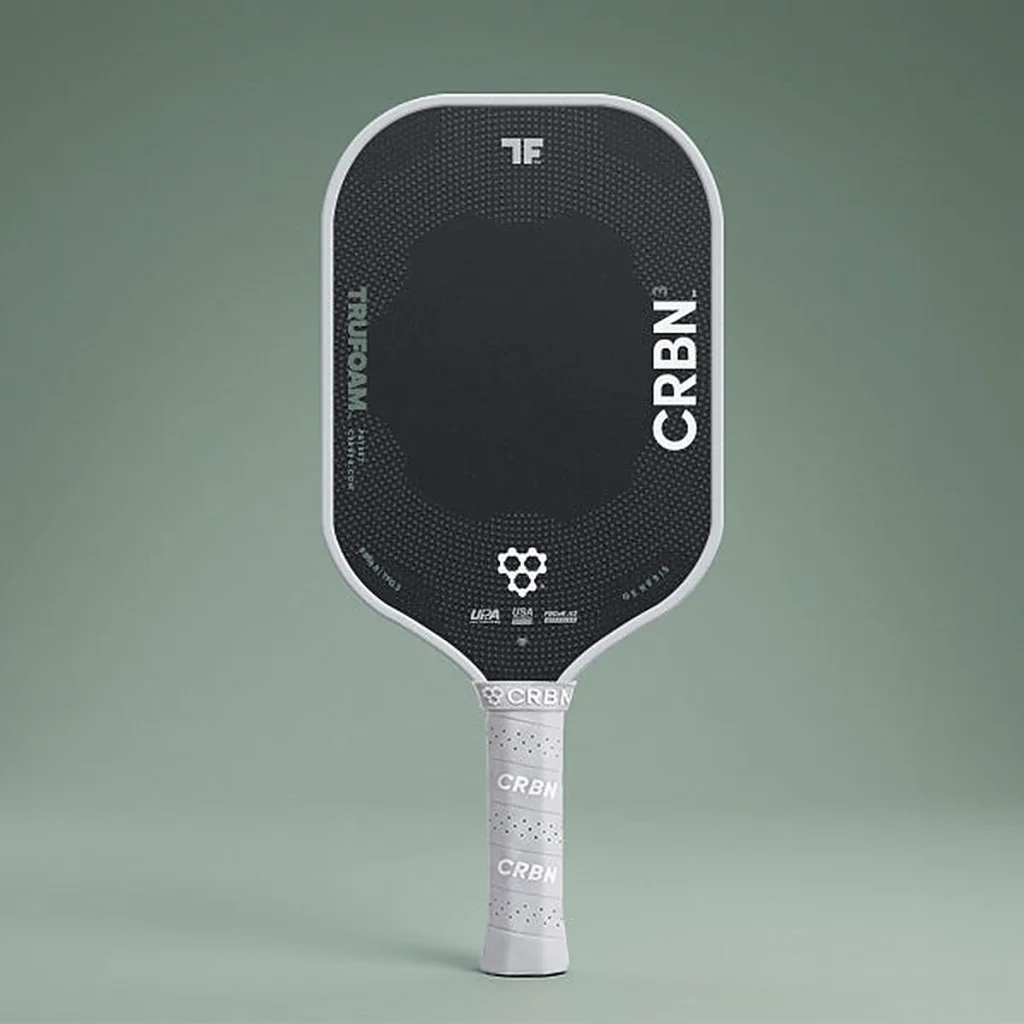
The TruFoam Genesis 3 is the best CRBN paddle because it solves the problem every other spin paddle on this list still has. Its core is solid foam all the way through, with no honeycomb anywhere inside, so the ball sinks into the face and stays there a fraction longer than on any other paddle I have tested.
That extra time is called dwell. Dwell is what lets you brush a serve and watch it kick, and it is what lets you shape a drive instead of just hitting it. The face grips at 2,401 RPM, the highest measured spin figure on this site, and it does it without the harsh, hollow crack of a stiff honeycomb paddle.
On court the feel matches the engineering. Drops and resets feel easy and reliable, because the foam swallows pace instead of returning it. Serves kick off the bounce, roll volleys bite and drop, and drives dive late.
The core has no honeycomb cells to crush and nothing to delaminate, so the response stays the same over time. One long test found zero drop-off from the first session to the most recent after more than twenty hours of play.
The honest costs come with it. The swing weight of 119 is the heaviest swing on this site’s spin page, so my hands were not as quick at the kitchen as the 14mm label promises. Drives need a full, committed swing, because the foam will not supply pace for you.
The fiberglass layer under the face can launch early resets high until your grip softens, and the launch angle runs higher than a normal 14mm, so resets and drops need a soft hand. The sweet spot is average, not a strength. And the raw carbon texture is a wear surface, so the bite is strongest early and softens over months of play.
Buy it if spin, dwell, and a softer connected feel are how you win points. Skip it if you want the paddle to create pace for you, or if your game is built on lightning hands at the net. Read the full test in my CRBN TruFoam Genesis review.
If foam is the draw, the best foam core pickleball paddles list shows where these picks sit against the rest of the foam field, and the best pickleball paddles for spin list ranks them on spin alone.
2. CRBN TruFoam Barrage 4 14mm: Best Power CRBN Pickleball Paddle in 2027
AT A GLANCE
CRBN TruFoam Barrage 4 14mm
WEIGHT
8.0 oz ± 0.2
SWING WEIGHT
112
TWIST WEIGHT
6.66
SPIN
2,091 RPM
Shape: Hybrid AeroCurve, 16.2 x 7.8 in
Grip: 5.5 in handle, 4.125 in circumference
Core: 14mm TruFoam Floating Core, 100% foam with EVA perimeter ring
Face: T700 raw carbon fiber
Approval: USAP and UPA-A
Feel: Poppy power
Warranty: 1 year, registered
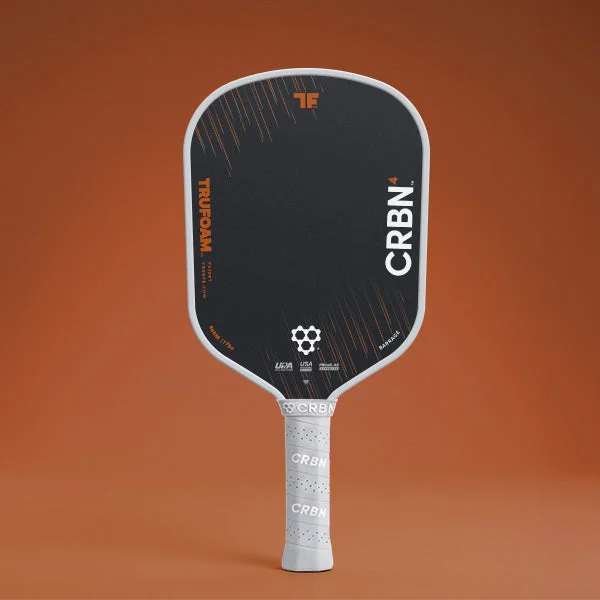
The TruFoam Barrage 4 is the poppiest CRBN, and it is the paddle I hand to a player who already loves the Genesis and wants more of it. The core is still 100 percent TruFoam, a floating foam build with a foam ring around the edge, but the firmer tune changes the first impression completely.
Contact is immediate, the ball leaves with pace you did not have to manufacture, and counters that I used to block became counters I could aim at feet.
The measured line backs the feel: a swing weight of 112 keeps the head quick in kitchen exchanges, a twist weight of 6.66 keeps stretched blocks square, and spin at 2,091 RPM is real working spin, enough to keep aggressive drives dipping inside the baseline.
The firepower figure tells the same story. One lab measured it at 71, the most firepower in the whole CRBN range, and a hands-on review scored it 9.5 out of 10 for power and spin. The hybrid shape has the better sweet spot of the two Barrage shapes, and the 112 swing weight is the quickest of the power paddles on this list.
The honest limits are the power limits. The Barrage 4 is a pop-first paddle, so a tense hand on a reset will pay for it. The raw carbon face will soften with hours played like every raw carbon face in this class.
One hands-on test found it felt light and twisty until lead tape was added. And its long-season record is shorter than the Genesis has earned, because it is the newest line CRBN makes.
Buy it if your points are won on tempo, counters and speed-ups, and you want the poppiest version of the TruFoam platform. Skip it if your soft game is a project and you want the calmest reset in the class. The Genesis 3 above is the calmer teacher.
If carbon is the draw, the best carbon fiber pickleball paddle list shows where the Barrage 4 sits against the rest of the carbon field.
3. CRBN TruFoam Genesis 4 14mm: Best All-Court CRBN Pickleball Paddle in 2027
AT A GLANCE
CRBN TruFoam Genesis 4 14mm
WEIGHT
8.1 oz ± 0.2
SWING WEIGHT
107
TWIST WEIGHT
6.25
SPIN
2,315 RPM
Shape: Hybrid AeroCurve, 16.2 x 7.8 in
Grip: 5.5 in handle, 4.125 in circumference
Core: Full TruFoam foam, 14mm
Face: T700 raw carbon fiber with fiberglass layer
Approval: USAP and UPA-A
Feel: Fast all-court
Warranty: 1 year, registered
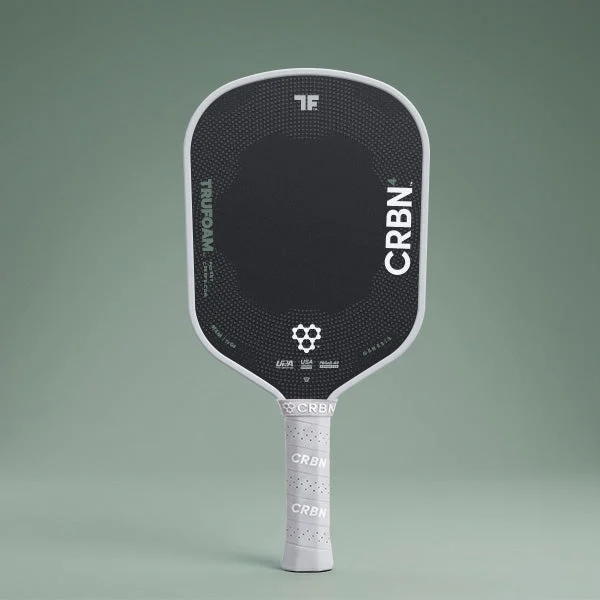
The TruFoam Genesis 4 is the quickest swinging Genesis, and it is the Genesis I hand to a player who wants the foam feel with fast hands. Its swing weight is 107, the lowest CRBN publishes in the family, and only a few hybrids I have tested swing lighter.
The shape is the same hybrid as the Barrage 4, but the tune is all-court instead of power: soft enough for the kitchen, quick enough for firefights, and playable straight out of the box. One hands-on review calls it the most well-rounded and playable of the Genesis shapes.
What sets it apart is balance. Spin measures 2,315 RPM, the second highest in the Genesis family, and most of that spin comes from dwell, the ball sitting on the soft foam core a little longer before it leaves, rather than from the grit on the face.
The face is raw carbon with a peel ply finish, which leaves a little cloth texture pressed into the carbon, but it still feels smooth. So the spin survives longer than on a grit-only paddle, because the core does the work.
The honest costs are power and control. It does not hit very hard for a hybrid, so do not count on your drives to finish points. Control is one of its weaker spots too, so resets can sit up on you. It is less stable on off-center hits than the widebody sibling, and the sweet spot is tighter than some of its top-tier rivals.
The grip gets sweaty after a few games. And one hands-on review would not recommend it to newer players. For most buyers, the Barrage 4 in the same shape hits a lot harder and costs the same, so that is the one to compare it against before you buy.
Buy it if you want a light swing and a softer feel than the Barrage, with the foam dwell intact. Buy the Barrage 4 instead if you want the same shape with real pop. One buying note: the brand’s own site showed this model sold out when I checked, so confirm the listing before you buy.
If all-court play is the draw, the best pickleball paddles for advanced players list shows where the Genesis 4 sits against the rest of the advanced field.
4. CRBN TruFoam Barrage 2 14mm: Best Stability CRBN Pickleball Paddle in 2027
AT A GLANCE
CRBN TruFoam Barrage 2 14mm
WEIGHT
8.0 oz ± 0.2
SWING WEIGHT
110
TWIST WEIGHT
6.90
SPIN
2,084 RPM
Shape: Square widebody, 16 x 7.85 in
Grip: 5.5 in handle, 4.125 in circumference
Core: 14mm TruFoam Floating Core, 100% foam with EVA perimeter ring
Face: T700 raw carbon fiber
Approval: USAP and UPA-A
Feel: Dense pop
Warranty: 1 year, registered
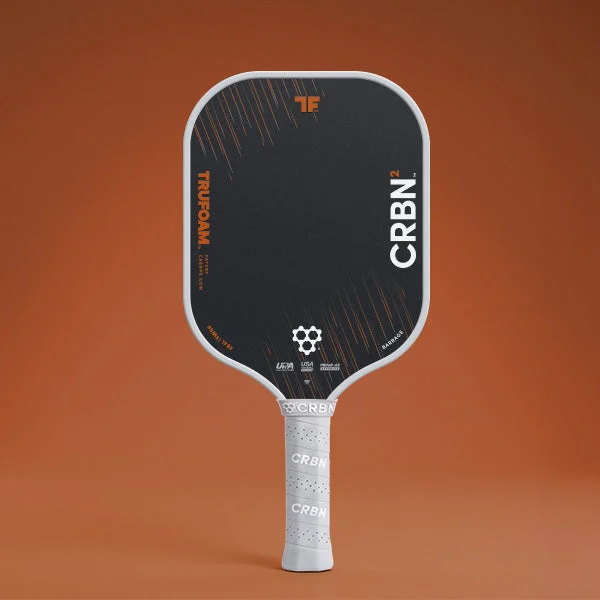
The TruFoam Barrage 2 is the most stable CRBN, and it is the Barrage I hand to a player who blocks and resets at the kitchen and wants a wide face. Its twist weight is 6.90, the highest on this list, and the widebody shape gives it the biggest, calmest face in the Barrage line.
The pop is still there: only about one paddle in six tested hits harder, and counters and punch volleys come back fast. It comes with a dense, solid feel instead of the stiff, hollow one so many power paddles have right now.
The ranking logic is simple. Next to the Barrage 4, the widebody has a bit bigger sweet spot and a bit more control, and it hits about as hard.
The swing weight is 110, so it moves easily, and the comfort score in one lab’s testing sits high enough that long sessions leave the arm fresher than stiff honeycomb builds do. For most players, this is the Barrage to buy first.
The honest limits are the widebody limits. The sweet spot is about average for a widebody and drops off toward the edges, so when you catch a reset off center, it comes off weaker than you would expect. The face is plain raw carbon with no durable grit, so the spin fades the more you play it.
One lab’s wear tracking found raw carbon faces lose about 14 to 18 percent of their spin over 100 games, while embedded-grit faces lose only about 1 to 2 percent over the same stretch. After a hundred or so games, this paddle will not spin like it did out of the box.
Buy it if you spend your points at the kitchen line and want a wide foam paddle with real pop. Skip it if you lean on spin and want it to last, because the face will want replacing sooner than a grit-built face would.
5. CRBN TruFoam Genesis 2 14mm: Best Control CRBN Pickleball Paddle in 2027
AT A GLANCE
CRBN TruFoam Genesis 2 14mm
WEIGHT
8.1 oz ± 0.2
SWING WEIGHT
113
TWIST WEIGHT
6.70
SPIN
1,992 RPM
Shape: Square widebody, 16 x 7.85 in
Grip: 5.25 in handle, 4.125 in circumference
Core: Full TruFoam foam, 14mm
Face: T700 raw carbon fiber with fiberglass layer
Approval: USAP and UPA-A
Feel: Stable all-court
Warranty: 1 year, registered
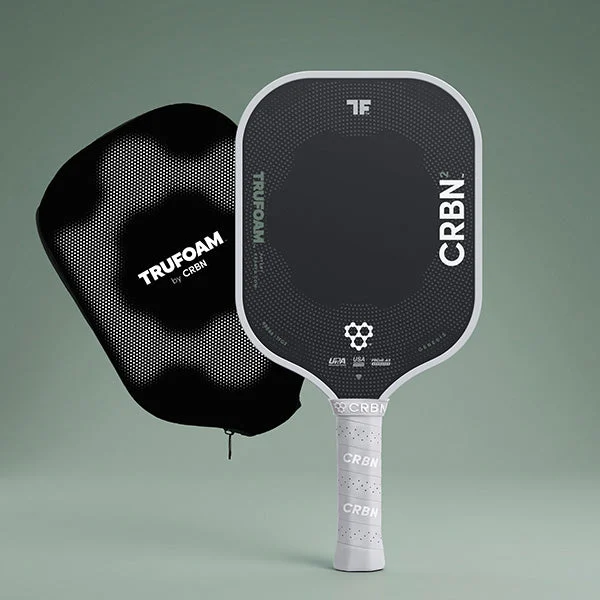
The TruFoam Genesis 2 is the best shape in the Genesis line, and it is the Genesis I hand to a player who wants the foam feel with the most forgiveness attached. The numbers explain why: the swing weight drops to 113, the twist weight climbs to 6.70, and suddenly the dwell and spin come with quick hands and a forgiving face attached.
The lab that measured all four Genesis shapes calls the widebody the best shape in the series because of its stability, which the rest of the line struggles with.
On court, the control half is the foam. The ball sinks in, holds, and leaves with shape. The power half hides in the face layup: raw carbon over a fiberglass layer, which adds a lively kick on counters and speed-ups that pure foam paddles usually make you swing harder for.
Spin measured around 1,992 RPM is plenty to keep aggressive drives diving inside the baseline.
The honest costs are power and spin ceiling. It still is not a free power paddle. Baseline drives need a committed swing, and that fiberglass liveliness surprised me early, launching a few resets higher than I meant before my grip learned to soften.
The spin is the lowest in the Genesis family, and the grit durability is the lowest tier in one lab’s rating, so the bite is strongest early.
Buy it if you want foam control with a counterpunch built in. Skip it if you want the paddle to supply baseline pace for you. One naming note: this paddle is called the Genesis 2 on the site’s other pages, but the 2 is a shape number, not a second generation. It is the square widebody of the original Genesis family.
If control is the draw, the best pickleball paddles for control list shows where the Genesis 2 sits against the rest of the control field.
6. CRBN TruFoam Genesis 1 14mm: Best Reach CRBN Pickleball Paddle in 2027
AT A GLANCE
CRBN TruFoam Genesis 1 14mm
WEIGHT
8.0 oz ± 0.2
SWING WEIGHT
118
TWIST WEIGHT
5.51
SPIN
2,036 RPM
Shape: Elongated long handle, 16.5 x 7.35 in
Grip: 5.5 in handle, 4.125 in circumference
Core: Full TruFoam foam, 14mm
Face: T700 raw carbon fiber with fiberglass layer
Approval: USAP and UPA-A
Feel: Reach spin
Warranty: 1 year, registered
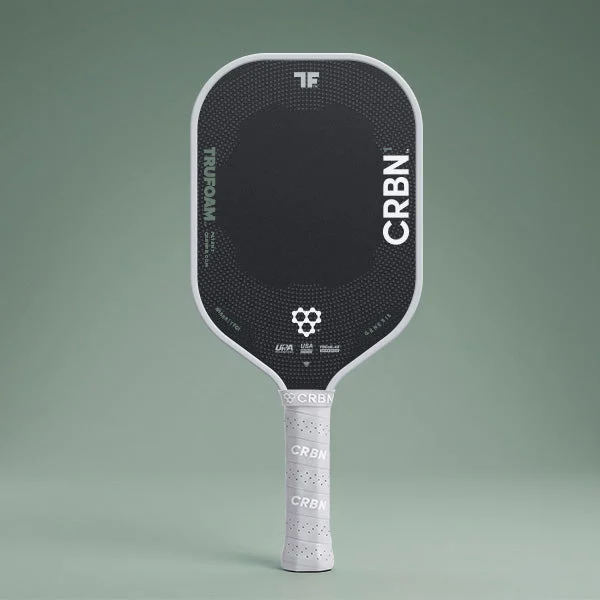
The TruFoam Genesis 1 is the longest handle CRBN makes, and it is the Genesis I hand to a two-handed backhand player. The handle is 5.5 inches, the face is 16.5 inches long and 7.35 inches wide, and the shape adds reach and leverage for power and serves while keeping the raw carbon face’s signature spin.
One lab measured it at 2,036 RPM, the highest spin of the Genesis series on its rig, and a second lab measured 2,151 RPM on its sample.
The feel is the same full-foam dwell as the rest of the family, with more leverage attached. Serves carry, drives dip, and the long handle leaves room for a second hand on the backhand without crowding the fingers. It is the elongated Genesis for players who want spin plus reach.
The honest costs are forgiveness and hand speed. The twist weight of 5.51 is the lowest in the family, low even by elongated standards, so it is not a forgiving paddle.
The sweet spot is small, and stretched contact punishes you. The 118 swing weight is slow in fast kitchen exchanges, and elongated shapes need more head speed to get the same power as the widebody.
Buy it if you play with two hands on the backhand and want the longest reach in the Genesis line. Skip it if your contact wanders, because the low twist weight will show it on every mishit.
7. CRBN 1X 16mm: Best Value Power CRBN Pickleball Paddle in 2027
AT A GLANCE
CRBN 1X 16mm
WEIGHT
7.8-8.1 oz
SWING WEIGHT
124
TWIST WEIGHT
6.18
SPIN
1,720 RPM
Shape: Elongated, 16.5 x 7.5 in
Grip: 5.5 in handle, 4.25 in circumference
Core: 16mm polypropylene honeycomb with foam-injected edge walls, unibody
Face: T700 raw carbon fiber
Approval: USAP
Feel: Stiff power
Warranty: 1 year, registered
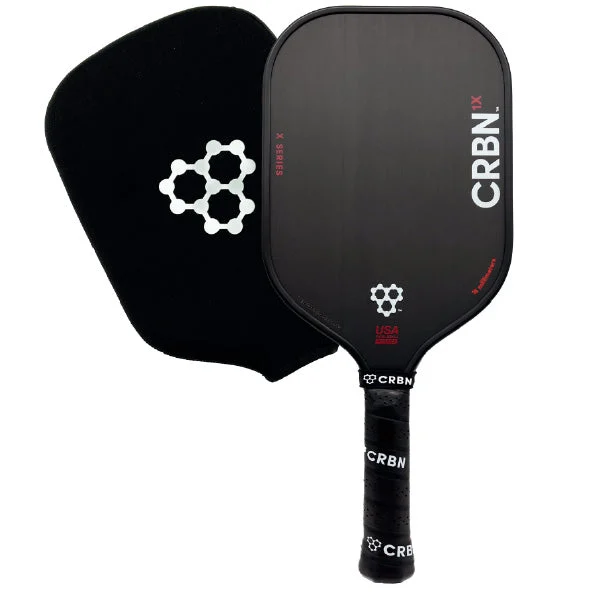
The CRBN 1X 16mm is the hardest-hitting CRBN in the value tier, and it is the paddle I hand to a player who wants raw carbon pace without the flagship core.
The build is different from the TruFoam line: a polypropylene honeycomb core with foam injected into the edge walls, and a unibody construction that runs the carbon face through the handle as one continuous piece.
That one-piece build cuts torque when you hit off center, and the reinforced edges add density and grow the sweet spot. One hands-on review calls it a more powerful Hyperion CFS with better build quality and higher spin, and scores it at the ceiling of its spin rubric.
On court it plays stiff with plenty of pop. The elongated shape moves weight to the tip for leverage on drives and overheads, and the spin sits at 1,720 RPM, which is very high for this tier and lets you shape the ball at will. Serves kick, drives dip, and short backswings still generate pace.
The honest costs are hand speed and feel. The swing weight of 124 is high, so it is not quick at the net in hand battles and it is a little harder to swing through backhand volleys.
It plays stiffer than the original CRBN paddles, which gives it more pop and power but makes it harder to control and adapt to. One lab’s roughness meter read its sample over the legal limit, though the brand says its paddles passed before shipment with a more accurate meter.
Buy it if you want the most pace CRBN sells at the lower tier and you already have a grooved swing. Skip it if hand speed at the kitchen is your whole game, because the 124 swing weight will slow you down there.
8. CRBN 3X 16mm: Best Value All-Court CRBN Pickleball Paddle in 2027
AT A GLANCE
CRBN 3X 16mm
WEIGHT
7.8-8.1 oz
SWING WEIGHT
-
TWIST WEIGHT
-
SPIN
-
Shape: Elongated, 16.5 x 7.5 in
Grip: 5.25 in handle, 4.125 in circumference
Core: 16mm polypropylene honeycomb with foam-injected edge walls, unibody
Face: T700 raw carbon fiber (gritty)
Approval: USAP
Feel: Balanced power
Warranty: 1 year, registered

The CRBN 3X 16mm is the most versatile X Series paddle, and it is the value pick I hand to a player who wants one paddle for the whole court.
One hands-on test ran it for three weeks on outdoor courts, through open play, drilling and round-robins, and called it a jack of all trades: a broad sweet spot, a healthy balance of offensive power and finesse, and a paddle that feels in control at the baseline and cutting volleys up at the net.
It brings a bit more pop than a typical control paddle without crossing into pure power territory.
The real selling point is spin longevity. The face design resists the balding that kills standard raw carbon surfaces, and after heavy play the spin loss was minimal, a real contrast to standard raw carbon faces, which show visible friction drop-off over the same testing window.
The foam-injected perimeter gives the paddle a lot of built-in plow-through, keeping drives low, heavy and fast. One hands-on guide calls it Best Spin Longevity among its intermediate picks.
The honest costs are the same as the family. It is stiffer and less forgiving at the kitchen than dedicated control paddles. The 16mm version trades pop for control, but it does not fully close the gap on control paddles.
And the X Series naming confuses buyers: this paddle is also called the CRBN-3 X Series, and the line is not self-explanatory. One buying note: the 14mm version of this paddle is head-heavy and hits harder on deep drives, but it slows the hands in fast net exchanges. This pick is the 16mm, the more versatile thickness.
Buy it if you play three or more times a week and want a paddle that holds its spin for months instead of weeks. Skip it if you want the softest kitchen game, because the unibody build always leans firm.
9. CRBN 2X 14mm: Best Value Quick Hands CRBN Pickleball Paddle in 2027
AT A GLANCE
CRBN 2X 14mm
WEIGHT
7.8-8.1 oz
SWING WEIGHT
103
TWIST WEIGHT
-
SPIN
1,843 RPM
Shape: Square, 15.75 x 8.0 in
Grip: 5.0 in handle (listing 4.75 in), 4.125 in circumference
Core: 14mm Upgraded Durable Core with foam-reinforced edge, unibody
Face: T700 Toray carbon fiber
Approval: USAP
Feel: Quick power
Warranty: 1 year, registered
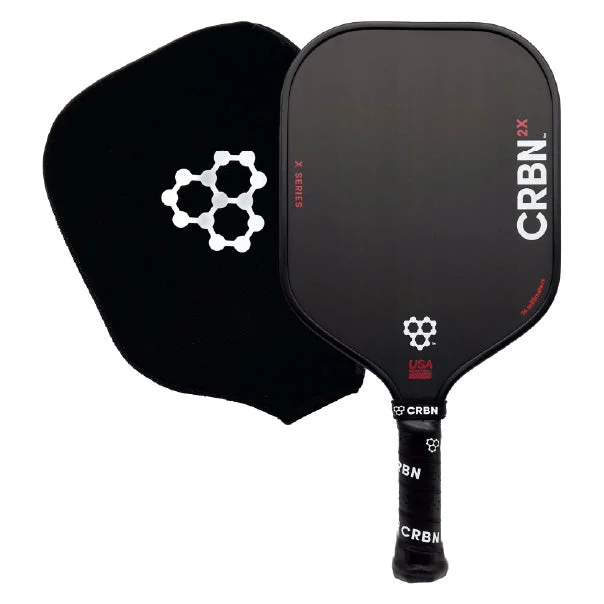
The CRBN 2X 14mm is the quickest-swinging CRBN on this list, and it is the value pick I hand to a player who wants a square CRBN at the lower tier and favours quick hands. Its swing weight is 103, against 109 for the thicker 16mm version, so your hand speed feels much faster.
The square face is forgiving, the unibody build runs carbon from the face down through the handle, and the foam-reinforced edge steadies the frame. One hands-on review expected this to be the popular square X Series paddle.
On court it is the thinner square X Series, for players who want a quick-swinging CRBN at a lower tier. Spin measures 1,843 RPM, which is high for this tier, and serves carry real bite.
The Amazon listing calls the 14mm Best for Power, and the thinner core compresses and releases faster, so drives and serves carry more pop than the 16mm version.
The honest costs are power and feel. It has noticeably less power than the elongated 1X, though your hand speed will feel much faster. One lab’s roughness meter read its sample over the legal limit, though the brand says its paddles passed before shipment with a more accurate meter.
And the listing’s own spec line prints another shape’s figures, so check the variant name before you buy: this pick is the square 2X in 14mm, 15.75 by 8.0 inches, with a 5.0 inch handle.
Buy it if you want the quickest hands in the CRBN value tier and you play a square shape. Skip it if you want the most power, because the elongated 1X hits harder.
10. CRBN 2X 16mm: Best Value Control CRBN Pickleball Paddle in 2027
AT A GLANCE
CRBN 2X 16mm
WEIGHT
7.8-8.1 oz
SWING WEIGHT
112
TWIST WEIGHT
-
SPIN
about 1,700 RPM
Shape: Square, 15.75 x 8.0 in
Grip: 5.0 in handle, 4.125 in circumference
Core: 16mm Upgraded Durable Core with foam-reinforced edge, unibody
Face: T700 Toray carbon fiber
Approval: USAP
Feel: Steady control
Warranty: 1 year, registered
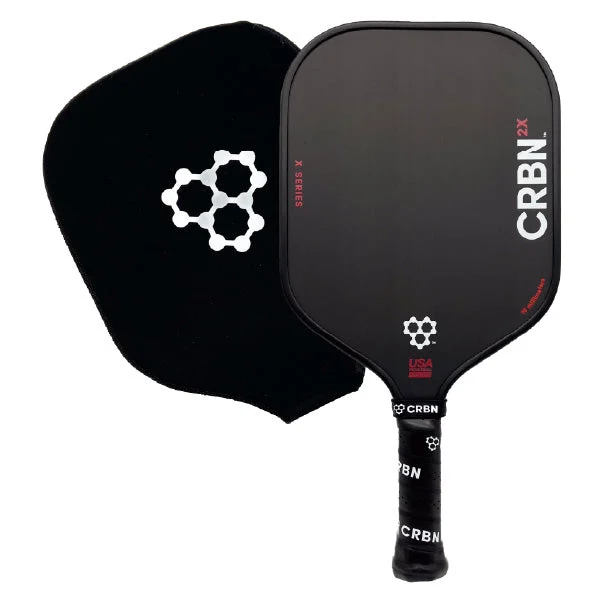
The CRBN 2X 16mm is the thicker square X Series, and it is the value pick I hand to a defensive doubles player who wants a forgiving square face and can adapt to a firmer feel.
The Amazon listing calls the 16mm Best for Control, and one hands-on review found a bigger sweet spot than the 1X, with a game that is really strong when blocking or countering drives. The carbon-reinforced handle is meant to reduce vibration and increase hand and paddle speed at the net.
On court it is the most balanced power-and-control option in the X Series. The square shape blends the power build with a big, stable sweet spot, so it is the paddle for players who want some extra pace without giving up control.
The 16mm core is thicker and softer than the 14mm, so drops and dinks sit down better, and the foam-injected edges steady the frame on blocks.
The honest costs are length and feel. It is on the shorter side, and the feel takes some getting used to. It is stiff, and it needed time to adjust. And the listing’s spec line prints the 3X’s figures, so check the variant name before you buy: this pick is the square 2X in 16mm, 15.75 by 8.0 inches, with a 5.0 inch handle.
Buy it if you want a forgiving square CRBN for defence and counters at the lower tier. Skip it if you want reach, because the short square frame gives up leverage on drives and serves.
How to Choose a CRBN Paddle in 2027
The short answer is to choose the line first, the shape second, and the approval third. CRBN sells three TruFoam lines and two older lines, and they play differently enough that the line decides the feel before the shape ever gets a say.
Start with the Line
The TruFoam lines all use a 100 percent foam core at one thickness, 14mm, with a T700 raw carbon face. The Genesis is the all-court line: the softest feel, the most versatile shots, and the highest spin in the family.
The Barrage is the power line: the same foam platform tuned for pop, with a floating foam core inside a foam ring around the edge, built for fast counters and putaways. The Waves is the dwell-power line: the most powerful TruFoam core, built for big drives and spin that comes from the core’s longer dwell time rather than surface grit.
The X Series is the value line: an older unibody carbon build with a honeycomb core and foam-injected edge walls, tuned for pace and a big sweet spot at a lower tier.
The Classic line is the original: a honeycomb core with a raw carbon face, and the paddle that built the brand’s name. If the foam feel is the reason you came to CRBN, buy TruFoam. If the value matters more, buy the X Series.
Then the Shape
CRBN numbers its shapes the same way in every line, and the number is the shape, not a generation. A 1 is elongated with a long handle, for reach and offense. A 2 is square, for defence and resets. A 3 is elongated, for consistency and forgiveness.
A 4 is the hybrid AeroCurve, for hand speed and attacks. In the Barrage and Genesis lines the 1 and 3 share the 16.5 inch length, but the 1 is narrower at 7.35 inches against 7.5 inches, with a 5.75 inch handle against 5.5 inches.
Elongated frames give you reach and leverage for singles and baseline drives, and they punish stretched doubles defence. Square frames give you the biggest sweet spot and the fastest hands at the kitchen. Hybrid frames split reach and width down the middle, and they are the best all-round shape on this list.
The grip is the quiet decision: almost every CRBN on this list ships with a 4.125 inch grip circumference, and the 1X lists 4.25 inches. Most hands build the grip up with overgrips, and each overgrip layer adds roughly 1/16 of an inch of circumference.
Then the Approval
Every paddle on this list carries USAP approval, so all ten play in sanctioned tournaments. The four TruFoam Genesis shapes and both Barrage shapes also carry UPA-A approval, which is the approval pro events use, so you can take them to pretty much any tournament.
UPA-A approval is not verified in this pass for the X Series, so check before you enter a pro event with one. Two approval notes belong here.
First, from 1 October 2026, paddles submitted for USA Pickleball certification must measure 2,100 RPM or less in the spin test. Paddles certified earlier keep their approval, so the Genesis 3 at 2,401 RPM stays legal.
Second, the Classic CRBN 1 entry on the approved list reads serialized models only, so only serialized units are approved. Before travelling to an event, confirm the exact model name on the approved list, as approval attaches to the specific model and variant.
Three Naming Traps
Three naming traps deserve their own paragraph, because CRBN reuses numbers across lines. First, the numbers are shapes, not generations.
The Genesis 2 is the square widebody of the original family, not a second-generation paddle, and the Genesis 4 is the hybrid shape added later, not a fourth generation. Second, there is no 4X in the X Series. The X Series is the 1X, 2X and 3X only, in 14 and 16mm.
The 4 belongs to the TruFoam lines, where it means the hybrid AeroCurve shape. Third, the Genesis 3X is not a Genesis shape. It is a later thermoformed power paddle with a foam-injected honeycomb core, and it is a different paddle from the Genesis 3, which is the elongated TruFoam shape.
Check the full name on the listing before you buy, because the two names differ by one letter and the wrong one buys a different construction.
Finally, the Beginner Question
The Barrage is an advanced-level paddle, and one hands-on review would not recommend the Genesis 4 to newer players. The premium TruFoam lines are not beginner paddles.
A newer player should start on the square shapes: the Genesis 2 widebody has the biggest sweet spot in the Genesis line, and the 2X 16mm is the forgiving square in the value tier. Both give you the CRBN feel without punishing every mishit. Come back to the Barrage when your contact centres.
The Bottom Line
The best CRBN paddle for most players is the TruFoam Genesis 3, because it pairs the highest measured spin on this site with a soft, pocketed feel and a core that never goes soft. The best CRBN for power is the TruFoam Barrage 4, because it takes the same foam platform and tunes it for pop, so counters jump off the face.
The best all-court CRBN is the Genesis 4, the best control CRBN is the Genesis 2, and the best value CRBN is the 1X 16mm.
Whichever line you choose, check three things before you buy: the exact model name on the listing, the shape number, and the approval list for your events, because CRBN’s numbers are shapes, not generations, and the wrong variant buys a different paddle.
Frequently Asked Questions (FAQs)
1. Which CRBN pickleball paddle is the best?
The TruFoam Genesis 3 is the best CRBN paddle for most players. It pairs the highest measured spin on this site at 2,401 RPM with a soft, pocketed feel, a 119 swing weight, a 6.21 twist weight, and a full foam core that never goes soft.
The TruFoam Barrage 4 is the best CRBN for power, with the most firepower in the range and a 9.5 out of 10 power score in one hands-on review. No source tests CRBN against other brands head to head in one protocol, so this article ranks CRBN paddles against each other, not against other brands.
2. Barrage, Genesis or Waves: which CRBN line should I buy?
Buy the Barrage if you want instant pop, fast counters and putaways. Buy the Genesis if you want an all-court paddle with a softer feel and precise, high-spin shots. Buy the Waves if you want maximum dwell-based power and big drives. All three use a thin, all-foam TruFoam core at 14mm.
The difference is the tuning: the Barrage floats its foam core inside a foam ring for pop, the Genesis uses a void core for all-court balance, and the Waves uses a wave core for dwell-based power.
If you are torn between the Barrage and the Genesis, the Barrage 4 and the Genesis 4 share the same hybrid shape, so you can compare them directly: the Barrage hits harder, and the Genesis swings softer.
3. What do the numbers in CRBN paddle names mean?
The numbers are shapes, not generations. A 1 is elongated with a long handle, a 2 is square, a 3 is elongated, and a 4 is the hybrid AeroCurve shape. The same numbering runs across the Barrage, Genesis and Waves lines, and the X Series uses 1X, 2X and 3X.
So the Genesis 2 is the square widebody of the original Genesis family, not a second-generation paddle, and there is no 4X in the X Series. The brand name is pronounced carbon.
4. Genesis 3 or Genesis 4: which should I buy?
Buy the Genesis 3 if you want the most spin and the most reach. It is the elongated hybrid at 16.5 by 7.5 inches, with a 119 swing weight, a 6.21 twist weight, and spin at 2,401 RPM. Buy the Genesis 4 if you want the fastest hands in the family.
It is the hybrid AeroCurve at 16.2 by 7.8 inches, with a 107 swing weight, a 6.25 twist weight, and spin at 2,315 RPM.
The Genesis 4 is the more well-rounded and playable shape in one hands-on review, but it hits softer and its sweet spot is tighter. For most players asking this question, the Genesis 3 is the answer, unless hand speed is the deciding factor.
5. Which CRBN paddle is best for beginners?
The Genesis 2 is the best CRBN for a newer player who wants the premium line. It is the widebody shape with the biggest sweet spot in the Genesis family, a 113 swing weight, a 6.70 twist weight, and the quickest hands in the line.
The 2X 16mm is the best CRBN for a newer player who wants the value tier: a forgiving square face with a bigger sweet spot than the 1X.
The Barrage is an advanced-level paddle, and one hands-on review would not recommend the Genesis 4 to newer players. A true beginner should start on one of the square shapes and come back to the Barrage when their contact centres.
6. Are CRBN paddles approved for tournaments?
Yes, every paddle on this list carries USAP approval, so all ten play in sanctioned tournaments. The four Genesis shapes and both Barrage shapes also carry UPA-A approval, which is the approval pro events use. UPA-A approval is not verified in this pass for the X Series, so check before you enter a pro event with one.
Two notes: from 1 October 2026, paddles submitted for USA Pickleball certification must measure 2,100 RPM or less in the spin test, but paddles certified earlier keep their approval, so the Genesis 3 at 2,401 RPM stays legal.
And the Classic CRBN 1 entry on the approved list reads serialized models only, so only serialized units are approved. Before travelling to an event, confirm the exact model name on the approved list.
7. Is the CRBN X Series still worth buying?
Yes, if you want CRBN pace and spin at a lower tier. The X Series uses an older unibody carbon build with a honeycomb core and foam-injected edge walls, rather than a foam core, and the brand itself says its TruFoam Genesis hits harder.
But the X Series still delivers: the 1X 16mm is the hardest-hitting value CRBN, the 3X 16mm holds its spin for months, and the 2X shapes give you the quickest hands and the most forgiving square face in the tier.
Every X Series paddle on this list is on the USA Pickleball approved list. Buy the X Series for value-priced power. Buy TruFoam for the foam feel and the durability.
8. 1X, 2X or 3X: which X Series paddle should I buy?
Buy the 1X if you want the most power. It is the elongated shape at 16.5 by 7.5 inches, with a 124 swing weight and spin at 1,720 RPM, and it hits the hardest of the three.
Buy the 2X if you want the quickest hands or the most forgiving face. It is the square shape at 15.75 by 8.0 inches, with a 103 swing weight in 14mm and a 112 swing weight in 16mm.
Buy the 3X if you want the most versatile paddle. It is the elongated shape with a shorter 5.25 inch handle, and one hands-on test calls it a jack of all trades with the best spin longevity in its class. The 16mm thickness is the all-court choice in each model, and the 14mm is the poppier, power choice.
9. Are CRBN paddles worth the money?
They are worth it if you love the foam feel, and they are not worth it if you do not. The TruFoam paddles are the premium tier of the range, and the extra money mostly buys you the feel: a soft, pocketed strike that holds the ball and then releases it, with a core that never crushes and never goes soft.
If that feel is what you want, no other CRBN reproduces it, and the Genesis 3 is the pick.
If you want most of the game for less, the X Series gives you pace, spin and a big sweet spot on a honeycomb core, and the 1X 16mm is the paddle most players should look at instead. The honest test is to play a TruFoam paddle for a week before you judge it, because the muted feel takes a few sessions to learn.
10. How long do CRBN paddles last, and does the spin wear off?
The foam core lasts longer than a honeycomb core, and that is the durability argument in its purest form. Honeycomb crushes at the sweet spot over long use, and both changes read as a dead spot.
The TruFoam core is solid foam with no cells to crush, so the response stays the same over time, and one long test found zero drop-off after more than twenty hours of play. The honest caveat sits on the face, not the core: the raw carbon texture is strongest early and softens over months of play.
One lab rates the Genesis grit durability at its lowest tier, and its wear tracking found raw carbon faces lose about 14 to 18 percent of their spin over 100 games, while embedded-grit faces lose only about 1 to 2 percent.
CRBN’s counter-claim, printed honestly alongside: spin comes from the core’s flex and dwell as much as from surface grit, so the paddle keeps shaping the ball longer than a grit-only paddle would. The warranty is a 1-year limited cover on registered paddles, so register it on day one and keep the receipt.
11. What is TruFoam, and how is it different from honeycomb?
TruFoam is CRBN’s proprietary high-density foam blend, not EVA or PMI, inspired by surfboard cores. Instead of a honeycomb grid of plastic cells, the core is solid foam all the way through, at one thickness, 14mm.
The foam flexes under the ball and springs back, so the ball stays on the face a fraction longer, which is called dwell. Honeycomb crushes at the sweet spot over long use, and foam settles, and both changes read as a dead spot or a softer centre.
The solid foam core does neither, so the response you calibrate in week two is the response you still own in month six.
The three TruFoam lines tune the same idea differently: the Genesis uses a void core for all-court balance, the Waves uses a wave core for dwell-based power, and the Barrage uses a floating core inside a foam ring for pop. The trade is feel: the foam core feels soft and muted, and some players never get used to it.
12. Which CRBN paddle has the most spin?
The TruFoam Genesis 3 has the most spin, at 2,401 RPM on the current independent protocol, the highest measured spin figure on this site.
The Waves 3 is second at about 2,404 RPM on one independent test, effectively tied, but it is a reserve on this list, not a pick. The Genesis 4 is third at 2,315 RPM, and the Barrage 4 is fourth at 2,091 RPM.
Spin figures move with the unit and the method, so treat the ranking as the finding, not the last digit. One note: from 1 October 2026, paddles submitted for USA Pickleball certification must measure 2,100 RPM or less, but paddles certified earlier keep their approval, so the Genesis 3 stays legal.

Michael Stevenson
Hi, my name is Michael Stevenson and I’m a passionate pickleball player. I’ve been playing the game for many years and I’m pretty highly skilled at it. Pickleball is one of my favorite topics so naturally, I love to write about it.
Whether it’s tips for beginners, guides for experts, reviews of new paddles, or advanced playing techniques – if it relates to pickleball then I have something interesting to write about it. So if you’re looking for entertaining and informative information on the topic of pickleball, look no further than my written works!