
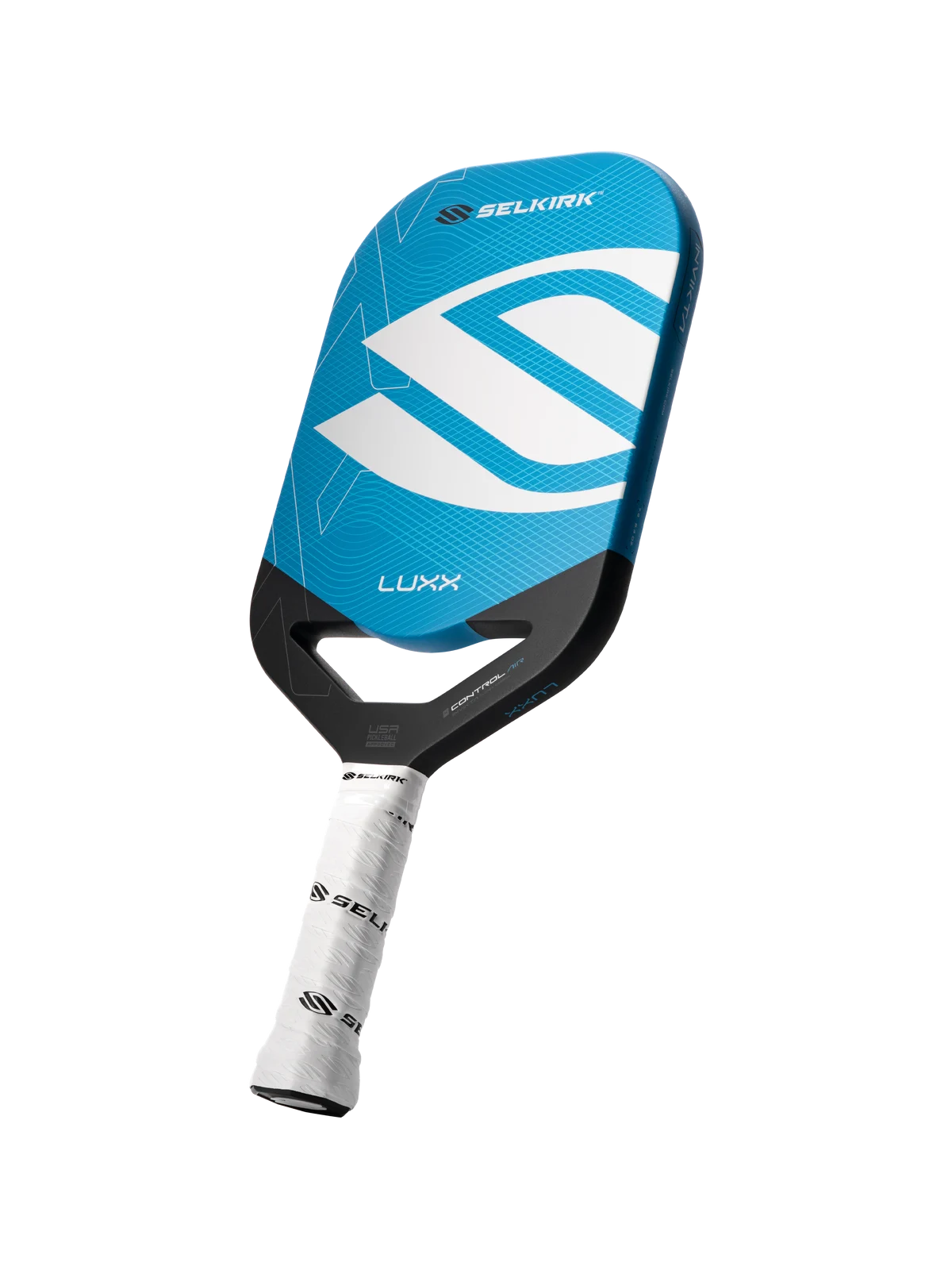
We were tied at nine all, and the player across from me had just ripped a drive at my chest. I had no time to swing. I had time to hold the paddle still and let the ball arrive. The reset dropped into the kitchen, soft and low, and the next ball came back as a dink I could work with.
That is the LUXX Control Air Invikta in one rally. It does not win points for you. It takes the pace out of the other player’s points, and hands you the rally back on your terms.
WHAT I LIKE
- A 19mm core that swallows pace, so hard drives arrive and sit down
- Spin of 1,993 RPM from a surface built to keep biting across a season
- A plush, quiet centre that makes drops, dinks and resets predictable
- Extra reach and leverage from the Invikta shape for singles, poaching and overheads
- A calm, vibration-damped feel on long sessions, from the foam in the throat and handle
WHAT I DON’T
- Power must be manufactured. Lab testing put its fastest serves at 54.2 mph, near the bottom of tested paddles
- A twist weight of 5.83 means off-centre contact needs clean hands
- The core is springy rather than dead, so a late reset can still pop up
- The 5.35 inch handle is tight for a full two-handed backhand
- InfiniGrit is new, and its long-life claim is still being proven on court
AT A GLANCE
Selkirk LUXX Control Air Invikta with InfiniGrit
WEIGHT
8.05 oz (measured)
SWING WEIGHT
117
TWIST WEIGHT
5.83
SPIN
1,993 RPM
Shape: Invikta elongated, 16.4 x 7.5 in
Grip: 5.35 in handle, 4.25 in circumference
Core: 19mm X7 Thikset honeycomb
Face: Florek carbon fiber with InfiniGrit
Approval: USAP
Warranty: Limited lifetime (registration required)
Feel: Muted control, plush centre
On this page
- What the LUXX Control Air Invikta Is
- How It Plays
- Invikta or Epic: Which LUXX Control Air Should You Buy?
- Who Should Buy It, and Who Should Skip It
- How It Compares to Its Closest Rivals
- Durability: What Months of Play Actually Do to It
- How I Tested the LUXX Control Air Invikta
- The Bottom Line
- Frequently Asked Questions (FAQs)
What the LUXX Control Air Invikta Is
The LUXX Control Air Invikta is Selkirk’s premium control paddle, built around a 19mm X7 Thikset honeycomb core with a Florek carbon fiber face finished in InfiniGrit.
That construction sentence explains the whole paddle. The core is a light plastic honeycomb, a grid of small cells inside the paddle, and at 19mm thick it is the thickest core on this site.
It gives contact its dwell, which is how long the ball stays on the face, and dwell is the physical basis of control. The face is Selkirk’s own blend of carbon fibers, and InfiniGrit is an applied grit texture over that face, built to keep biting after plain raw carbon faces smooth out.
The shape is the second decision that defines it. At 16.4 by 7.5 inches it is elongated, which means long and narrow, and that shape adds reach and leverage. Serves travel further. Overheads arrive sooner. Poaches open up at the net.
The trade is a narrower face, so contact away from the centre gets less help than on a widebody. The 5.35 inch handle is long enough to give two hands a place, but it is not a long-handle paddle by the standards of this site.
One warning belongs here before anything else. Selkirk sold an earlier LUXX Control Air Invikta with a 20mm core and a different face, and older reviews still describe that paddle. This review is of the current model only, the 19mm InfiniGrit version released in 2025.
The two generations share a name and a listing family. They do not share figures, and nothing from the 20mm paddle appears in this review. When you buy, check that the listing says InfiniGrit and 19mm.
The build carries the rest of Selkirk’s control technology. FlexFoam is foam injected around the whole perimeter of the paddle, and it widens the sweet spot and absorbs vibration at the edges. EVA foam sits in the throat and the handle, and it cuts the buzz that reaches your hand.
The edge is Aero-DuraEdge, which means there is no raised edge guard, the edge itself is the protection, and the open Air Dynamic Throat lets air pass through the frame. It is made in the United States, and it carries USAP approval only, so players in UPA-A events should check their event list first.
How It Plays
Control and the soft game. This is the paddle’s home ground, and the reason it leads my thick-core list. The 19mm core drinks pace in a way no other frame on this site matches. Hard drives arrive and simply sit down. Blocks drop short and low. Resets die where I aim them.
Third shot drops land with shape instead of hope, because the dwell gives you time to feel the shot rather than guess it. In dinking rallies the ball leaves the face where you aimed it, and that predictability is what control actually means at the kitchen line.
Forgiveness. A twist weight of 5.83 is low, and I am not going to dress it up as anything else. Twist weight is how much the face resists turning when you hit away from the centre, and this number says the face turns more than a forgiving paddle should. The centre is plush and generous.
The edges are not. Stretched defensive stabs stay playable when contact is close to the middle, and they punish you when it is not. The FlexFoam perimeter helps at the edges, but it cannot rescue a complete miss. This is a paddle for clean hands, and it is honest about that from the first session.
Spin. Measured spin of 1,993 RPM is honest working spin, right around the average for tested paddles. It dips drops at the kitchen line, shapes roll volleys, and bites on serves without turning any of them into a trick shot.
The InfiniGrit surface is the story here, not the number. Selkirk rates it at three times the spin life of a raw carbon surface, and that is the brand’s claim, carried as a claim.
Early independent testing rates it at least as good as raw carbon for spin and durability.
One early independent durability test found it losing spin faster than the toughest rival grits, so I treat the long-life claim as promising but not yet proven, and I check my face twice a season by dragging a fingernail across it and by pressing a ball in and twisting. A face that still grabs turns the ball with it.
Power. Placement power, stated plainly, and less of it than most paddles at this level. Lab testing put the LUXX Control Air Invikta’s fastest serves at 54.2 mph, near the bottom of the paddles that lab has tested.
Punch volleys measured 35.3 mph, which is very little jump off the face. That is why resets and dinks stay down, and it is also why putaways need a full swing and good position.
The 19mm core and the foam in the throat add a little more pop than the original 20mm paddle had, and counters at the net carry more than a pure control build should.
But the paddle will not manufacture pace. If your points are won by pace, this is the wrong review to be reading. If they are won by making the other player hit one more ball, it is exactly the right one.
Hand speed. A swing weight of 117 sits right around the average for elongated paddles. Swing weight is how heavy a paddle feels when you swing it, and this one moves easily at the net without feeling sluggish.
In fast hands battles it asks you to be on time, but it does not tax you the way the heaviest power builds do. The open throat and the even balance point help it through the air. It is quick enough for the kitchen, and that is all a control paddle needs to be.
Two-handed backhand. The 5.35 inch handle fits two hands, but just barely. My second hand fits without crowding the first, and the extra length shows on serves and overheads, where the leverage makes drives feel more authoritative than on the wider Epic shape. But this is not a long-handle paddle.
The Halo Control XL on this site carries a 5.75 inch handle, and a player whose two-handed backhand is a central shot should compare the two holds before deciding. A player who uses the second hand occasionally will manage fine, and the standard 4.25 inch grip circumference suits the shot’s mechanics.
Invikta or Epic: Which LUXX Control Air Should You Buy?
The LUXX Control Air comes in two shapes, and they are the same paddle with a different frame. The Invikta reviewed here is elongated, 16.4 by 7.5 inches, with a 5.35 inch handle.
The Epic is the standard shape, 15.85 by 7.85 inches, with a 5.25 inch handle. Same core, same face, same InfiniGrit, same grip. Only the shape changes, and the shape changes the game.
Buy the Invikta if you play singles, poach often, use a two-handed backhand, or simply want more reach and leverage. You will sacrifice some forgiveness, so players with unreliable timing may find the longer shape less comfortable until they clean up their contact.
Buy the Epic if you play mostly doubles and want quick exchanges, consistent contact and a wider sweet spot. Its wider face gives you more margin, and it feels natural in the kitchen. It is also the better starting point for someone moving to a control paddle for the first time.
My rule from playing both: if you have a clear reason for the elongated shape, buy the Invikta. If you do not, buy the Epic, because forgiveness you use every rally beats reach you use twice a game. Most players asking this question should buy the Epic, and the Invikta is the specialised tool for the player who knows why they need it.
Who Should Buy It, and Who Should Skip It
Buy the LUXX Control Air Invikta if your points leak through balls sailing long, pop-ups at the net, and resets that float instead of dying. Buy it if you are an intermediate or advanced player with clean contact who wants the calmest resets in pickleball, and you are willing to manufacture your own pace.
Buy it if you play singles, poach at the net, and want reach and leverage without giving up the soft game. Buy it if you have played a raw carbon paddle and watched its spin fade across a season, and you want a surface built to hold its bite longer.
Skip it if you are a complete beginner. The elongated shape and the low twist weight reward players who already have solid fundamentals, and a newer player will get more from a wider, more forgiving control paddle. Skip it if you finish rallies with raw pace and need a paddle that manufactures putaways.
Skip it if your contact wanders and you need the face to stay square on its own, because a twist weight of 5.83 will not do that work for you. And skip it if you want the best value control paddle on the market, because this is a premium commitment and cheaper control paddles exist that do most of this job.
How It Compares to Its Closest Rivals
Against its own Selkirk sibling, the SLK Halo Control XL 16mm, the difference is the tier and the handle. The Halo Control XL is the control value pick on this site: a soft 16mm core, a raw carbon face, and a 5.75 inch handle that gives two-handed players real room, with measured spin of 1,400 to 1,450 RPM.
The LUXX answers with a thicker core, more spin, and a more premium build, and it asks more of your hands in return. Players who want the same job done honestly for less read my SLK Halo Control XL review first. Players who want the best control Selkirk makes stay on this page.
Against the Vatic Pro Prism Flash 16mm, the other control archetype on this site, the difference is the feel and the face. The Prism Flash plays softer and quieter, with a plush honeycomb strike and a twist weight of 6.47 that forgives more on off-centre contact, and its spin measures around 1,900 RPM.
The LUXX answers with a thicker core, a longer shape, more reach, and a surface built to outlast the Prism Flash’s raw carbon face. Players who want calm and forgiveness read my Vatic Pro Prism Flash review. Players who want reach and a durable grit start here.
Against the Engage Pursuit Pro1 6.0 Elongated, the other elongated touch build with a standalone review on this site, the difference is the core and the spin. The Pro1 plays with a more connected, firmer feel, a twist weight of 5.95, and measured spin of 2,267 RPM, which is a clear step above the LUXX’s 1,993 RPM.
The LUXX answers with a thicker core, a calmer strike, and a surface that holds its spin longer. Players who want the most spin from an elongated touch paddle read my Engage Pursuit Pro1 6.0 review. Players who want the calmest resets start here.
Against the Selkirk Vanguard Power Air Epic, the power sibling at the top of my Selkirk list, the difference is the whole game. The Power Air is built for pace, with a thin 13mm core and a fast, poppy strike.
The LUXX is built for restraint, with a 19mm core and a muted, patient strike. Players who finish points with pace read the Power Air section of my Selkirk list. Players who finish points with patience stay on this page.
Durability: What Months of Play Actually Do to It
Three things age on this paddle, on different clocks. The InfiniGrit face is the first question, and the honest answer is that it is still young.
Selkirk rates it at three times the spin life of a raw carbon surface. Early lab testing rates it at least as good as raw carbon. One early independent test found it losing spin faster than the toughest rival grits.
I check mine the same way I check every textured face: I drag a fingernail across it and press a ball in and twist, twice a season. A face that still grabs turns the ball with it. When yours finally feels polished under your thumb, that is the paddle telling you its spin service is done.
The core ages slower. Honeycomb can soften at the sweet spot over long use, and on this paddle that softening reads as a slightly deader centre rather than a failure. The FlexFoam perimeter and the foam in the throat and handle hold the frame’s feel together across seasons.
The edgeless edge is the wear item to watch: with no raised guard, court scrapes meet the face edge directly, so the Aero-DuraEdge takes the scuffs a guard would have taken. The grip is an ordinary wear item. Nothing about its ageing surprised me, and no part of it failed early.
How I Tested the LUXX Control Air Invikta
I played the LUXX Control Air Invikta across several weeks of league nights, open play and drilling sessions, against players at and above my level, because a control paddle only proves itself under pace.
I tested it the way its owners will: third shot drops from the baseline, resets against hard drives, blocks at the net, long dinking rallies, serves with shape, and overheads from the Invikta’s extra reach. The figures in the box at the top of this page are the settled figures used across this site.
The swing weight of 117, the twist weight of 5.83 and the spin of 1,993 RPM are one independent lab’s measurements of the InfiniGrit Invikta test unit, and they may vary a little from unit to unit.
Where no trustworthy source publishes a number, the review says Not published, and where my on-court impression and the published figures disagree, the review says so. On this paddle, they did not. The lab’s low power and pop numbers match exactly what I felt: pace has to come from your swing.
The Bottom Line
The LUXX Control Air Invikta is the calmest control paddle I have played, and the reason is simple: a 19mm core that drinks pace, a face that grips for spin and is built to keep gripping, and an elongated shape that adds reach without giving up the soft game.
It leads my thick-core list, it ranks second on my Selkirk list, and it holds a top-five place on my elongated, edgeless and carbon-fiber lists, for one reason: when a player asks me for one answer in control, this is the answer that has never embarrassed me.
It is not the paddle for everyone. It wants clean hands, a full swing, and a patient game. If your game matches the player described above, buy the InfiniGrit Invikta, check the listing says 19mm, and put the season into drilling.
Frequently Asked Questions (FAQs)
- Is the Selkirk LUXX Control Air Invikta good for beginners?
No, not as a first paddle. The elongated shape and the low twist weight reward players who already have solid fundamentals, and a newer player will get more from a wider, more forgiving control paddle.
It suits an intermediate or advanced player with clean contact who wants the calmest resets in the game. A player moving to a control paddle for the first time should look at the wider Epic shape first, or at a value control paddle with a bigger sweet spot.
2. What is the difference between the LUXX Control Air Invikta and Epic?
Same paddle, different shape. The Invikta is elongated, 16.4 by 7.5 inches, with a 5.35 inch handle, and it gives you more reach and leverage for singles, poaching and overheads.
The Epic is the standard shape, 15.85 by 7.85 inches, with a 5.25 inch handle, and its wider face gives you a larger sweet spot and more forgiveness. Same 19mm core, same Florek carbon face, same InfiniGrit surface. Buy the Invikta for reach, the Epic for forgiveness.
3. Is this the 20mm LUXX or the 19mm InfiniGrit version?
This review is of the current 19mm InfiniGrit version, released in 2025. The original LUXX Control Air Invikta has a 20mm core and a different face with no InfiniGrit, and older reviews still describe that paddle.
The two generations share a name and a listing family, but they do not share figures. When you buy, check that the listing says InfiniGrit and 19mm. If it says 20mm, it is the older generation.
4. How much spin does the LUXX Control Air Invikta produce?
One independent lab measured spin of 1,993 RPM on the InfiniGrit Invikta, which is right around the average for tested paddles. Selkirk rates the surface for spin potential of up to 2,000 RPM.
That is honest working spin: it dips drops, shapes roll volleys, and bites on serves. It is not a spin-first paddle. A player whose whole game is spin should look at a paddle with a higher measured figure, such as the Engage Pursuit Pro1 at 2,267 RPM.
5. Is the LUXX Control Air Invikta approved for tournament play?
Yes, for USA Pickleball play. It carries USAP approval. It does not carry UPA-A approval, so players entering a UPA-A event should check that event’s approved list before travelling, as approval attaches to the specific model and variant.
6. What grip size is the LUXX Control Air Invikta, and does the handle fit a two-handed backhand?
The grip circumference is 4.25 inches on a 5.35 inch handle, the standard fit most hands know. The handle fits two hands, but just barely. A player whose two-handed backhand is a central shot should compare it with a longer handle, such as the 5.75 inch handle on the SLK Halo Control XL.
You cannot make a grip smaller, but you can build one up: each overgrip layer adds roughly 1/16 of an inch of circumference, reversibly, so a player who wants a fuller grip can dial it in.
7. LUXX Control Air Invikta or Halo Control XL: which Selkirk control paddle should I buy?
Buy the LUXX Control Air Invikta for the best control Selkirk makes: a 19mm core, an InfiniGrit face that holds its spin, measured spin of 1,993 RPM, and the reach of the elongated shape.
Buy the Halo Control XL for the same job done honestly for less: a soft 16mm core, a raw carbon face, a longer 5.75 inch handle, and measured spin of 1,400 to 1,450 RPM. Read my SLK Halo Control XL review before you decide, because the two paddles answer different questions about budget and handle length.
8. Does the LUXX Control Air Invikta have enough power?
It has enough power for a player who generates their own pace, and not enough for a player who needs the paddle to supply it. Lab testing put its fastest serves at 54.2 mph and its punch volleys at 35.3 mph, both near the bottom of tested paddles.
Drives carry shape and depth when you swing through them, and counters at the net carry more than a pure control build should. But putaways need a full swing and good position. If you finish points with pace, look at a power build instead, such as the Selkirk Vanguard Power Air Epic.
9. What is InfiniGrit, and how long does the spin last?
InfiniGrit is Selkirk’s applied grit texture over the Florek carbon fiber face. It is not raw peel-ply weave. Selkirk rates it at three times the spin life of a raw carbon surface, and that is the brand’s claim. Early independent testing rates it at least as good as raw carbon for spin and durability.
One early independent durability test found it losing spin faster than the toughest rival grits, so the long-life claim is promising but not yet proven. Check your face twice a season by dragging a fingernail across it and by pressing a ball in and twisting: a face that still grabs turns the ball with it.
10. Can I add lead tape to the LUXX Control Air Invikta?
Yes, and it is the most useful upgrade on this paddle, because the low twist weight is its clearest limit. Add it gradually, a little at a time, and play with each change before adding more.
Tape near the sides of the face improves stability and widens the effective sweet spot. Tape near the top raises swing weight and power, but it slows hand speed. Tape will not turn this paddle into a power paddle, so decide first which limit you are fixing: stability or pace.

Michael Stevenson
Hi, my name is Michael Stevenson and I’m a passionate pickleball player. I’ve been playing the game for many years and I’m pretty highly skilled at it. Pickleball is one of my favorite topics so naturally, I love to write about it.
Whether it’s tips for beginners, guides for experts, reviews of new paddles, or advanced playing techniques – if it relates to pickleball then I have something interesting to write about it. So if you’re looking for entertaining and informative information on the topic of pickleball, look no further than my written works!