
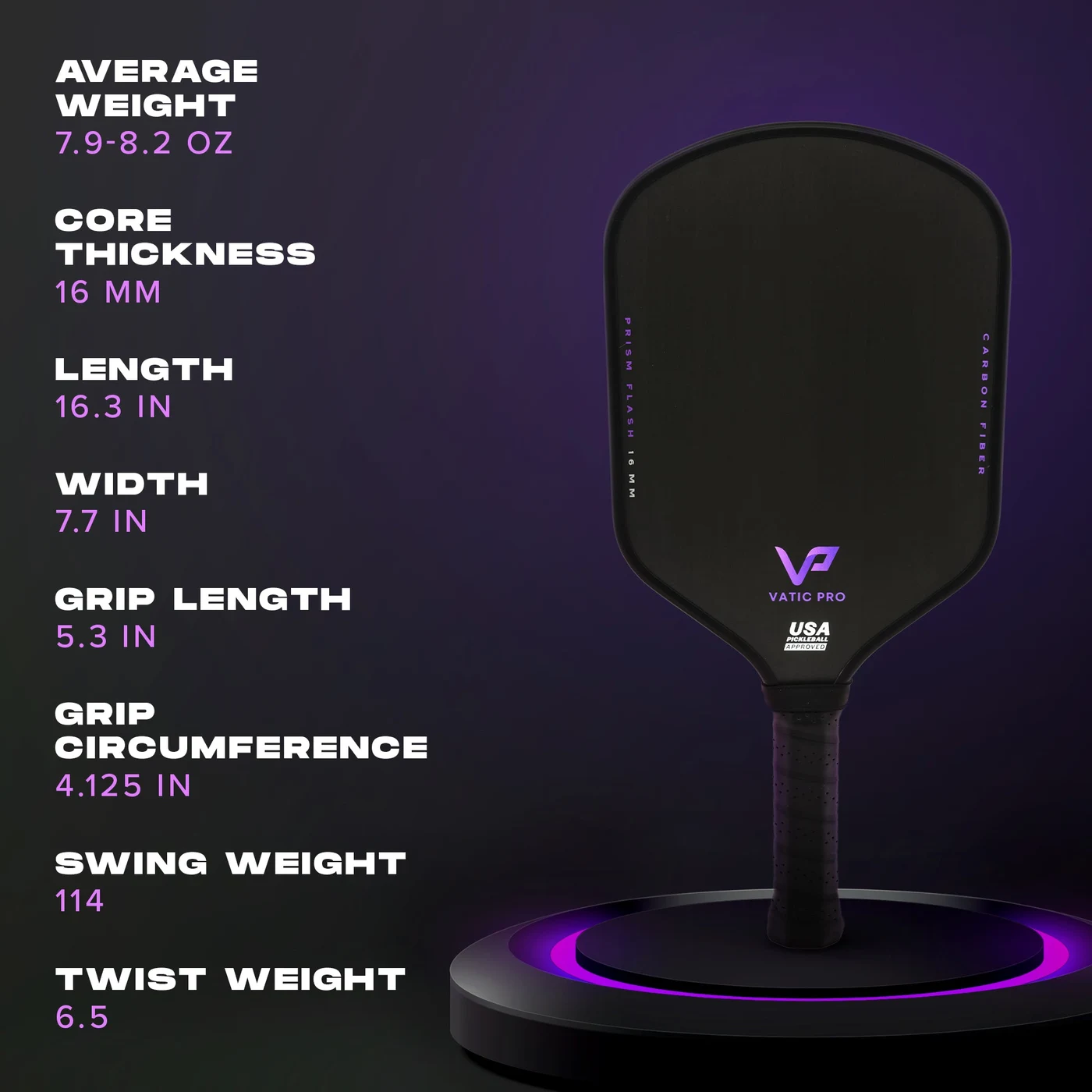
Best pickleball paddles under $100 now use flagship ideas: thermoformed builds, foam-injected edges, raw carbon faces, and measured handling figures too.
I tested every paddle on this list on court myself and checked the figures, so the ranking follows real games, not price tags. I judged contact quality first, then stability, spin, and hand speed, and each section states plainly how its paddle handles weakness.
My number one pick is the Vatic Pro Prism Flash 16mm, the best pickleball paddle under $100 because its edges forgive mistakes. It scored 8.8 out of 10 in my testing, and foam inside its edge walls softens contact before the ball leaves you.
So drops leave without drama, resets stay low, and hard drives at your chest stay blocked instead of jumping into trouble. Check the Vatic Pro Prism Flash 16mm on Amazon if you want the under $100 paddle I recommend first for calm control.
The 10 Best Pickleball Paddles Under $100 in 2027
1Vatic Pro Prism Flash 16mm: Best Overall Pickleball Paddle in 2027
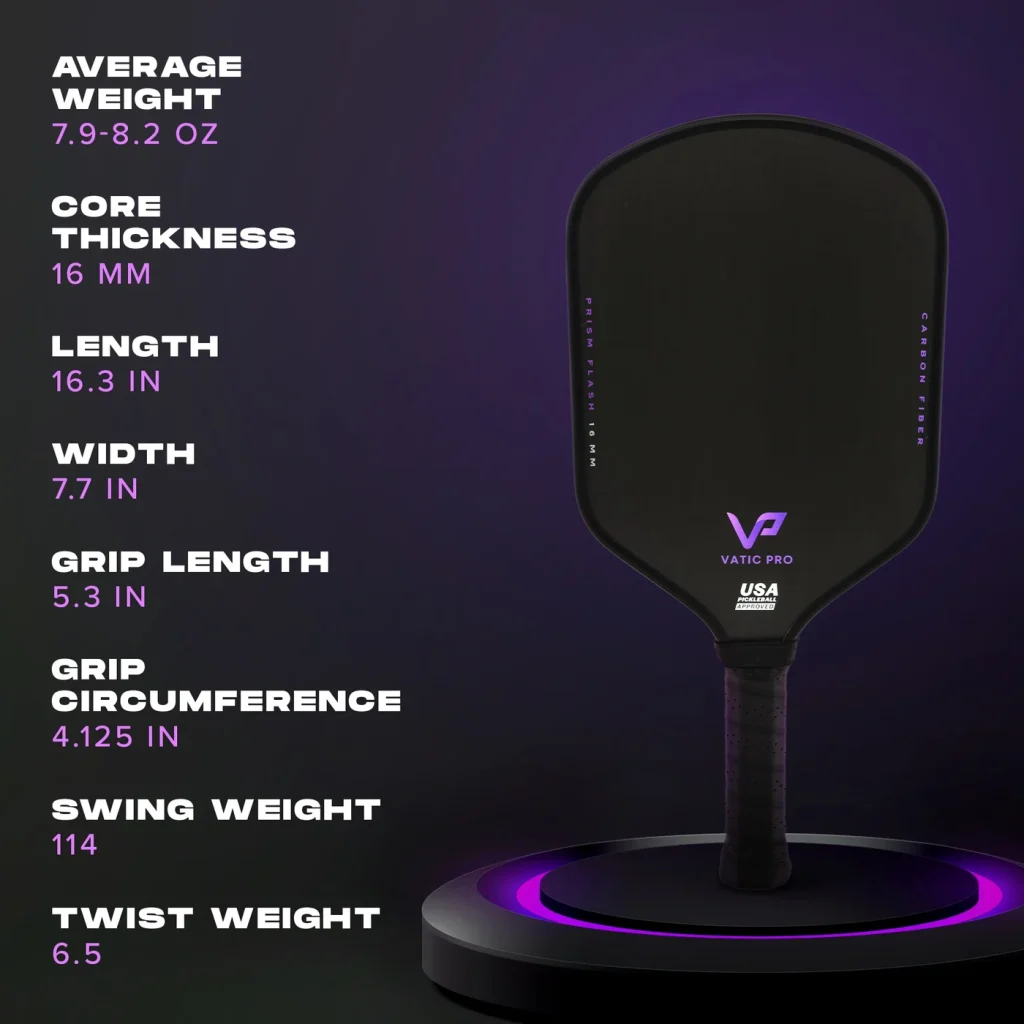
AT A GLANCE
Vatic Pro Prism Flash 16mm
WEIGHT
7.9-8.2 oz
SWING WEIGHT
114
TWIST WEIGHT
6.47
SPIN
~1,900 RPM
Shape: Hybrid, 16.25 x 7.7 in
Grip: 5.3 in handle, 4.25 in circumference
Core: 16mm C7 polymer honeycomb with foam-injected edge walls
Face: Raw carbon fiber, T700 class
Approval: USAP
Feel: Plush control
The Prism Flash is the paddle I hand someone when they want one recommendation and no appetite for a long shortlist.
Its hybrid frame sits between reach and forgiveness, while the thick polymer core gives the ball a calm, pocketed response. Drops leave the face without drama, resets stay low, and blocks do not jump when a harder drive arrives at my chest.
That softness does not make it timid. The raw carbon face grips well enough for dipping drives and sharp roll volleys, and the measured spin figure is strong for this class.
At a 114 swing weight it feels substantial without becoming sluggish, while the 6.47 twist weight helps contact away from the center hold its line. I notice that stability most on stretched counters, where the face stays quieter than I expect.
Power remains the honest limit. I can finish points when I create pace with a full swing and good position, but the Prism Flash will not manufacture easy putaways for a short, tentative stroke.
That is the correct tradeoff for the player it suits: control first, enough spin to shape the ball, and a measured response that builds confidence at the kitchen.
Buy it if you want the most complete control paddle here. Skip it if free power matters more than touch.
2Vatic Pro Saga Flash 16mm: Best All-Court Pickleball Paddle in 2027
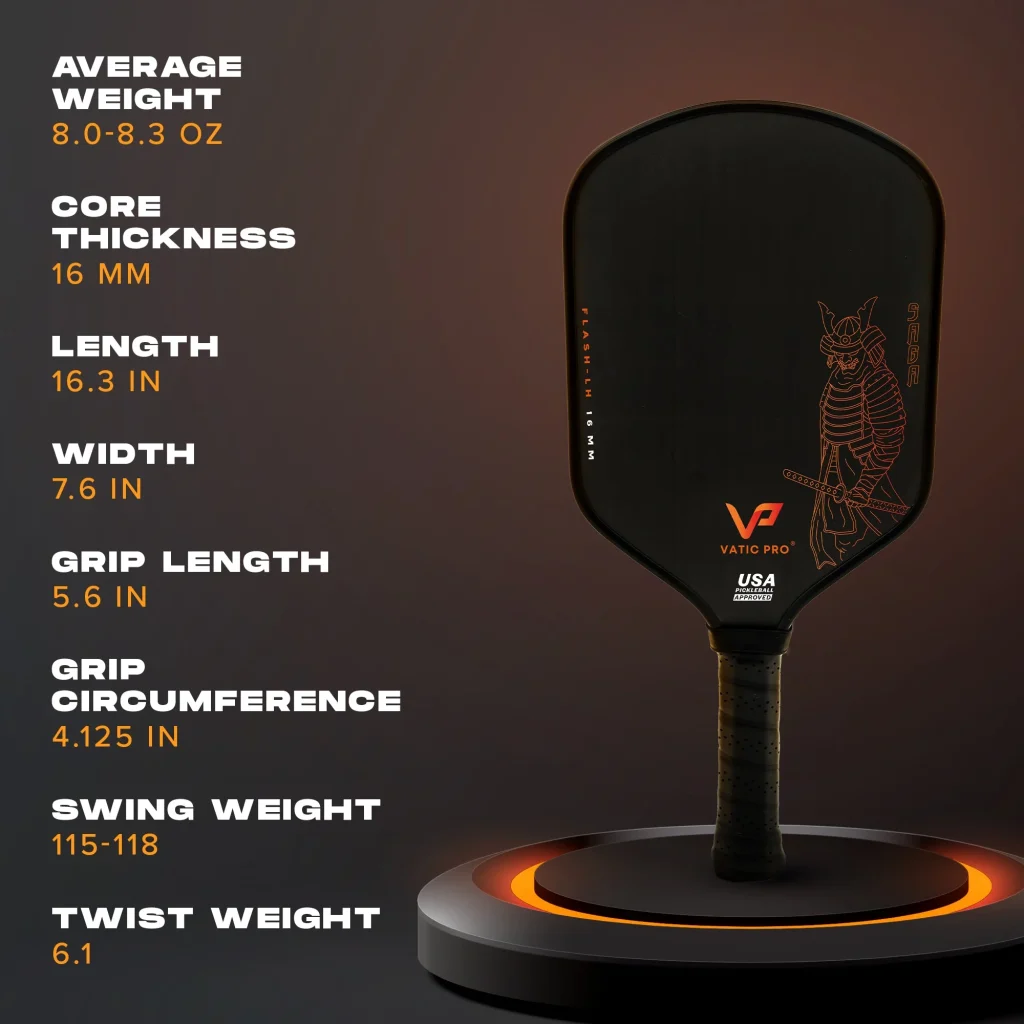
AT A GLANCE
Vatic Pro Saga Flash 16mm
WEIGHT
8.0-8.3 oz (range across Saga shapes; Flash measured ~8.1 oz)
SWING WEIGHT
114-116 (brand-published)
TWIST WEIGHT
6.45 (brand-published)
SPIN
-
Shape: Hybrid (Flash), 16.3 x 7.7 in
Grip: 5.3 in handle, circumference -
Core: 16mm polypropylene honeycomb power core (10mm cells)
Face: Multi-layer composite with Toray T700 carbon top layer
Approval: USAP (most versions; verify variant)
Feel: Balanced all-court
The Saga Flash is the livelier Vatic option, built for players who like the Prism shape but want a firmer push from the baseline.
Its power core and layered face give drives a cleaner launch, while the hybrid outline keeps enough width for blocks and counters. I can lean on a serve, step in behind it, then soften my hands for a fifth shot without feeling that I brought the wrong tool.
The balance is what earns it the all-court label. Published figures put swing weight at 114 to 116, so it carries useful plow-through without turning into a slow hammer.
Contact feels less muted than the Prism Flash and a little more direct at impact. That makes counters satisfying, though resets need slightly softer hands when the ball arrives with pace.
Two pieces of honesty belong here. Spin is not published in a figure I can stand behind, even though the carbon top layer gives the ball useful bite in play.
More importantly, most Saga versions appear on the USAP approved list, but one recent check could not find this exact 16mm standard-handle Flash by name, and other records leave its status unconfirmed. Treat the approval line as a variant check before sanctioned play, not a blanket promise.
Buy it if you want Vatic balance with a firmer all-court response. Skip it if you need approval certainty for a specific sanctioned event without checking the exact variant first.
311SIX24 Jelly Bean 16mm: Best for Beginners Pickleball Paddle in 2027
AT A GLANCE
11SIX24 Jelly Bean 16mm
WEIGHT
8.0-8.3 oz
SWING WEIGHT
107
TWIST WEIGHT
7.21
SPIN
2,103 RPM
Shape: Widebody (Pegasus), 16 x 8 in
Grip: 4.125 in circumference, 5.75 in handle
Core: 16mm polymer honeycomb, thermoformed
Face: CFC: two layers Toray T700 raw carbon fiber over one fiberglass layer
Approval: USAP
Feel: Soft forgiveness
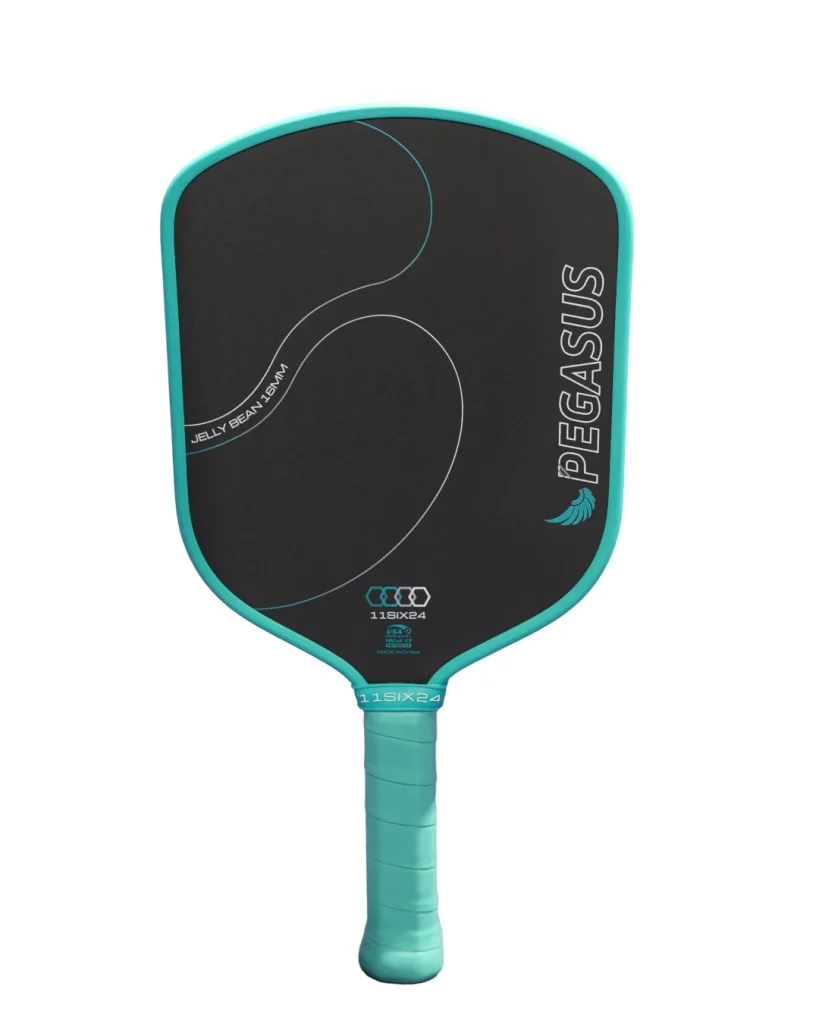
The Jelly Bean makes the early stages of pickleball feel less punishing. Its wide Pegasus shape puts a broad face behind the ball, and the twist weight of 7.21 tells the real story: contact near the edges stays usable instead of twisting the paddle open.
When I reach wide for a block or catch a dink late, the result is more likely to stay in play.
That forgiveness does not come with a dull face. The layered raw carbon surface produces strong measured spin, so a new player can learn to roll a volley and shape a dipping drive without immediately outgrowing the paddle.
The thermoformed honeycomb build also gives the response a soft, settled character. I feel the ball long enough to correct a drop, and counters do not launch unless my swing gets reckless.
At 8.0 to 8.3 ounces, it is not a feather, but the 107 swing weight keeps it moving well in exchanges. The tradeoff is reach and attacking leverage.
An elongated paddle gives a stronger player more leverage from the baseline, while this widebody favors clean contact and confidence around the kitchen. For a beginner building reliable mechanics, that is the right priority.
Buy it if you want a forgiving first serious paddle with real spin. Skip it if reach and maximum drive leverage are already the center of your game.
411SIX24 Pegasus Power 1 (Gen 3): Best Power Pickleball Paddle in 2027
AT A GLANCE
11SIX24 Pegasus Power 1 (Gen 3)
WEIGHT
8.0-8.3 oz
SWING WEIGHT
107
TWIST WEIGHT
7.21
SPIN
2,103 RPM
Shape: Widebody (Pegasus), 15.8 x 8.12 in
Grip: 4.125 in circumference, 5.75 in handle
Core: 16mm polypropylene honeycomb with EVA foam perimeter (Gen 3 thermoformed)
Face: CFC carbon/fiberglass/carbon
Approval: USAP
Feel: Stable power
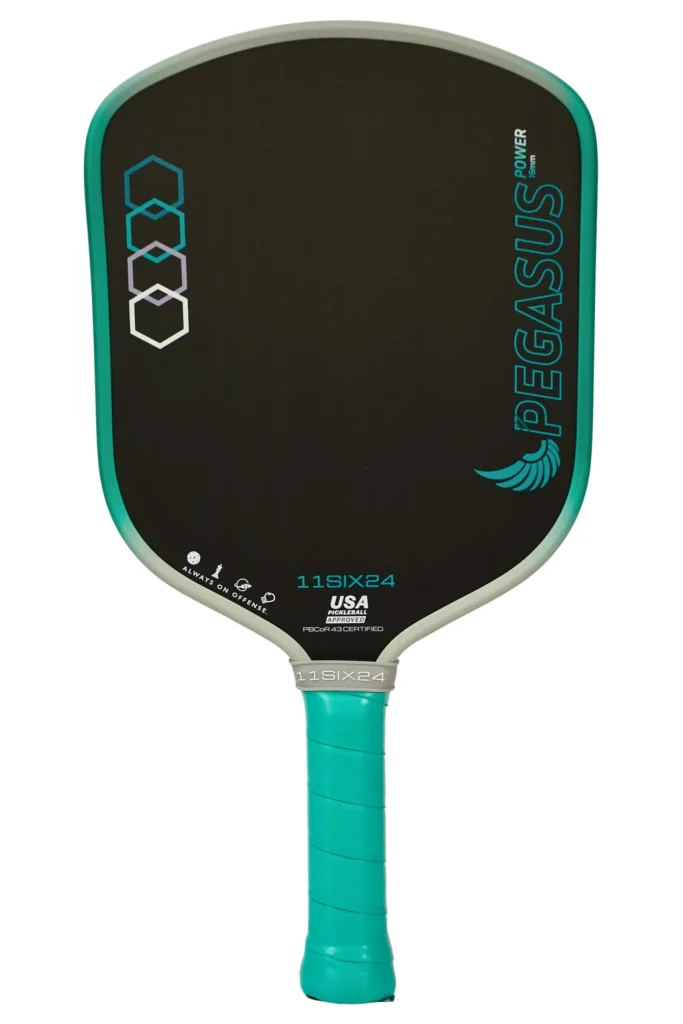
The Pegasus Power 1 is the more assertive widebody in this list. The foam perimeter firms up the edge, the layered face drives through the ball, and the broad outline protects the shot when contact drifts away from the middle.
I feel the difference on counters: instead of merely absorbing pace, the paddle sends the ball back with enough authority to keep an aggressive opponent honest.
Its measured profile is interesting because the headline numbers match the Jelly Bean above: a 107 swing weight, a 7.21 twist weight, and 2,103 RPM of spin. The playing personality is not identical, though.
This Gen 3 Power build feels crisper and pushes harder on full swings, while the long 5.75 inch handle gives two-handed backhands welcome room. Hands battles stay manageable because the swing weight remains moderate for such a stable frame.
Here is the context that must stay attached to it. The Power 1 is the previous-generation line, kept in the catalogue while the Power 2 sits above it. That does not make it obsolete on court, but nobody should buy it thinking it is the newest flagship.
Also check the exact Power 1 variant before sanctioned play, because the maker also sells paddles certified only through UPA-A. The approval care is about the precise model, not the family name.
Buy it if you want widebody stability with a firmer counterpunch. Skip it if owning the current generation matters more than how this one plays.
5Onix Evoke Premier Raw Carbon: Best Spin Pickleball Paddle in 2027
AT A GLANCE
Onix Evoke Premier Raw Carbon
WEIGHT
7.8-8.2 oz
SWING WEIGHT
-
TWIST WEIGHT
-
SPIN
-
Shape: Standard
Grip: -
Core: 16mm polymer honeycomb
Face: Raw carbon fiber
Approval: USAP
Feel: Crisp spin
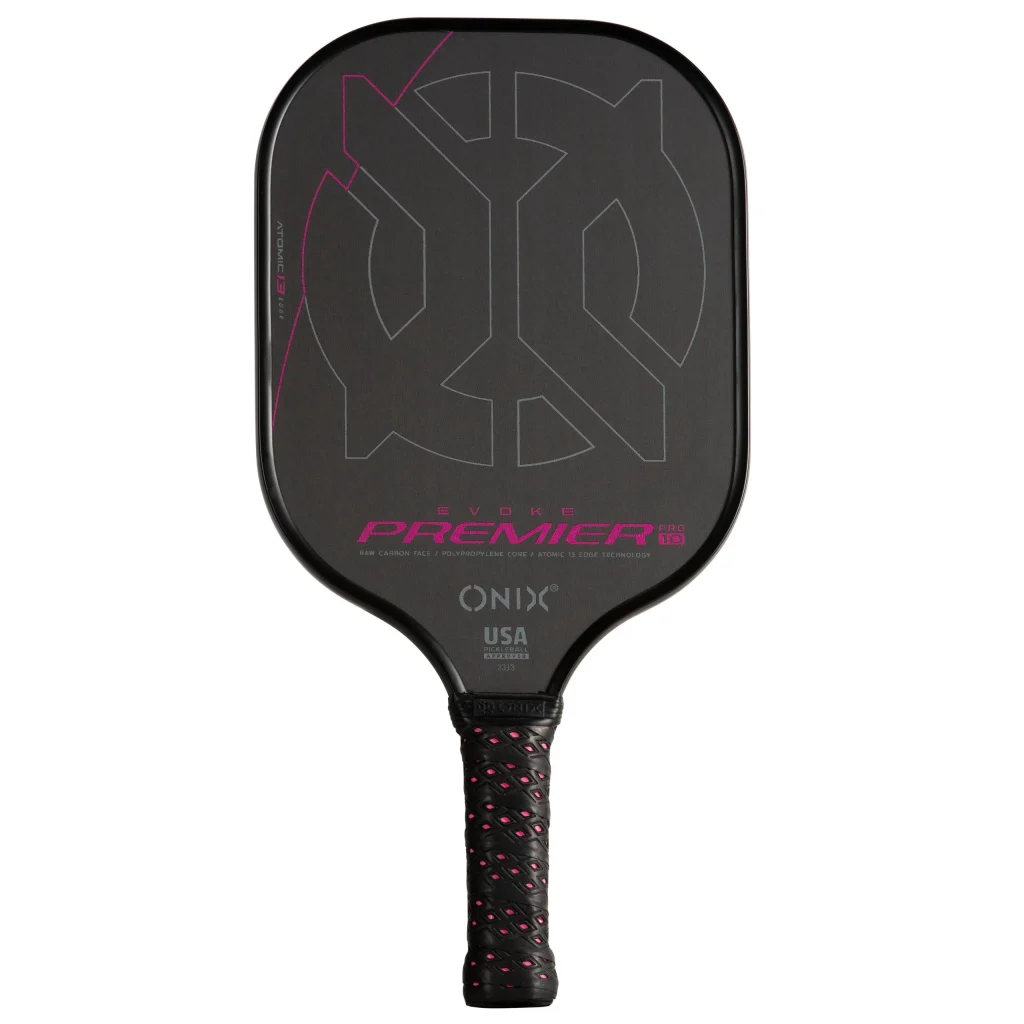
The Evoke Premier Raw Carbon earns its spin label from the way the face takes hold of the ball, not from a laboratory number I can print. That distinction matters.
I found no public swing weight, twist weight, or measured spin figure for this exact model, so the box leaves those fields unpublished instead of borrowing figures from a sibling variant.
On court, the response is crisp rather than plush. The raw carbon surface gives topspin drives a satisfying bite and lets me roll the ball at the kitchen without forcing the motion.
The standard shape keeps the head easy to place, and the thick polymer core settles blocks more calmly than the firm first contact suggests. It feels like a paddle for players who value clean mechanics and quick adjustments over a huge margin for error.
The narrower standard outline is also the limitation. Mishits toward the edge lose more than they do on the widebody picks, and the absence of published handling figures means buyers who shop by swing weight have less to go on.
Grip information was likewise not published in the material I could verify. None of that cancels the face’s appeal, but it makes this a more deliberate choice.
Buy it if face bite and a crisp standard shape are your priorities. Skip it if you need published handling data or the forgiveness of a widebody.
6Onix Graphite Z5: Best Widebody Pickleball Paddle in 2027
AT A GLANCE
Onix Graphite Z5
WEIGHT
7.5-8.2 oz
SWING WEIGHT
-
TWIST WEIGHT
-
SPIN
-
Shape: Widebody, 15.5 x 8.125 in
Grip: 5 in handle, 4.25 in circumference
Core: Nomex honeycomb
Face: Graphite
Approval: USAP
Feel: Crisp control
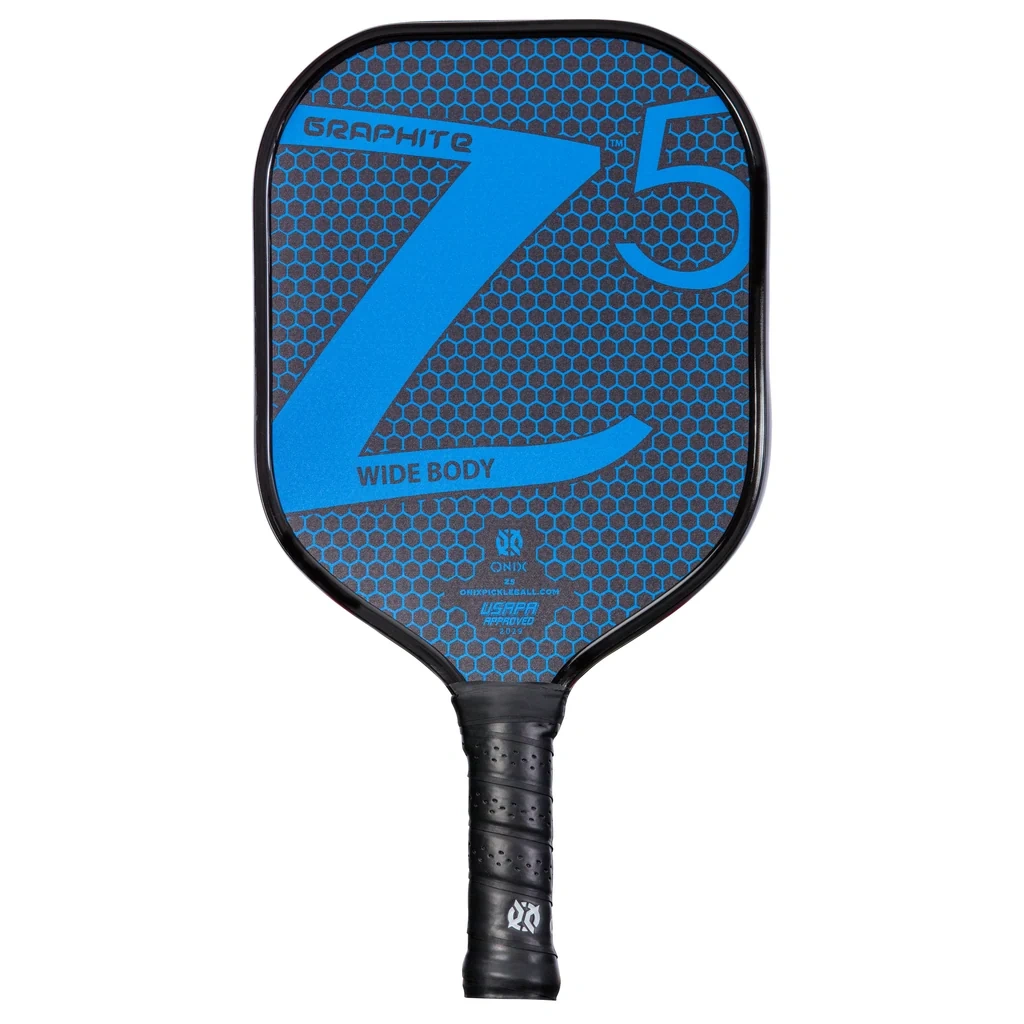
The Z5 has survived in a sport that replaces models constantly because its basic bargain still works. A broad 8.125 inch face gives developing players a generous target, while the graphite surface and Nomex honeycomb produce a crisp, immediate response.
I always know where contact happened, which makes it a useful teaching paddle as well as a straightforward match paddle.
It plays more directly than the softer thermoformed picks. Blocks come off cleanly, volleys feel precise, and the wide face helps when a fast exchange pushes contact away from the center.
There are no published laboratory swing weight, twist weight, or spin figures to dress that up, and I am not going to invent a modern data profile for a long-running design. The specs that matter are visible in the shape and in the feedback through the handle.
That feedback can become a weakness. The Z5 feels firmer on mishits, its spin ceiling is lower than the raw carbon models here, and stronger players may find its power ordinary once their swings develop.
Yet its simplicity is also refreshing: no complicated break-in story, no extreme head weight, and no need to relearn your touch every few games. It remains a clear, honest widebody.
Buy it if you want a broad face and direct control feedback. Skip it if maximum spin and a plush response lead your list.
7Friday Challenger 16mm: Best Elongated Pickleball Paddle in 2027
AT A GLANCE
Friday Challenger 16mm
WEIGHT
8.0 oz
SWING WEIGHT
122 (brand-published)
TWIST WEIGHT
6.38 (brand-published)
SPIN
1,890 RPM (brand-published)
Shape: Elongated, 16.5 x 7.5 in
Grip: 5.5 in handle, 4.25 in circumference
Core: 16mm polypropylene honeycomb, thermoformed with foam-injected walls
Face: Double-layer T700 raw carbon fiber
Approval: USAP
Feel: Firm power
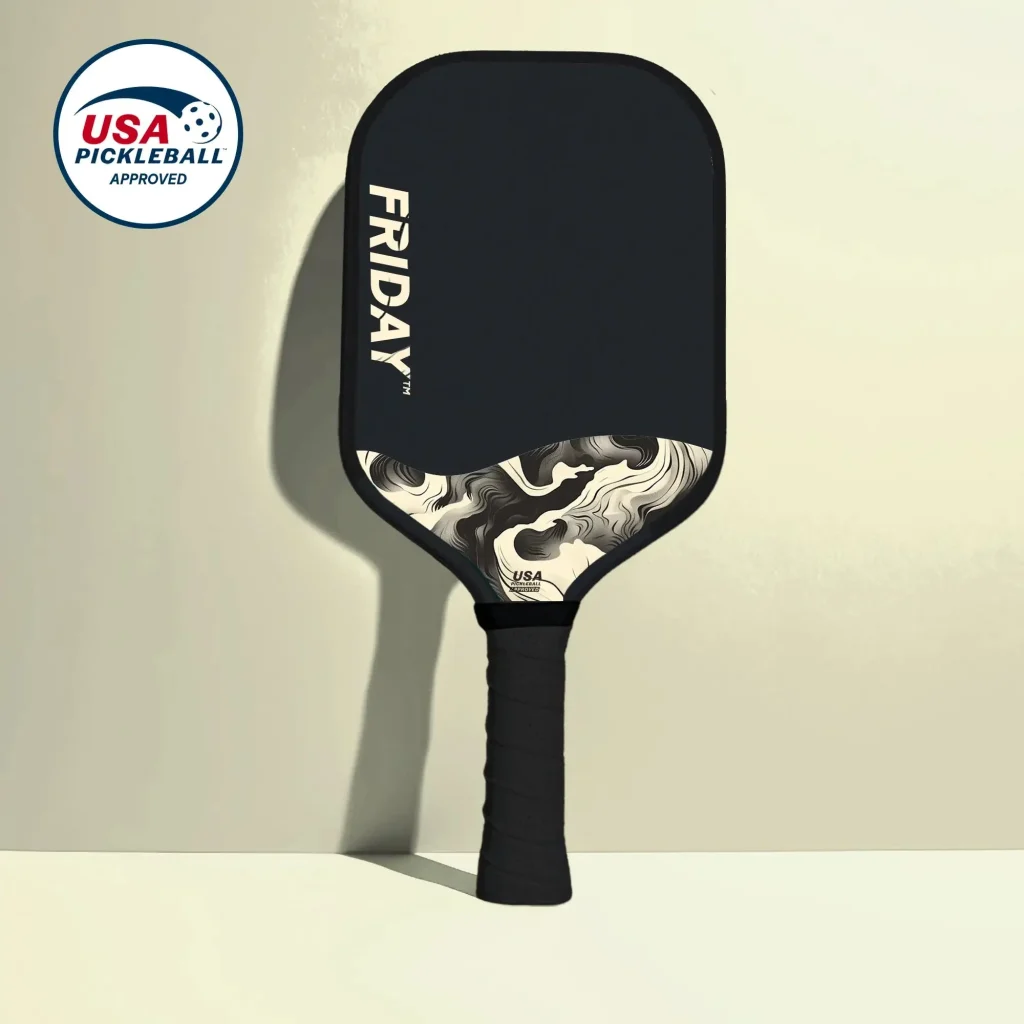
The Challenger is the heavy hitter of this group, and its brand-published 122 swing weight explains why. The elongated head carries real leverage into serves and drives, so the ball leaves with pace when I swing through it properly.
The narrow frame also reaches balls at the kitchen that a standard shape forces me to lunge for, and the long handle leaves useful room for a two-handed backhand.
Foam-injected walls and a 6.38 twist weight keep that leverage from becoming completely unruly. Stretched blocks still demand good positioning, but the face does not collapse the moment contact moves high or wide.
The double-layer raw carbon surface adds useful grip for dipping drives, with a brand-published spin figure of 1,890 RPM. I would describe the personality as firm and purposeful rather than soft.
That head weight is not free. Hands battles require earlier preparation, and long sessions can expose a player who relies on wrist speed instead of clean positioning.
Resets also need discipline, because the same leverage that powers a drive can send a careless block long. This is not the easiest paddle here, and it should not pretend to be. It rewards a stronger, more deliberate swing.
Buy it if you want elongated reach and the firmest drive in this list. Skip it if fast hands and easy resets matter more than baseline leverage.
8Six Zero Quartz: Best for Fast Hands Pickleball Paddle in 2027
AT A GLANCE
Six Zero Quartz
WEIGHT
7.6-8.2 oz (avg 7.9 oz)
SWING WEIGHT
108
TWIST WEIGHT
6.4
SPIN
1,950 RPM
Shape: Standard, 16 x 7.9 in
Grip: 5 in handle, 4.25 in circumference
Core: 15mm polypropylene honeycomb
Face: Raw carbon fiber (T300)
Approval: USAP
Feel: Light control
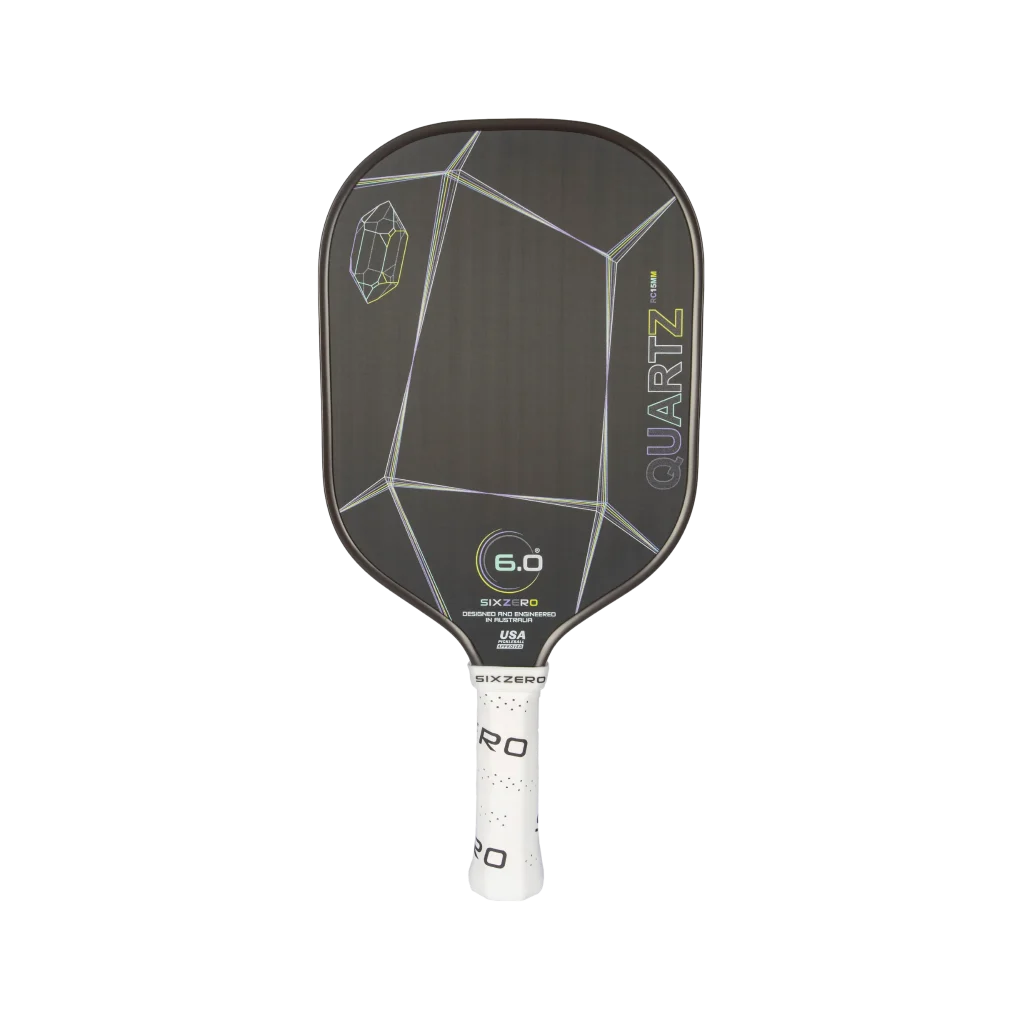
The Quartz feels quick the moment a hands battle starts. Its average weight sits under eight ounces, the published swing weight is a manageable 108, and the standard shape changes direction without the delay I feel from a head-heavy elongated paddle.
Counters come up on time, and I can reset my grip between shots instead of fighting the paddle’s momentum.
Quick does not mean flimsy. A 6.4 twist weight gives the face respectable steadiness for its size, and the raw carbon surface produces a published spin figure of 1,950 RPM.
Drives dip enough to stay aggressive, while dinks and rolls feel connected rather than floaty. The 15mm core gives contact a slightly livelier edge than the thickest control models, which suits players who like information coming back through their hands.
The limits show against heavy hitters. There is less plow-through than the Challenger or Prism Flash provide, and a passive block can get pushed around if I am late. Baseline power has to come from technique and timing rather than mass.
Players who already own a fast, compact swing will see those as fair terms. Players looking for a paddle to add force to a short swing should look elsewhere in this list.
Buy it if kitchen speed and light control define your game. Skip it if you need head weight to stabilize blocks against hard drivers.
9Selkirk SLK EVO Control 2.0 Max (16mm): Best Control Pickleball Paddle in 2027
AT A GLANCE
Selkirk SLK EVO Control 2.0 Max (16mm)
WEIGHT
7.6-8.1 oz
SWING WEIGHT
-
TWIST WEIGHT
-
SPIN
-
Shape: Max (standard/wide), 16 x 7.85 in
Grip: 4.85 in handle, 4.25 in circumference
Core: 16mm Rev-Control polymer core
Face: C7-Flex hybrid fiberglass with SpinFlex texture
Approval: USAP
Feel: Soft control
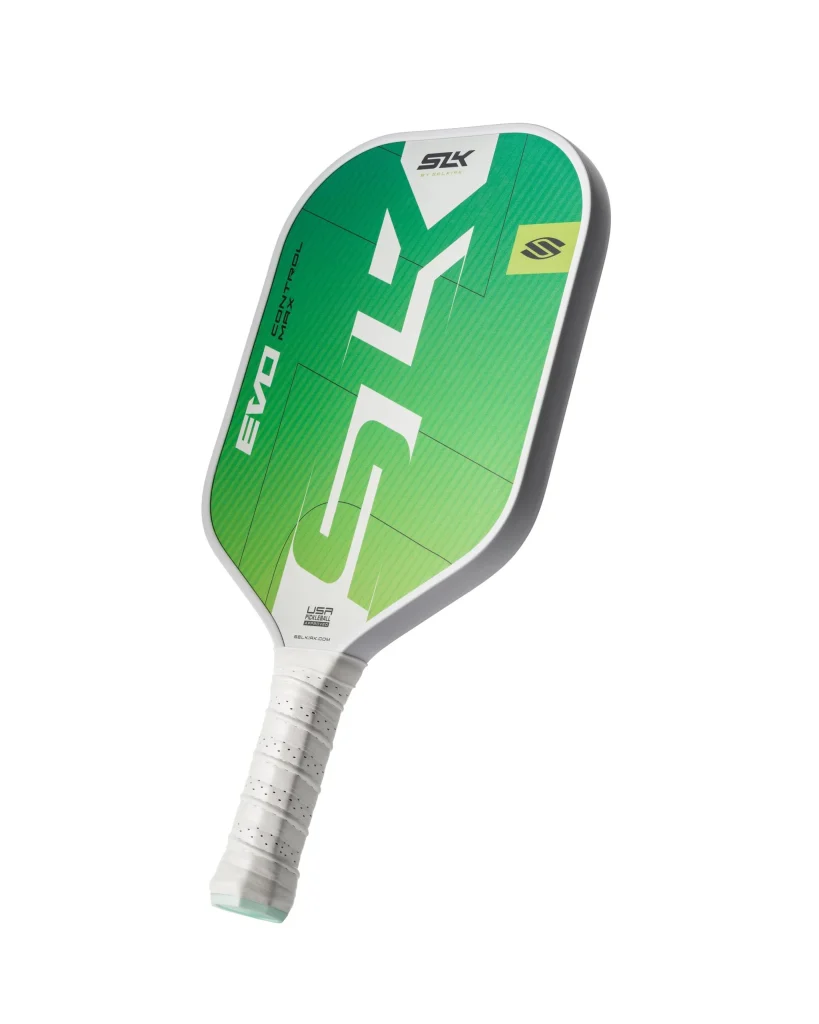
The EVO Control 2.0 Max is for the player who would rather place three balls carefully than blast one and hope.
Its thick Rev-Control polymer core gives contact a soft, settled feel, and the Max outline adds enough width to make blocks and resets less fragile. When a rally speeds up, I can take pace off the ball without the face feeling dead.
The C7-Flex hybrid fiberglass face is different from the raw carbon models dominating this list. It has a textured SpinFlex surface, so it can shape the ball, but the personality is smoother and less abrasive.
I would not choose it to chase the highest spin ceiling. I would choose it for dependable drops, patient dinking, and a response that stays predictable when contact is not perfect.
Selkirk does not give me published swing weight, twist weight, or spin figures for this exact model in the material I could verify, so those fields stay unpublished rather than borrowed from the Power or Hybrid versions in the same family.
That family point matters when buying as well: this pick is specifically the Control version in the 16mm Max shape. Within that exact brief, it is a composed and confidence-building paddle.
Buy it if soft control and a forgiving Max shape suit your game. Skip it if raw carbon bite and maximum spin are non-negotiable.
10Franklin Signature Pro 16mm: Best Durability Pickleball Paddle in 2027
AT A GLANCE
Franklin Signature Pro 16mm
WEIGHT
7.9-8.3 oz
SWING WEIGHT
116
TWIST WEIGHT
6.95
SPIN
-
Shape: Elongated, 16.5 x 7.3 in
Grip: 5.6 in handle, 4.5 in circumference
Core: 16mm polypropylene
Face: Fiberglass with MaxGrit surface
Approval: USAP
Feel: Solid power

The Signature Pro has been around long enough to prove that its formula is more than a launch-season story.
Franklin’s fiberglass face and thick polypropylene build give it a solid, hard-wearing character, while the narrow elongated shape adds reach and leverage. It feels substantial in a good way, like a paddle built to be played hard rather than handled delicately.
Retailer-published handling figures point to a 116 swing weight and a strong 6.95 twist weight. On court, that combination gives drives useful weight and keeps stretched contact from folding open.
The MaxGrit fiberglass surface is not a raw carbon face, so I am not assigning it a spin figure I could not verify. It still grips well enough to shape the ball, but its clear strengths are stability, reach, and repeatable power.
The grip needs a transparent note. Franklin’s published sheets do not agree perfectly on the circumference for this 16mm model: the figure used in the box is 4.5 inches, while another Franklin sheet lists 4.75 inches.
The 5.6 inch handle length is the part I notice most, especially for a two-handed backhand. Players who are sensitive to small grip differences should check the exact paddle in hand rather than treating either published figure as beyond dispute.
Buy it if you want an elongated workhorse with stability and a long service record. Skip it if a slim, precisely documented grip is essential.
How to Choose a Pickleball Paddle Under $100 in 2027
This class has become crowded because construction has moved quickly. The safest way to choose is to start with how you lose points, not with a headline figure.
A player whose blocks sail long needs a different paddle from a player whose drives lack dip, and both need something different from a beginner whose contact still wanders across the face. Use the sections below to match construction and shape to the problem you are actually trying to solve.
What This Band Unlocks
The biggest change is access to construction that used to sit in higher tiers. Thermoformed unibody builds, foam-injected walls, and raw carbon faces now appear together, and those features change real shots.
A thermoformed paddle usually gives a larger, more consistent sweet spot. Foam around the perimeter can steady the edge, and a textured carbon face lets a developing swing create useful topspin.
Measured data is the other unlock. Swing weight tells you how heavy the paddle feels in motion, twist weight hints at forgiveness, and spin figures give a rough guide to face grip.
Those figures are not perfect across every test method, but they are more useful than choosing by weight alone. Read them together and compare paddles within the same general shape before drawing conclusions.
Thermoforming, Explained
Thermoforming moulds the paddle as a connected unibody instead of relying only on separate pieces joined around a core.
In play, the benefit is consistency: contact toward the edge feels less abrupt, the face responds more evenly, and the structure can hold its shape well over time. It is one reason several paddles in this list feel more composed than older honeycomb models with similar dimensions.
Foam-enhanced builds have a break-in period to understand. Some become slightly livelier as the materials settle, so the paddle you judge in the first hour may not be the exact paddle you own after several sessions.
That is not automatically a flaw. Give a new thermoformed paddle time, pay attention to resets, and adjust your touch before deciding that it has too much pop.
Raw Carbon vs Fiberglass Faces
Raw carbon is the spin-first choice. Its peel-ply texture grips the ball, helps drives dip, and gives roll volleys a clear bite.
It also asks for sound technique: a flat, rushed swing will not magically become a heavy topspin shot. Over time, heavy use smooths the exposed grit, so the sharpest spin usually belongs to the earlier part of the face’s life.
Fiberglass plays a different game. It often feels smoother or springier, can help a player generate pace, and may use an applied textured surface rather than exposed peel-ply grit. That surface can wear too, just by a different route.
Choose carbon if shaping the ball is central to your game. Choose fiberglass if you prefer its contact feel and a steadier route to power, and inspect the surface regularly either way.
Approval, Stated Plainly
Approval belongs to an exact paddle model and variant, not to a brand as a whole. USAP approval is the safe route for sanctioned league and tournament play.
A UPA-A-only paddle can be legal for UPA events and perfectly enjoyable for recreational games, drilling, and unsanctioned competition, but it should not be carried into a USAP event on the assumption that another model from the same maker is approved.
That is why the exact variant language matters on this page. I did not knowingly include a UPA-A-only model in the ten, but the Saga Flash carries a specific instruction to verify the exact version, and the Pegasus Power 1 needs the same care because its maker sells more than one certification path.
When an event matters, check the paddle name, shape, and approval listing together before you travel.
Shape and Grip Choices
Widebody paddles spread their width across the face and usually raise twist weight, which makes them forgiving when contact is off center. They suit beginners, fast kitchen exchanges, and players who block more than they drive.
Elongated paddles add reach and leverage, but they often raise swing weight, so the same player may gain baseline power while losing a little hand speed.
Hybrid shapes split those priorities and are often the sensible middle ground. After shape, check the grip. Circumference controls how securely the paddle sits in the hand, while handle length decides how much room a two-handed backhand has.
A grip that is too large can slow wrist movement; one that is too small can invite squeezing and twisting. Use an overgrip for small adjustments, not to rescue a fundamentally wrong fit.
The Upgrade Path
A good paddle in this class can stay competitive for a long time. The usual reason to replace it is not that it suddenly becomes unplayable. Grit fades, the edge takes damage, the core response changes, or your game develops until a weakness becomes obvious.
A control player may eventually want more putaway power; a power player may want a calmer reset; a beginner may simply learn what shape fits their hands.
The next step up buys refinement: more precise construction, better quality control, a wider choice of shapes and swing weights, and sometimes stronger measured performance. It does not buy a new technique or erase poor shot selection.
Upgrade when you can name the exact limitation you are trying to remove. Until then, a well-chosen paddle from this list is not a placeholder. It is a complete piece of equipment.
Frequently Asked Questions (FAQs)
1. What is the best pickleball paddle in this class overall?
The Vatic Pro Prism Flash 16mm is my overall pick. Its plush control, strong measured spin, 6.47 twist weight, and hybrid shape make it the most complete option here for the widest range of players.
2. Do paddles in this class really play like flagship paddles?
They can come close in construction and in many ordinary rallies. Thermoforming, raw carbon, and foam-injected edges are no longer exclusive to flagship lines, but top models still tend to offer more refinement, more shape choices, and tighter consistency from one paddle to the next.
3. What does thermoformed mean, and does it matter?
Thermoformed means the paddle is moulded into a connected unibody structure. It matters because that build usually creates a larger and more consistent sweet spot, steadier edge response, and better durability than a basic joined construction.
4. Raw carbon or fiberglass face: which should I choose?
Choose raw carbon if spin and ball bite are your priorities. Choose fiberglass if you prefer a smoother or springier contact feel and a simpler route to pace, accepting that its textured surface will also wear with use.
5. Are these paddles legal for league and tournament play?
Most of the ten are listed as USAP approved, but legality always belongs to the exact model and variant. Check the Saga Flash version carefully before sanctioned play, and confirm the exact Pegasus Power 1 variant as well, because approval does not transfer across a whole brand or family.
6. What is the difference between USAP and UPA-A approval?
USAP approval covers USA Pickleball sanctioned play, while UPA-A approval covers events run under the United Pickleball Association pathway. A paddle approved only by UPA-A is not automatically legal for a USAP sanctioned event.
7. Which shape is best for a beginner: widebody, hybrid, or elongated?
A widebody is usually best for a beginner because its broader face and higher twist weight forgive off-center contact. A hybrid is the next step when you want a little more reach without giving up too much forgiveness.
8. How much spin can I honestly expect from a paddle in this class?
You can expect genuinely useful spin, including dipping drives and controlled roll volleys, from the stronger raw carbon faces here. Technique still decides most of the result, and published spin figures vary by test method, so use them as a guide rather than a promise.
9. How long will the grit and spin last?
It depends on how often and how hard you play, because grit fades gradually rather than failing on one fixed date. Heavy play smooths peel-ply carbon over time, while applied textured surfaces wear by contact and abrasion, so inspect the face and judge by how the ball responds.
10. Is a 16mm core better than a 14mm core at this level?
A 16mm core is usually calmer and more forgiving, while a 14mm core usually feels quicker and livelier. Neither is automatically better; the right choice depends on whether you need help settling the ball or help adding response and hand speed.
11. What grip size and handle length should I pick?
Pick a circumference that lets you hold the paddle securely without squeezing, and choose handle length around your backhand style. One-handed players often need less handle, while two-handed backhand players benefit from the longer handles on several picks in this list.
12. When will I need to upgrade from a paddle in this class?
You will need to upgrade when you can name a specific limitation that is holding back your game, such as faded grit, a shape that no longer fits your strokes, or a response that cannot produce the shots you now play. Until that point, a sound paddle in this class can remain competitive for a long time.

Michael Stevenson
Hi, my name is Michael Stevenson and I’m a passionate pickleball player. I’ve been playing the game for many years and I’m pretty highly skilled at it. Pickleball is one of my favorite topics so naturally, I love to write about it.
Whether it’s tips for beginners, guides for experts, reviews of new paddles, or advanced playing techniques – if it relates to pickleball then I have something interesting to write about it. So if you’re looking for entertaining and informative information on the topic of pickleball, look no further than my written works!