
Best pickleball shoes for men must handle harder loads than most shoes, because men put more weight behind every plant and drag their toes more.
These ten picks lean toward durability, stability and genuine width options, and some are pickleball shoes while others are tennis shoes borrowed for toughness. Every weight below carries the shoe size it was measured in, because an ounce means nothing without the size attached to it for comparison.
The K-Swiss Express Light Pickleball 2 is the best overall pickleball shoes for men because it does the most things well in one light shoe. At 10.9 ounces in a men’s 9 it is the lightest shoe on this page, so your calves feel fresher in the third hour.
Its outsole uses a herringbone tread with DragGuard at the toe and heel, and herringbone means a zigzag pattern that grips in every direction here. The upper is reinforced where men scuff and drag, and it comes in a 2E wide, so check its Amazon listing through the link below.
The 10 Best Pickleball Shoes for Men in 2027
1K-Swiss Express Light Pickleball 2: Best Overall Pickleball Shoes for Men in 2027
AT A GLANCE | K-Swiss Express Light Pickleball 2
Weight
10.9 oz (men’s US 9)
Outsole
Non-marking rubber, modified herringbone with DragGuard
Cushioning
CMEVA midsole
Fit
Medium width, 2E wide exists
Type: Pickleball-specific
Sizing: Men’s
Upper: Synthetic and mesh, reinforced in high-wear zones
Midsole: CMEVA
Non-marking: Yes
Stability: Not published
Feel: Light and versatile
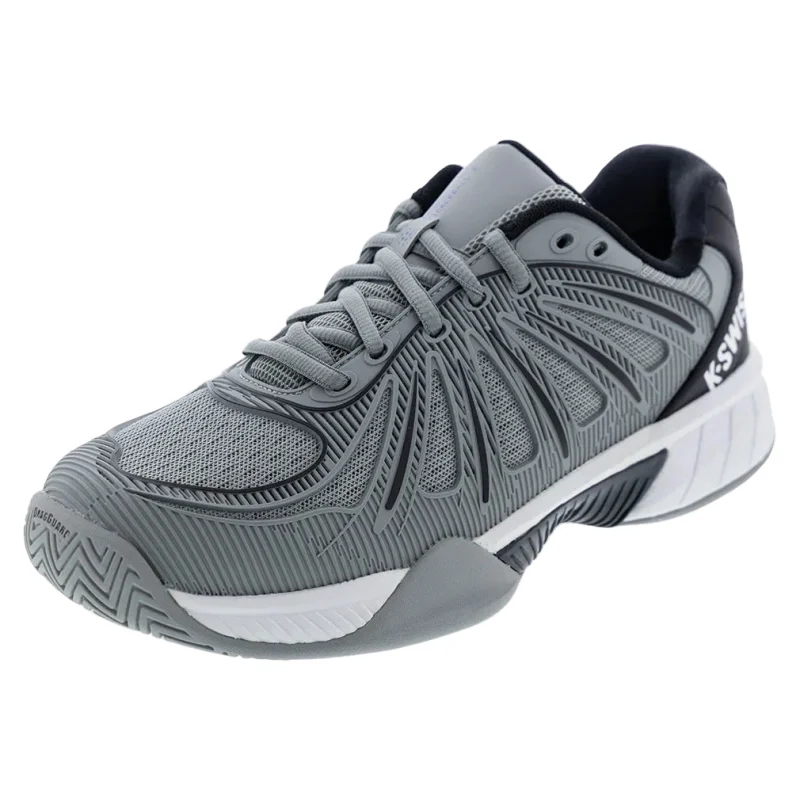
Start with the shoe that does the most things well.
The Express Light Pickleball 2 is the current version of the shoe that made K-Swiss the default name in pickleball footwear, and the update keeps the formula honest: a modified herringbone outsole in non-marking rubber, DragGuard reinforcement where the toe and heel take their beating, and a CMEVA midsole that gives a medium, dependable cushion rather than a marshmallow.
On court it feels like the shoe has read the sport’s movement patterns and answered each one plainly.
What I noticed most across long sessions was the upper. It is synthetic and mesh, but reinforced in the high-wear zones, and that matters for men who drag a toe or scuff the inside of the shoe on lunges.
The first version of this shoe survived months as a tester’s main pair with its durability rated at the top of the scale, and the 2 keeps that build philosophy. At 10.9 ounces in a men’s 9 it is also the lightest shoe on this page, which your calves will appreciate in the third hour.
One honest gap: K-Swiss does not publish a named stability system for this generation, so the box says so rather than borrowing the old model’s spec sheet. The support story here is the last shape and the outsole geometry, and in play that proves to be enough for most men.
Buy it if you want one shoe that covers the whole brief. Skip it if you need maximum cushioning or a heavyweight stability build.
2Skechers Viper Court Pro 2.0: Best Cushioning and Extra Wide Pickleball Shoes for Men in 2027
AT A GLANCE | Skechers Viper Court Pro 2.0
Weight
-
Outsole
Goodyear Gold rubber
Cushioning
ULTRA GO foam
Fit
Relaxed Fit, Medium and Extra Wide
Type: Pickleball-specific
Sizing: Men’s
Upper: Engineered mesh
Midsole: ULTRA GO foam
Non-marking: Not published
Arch support: Arch Fit
Insole: Removable Arch Fit EVA insole
Feel: Cushioned and roomy
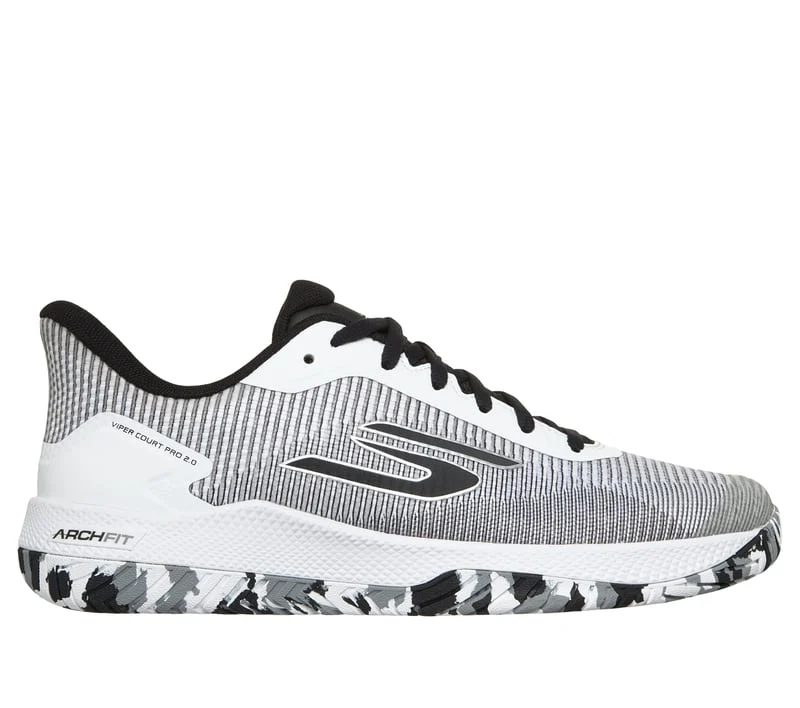
If cushioning and width are your two problems, this is the shoe built to solve both at once.
The Viper Court Pro 2.0 pairs an ULTRA GO foam midsole with Skechers’ Arch Fit insole, a shaped, removable footbed that supports the arch instead of leaving it to fend for itself, and for men whose feet ache after long sessions that combination is the whole story.
The insole comes out, too, so if you run your own orthotic, it drops straight in.
The fit is the second headline. The Relaxed Fit last gives the forefoot genuine room, and this is the only Skechers pickleball shoe offered in Extra Wide, which makes it one of the very few performance options for men whose feet simply do not fit a standard last.
The outsole is Goodyear Gold compound rubber, and the engineered mesh upper has been redesigned with durability in mind, answering the main complaint about softer comfort shoes.
Two honest notes. Skechers does not publish a weight for this shoe, and it does not publish a formal non-marking rating in its spec material either, although the brand describes the outsole as non-marking in its own answers to buyers; if your indoor facility is strict, confirm before you commit.
Neither gap changes how it plays: this is the most forgiving ride on the page.
Buy it if your feet hurt after sessions or you need real extra width. Skip it if you want a narrow, locked-down performance fit.
3Selkirk CourtStrike Pro 3.0: Best Outsole Warranty Pickleball Shoes for Men in 2027
AT A GLANCE | Selkirk CourtStrike Pro 3.0
Weight
13.0 oz (men’s US 9)
Outsole
4-way grip rubber with stability outrigger
Cushioning
EVA PureFoam
Fit
Snug
Type: Pickleball-specific
Sizing: Men’s 7-14
Upper: Premium engineered mesh with abrasion-resistant lining
Midsole: EVA PureFoam
Non-marking: Not published
Stability: TPU shank and outrigger
Insole: Removable supercritical foam
Warranty: 6-month outsole warranty
Feel: Stable and grippy
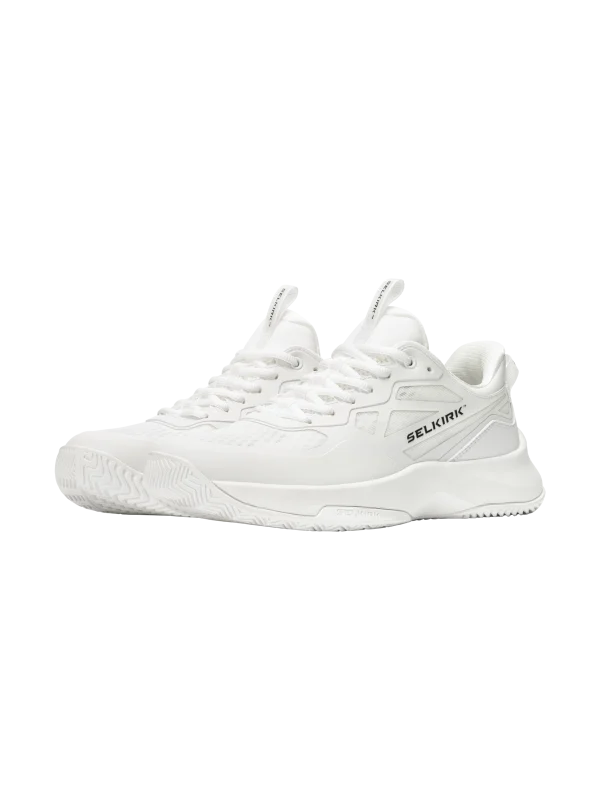
Some men do not wear shoes out. They destroy them, usually at the ball of the foot where every pivot grinds.
The CourtStrike Pro 3.0 is the pick for that player, because Selkirk backs its outsole with a published 6-month outsole warranty, the only pickleball-specific shoe here that puts a guarantee behind its rubber. That tells you how the brand expects the shoe to be used: hard, often, by men who go through soles.
The build matches the promise. The outsole is a 4-way grip rubber with a stability outrigger flaring at the forefoot, so lateral plants land on a wider base.
A TPU shank runs through the midfoot to resist twisting, the EVA PureFoam midsole keeps the ride firm and controlled, and the insole is a removable supercritical foam unit, a step up in spring from a basic sockliner and easy to swap if you prefer your own.
The premium engineered mesh upper carries an abrasion-resistant lining where the shoe rubs and drags.
At 13.0 ounces in a men’s 9 it sits in the middle of this page on weight, and the fit runs snug, so men between sizes or with wider feet should try before committing. Selkirk does not publish a non-marking rating, so the box leaves it open. What is published, and what decides this pick, is the warranty.
Buy it if you burn through outsoles. Skip it if you have wide feet or want a plush ride.
4K-Swiss Pickleball Supreme: Best Pickleball Shoes for Men Who Play Every Day in 2027
AT A GLANCE | K-Swiss Pickleball Supreme
Weight
-
Outsole
Aosta 7.0 rubber with DragGuard 7.0
Cushioning
Surge 7.0 midsole
Fit
K-Swiss advises half a size up
Type: Pickleball-specific
Sizing: Men’s
Upper: Durawrap Flex
Midsole: Surge 7.0
Non-marking: Yes
Stability: 180 PSC chassis
Feel: Locked-in durability

The Supreme is the K-Swiss built for volume: the player on court five to seven days a week, whose shoes die from accumulated punishment rather than one bad moment.
Its support story is the most explicit on this page, a 180 PSC chassis, a thermoplastic Plantar Support Chassis that braces the midfoot against twisting when a plant lands off balance. You feel it as a shoe that refuses to fold, and for heavier men that refusal is worth more than any foam claim.
Around that chassis, everything is reinforced. The Aosta 7.0 outsole is non-marking, with DragGuard 7.0 in the toe and heel wear areas, the Durawrap Flex upper holds the midfoot like a strap, and the Surge 7.0 midsole is firmer and more responsive than the brand’s softer builds, so push-offs feel direct rather than absorbed.
In testing by players who log heavy hours, the reinforced toe box survived a month of serious toe-dragging, which is where most men’s shoes surrender first.
Sizing needs honesty, because the guidance conflicts. K-Swiss advises ordering half a size up and warns the support can take some time to adjust to, while at least one tester found it true to size with room for wider feet.
My advice: follow the brand, order the half size up, and give the chassis a few sessions before judging it. K-Swiss does not publish a weight.
Buy it if you play most days and kill shoes with mileage. Skip it if you play twice a month and want instant comfort.
5Mizuno Wave Exceed Tour 7 AC: Best Performance Fit Pickleball Shoes for Men in 2027
AT A GLANCE | Mizuno Wave Exceed Tour 7 AC
Weight
Under 13 oz (men’s US 10.5)
Outsole
DX Rubber, all-court
Cushioning
ENERZY XP and ENERZY NXT
Fit
True to size, snug
Type: General court (tennis)
Sizing: Men’s
Upper: Engineered mesh
Midsole: ENERZY XP with WAVE plate
Non-marking: Not published
Stability: WAVE plate and D-Flex Groove
Warranty: 6-month outsole guarantee (AC version, US)
Feel: Fast and precise
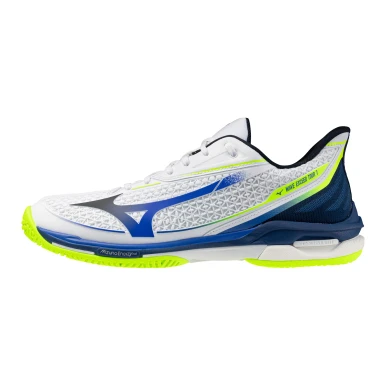
Honest labelling: this is a tennis shoe, Mizuno’s all-court tour model, and it earns its place because Mizuno pitches it at pickleball and its hardware answers pickleball’s questions.
The heart of it is the WAVE plate running through the midsole, a stability structure that spreads load and resists the twist of a hard lateral plant, backed by a D-Flex Groove designed to enhance lateral stability.
Playtesters were split on exactly how locked-in it felt, and that split is worth knowing: this is a performance fit, snug and precise, not a relaxed one.
The cushioning stack pairs ENERZY XP in the forefoot and heel with ENERZY NXT, and the result is a responsive, court-connected ride that suits men who play on their toes and win points with first steps.
The DX Rubber outsole is the all-court AC version, and that detail matters, because Mizuno’s 6-month outsole guarantee applies to the AC version in the US. Few tennis crossovers offer pickleball players that kind of backing.
At under 13 ounces in a men’s 10.5 on a playtest scale, it carries its structure lightly. Mizuno does not publish a consumer weight or a non-marking rating, so both boxes stay honest. Men with wide feet should look at the New Balance picks below; this last is for standard and narrower feet that want precision.
Buy it if you want a fast, structured, performance fit. Skip it if you need width or a soft, forgiving ride.
6Wilson Rush Pro 4.5: Best Tennis Crossover Pickleball Shoes for Men in 2027
AT A GLANCE | Wilson Rush Pro 4.5
Weight
-
Outsole
Duralast rubber, herringbone
Cushioning
R-DST+ with Energy Cell EVA
Fit
Medium
Type: General court (tennis)
Sizing: Men’s
Upper: Engineered mesh with lateral drag pad
Midsole: R-DST+
Non-marking: Not published
Stability: 4D Support Chassis 2.0 and Endofit
Feel: Powerful and planted
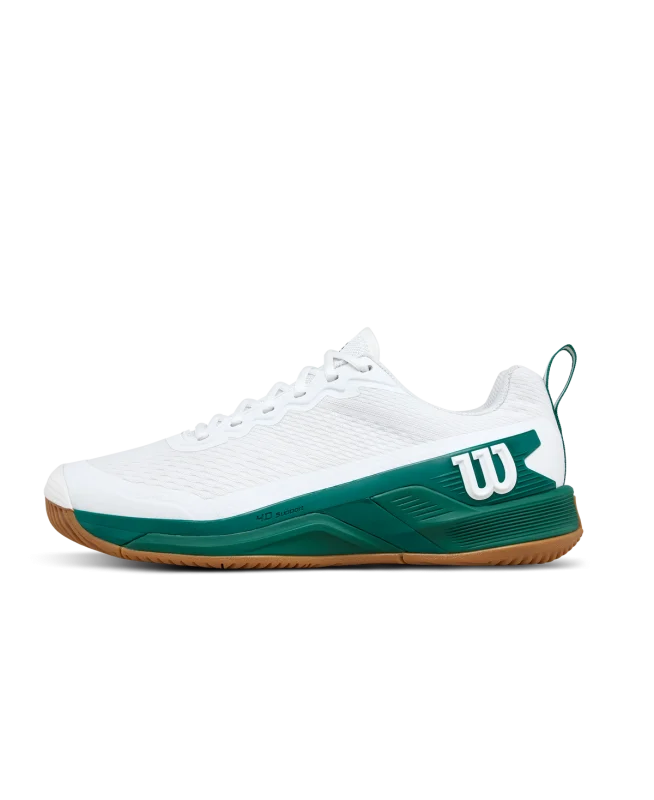
The Rush Pro is Wilson’s best-selling tennis franchise, and powerful movers keep borrowing it for pickleball for one reason: it is built to survive force.
The 4D Support Chassis 2.0 runs through the shoe to limit how far it can twist and roll under a heavy plant, the Endofit inner sock holds the foot inside the shoe instead of letting it slide, and the outsole is Duralast, a high-density rubber in a herringbone pattern that trades a little softness for a great deal of life.
The detail that gives it away as a shoe designed by people who watch feet is the enlarged lateral drag pad on the upper. Toe draggers and inside-of-the-foot draggers shred that zone on lesser shoes, and Wilson armoured it.
The R-DST+ midsole with a Lightweight Energy Cell under the forefoot keeps the ride responsive rather than dead, so the shoe pushes back when you drive off it. For a man who plays pickleball the way he played every other sport, at full commitment, this is the crossover that keeps up.
The honest gaps: Wilson does not publish a weight for the 4.5, and no non-marking rating was published in the material I checked, so both boxes say so. Its fit is a traditional medium, so genuinely wide feet should take the 2E options elsewhere on this page. What it offers instead is structure and durability in a proven package.
Buy it if you are a powerful mover who destroys lighter shoes. Skip it if you need width or a featherweight feel.
7Wilson Pickle Pro: Best Roomy Toe Box Pickleball Shoes for Men in 2027
AT A GLANCE | Wilson Pickle Pro
Weight
12.8 oz (men’s US 10.5)
Outsole
Duralast rubber
Cushioning
Court EVA with 6 mm OrthoLite sockliner
Fit
Roomy toe box
Type: Pickleball-specific
Sizing: Men’s
Upper: Engineered mesh
Midsole: Court EVA
Non-marking: Not published
Stability: Midfoot saddle support
Insole: Removable OrthoLite sockliner
Feel: Roomy and ready
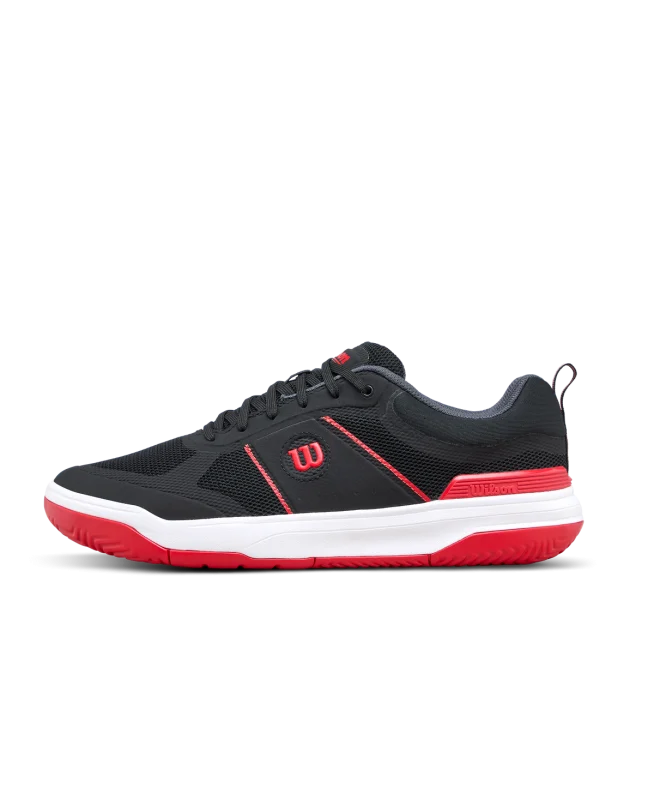
Wilson’s pickleball-specific entry takes the opposite approach to its tennis sibling: where the Rush Pro locks you down, the Pickle Pro gives your forefoot room to work.
The toe box is genuinely roomy, roomy enough that Wilson itself notes it accommodates wider feet, and on plants that room shows up as balance, because toes that can spread can stabilise. For men whose feet swell over a long session, that extra space is the difference between finishing the evening and sitting out the last games.
The rest of the shoe is sensibly built. The Duralast outsole is rated by Wilson for maximum traction on all surfaces, a midfoot saddle support system holds the middle of the shoe together, and the cushioning pairs a court EVA midsole with a 6 mm OrthoLite sockliner that removes if you want to run your own insole.
In testing, the grip impressed and the sole showed minimal wear after weeks of play, and the shoe is game-ready with no break-in period, which men who rotate pairs will appreciate.
At 12.8 ounces in a men’s 10.5 it is mid-weight and plays that way: stable, honest, not flashy. The one cosmetic complaint from testing was toe-drag scuffing on the white upper, a looks issue rather than a structural one, and Wilson does not publish a non-marking rating. If the Rush Pro is too narrow for you, this is Wilson’s answer.
Buy it if you want room up front and no break-in. Skip it if you want a firm chassis and hard lockdown.
8New Balance SmashStep PKL: Best True 2E Pickleball Shoes for Men in 2027
AT A GLANCE | New Balance SmashStep PKL
Weight
12.1 oz (men’s US 9, 2E)
Outsole
Ndurance rubber in high-wear areas
Cushioning
FuelCell foam
Fit
Standard and Wide 2E
Type: Pickleball-specific
Sizing: Men’s
Upper: Synthetic and mesh
Midsole: FuelCell
Non-marking: Not published
Stability: Supportive upper, no named chassis
Feel: Cushioned width
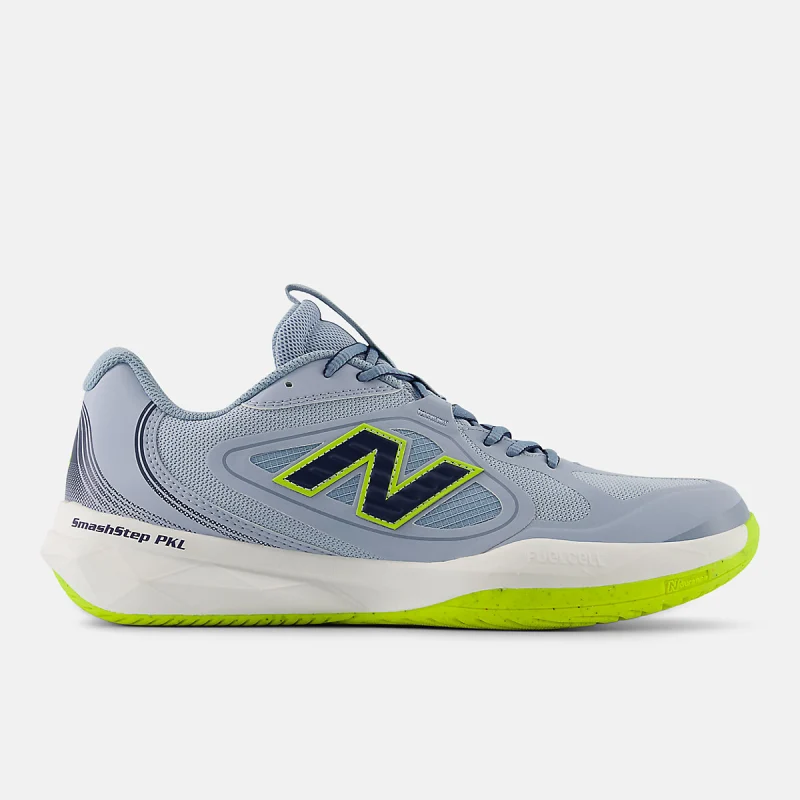
New Balance is the brand men with wide feet learn to trust, and the SmashStep PKL is its dedicated pickleball shoe, offered in a true Wide 2E rather than a token roomy standard.
That matters more than any technology on this page for a wide-footed man, because a real 2E is built on a wider last from the ground up. Your forefoot gets width where your foot actually is, instead of extra length you did not ask for.
The shoe underneath the width is solid New Balance court engineering. The FuelCell midsole gives a responsive, lively cushion, livelier than the plush Fresh Foam below, and the Ndurance rubber is placed in the high-wear areas where pickleball grinds outsoles down.
The supportive synthetic and mesh upper does the holding work, because there is no named stability chassis in this shoe, and the box says so; the support story is the last and the upper, not a brace.
Tennis retail testers also flagged a durability guarantee on this model, though New Balance does not publish the terms on the pages I checked, so treat it as a question to confirm rather than a promise to bank on.
At 12.1 ounces in a men’s 9 in the 2E, it carries its width lightly. So far the evidence for this shoe is maker specifications rather than long independent testing, and I would rather tell you that than dress it up.
Buy it if you need a true 2E in a pickleball-specific shoe. Skip it if you want a named stability chassis.
9New Balance Fresh Foam X 1007: Best Maximum Cushion Pickleball Shoes for Men in 2027
AT A GLANCE | New Balance Fresh Foam X 1007
Weight
15.6 oz (men’s US 10.5)
Outsole
NDurance rubber
Cushioning
Fresh Foam X
Fit
Widths D, 2E and 4E
Type: General court (tennis)
Sizing: Men’s
Upper: Synthetic and mesh with toe protection
Midsole: Fresh Foam X
Non-marking: Yes
Arch support: None named
Warranty: 6-month outsole guarantee
Feel: Plush and heavy-duty
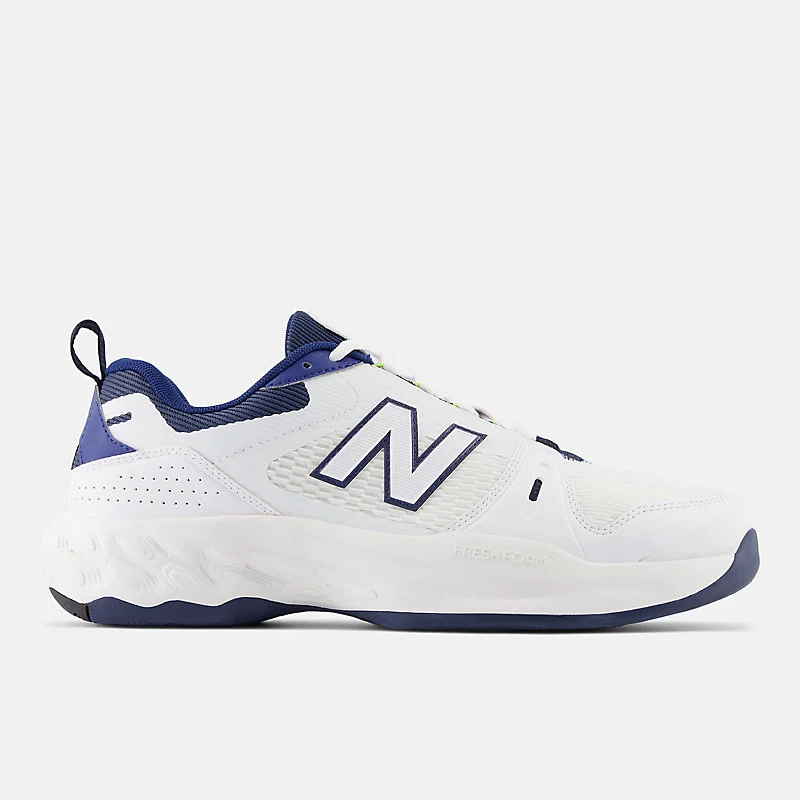
This is the heavyweight of the page, and I mean that in both senses.
At 15.6 ounces in a men’s 10.5, the Fresh Foam X 1007 is the heaviest shoe here by a clear margin, and the honest reason to buy it anyway is what the weight carries: the maximum cushioning rating in the New Balance court line and the widest fit range on this page, D, 2E and a genuine 4E.
For a big man whose knees and heels file complaints after every session, or whose feet no standard shoe has ever fit, those two facts outweigh the ounces.
The Fresh Foam X midsole is the softest ride here, absorbing the repeated stops that hard courts send up through a heavier frame. The NDurance outsole is non-marking and carries a 6-month outsole guarantee in retailer listings, a real durability promise.
The upper adds toe protection where draggers need it, and the fit runs true to length with no break-in period, which wide-footed men know is not a given.
The limits deserve the same honesty. There is no named arch support system in this shoe; its arch is a low, neutral platform, so men who need structured arch support should look at the Skechers above or plan on an insole.
And the weight is real: explosive first-step players will feel it. This shoe is for the man who values finishing the session over winning the first step.
Buy it if you need maximum cushion or a 4E fit. Skip it if foot speed is your game.
10K-Swiss Hypercourt Express 2: Best Roomy All-Rounder Pickleball Shoes for Men in 2027
AT A GLANCE | K-Swiss Hypercourt Express 2
Weight
13.0 oz (men’s US 10.5)
Outsole
Aosta 7.0 rubber, modified herringbone
Cushioning
SurgeLite midsole with OrthoLite X40 sockliner
Fit
Roomy, genuine 2E available
Type: General court (tennis)
Sizing: Men’s
Upper: Seamless synthetic and mesh with Durawrap Flex
Midsole: SurgeLite
Non-marking: Yes
Stability: Midfoot shank
Insole: OrthoLite X40 sockliner
Feel: Roomy and cushioned
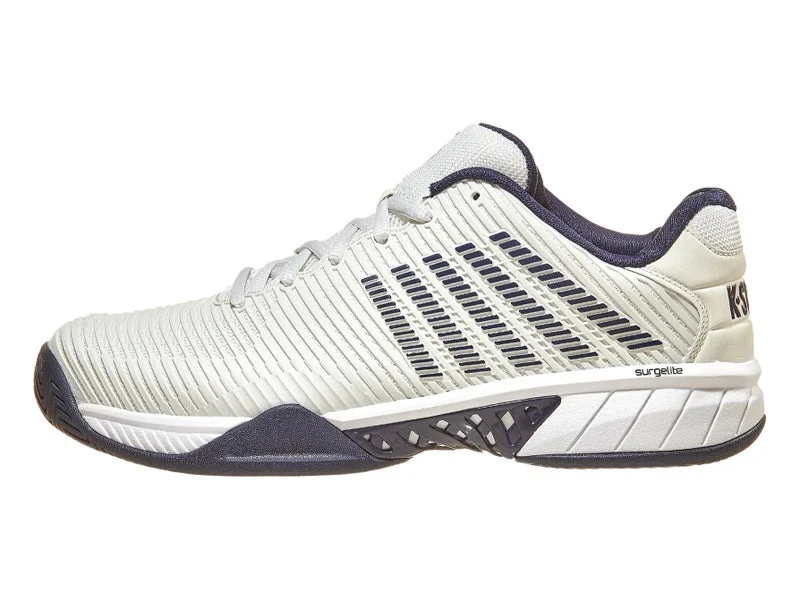
The last pick is the roomy all-rounder from the tennis side of K-Swiss. The Hypercourt Express 2 runs on a wider, more forgiving platform than most performance court shoes, and it comes in a genuine 2E version, which makes it the third real wide option on this page and the most cushioned of the three.
The SurgeLite midsole is light and soft underfoot, the OrthoLite X40 sockliner adds a quality layer you can feel, and a midfoot shank keeps the shoe from twisting itself apart on hard plants.
The outsole is Aosta 7.0 rubber in a modified herringbone, non-marking, and lab measurements of the rubber found it exceptionally hard and durable, which matches the shoe’s reputation for surviving heavy use.
The seamless synthetic and mesh upper carries Durawrap Flex protection and added toe coverage, and lab scoring rated its toebox protection at the top of the scale, exactly what a toe-dragger wants to hear.
At 13.0 ounces in a men’s 10.5, and 13.2 in the 2E, it is not light, but it never feels clumsy, because the roominess makes it easy to wear for hours.
There is no outsole warranty on this model, and K-Swiss publishes none, so the box leaves that story to the picks above. What you get is comfort, room and durability in one shoe.
Buy it if you want a roomy, cushioned all-rounder in standard or 2E. Skip it if you want the lightest shoe or a warranty behind the sole.
How to Choose Pickleball Shoes for Men in 2027
Men shop for court shoes the way they shop for everything: find the one that looks toughest and hope the fit works out.
Pickleball punishes that approach, because the shoe that fails you will fail at the exact moment you load it hardest, mid-plant, mid-lunge, two hours into a session when your feet have swollen into whatever room the shoe actually has.
Work through the six sections below in order, fit first, and the list above reads itself: every pick is there because it answers one of these questions better than the shoes that did not make it.
Fit and Sizing: Width Is Bought, Not Sized Into
Court fit for men starts with a simple rule: width is a separate dimension, and you cannot reach it by buying a longer shoe. Sizing up to get room across the forefoot adds length in front of your toes, and that length is exactly where your foot slams forward on hard stops.
If your feet are wide, buy a shoe built in wide, a genuine 2E or 4E last like the SmashStep PKL, the Fresh Foam X 1007 or the Hypercourt Express 2, or a model whose standard fit is honestly roomy, like the Pickle Pro or the Relaxed Fit Viper Court Pro 2.0, which also comes in Extra Wide.
The rest of the fit is about lockdown in the right places. The heel and midfoot should hold firmly, with a thumb’s width of space beyond your longest toe, because a foot that slides inside the shoe blisters, jams toenails and arrives late to every plant.
Brand sizing is not consistent, and this page proves it: K-Swiss advises half a size up in the Pickleball Supreme, the CourtStrike Pro 3.0 runs snug, and the Wave Exceed Tour 7 AC is a narrow performance last.
Read each shoe’s fit note before ordering, and try court shoes on late in the day, in playing socks, when your feet are at working size.
Durability for Heavier Players and Toe-Draggers
The heavier the man, the faster a court shoe dies, and it almost always dies in the same two places. The first is the outsole at the ball of the foot, ground smooth by thousands of pivots until the tread is a rumour.
The second is the drag hole: the spot beside the big toe, or along the inside of the forefoot, where the upper or the rubber wears through from dragging on serves, lunges and recovery steps. Once either one goes, the shoe is finished, whatever the rest of it looks like.
Shop durability deliberately. Look for named hard-wearing rubber and reinforcement where you personally wear shoes out: DragGuard on the K-Swiss models, the Duralast outsole and lateral drag pad on the Wilsons, Ndurance rubber in the high-wear areas of the SmashStep PKL, toe protection on the 1007.
Then look for the strongest signal of all, a warranty. Three picks on this page carry published 6-month outsole guarantees: the Selkirk CourtStrike Pro 3.0, the Mizuno Wave Exceed Tour 7 AC (AC version, US) and the New Balance Fresh Foam X 1007. A brand that guarantees its outsole is telling you how it expects men to treat it.
Stability for Aggressive Movement
Pickleball movement for an aggressive player is a series of loaded sideways plants, and stability is what keeps those plants from turning into rolls.
The support that matters is structural, not soft: a midfoot chassis or shank that resists twisting, a plate that spreads the load, an outrigger flaring the base where you land, and an upper and heel that hold your foot on top of the platform instead of letting it spill over the side.
On this page that hardware has names: the 180 PSC chassis in the Pickleball Supreme, the WAVE plate in the Mizuno, the 4D Support Chassis 2.0 in the Rush Pro 4.5, the TPU shank in the CourtStrike Pro 3.0.
Do the twist test on any shoe you are considering: hold the heel and forefoot and twist in opposite directions. A shoe that wrings out like a towel has nothing between your foot and a bad plant. A shoe that resists as one unit is doing the job.
Soft, thick foam is not stability; stacked under a heavy man it can work against you, compressing unevenly on a cut. The most stable shoes here pair their structure with firm, controlled cushioning, and that combination, not softness, is what lets you plant as hard as you play.
Cushioning vs Court Feel
Every man lands somewhere on the line between wanting the floor to disappear and wanting to feel it. At the plush end of this page sit the Fresh Foam X 1007 and the Viper Court Pro 2.0, shoes that absorb the repeated stops of a long session and suit players whose knees, heels and arches keep score.
In the middle sit the SurgeLite, CMEVA and PureFoam builds, honest cushioning most players stop noticing by the second game. At the connected end, the Mizuno’s ENERZY stack and the responsive FuelCell foam in the SmashStep PKL keep you low and aware, which quicker players read as speed.
Match the choice to your body and your session, not your ego. Heavier players and long-session players compress foam harder and benefit most from the cushioned end; the foam is doing real work under real load.
Lighter, faster players often prefer court feel, because a thinner, firmer ride shortens the path between deciding to move and moving. One warning applies to both ends: foam dies before shoes look dead. When a midsole stops rebounding and your joints start reporting it, the cushioning argument is over, whatever the upper still looks like.
Outsoles by Surface
The outsole question is simpler than the marketing makes it: match the rubber to the floor you play on most. All-court herringbone, the pattern on most picks here, is the safe default for the outdoor asphalt and hard courts where most men play, because it grips in every direction and survives rough surfaces.
Softer and gum-style compounds grip polished indoor floors harder, but they wear quickly outside, and a shoe kept for indoor play should stay indoors, because outdoor grit chews the tread and then scratches the gym floor.
The one hard rule is the non-marking requirement at indoor facilities: if a venue mandates non-marking soles, the shoe either carries that rating or it stays home.
Several picks here publish it plainly, the Express Light Pickleball 2, the Pickleball Supreme, the Hypercourt Express 2 and the Fresh Foam X 1007 among them, and where a brand does not publish a rating, this page says so rather than guessing, so check before an indoor session in the Mizuno, the Wilsons or the CourtStrike.
Whatever the surface, wipe your soles between games. Dust defeats more outsoles than wear does.
Weight: What the Extra Ounces Buy
Shoe weight only means something with the size attached, which is why every figure on this page carries one: the Express Light Pickleball 2 at 10.9 ounces in a men’s 9 is the lightest pick here, and the Fresh Foam X 1007 at 15.6 ounces in a men’s 10.5 is the heaviest, and comparing those two numbers without the sizes would mislead you by design.
Within the same size, the spread on this page runs from genuinely light to genuinely substantial, and the ounces are never free in either direction.
The heavy shoes spend their weight on things heavier men actually use: maximum cushioning, wider lasts, reinforced uppers and outsoles thick enough to carry guarantees. The light shoes spend nothing, and give you a quicker first step and fresher calves in the third hour.
Neither is the correct answer in the abstract. If your game is built on speed and your joints are quiet, take the light end. If your body files complaints after sessions and your shoes die young, the extra ounces are buying you cushion, structure and time, and that is usually the better trade.
Frequently Asked Questions (FAQs)
1. How should men’s pickleball shoes fit?
Snug at the heel and midfoot, with a thumb’s width of space in front of your longest toe. Your foot should not slide forward on hard stops or sideways on plants, because sliding is where blisters, jammed toenails and late plants come from.
If you need more room across the forefoot, buy a wide fitting rather than a longer size, and try shoes on late in the day in your playing socks, when your feet are at working size.
2. What are the best pickleball shoes for men?
It depends on what your game asks of them, which is why this page routes by need instead of crowning one shoe. The K-Swiss Express Light Pickleball 2 is the all-rounder, the Viper Court Pro 2.0 is the cushioning and Extra Wide pick, the CourtStrike Pro 3.0 carries the outsole warranty, and the SmashStep PKL is the true 2E option.
Start with your biggest problem, width, cushioning, durability or speed, and the right pick is the one built for it.
3. Which men’s pickleball shoes come in wide or 2E?
The New Balance SmashStep PKL comes in a genuine Wide 2E, the K-Swiss Hypercourt Express 2 comes in a real 2E version, and the K-Swiss Express Light Pickleball 2 has a 2E, though availability varies.
The New Balance Fresh Foam X 1007 goes further, with D, 2E and 4E widths, and the Skechers Viper Court Pro 2.0 is offered in Extra Wide. The Wilson Pickle Pro is not a labelled wide, but its roomy toe box accommodates wider feet.
4. What is the difference between a tennis shoe and a pickleball shoe?
They are the same family: both are court shoes built for lateral movement, hard stops and pivoting.
Pickleball-specific models tune the details to this sport, with toe-drag protection, pivot-friendly outsoles, roomier forefeet and stability outriggers, while tennis shoes bring tour-level durability and structure from a sport that punishes shoes even harder.
That is why several picks on this page are tennis shoes, and why a good tennis shoe beats a poor pickleball shoe every time.
5. Can I wear tennis shoes for pickleball?
Yes. Tennis shoes are proper court shoes, built for the same sideways loads, and several of the ten picks here are exactly that: the Mizuno Wave Exceed Tour 7 AC, the Wilson Rush Pro 4.5, the K-Swiss Hypercourt Express 2 and the New Balance Fresh Foam X 1007.
Check the outsole suits your surface, confirm it is non-marking if your indoor facility requires that, and play.
6. Can I wear running shoes for pickleball?
No. Running shoes are built for straight-line forward motion, with a raised, cushioned heel and a soft upper that offers no lateral support.
On a hard sideways plant your foot rides over that heel and the upper gives way, which is how ankles roll, and for heavier men the load makes it worse, not better. Any court shoe on this page is a safer choice than the trainers in your gym bag.
7. What is the difference between indoor and outdoor pickleball shoes?
The outsole. Indoor shoes use softer, non-marking rubber with fine patterns that grip polished wood and sport-court floors without streaking them. Outdoor shoes use harder, more durable rubber built to survive asphalt and rough hard courts.
An indoor sole played outdoors wears out fast, and an outdoor sole can feel slick on polished floors, so if you play both regularly, the honest setup is a pair for each, or one all-court shoe whose soles you clean before indoor sessions.
8. How long do men’s pickleball shoes last?
For a frequent outdoor player, often only one to four months. Lifespan depends on your weight, how many hours you play, how hard you drag and pivot, and the surface, and heavier, aggressive men sit at the short end of every range.
The end is usually obvious: a hole worn through beside the big toe, or a sole worn slick at the pivot point. Shoes with published 6-month outsole guarantees, three of them on this page, exist precisely because brands know how fast men wear through rubber.
9. When should I replace my pickleball shoes?
Replace them when the drag hole appears beside the big toe, when the tread at the forefoot pivot point has worn smooth, or when the cushioning feels dead and your feet and knees ache after sessions that used to feel fine.
Do not wait for the upper to fall apart; the midsole and outsole do the protective work, and both usually die first. Playing on in a dead shoe loads your joints and lets your foot move inside it.
10. Do pickleball shoes need breaking in?
It depends on the model. The Wilson Pickle Pro is game-ready with no break-in, and Durawrap-style K-Swiss models generally play well out of the box. Structured shoes can ask for patience: K-Swiss itself warns that the Pickleball Supreme’s support may take some time to adjust to.
A sensible rule is to give any new pair one lighter session before a hard one, and to treat genuine pain, rather than new-shoe stiffness, as a fit problem.
11. What socks should I wear for pickleball?
Wear cushioned court socks, not cotton. A proper court sock pads the heel and forefoot, manages sweat, and reduces the sliding inside the shoe that causes hot spots and blisters, which matters more as sessions lengthen and feet swell.
Cotton does the opposite, soaking up sweat and turning abrasive. Socks will not fix a wrong shoe, but they improve every right one.
12. What is the number one pickleball shoe for men?
There is no single number one, and any list that crowns one is selling something.
The best shoe is the one matched to your foot and your game: the Express Light Pickleball 2 for all-round play, the Viper Court Pro 2.0 for cushioning and Extra Wide, the CourtStrike Pro 3.0 for its outsole warranty, the SmashStep PKL for a true 2E, the Fresh Foam X 1007 for maximum cushion up to 4E.
Pick by your biggest problem and you will land on the right answer.

Michael Stevenson
Hi, I’m Michael Stevenson, a pickleball enthusiast and the voice behind Picky Paddle. My passion for pickleball began on the tennis courts, where I quickly fell in love with the game’s unique blend of strategy, speed, and social interaction.
As a dedicated player and gear aficionado, I’ve spent countless hours researching and testing pickleball equipment to help fellow players find the best products for their needs.
Whether you’re a beginner looking for your first paddle or an experienced player seeking to upgrade your gear, my goal is to provide honest, unbiased, and comprehensive reviews that make your decision-making process easier. Let’s hit the courts and elevate your pickleball game together!