Best JOOLA pickleball paddles are easy to misread, because one Roman numeral separates two generations that share a shape and little else.
I tested every paddle on this list on court myself and checked the figures, so the ranking follows real games, not famous names. This list separates every shape and every generation, so you can never finish it able to mistake one JOOLA for another one.
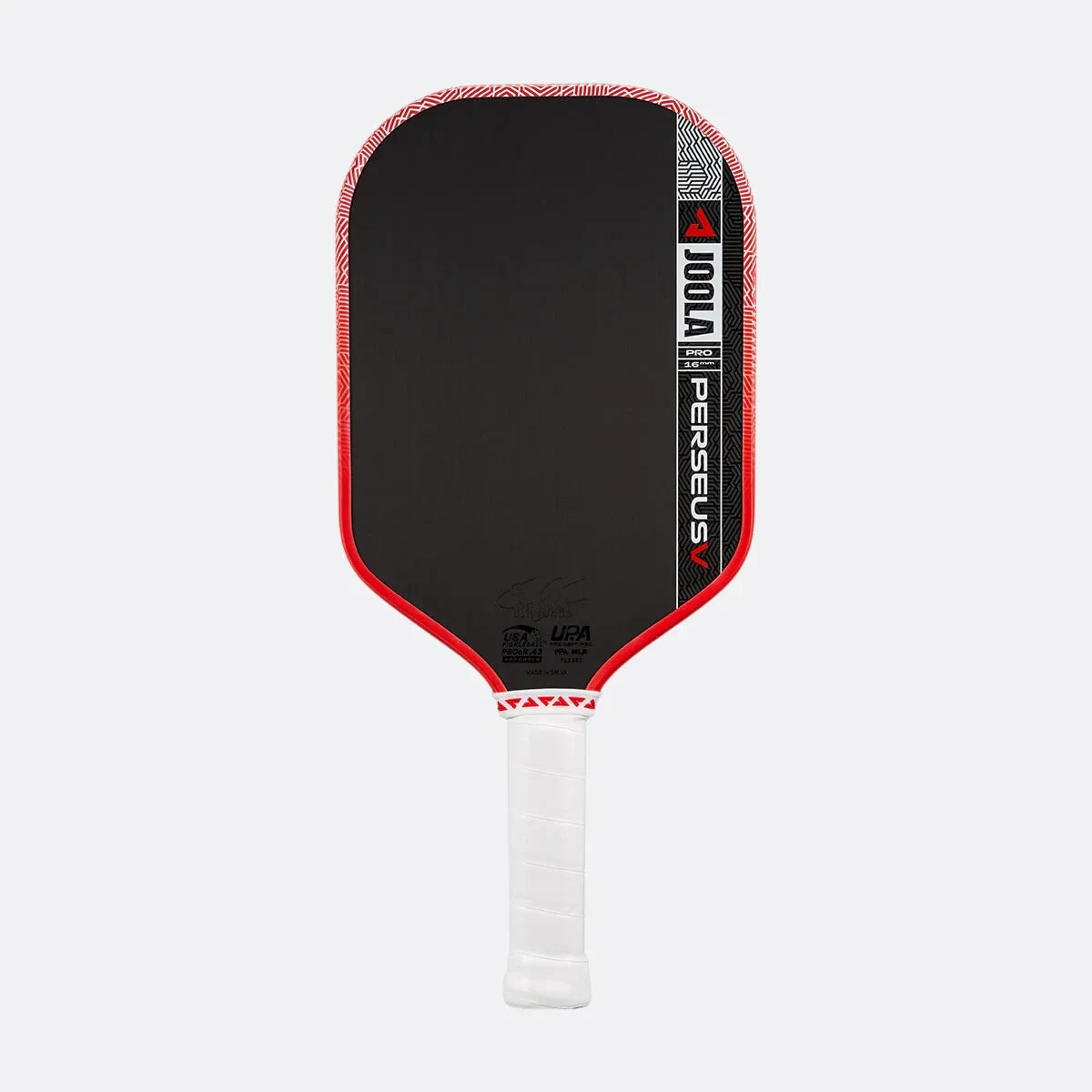
My number one pick is the JOOLA Perseus Pro V 16mm, the best JOOLA paddle for consistency because shots repeat every time. It scored 9.3 out of 10 in my testing, the highest score on this site, with measured spin of 2,060 RPM recorded.
Its slim throat flexes at contact, and flex means it bends slightly, so hard balls lose their sting and resets land true. Check the JOOLA Perseus Pro V 16mm on Amazon if you want the JOOLA I recommend first for a complete flagship game.
The 10 Best JOOLA Pickleball Paddles in 2027
1JOOLA Perseus Pro V 16mm: Best Overall Pickleball Paddle in 2027
AT A GLANCE
Perseus Pro V 16mm
WEIGHT
8.1 oz
SWING WEIGHT
117
TWIST WEIGHT
6.26
SPIN
2,060 RPM
Shape: Elongated, 16.5 x 7.5 in, 5.5 in handle
Grip: 5.5 in, 4.25 in circumference
Core: Propulsion Core, polypropylene with EVA foam, 16mm
Face: Raw carbon fiber
Approval: USAP and UPA-A
Feel: Firm consistency
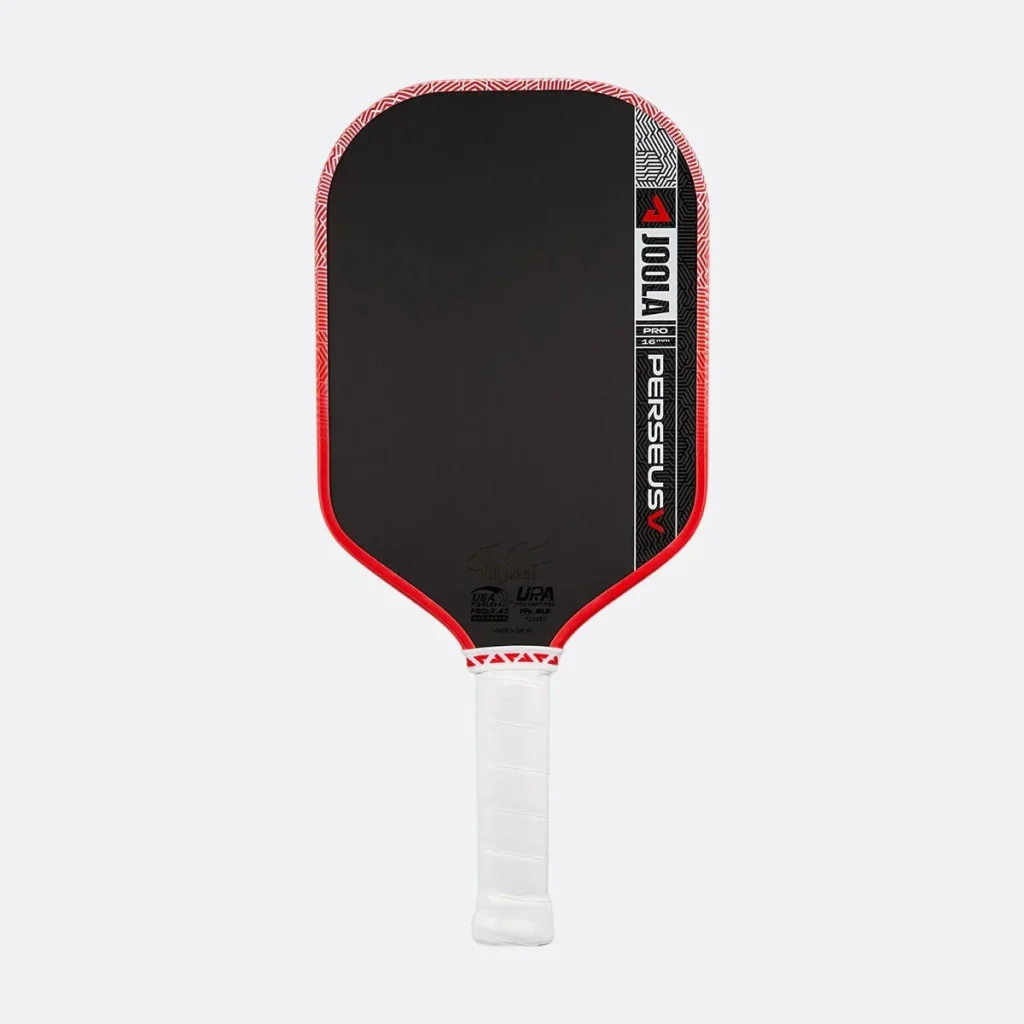
Every JOOLA conversation starts here, because this is the paddle the rest of the range is measured against.
The Perseus Pro V is the elongated flagship: 16.5 by 7.5 inches on a 5.5 inch handle, built around the Propulsion Core and the generation’s defining idea, the KineticFrame, a slimmer throat designed to flex at contact, store energy and return it as the ball leaves.
It is also the paddle Ben Johns carries into matches, which tells you the brief JOOLA built it to fill.
On court, the word that keeps surfacing is consistency. The measured line I play it by reads 117 swing weight, 6.26 twist weight and 2,060 RPM of spin, and it behaves to those numbers.
Drives dip on a repeatable arc, counters hold their line when contact drifts toward the edge, and the flexing throat takes the sting out of hard balls at the kitchen so resets land where I aimed them. It also swings a touch head-light next to the older generation, so hands battles feel quicker than the elongated outline suggests.
The honest limit is where the power comes from. The Pro V asks your swing to supply it, and players who lean on the paddle for free pace will find the previous generation at pick 8 livelier on serves and putaways. The feel is firm and connected rather than plush.
Buy it if you generate your own power and want the most consistent flagship JOOLA makes. Skip it if you need the paddle to supply your pace.
2JOOLA Scorpeus Pro V 16mm: Best Widebody Pickleball Paddle in 2027
AT A GLANCE
Scorpeus Pro V 16mm
WEIGHT
8.2 oz
SWING WEIGHT
113
TWIST WEIGHT
7.21
SPIN
-
Shape: Widebody, 16 x 8 in, 5.25 in handle
Grip: 5.25 in, 4.125 in circumference
Core: Propulsion Core with KineticFrame, 16mm
Face: Textured carbon fiber
Approval: USAP and UPA-A
Feel: Stable and quick
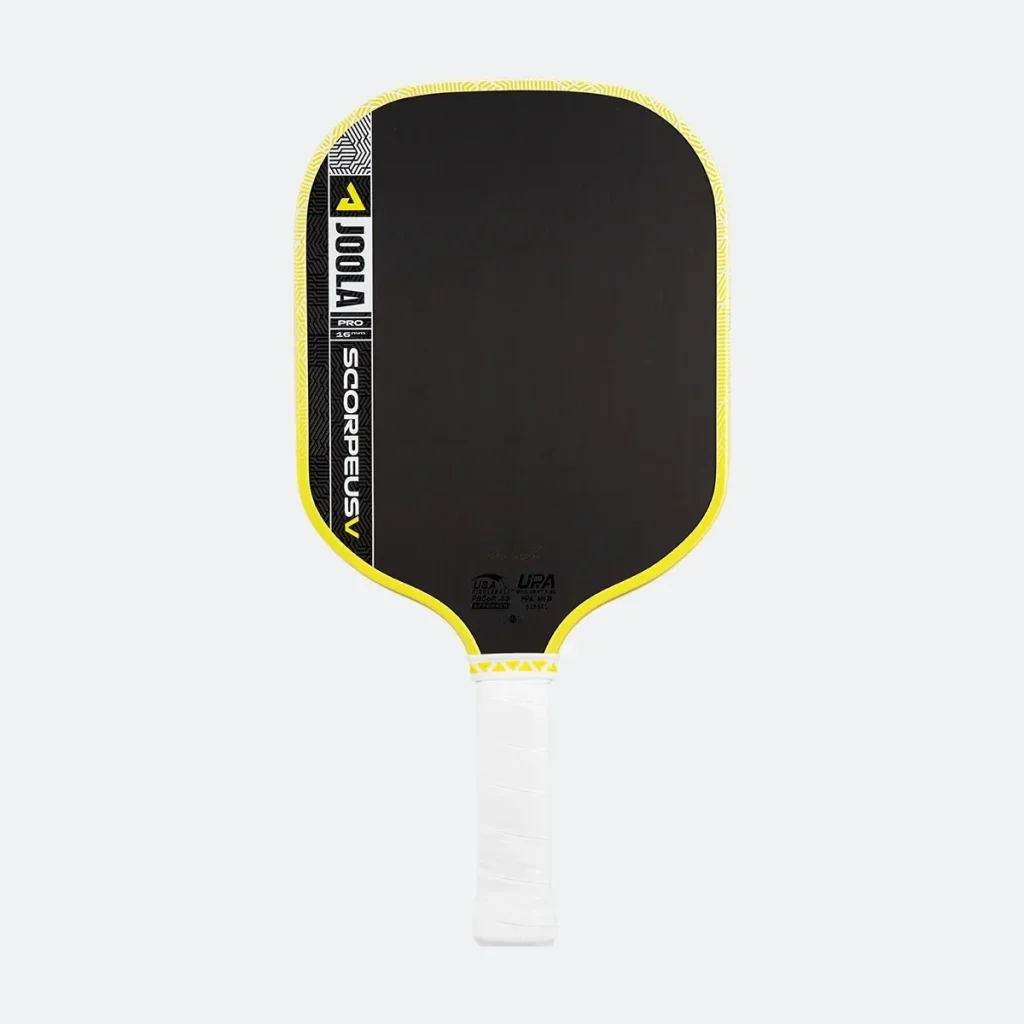
If the Perseus is the range’s spearhead, the Scorpeus is its wall. This is JOOLA’s widest and shortest flagship shape, 16 by 8 inches, and it plays the defensive doubles brief better than anything else in the line.
The two numbers that explain it are a 7.21 twist weight, at the top of what labs record for widebody paddles, on a 113 swing weight, the lowest of the flagship shapes here. Stability and hand speed usually trade against each other. This shape refuses the trade.
Blocks sit down instead of popping up, stretched counters stay square instead of twisting open, and the shorter head arrives at the ball early in fast exchanges.
One listing detail matters more than any spec: this paddle is sold as two signature editions of the same paddle, Anna Bright’s in JOOLA Yellow with a 4.125 inch grip, and Collin Johns’ in Club Green with a 4.25 inch grip, both at 8.2 ounces.
The box above prints the Bright edition. Larger hands should select the Johns edition on the same listing and lose nothing but a tighter wrap.
The honest gaps are reach and an unpublished number. At 16 inches it gives back the baseline leverage the Perseus shapes hold, and no lab has published a measured spin figure for this shape, so the box leaves spin unpublished rather than borrowing the Perseus number or the previous generation’s.
Buy it if your game is won on blocks, counters and resets. Skip it if baseline reach and drive leverage lead your game.
3JOOLA Agassi Pro V 16mm: Best for Tennis Converts Pickleball Paddle in 2027
AT A GLANCE
Agassi Pro V 16mm
WEIGHT
8.1 oz
SWING WEIGHT
118
TWIST WEIGHT
6.25
SPIN
-
Shape: Elongated, 16.5 x 7.5 in, 5.5 in handle, tapered throat
Grip: 5.5 in, 4.25 in circumference
Core: Propulsion Core with Hyper-Foam Edge Wall, 16mm
Face: Textured carbon fiber
Approval: USAP and UPA-A
Feel: Plush power
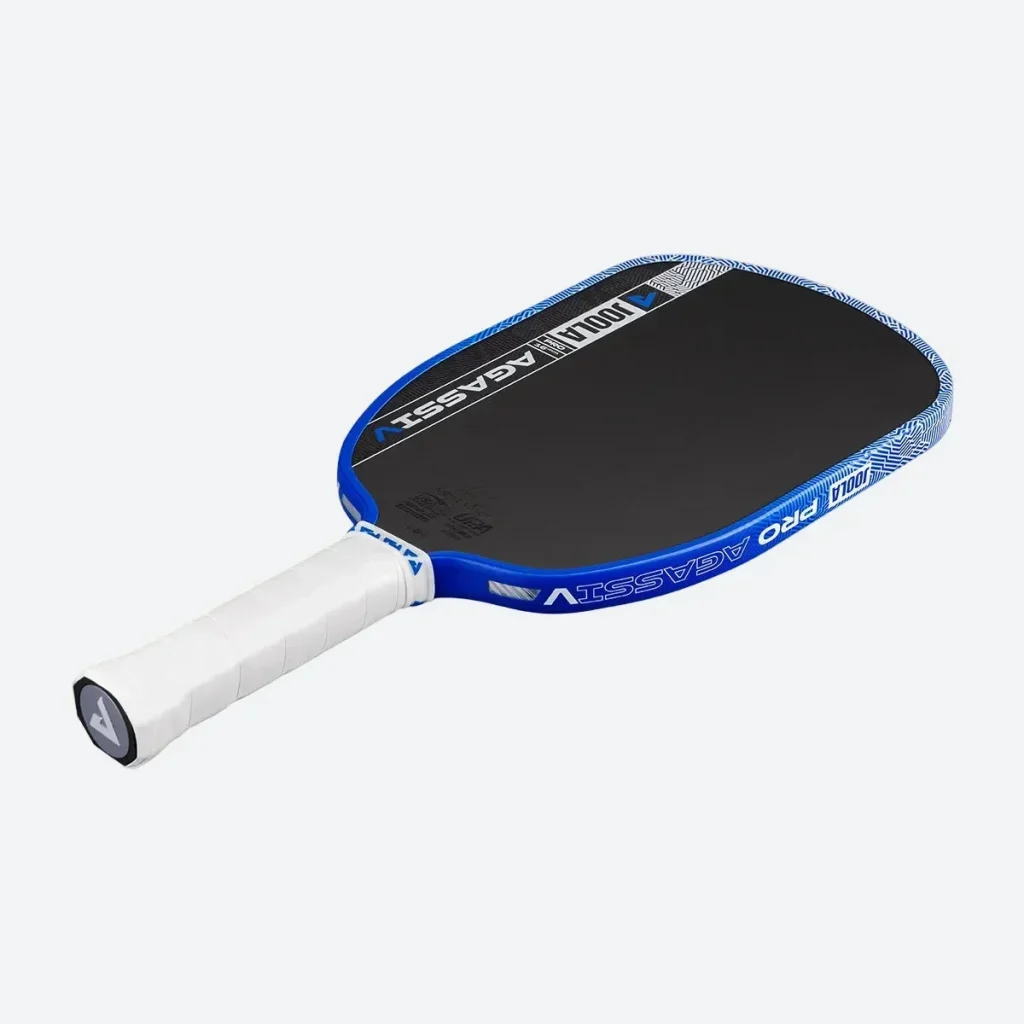
This shape was built with Andre Agassi, and you can feel the brief in the first rally. The throat tapers instead of flaring, and the sweet spot sits high on the face, exactly where a tennis groundstroke already meets the ball.
Converts who keep catching a standard paddle low, near the throat, find their contact point waiting for them here. The response is plush power: the ball pockets, then leaves with the kind of shape a topspin drive produces, and the 5.5 inch handle leaves honest room for a two-handed backhand.
The measured line reads 118 swing weight and 6.25 twist weight, the heaviest swing among the Pro V picks on this page, and it plays like it. Serves and drives carry real plow-through, and once the swing starts it wants to finish.
That same head weight is the tax in hands battles, where it arrives a fraction later than the Hyperion or the Scorpeus. Spin stays unpublished in the box: no figure on the scale this site publishes exists for this shape, and nothing is borrowed from the Pro IV version of it.
One naming warning belongs in this section. The Graf Pro V is this same tapered-throat shape with a 4.125 inch grip, a different nameplate for smaller hands. The guide separates the twins properly; do not let a listing blur them.
Buy it if you arrive from tennis and swing like it. Skip it if your game is built on wrist speed at the kitchen line.
4JOOLA Kosmos Pro V 16mm: Best Hybrid Pickleball Paddle in 2027
AT A GLANCE
Kosmos Pro V 16mm
WEIGHT
8.1 oz
SWING WEIGHT
114
TWIST WEIGHT
6.68
SPIN
2,057 RPM
Shape: Hybrid, 16.3 x 7.7 in
Grip: 5.25 in handle, 4.25 in circumference
Core: Propulsion Core with KineticFrame, 16mm
Face: Textured raw carbon fiber
Approval: USAP and UPA-A
Feel: Balanced and quick
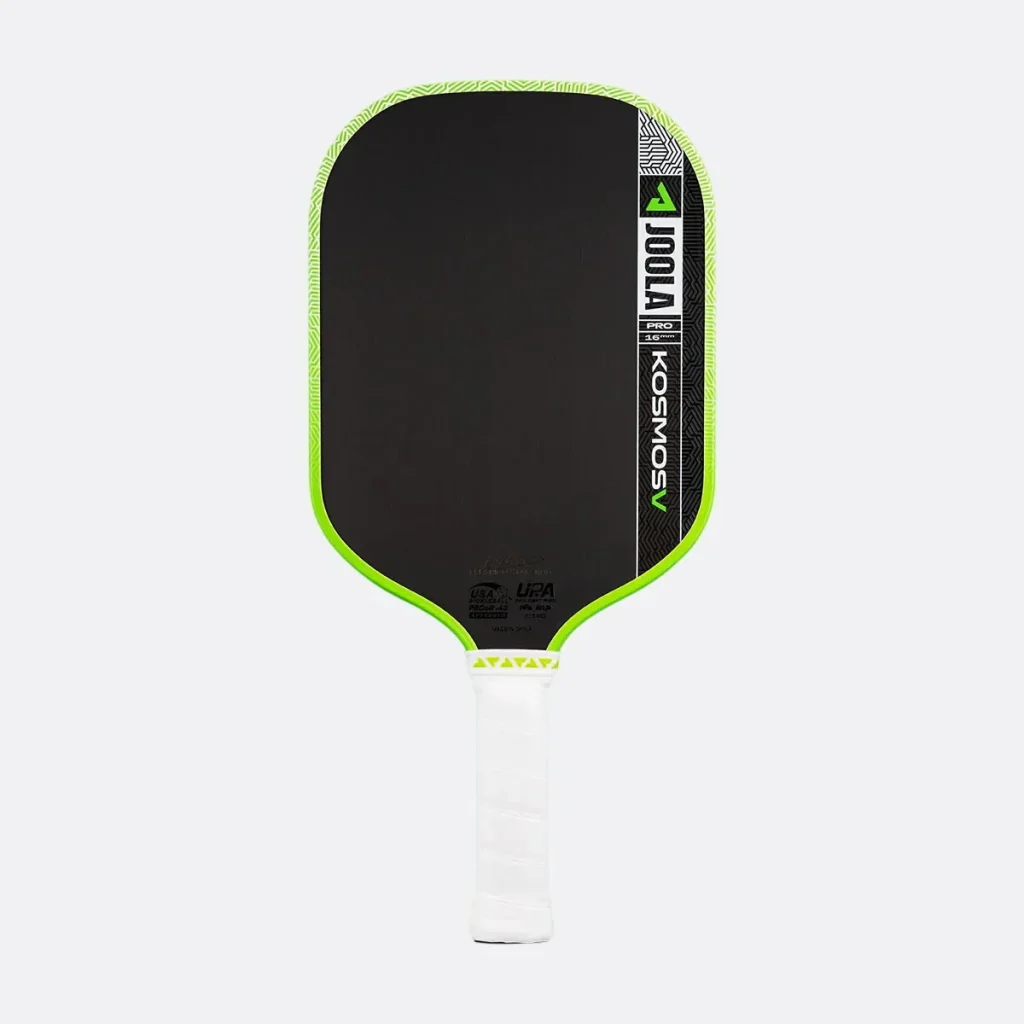
The Kosmos is the new shape in the flagship line, the flat-topped hybrid that replaced the dropped Magnus, and it sits deliberately between the Perseus and the Scorpeus: longer than the widebody, wider than the elongated, with a squarer head that keeps more face in the hitting zone.
It is Federico Staksrud’s signature shape in this 16mm build, and it is the Pro V that surprised me most, because its lab line is the most balanced in the range: 114 swing weight, 6.68 twist weight, and 2,057 RPM of measured spin.
That balance is a playing personality. The Kosmos drives like an elongated, with enough leverage to shape the ball down, then defends like a widebody, because the 6.68 twist weight is the best stability figure here outside the Scorpeus itself.
Counters that would twist a Perseus open stay on line. If a player asked me for the one Pro V shape with no obvious weakness to manage, this is the one I would hand them, and the guide’s shape section explains where it concedes ground to each sibling.
Two honest notes. The 5.25 inch handle is the shortest among the elongated-class picks here, so committed two-handed backhand players get less room than the Perseus shapes give.
And the raw carbon face is rated wear-prone by the lab that measured it: the spin starts strong and fades as the surface smooths with months of play, exactly the grit-fade pattern this site reports on raw carbon everywhere.
Buy it if you want the flagship balance point between reach and forgiveness. Skip it if two-handed room or maximum reach decides your shortlist.
5JOOLA Hyperion Pro V 16mm: Best for Hand Speed Pickleball Paddle in 2027
AT A GLANCE
Hyperion Pro V 16mm
WEIGHT
8.1 oz
SWING WEIGHT
115
TWIST WEIGHT
6.17
SPIN
-
Shape: Elongated with aero-curve head, 16.5 x 7.5 in, 5.5 in handle
Grip: 5.5 in, 4.25 in circumference
Core: Propulsion Core with KineticFrame, 16mm
Face: Textured carbon fiber
Approval: USAP and UPA-A
Feel: Fast and fluid
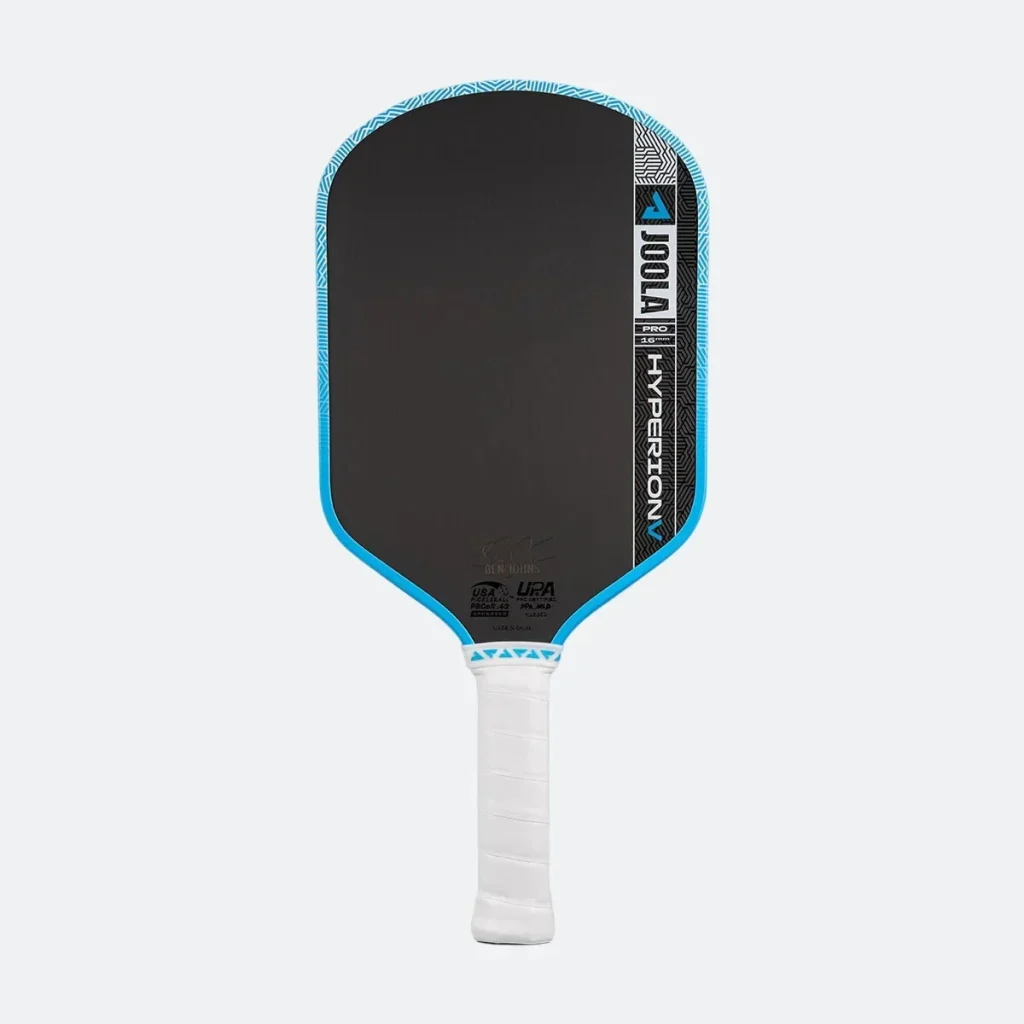
The Hyperion is the oldest signature geometry in the brand, the aero-curve shape Ben Johns co-developed as his original signature before the Perseus era, rebuilt here on the Pro V platform.
One clarification belongs up front, because listings blur it: Johns’ current match paddle is the Perseus Pro V at pick 1. The Hyperion is his original shape, kept in the line because the curved head does something no other JOOLA outline does. It cuts the air.
That curve is a hand-speed tool. The measured line reads 115 swing weight and 6.17 twist weight, mid-pack numbers, but the shape feels quicker than its figures in a hands battle, because the rounded head sheds drag as it whips through counters and speed-ups.
You keep the elongated 16.5 inch reach of the Perseus for serves and baseline drives, then win the kitchen exchanges the Perseus fights harder for. For a player whose points are decided in fast hands at the net, this is the flagship shape pointed at their game.
The trade is stability. The 6.17 twist weight is the lowest among the Pro V picks here, so contact that drifts toward the edges twists more than it does on the Kosmos or the Scorpeus, and stretched blocks need cleaner hands.
Spin is also unpublished in the box: no lab figure on the scale this site publishes was recovered for this shape, and JOOLA’s own high spin rating for it is a brand rating, not a measured RPM, so it is not printed as one.
Buy it if your game is won in hand battles at the kitchen. Skip it if off-center forgiveness matters more than swing speed.
6JOOLA Perseus Power FX 16mm: Best Foam-Core JOOLA Pickleball Paddle in 2027
AT A GLANCE
Perseus Power FX 16mm
WEIGHT
8.0 oz
SWING WEIGHT
115
TWIST WEIGHT
6.0
SPIN
2,043 RPM
Shape: Elongated (Perseus shape), 5.5 in handle
Grip: 5.5 in handle, circumference -
Core: Full EPP foam, Adaptive Propulsion Core, 16mm
Face: Revised raw carbon weave
Approval: USAP and UPA-A
Feel: Stiff foam pop
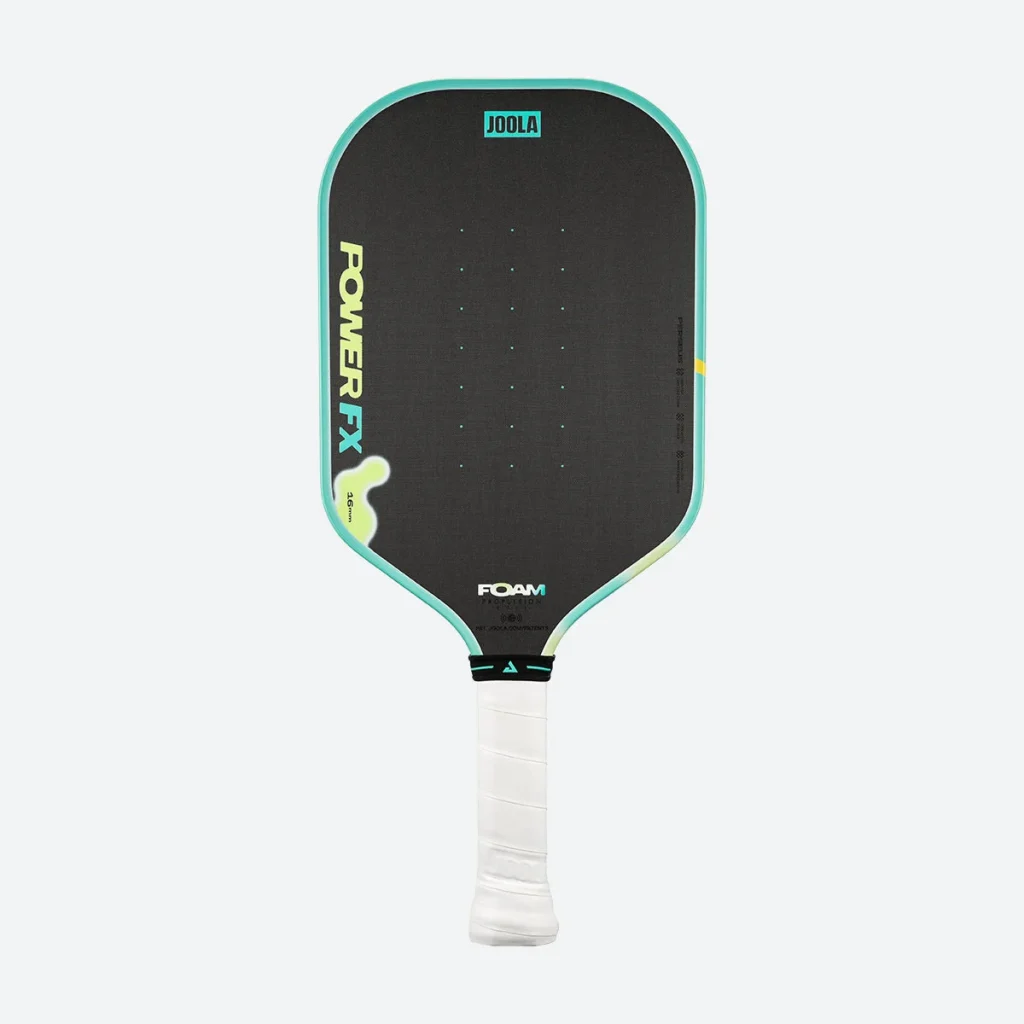
This is the fork in JOOLA’s road. The brand publicly declined to chase full foam for its flagship, kept a polymer core in the Pro V, and then shipped a full-foam Perseus anyway.
The Power FX replaces the honeycomb with a full EPP foam core JOOLA calls the Adaptive Propulsion Core, keeps the Perseus outline and 5.5 inch handle, and wears a revised raw carbon weave JOOLA says holds its grit longer than the surface it replaces.
That last part is the brand’s claim, framed as such; the court time to settle it is still accumulating.
The one lab line published for this paddle so far reads 115 swing weight, 6.0 twist weight and 2,043 RPM of spin, and I present those as one lab’s measurements, not a settled consensus, because no second lab has weighed in yet. The playing feel needs no caveat: this is the liveliest, stiffest JOOLA here.
The ball jumps off the foam with a pop the polymer picks do not produce, drives feel urgent, and counters need almost no swing behind them. The flat-feeling handle drew comment from testers, and you should know about it before you order.
The honest limits are the 6.0 twist weight, the lowest on this page, which makes stretched contact livelier than a control player wants, and the same pop that launches careless resets long. Grip circumference is not published in any source I could verify, so the box leaves it unpublished.
Buy it if you want foam feel without leaving the brand. Skip it if resets and soft hands are your foundation.
7JOOLA Astral Perseus: Best for Beginners Pickleball Paddle in 2027
AT A GLANCE
Astral Perseus
WEIGHT
7.8 oz
SWING WEIGHT
-
TWIST WEIGHT
-
SPIN
-
Shape: Elongated (Perseus shape), 16.5 x 7.5 in, 5.5 in handle
Grip: 5.5 in handle, circumference -
Core: Polymer honeycomb (thickness -)
Face: Sandblasted carbon fiber
Approval: USAP
Feel: Calm and forgiving
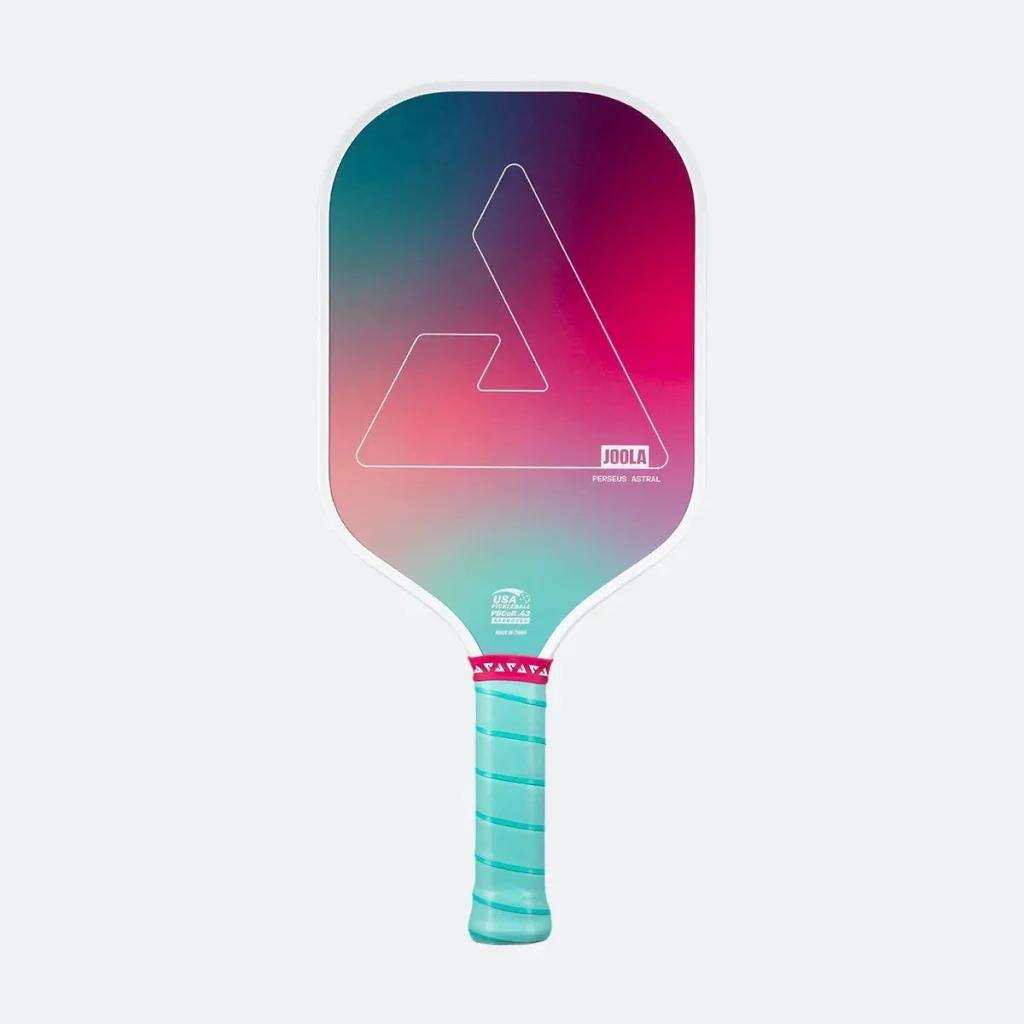
This slot was held for the round Radius shape, and it goes instead to the paddle JOOLA itself designed for new players, because this one can actually be bought from the brand’s own Amazon store.
The Astral Perseus takes the elongated Perseus outline from pick 1, 16.5 by 7.5 inches on a 5.5 inch handle, and builds the beginner brief on it honestly: a sandblasted carbon fiber face, which is real carbon rather than the fiberglass most first paddles wear, over a polymer honeycomb core.
On court it plays calm. At 7.8 ounces it is light enough for a developing swing to last a full session, the elongated reach covers the balls a new player arrives late for, and the 5.5 inch handle leaves room to experiment with a two-handed backhand from the start.
The data honesty is the same as everywhere on this page: no independent lab has published swing weight, twist weight or spin for the Astral, and JOOLA does not publish its core thickness or grip circumference, so the box leaves all of them unpublished rather than borrowing the flagship Perseus figures, which belong to a different build.
The ownership side matches the flagships: an NFC chip in the handle with the same 12-month warranty registration, and USA Pickleball approval, so a first paddle does not need replacing the moment league or tournament play starts.
The honest limit is ceiling. A player who improves quickly will eventually want the Pro lines’ response, and that is the right problem to have. As a first JOOLA, this is the one the brand built for the job.
Buy it if you are starting out and want a genuine carbon first paddle inside the flagship’s ecosystem. Skip it if you already play competitively and want a Pro core’s response.
8JOOLA Perseus Pro IV 16mm: Best Previous Generation Pickleball Paddle in 2027
AT A GLANCE
Perseus Pro IV 16mm
WEIGHT
8.1 oz
SWING WEIGHT
118
TWIST WEIGHT
6.3
SPIN
1,971 RPM
Shape: Elongated, 16.5 x 7.5 in, 5.5 in handle
Grip: 5.5 in, 4.25 in circumference
Core: Gen 3 Propulsion Core, 16mm
Face: Textured raw carbon fiber
Approval: USAP and UPA-A
Feel: Plush power
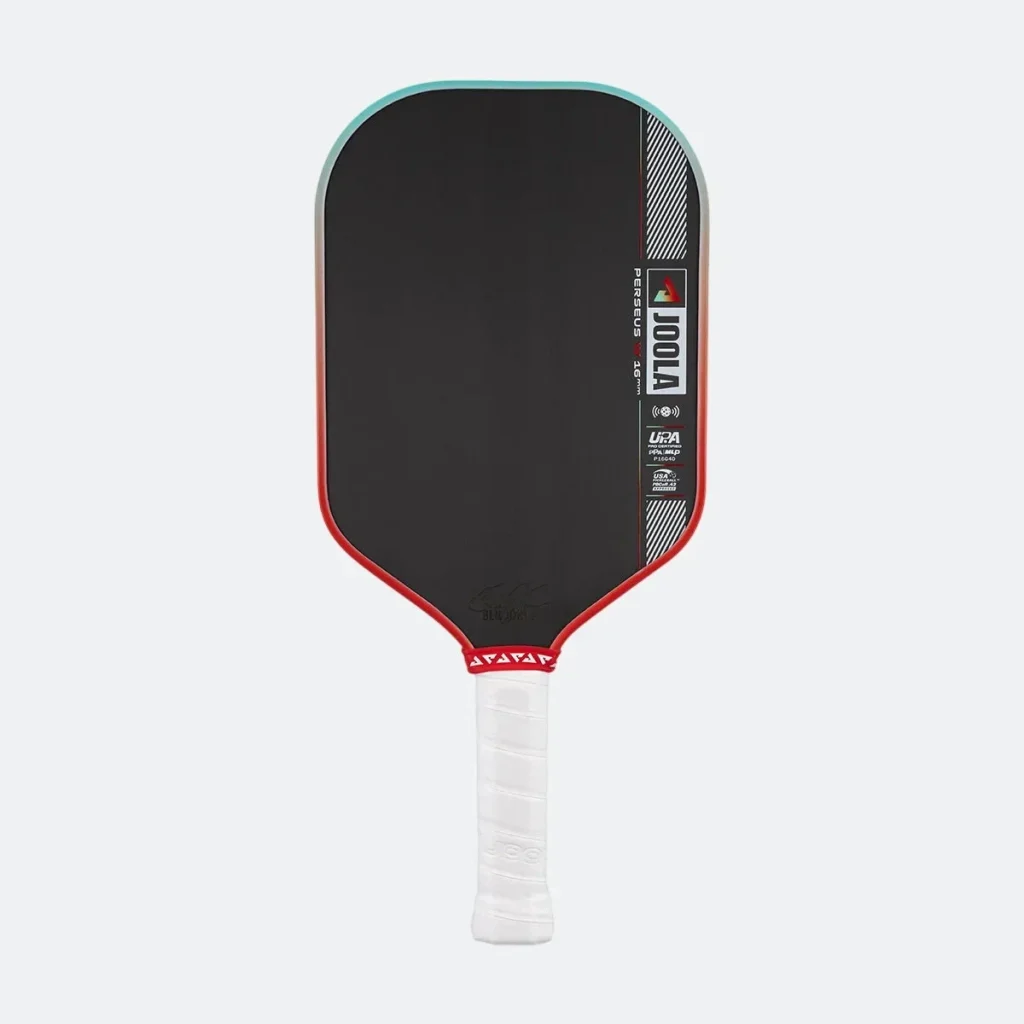
This is the previous generation, presented as exactly that, and it earns its place because previous is not the same as lesser. The Perseus Pro IV is the Gen 3 Propulsion Core build with the frame-flex foam JOOLA called TechFlex Power, and in head-to-head lab testing against its own successor it produced the higher serve and pop speeds.
The Pro V at pick 1 is the more consistent, more head-light paddle. This one is the easier-power one, the generation that supplies pace to players who do not generate all of their own.
On court the feel is plush power: the ball sinks a fraction longer than it does on the Pro V, then leaves with intent, and the measured line, 118 swing weight, 6.3 twist weight and 1,971 RPM of spin, describes a paddle built to hit through the ball rather than around it.
JOOLA kept this generation in the range alongside the Pro V rather than retiring it, and that decision reads correctly to me. For a large class of strong players, this is still the better JOOLA of the two generations, and owning one is no reason to replace it.
The generation’s known weakness belongs in this section, as it does everywhere this site covers the Pro IV: core durability complaints attach to it. Register the warranty through the handle chip the day the paddle arrives, and keep the receipt. That habit turns the complaint pattern into a covered event instead of an argument.
Buy it if you want JOOLA’s elongated power with the work done for you. Skip it if consistency and a lighter swing matter more than free pace.
9JOOLA Scorpeus Pro IV 16mm: Best for Stability Pickleball Paddle in 2027
AT A GLANCE
Scorpeus Pro IV 16mm
WEIGHT
8.24 oz
SWING WEIGHT
114.95
TWIST WEIGHT
7.4
SPIN
2,221 RPM
Shape: Widebody
Grip: 5.25 in handle, 4.25 in circumference
Core: Gen 3 Propulsion Core, 16mm
Face: Peel-ply carbon fiber
Approval: USAP and UPA-A
Feel: Stable plush
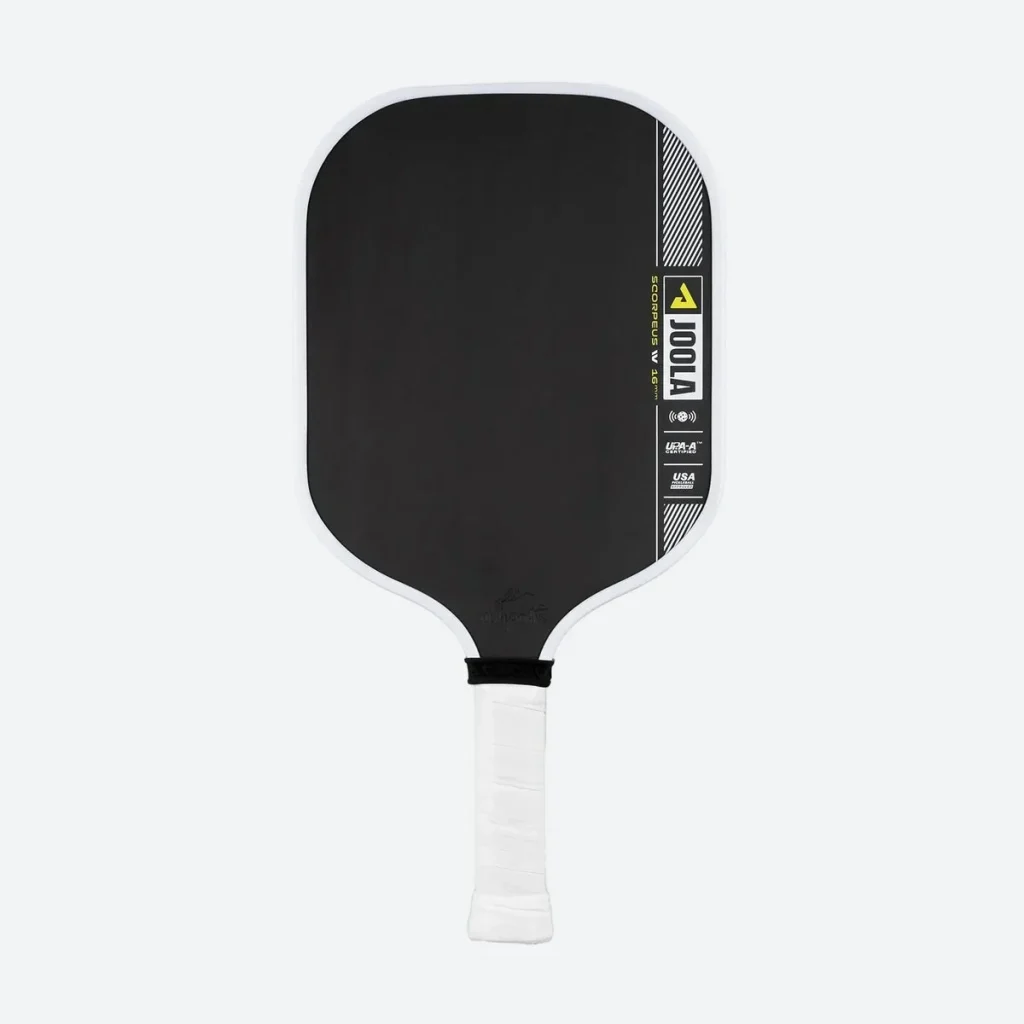
Readers choosing between pick 2 and this pick are choosing generations inside one shape, which is the exact decision this page exists to explain.
The Scorpeus Pro IV is the previous generation’s widebody, and its measured line still leads the brand where it matters for a stability pick: a 7.4 twist weight, the highest this site publishes for any JOOLA, with 2,221 RPM of measured spin, a figure higher than its own elongated sibling at pick 8 produces.
The Pro V edition at pick 2 swings lighter and answers faster. This one simply refuses to twist.
That refusal is the whole playing experience. Off-center contact, the mishit toward the edge that opens a lesser face up, comes off this paddle pointing at the court. Blocks against hard drives sit down with a plush, settled thud, and the peel-ply carbon surface grips the ball hard enough to shape dipping counters.
At 8.24 ounces it is the heaviest static weight here, carried low and wide rather than in the head, so the swing stays manageable at a 114.95 swing weight while the face does its work.
It carries the previous generation’s terms, stated the same way as at pick 8: the Pro IV core durability complaints apply to this build too, so register the warranty through the handle chip on arrival and keep the receipt. What you are buying is one generation back, with the strongest off-center-contact story in the brand.
Buy it if stability on mishits decides your matches. Skip it if you want the current generation’s lighter, quicker swing in this shape.
10JOOLA Scorpeus Heat Vision 16mm: Best Mid-Range Pickleball Paddle in 2027
AT A GLANCE
Scorpeus Heat Vision 16mm
WEIGHT
7.8 oz
SWING WEIGHT
-
TWIST WEIGHT
-
SPIN
-
Shape: Widebody, 16 x 8 in
Grip: 5.25 in handle, circumference -
Core: Honeycomb core with bonded SK film (thermoformed)
Face: Textured carbon fiber
Approval: USAP (PBCoR.43 certified)
Feel: Lively thermoformed widebody
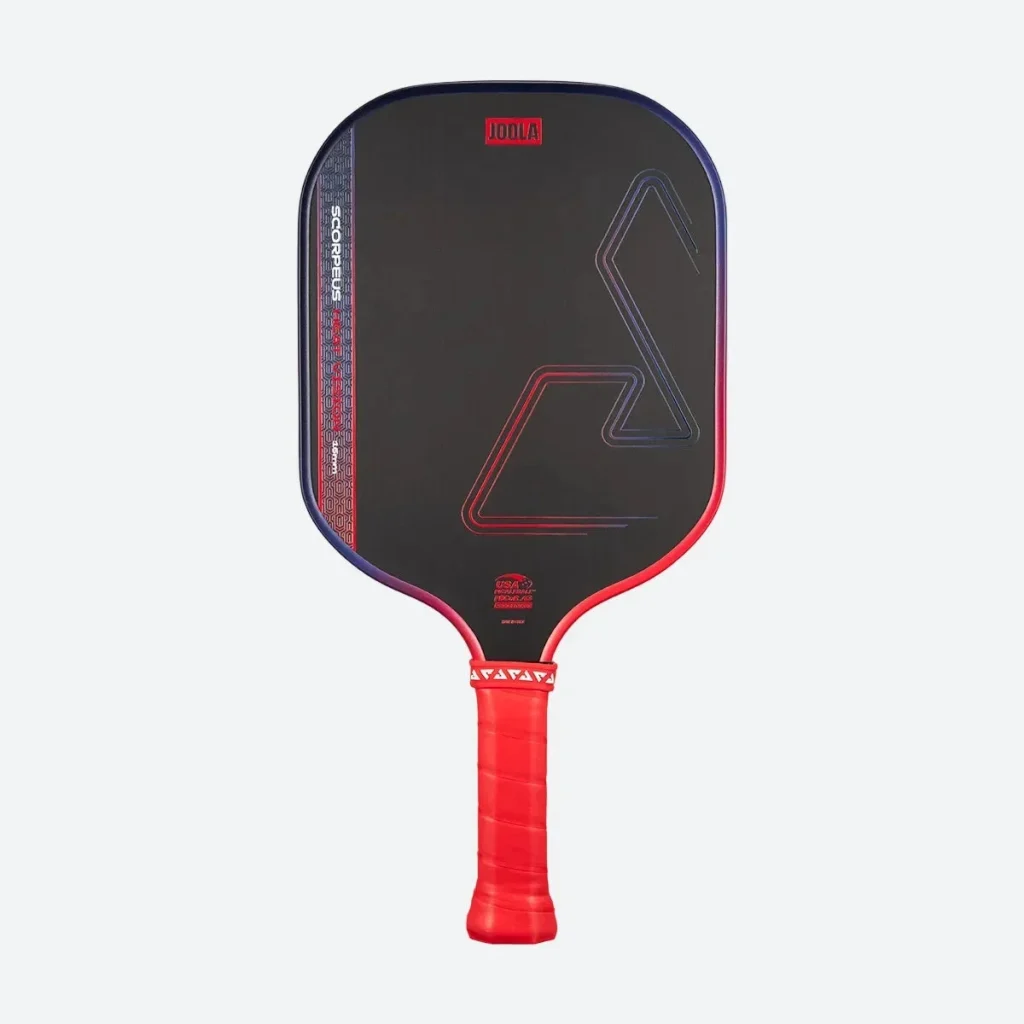
Everything above this pick is a flagship, a foam fork, a previous generation or a first paddle.
The Heat Vision is the range’s middle tier, and it earns the closing slot because it is built differently from everything around it: this is JOOLA’s thermoformed widebody, the Scorpeus outline at 16 by 8 inches with a bonded SK film fused over its honeycomb core.
That heat-fused construction is what gives thermoformed paddles their pop, and it puts a livelier build under the widebody shape than the flagship Scorpeus at pick 2 carries.
On court it plays the stability brief with more life in it. The wide face holds its line on off-center contact the way this shape always does, and the thermoformed build sends counters and drives back with a spring the calmer honeycomb picks do not produce.
At 7.8 ounces it is light for its size, and the certification deserves a sentence of its own: it carries the USAP PBCoR.43 power certification, the same power-cap standard the flagship lines are certified under, so its liveliness is certified liveliness.
The NFC chip in the handle keeps the ownership and warranty system identical to the Pro lines.
Two honest notes close the page. This slot was written for the Edge line, and no Edge model appears in this list: JOOLA’s own site now states the Edge is not eligible for USAP competitions as of May 2026, and a page that teaches readers to check the approved list does not recommend against the brand’s own notice.
And the Heat Vision’s approval, on its listing, is USA Pickleball only, with no UPA-A badge shown; no independent lab has published swing weight, twist weight or spin for it either, so those fields sit unpublished rather than borrowed from the flagship Scorpeus.
Buy it if you want the widebody stability brief at the range’s middle tier, with certified pop. Skip it if you need UPA-A certification or published lab figures.
How to Choose the Best JOOLA Pickleball Paddle in 2027
Six decisions decide every JOOLA purchase, and none of them is the colourway.
Work through them in this order: the generation, because it sets the core platform and the approval story; the shape, because it sets the game the paddle plays; the thickness, because the same shape in 14mm is a different tool; the generation upgrade question, if you already own one; the twin question, because half the range’s apparent complexity is one grip decision repeated; and the authenticity check, because this brand is the one counterfeiters copy.
The sections below take each in turn.
The JOOLA Generations, Decoded
The generation word in a JOOLA name matters more than the shape word, because the generation is the core platform. The Gen 2 era, the Hyperion CFS and CAS signatures and their contemporaries, is legacy stock now.
The 3S generation that followed is approved for UPA-A play only, not USA Pickleball, and has been superseded twice over; it appears in this guide as history, never as a recommendation.
The Pro IV generation rebuilt the core as the Gen 3 Propulsion Core, a polypropylene honeycomb with foam frame technology, and added full dual certification.
The current Pro V keeps that polymer platform, reinforces the top of the core with a carbon layer, and adds the KineticFrame throat that flexes to store and release energy. Through every generation JOOLA deliberately stayed with a polymer core while most of the market switched to full foam.
The single exception is the Power FX, the brand’s first all-foam build, sitting beside the flagship line rather than replacing it. When a listing names a shape with no generation, or a generation you do not recognise, stop and decode it before anything else on the page.
Pick Your Shape First
Inside one generation, the shape is the game. The Perseus is the elongated reference: reach, leverage and the line’s benchmark power, for players who drive and finish from mid-court. The Hyperion keeps the elongated footprint and curves the head, trading a little stability for swing speed in kitchen exchanges.
The Agassi and Graf share a tapered-throat elongated geometry with the sweet spot placed high, built for racket-sport converts whose contact point already lives up the face. The Kosmos is the hybrid between the elongated and widebody families, the balance point of the range.
The Scorpeus is the widebody: the widest face, the highest stability figures, the defensive doubles brief. The Radius is the round outlier, the shortest handle and the flick-and-control game no other brand currently sells.
The professionals attached to these shapes are evidence of intent rather than decoration: the game’s best attacking player chooses the Perseus, the best defensive hands choose the Scorpeus, and the newest signature names chose the Kosmos.
Pros play tuned units of their sponsor’s paddles, so treat the signature as a statement about the shape’s brief, then confirm it against the measured figures in the boxes above.
14mm or 16mm: What the Thinner Core Buys
Every flagship shape on this page is sold in both thicknesses, and this list picks the 16mm throughout, so the 14mm case needs making honestly. The thinner core buys pop and hand speed: the ball leaves faster off a shorter dwell, counters snap, and the paddle usually weighs a little less.
It gives up dwell and stability in exchange, so drops and resets demand cleaner hands and off-center contact twists more. The side effect most buyers miss is the grip.
On several shapes the 14mm version ships with a 4.125 inch grip circumference where the 16mm carries 4.25 inches: the Hyperion and the Kosmos both step down at 14mm, and the Kosmos 14mm is a different signature edition entirely, played by Tyson McGuffin where the 16mm is Federico Staksrud’s.
So the thickness decision is secretly two decisions, core response and grip fit, made with one click. Players with smaller hands sometimes find their best JOOLA is a 14mm bought for the grip as much as for the pop. Decide which of the two effects you are actually shopping for before you select the variant.
Pro V or Pro IV: The Honest Upgrade Question
This is the question current JOOLA owners ask most, and the honest answer surprises people: the Pro V is not simply a better Pro IV.
In head-to-head lab testing, the older generation produced higher serve and pop speeds. The Pro IV gives easier power, because its build supplies pace to a player whose swing does not generate all of its own.
The Pro V answers with consistency: a more head-light balance, better absorption of incoming pace, and contact that behaves the same way late in a match as it did in the first game. It rewards players who bring their own swing speed and want the paddle to stop interfering.
So the upgrade logic runs by player, not by calendar. If your Pro IV feels lively and your results come from power it supplies, replacing it buys you a different paddle, not a better one. If your Pro IV feels inconsistent under pressure, the Pro V was built for exactly that complaint.
One ownership note applies to the older generation wherever it appears on this page: core durability complaints attach to the Pro IV line, so register the warranty through the handle chip the day any Pro IV arrives, and keep the receipt with it.
Twins and Near-Twins: Agassi vs Graf, Bright vs Johns, Edge vs Edge
Half the complexity in this range dissolves once you see the twin pattern. JOOLA sells the same paddle under two names differing only in grip circumference. The Agassi carries a 4.25 inch grip and the Graf, the identical tapered-throat shape, carries 4.125 inches.
The Edge pair repeats the pattern exactly: Agassi Edge at 4.25 inches, GRAF Edge at 4.125, same core, same face, same certification. The Scorpeus Pro V does it inside one listing as two signature editions, Anna Bright’s at 4.125 inches and Collin Johns’ at 4.25.
So before comparing any two of these names on specs, check whether you are looking at two paddles or one paddle at two grip sizes. Choosing between them is a hand measurement, not a research project: measure from the middle crease of your palm to the tip of your ring finger and match the figure to the circumference.
Then remember the asymmetry that settles every borderline case. A grip can be built up with an overgrip, layer by layer, until it fits. It can never be shrunk below the handle underneath the wrap. When you land between the twins, take the smaller grip and tune upward.
Approvals, Authenticity and the Warranty
Every Pro V, Pro IV and Power FX pick on this page is certified by both USA Pickleball and UPA-A, and the flagship lines add the PBCoR.43 certification layer on top. Dual certification sounds like a formality until the brand’s own history explains why it is not.
The 3S generation is approved for UPA-A play only, and an earlier JOOLA model, the Mod TA-15, was removed from the USA Pickleball approved list in 2024.
Approvals move, and they are still moving: JOOLA’s own site now states that the Edge line is not eligible for USAP competitions as of May 2026, which is why no Edge model appears in the ten above, whatever its listing badges say.
Before any sanctioned event, check the current approved list for your exact model rather than trusting the badge printed on a listing. Authenticity is the other half of the same caution. JOOLA is the most counterfeited name in the sport, and lookalike paddles circulate through marketplace sellers with copied graphics.
The defences are simple and this page is built on them: buy from JOOLA’s own Amazon store or from Amazon itself, never from an unfamiliar third-party listing, and register the chip in the handle when the paddle arrives.
Current lines carry a 12-month warranty, registration starts the record, and the receipt completes it. A genuine paddle with its paperwork in order is the whole system working as designed.
Frequently Asked Questions (FAQs)
1. What is the best JOOLA pickleball paddle overall?
The JOOLA Perseus Pro V 16mm. It is the current flagship’s reference shape, the paddle Ben Johns carries into matches, and the most consistent build in the range, with a measured line of 117 swing weight, 6.26 twist weight and 2,060 RPM of spin.
Players who need the paddle to supply more of their power should read the Perseus Pro IV section before deciding, because the previous generation trades some of that consistency for easier pace.
2. What is the difference between the JOOLA Pro V and the Pro IV?
The Pro V adds a reinforced core top and the KineticFrame, a flexing throat that stores and releases energy, and it plays more head-light, absorbs incoming pace better and behaves more consistently across a match.
The Pro IV, built on the Gen 3 Propulsion Core with frame-flex foam, produces higher serve and pop speeds in head-to-head testing and supplies easier power. Both generations are certified by USA Pickleball and UPA-A. The newer paddle is the consistency upgrade, not a power upgrade.
3. Which JOOLA paddle does Ben Johns actually play?
Ben Johns plays the Perseus Pro V 16mm. The Hyperion shape is the geometry he co-developed as his original signature, and it remains in the range at pick 5 of this list, but it is not his current match paddle. Listings that present the Hyperion as the paddle Johns plays today are trading on the older story.
4. Which JOOLA shape should I choose: Perseus, Hyperion, Agassi, Kosmos, Scorpeus or Radius?
Choose by the game you play.
Perseus for elongated reach and drive power, Hyperion for the same footprint with a curved head that swings faster in hand battles, Agassi or Graf for a tapered throat and a high sweet spot that suits racket-sport converts, Kosmos for the hybrid balance point between the elongated and widebody families, Scorpeus for widebody stability, blocks and defensive doubles, and Radius for the round shape, the short handle and a flick-based control game at the kitchen.
The guide above works through each shape against its alternatives.
5. Should I buy the 14mm or the 16mm version of a JOOLA paddle?
Buy the 16mm for dwell, stability and a calmer response on drops and resets, and the 14mm for pop, hand speed and a livelier ball off the face.
Check the grip before you decide, because the choice is not only about the core: on several shapes, including the Hyperion and the Kosmos, the 14mm version ships with a 4.125 inch grip where the 16mm carries 4.25 inches, so smaller-handed players may be choosing their grip at the same time as their core.
6. What is the difference between the JOOLA Agassi and Graf models?
Grip circumference, and nothing else. The Agassi and the Graf are the same tapered-throat elongated shape with the sweet spot placed high on the face; the Agassi carries a 4.25 inch grip and the Graf a 4.125 inch grip for smaller hands.
The same twin pattern runs through the brand’s Edge line. Measure your hand, and if you land between the two, take the smaller grip, because a grip can be built up with an overgrip and never shrunk.
7. Does JOOLA make a foam-core paddle?
Yes. The JOOLA Perseus Power FX 16mm, pick 6 on this list, is the brand’s first full-foam paddle, built on the Perseus shape with a full EPP foam core JOOLA calls the Adaptive Propulsion Core.
Every other current JOOLA, including the flagship Pro V, stays on a polymer honeycomb platform by deliberate choice, so the Power FX is the foam answer inside the brand rather than the direction of the whole range.
8. Which JOOLA paddle is best for a beginner?
The JOOLA Astral Perseus, pick 7 on this list: the line JOOLA itself designed with beginners in mind, with a sandblasted carbon face on the elongated Perseus outline and USA Pickleball approval.
The JOOLA Essentials, the brand’s fiberglass entry model with the smallest grip in the range at 4.0 inches, is the other starting point this site recommends, and it leads the under-50 and beginners lists elsewhere on this site.
9. Which JOOLA paddle gives the most spin?
On the measured figures published on this page, the Scorpeus Pro IV 16mm, at 2,221 RPM, ahead of the Perseus Pro V at 2,060 RPM and the Kosmos Pro V at 2,057 RPM. Two cautions belong with that answer.
Those figures come from different labs measuring on different rigs, so treat them as a guide to each paddle’s tier rather than a photo finish, and no review-lab figure is a certification result. Raw carbon grit also wears with play, so the spin a paddle produces in its first month is its ceiling, not its average.
10. Which JOOLA paddle has the biggest sweet spot?
JOOLA’s own answer is the Radius Pro V, which the brand describes as having the largest hitting area and sweet spot in its lineup, and that claim is framed as the brand’s because no independent lab has published measured figures for the shape.
If you want the biggest sweet spot expressed in measured numbers instead, look at twist weight, where the widebody Scorpeus shapes lead this page: 7.4 on the Scorpeus Pro IV and 7.21 on the Scorpeus Pro V, the figures that describe how much of the face stays usable on off-center contact.
11. Are JOOLA paddles approved for USA Pickleball and UPA-A tournament play?
The current lines are, though the details need checking per model. Every Pro V, Pro IV and Power FX pick on this page carries both USA Pickleball and UPA-A certification, the Astral line and the Scorpeus Heat Vision are USA Pickleball approved, and the Essentials carries USAPA approval.
The cautions are historical and current: the older 3S generation is UPA-A only, one earlier JOOLA model was removed from the USA Pickleball list in 2024, and JOOLA’s own site now states the Edge line is not eligible for USAP competitions as of May 2026.
Approvals change, so confirm your exact model on the current approved list before entering a sanctioned event.
12. How do I know a JOOLA paddle is genuine, and how does the warranty work?
Buy from JOOLA’s own Amazon store or from Amazon itself, because JOOLA is the most counterfeited name in the sport and lookalike paddles circulate through unfamiliar third-party listings.
A genuine current JOOLA carries a chip in the handle: register it when the paddle arrives, which starts the authenticity and warranty record, and keep your receipt alongside it. Current lines carry a 12-month warranty. Registration plus receipt is what turns a problem into a covered claim instead of an argument.

Michael Stevenson
Hi, my name is Michael Stevenson and I’m a passionate pickleball player. I’ve been playing the game for many years and I’m pretty highly skilled at it. Pickleball is one of my favorite topics so naturally, I love to write about it.
Whether it’s tips for beginners, guides for experts, reviews of new paddles, or advanced playing techniques – if it relates to pickleball then I have something interesting to write about it. So if you’re looking for entertaining and informative information on the topic of pickleball, look no further than my written works!